


Ships Built Today May Still Be Trading in 2050. Shipping Is Paying for Optionality
A vessel ordered in 2026 may still be operating in 2050, while fuel economics, carbon rules, geopolitical risks and trade networks can change within a few years. At the Xinde Marine Forum Hamburg, senior executives from DNV, IBIA, MPC Container Ships, Bernhard Schulte and Hapag-Lloyd offered different answers to the same problem: when the future cannot be predicted with confidence, companies need to preserve room to change course.
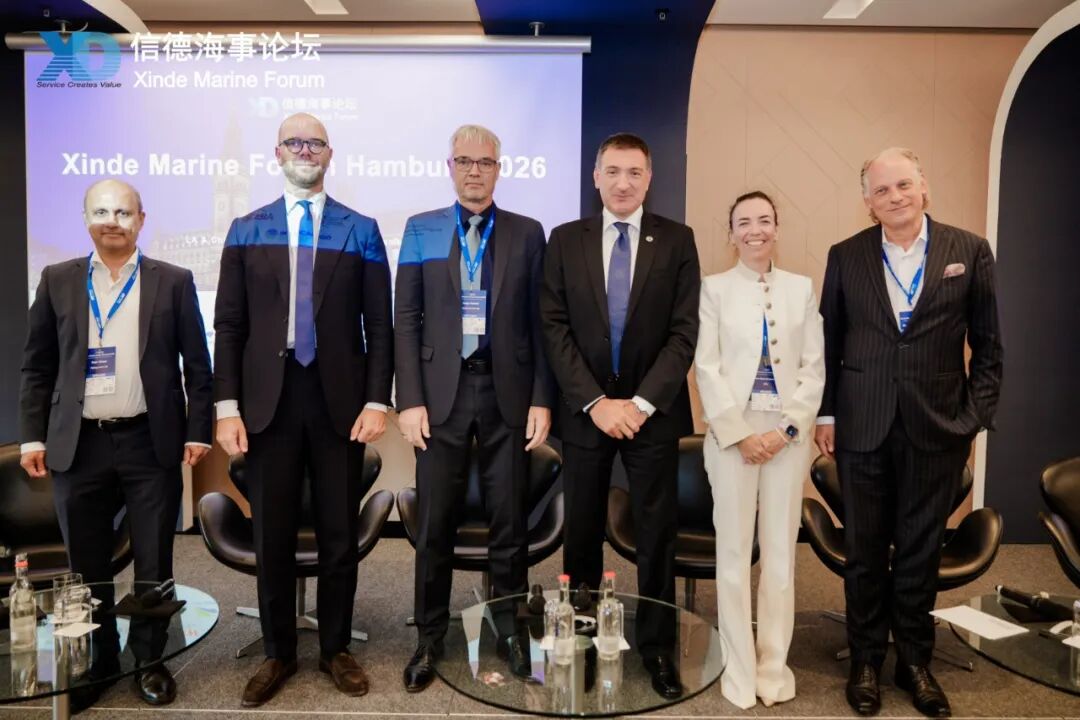

When moderator Martin Kröger asked five shipping executives at the Xinde Marine Forum Hamburg to name one decision companies should take now to strengthen resilience, the answers were strikingly different.
Cristina Sáenz de Santa María, CEO Maritime at DNV, chose energy efficiency.

Alexander Prokopakis, executive director of the International Bunker Industry Association, also pointed to efficiency, while adding cooperation.
Moritz Fuhrmann, co-CEO and CFO of MPC Container Ships, focused on scale, balance-sheet strength and retaining qualified seafarers.
Rajiv Ghose, Hapag-Lloyd’s managing director for network operations, gave perhaps the most concrete answer of all: terminal capacity, followed by the need for an organisation agile enough to adjust quickly.
Taken separately, these look like very different priorities.
Taken together, however, they reveal an increasingly important investment principle in shipping: when companies cannot know which future will materialise, they are increasingly paying to keep more than one future available.
That is the essence of optionality.
A 25-year asset in a five-year world
Kröger framed the central problem at the start of the panel.

Trade routes are shifting. New fuels and technologies are emerging. Regulation remains uncertain. Yet shipowners cannot simply wait for the picture to clear: vessels ordered today — many of them built in China — may still be operating in 2050.
“Decisions deferred are decisions taken as well,” he told the audience.
Fuhrmann put the mismatch in even starker terms.
Ships are typically 25- to 30-year assets. Political and geopolitical conditions, by contrast, can change substantially within four, five or six years.
That makes it virtually impossible to optimise an investment today against every scenario a vessel could face during its lifetime.
For owners, the question is therefore shifting away from:
What will the world look like in 2050?
towards:
If our assumptions prove wrong, how much room will we still have to adjust?
That room can be created through vessel design, charter contracts, financing, fuel flexibility, terminal access, network architecture and human capability.
In other words, optionality is increasingly being built into the entire shipping business model.
MPCC: manage the residual risk, not the perfect forecast
MPC Container Ships provides a useful example.
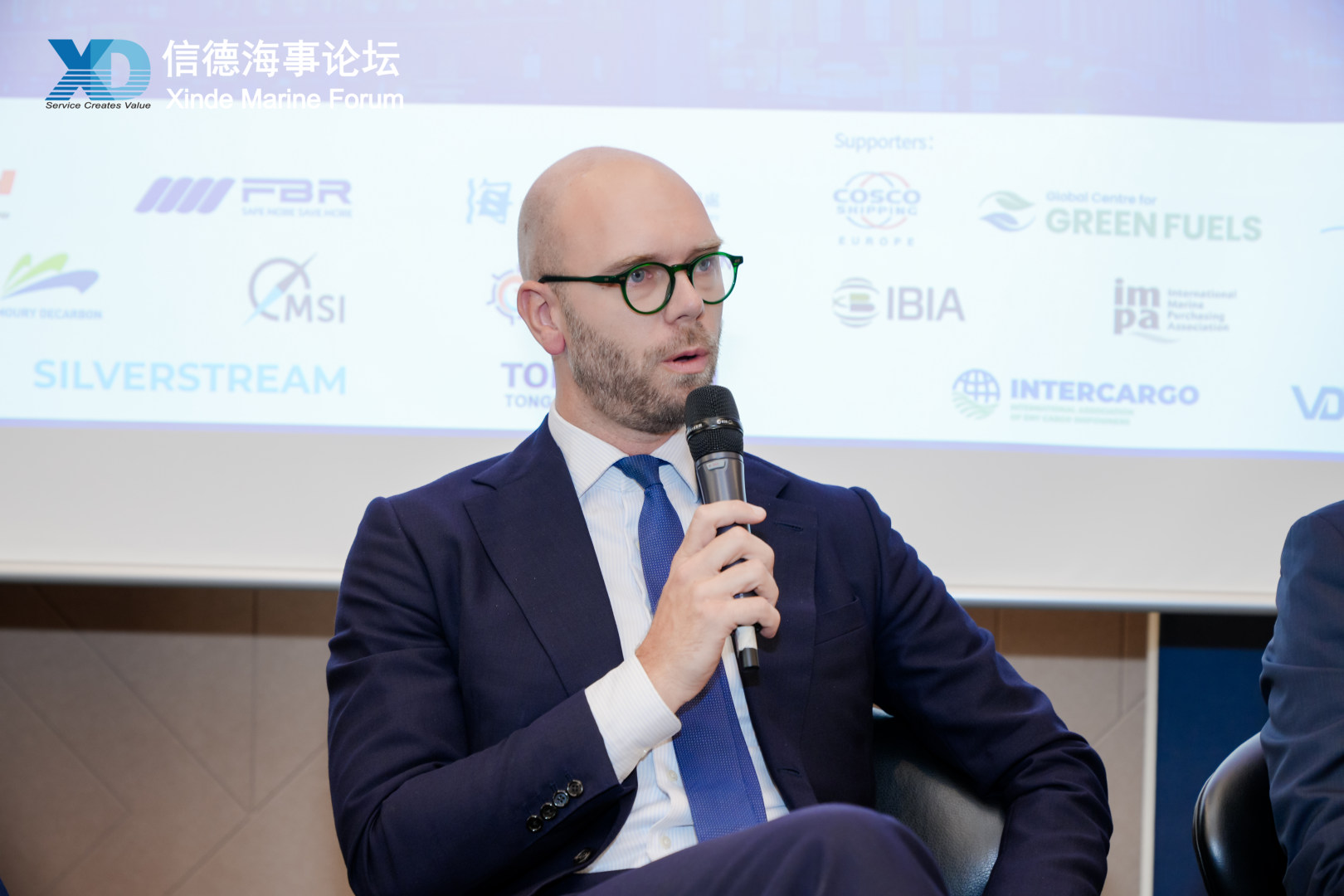
Fuhrmann repeatedly returned to the concept of residual risk — the exposure that remains after an owner has used charters, financing structures and commercial partnerships to transfer or reduce other risks.
That matters particularly now.
Shipping markets remain strong across several sectors, but vessel values and newbuilding prices are also elevated. An investment made near the top of the cycle can look very different several years later.
MPCC’s answer has been to combine fleet renewal with unusually high forward revenue visibility.
The company reported in August that it had about $2.2bn of contracted revenue, with 99% charter coverage for 2026, 85% for 2027, 60% for 2028 and 39% for 2029. It also reported 30 debt-free vessels and a leverage ratio of 28.4%.
At the same time, MPCC is not withdrawing from debt markets. It has secured around $375m in financing connected to its newbuilding and fleet-renewal programme.
Fuhrmann’s call in Hamburg to repay debt and maintain a clean balance sheet should therefore not be read as an argument against leverage.
The more important point is that leverage should be supportable through the cycle.
Long charters protect cash flow. Moderate debt provides downside capacity. Fleet renewal protects competitiveness.
Together, they amount to a financial form of optionality: the company is trying to ensure that a weaker market does not remove its ability to operate, refinance or invest.
The cheapest optionality may be energy efficiency
The green transition produced one of the clearest areas of agreement on the panel.
When Prokopakis was asked whether the greater danger was investing too early, choosing the wrong technology or waiting too long, he did not select LNG, methanol or ammonia.
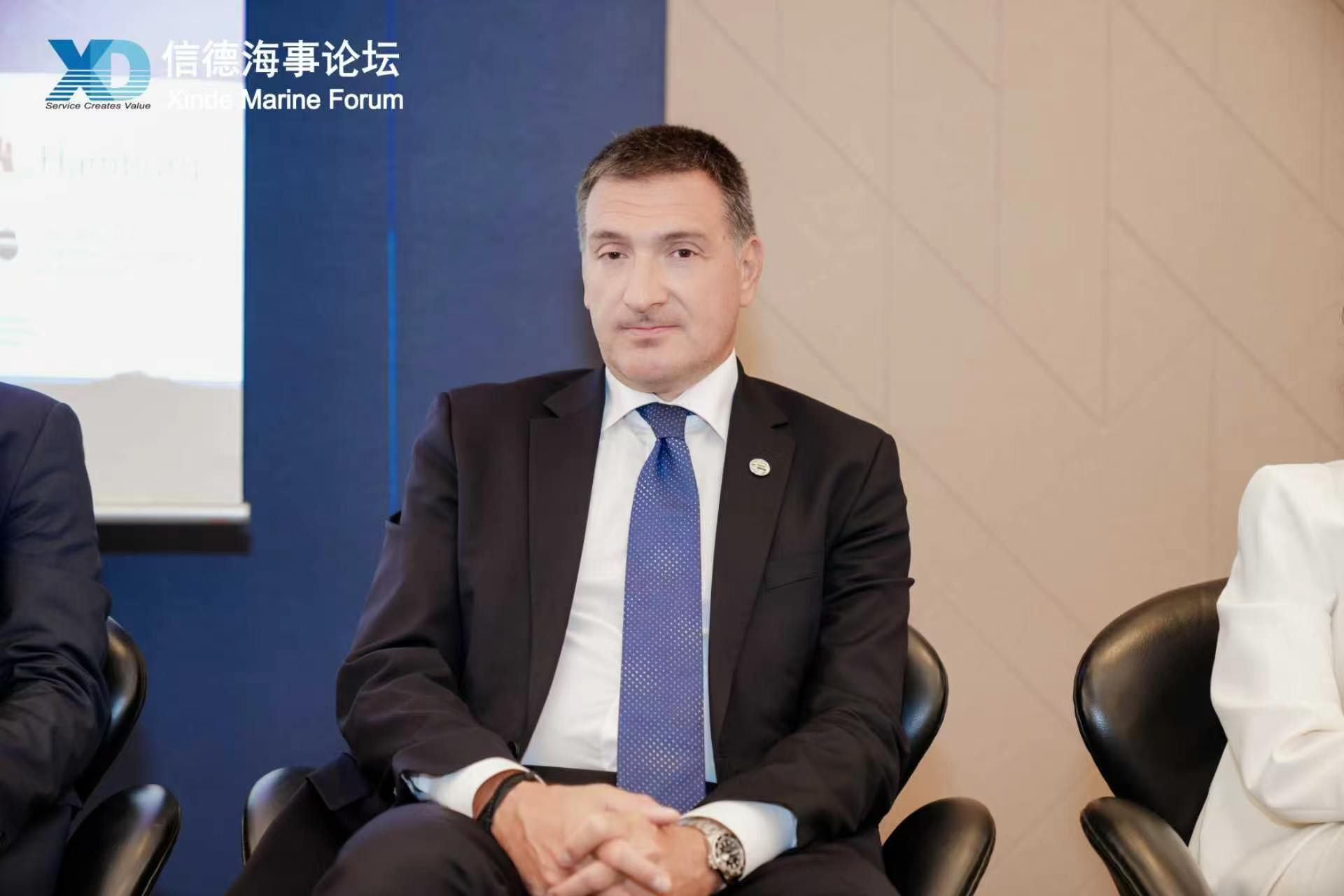
His first recommendation was simpler:
Invest in energy efficiency now.
For fuel choices, he argued, owners should develop a strategy appropriate to their vessel type, segment and trading pattern — and preferably keep more than one option open.
Sáenz de Santa María reached almost exactly the same conclusion when asked what maritime companies should do immediately.
Her answer was simply: energy efficiency.
There is a strong commercial logic behind that position.
A ship will require energy regardless of whether its future fuel is conventional bunker fuel, LNG, methanol, ammonia or something not yet deployed at scale.
Reducing the energy required to move the vessel therefore creates value across multiple future fuel scenarios.
DNV’s latest Maritime Forecast to 2050 illustrates the point. In one 5,000-TEU containership case study, a package of hydrodynamic efficiency measures could cut annual fuel consumption by about 16%, with payback periods of roughly one to four years depending on the fuel-price scenario.
That gives energy efficiency a particularly valuable characteristic.
It does not require an owner to solve the 2050 fuel question first.
Hull optimisation, air lubrication, shaft generators, wind-assisted propulsion, engine improvements and digital voyage optimisation can all reduce exposure to whatever fuel ultimately becomes dominant.
They are, in effect, fuel-agnostic investments.
The fuel question is becoming less about picking a winner
For years, much of shipping’s alternative-fuel debate has been framed as a contest:
Will LNG win? Methanol? Ammonia?
The investment behaviour of major carriers increasingly suggests that this may be the wrong question.
Fuhrmann noted in Hamburg that Maersk had been one of the strongest advocates of methanol before adding more LNG-capable tonnage to its plans.
But that development should not be interpreted as Maersk abandoning methanol.
Its strategy is becoming broader.
Maersk continues to receive methanol dual-fuel ships while simultaneously developing liquefied biomethane and bio-LNG pathways and examining other potential fuels. The company describes its approach as a diversified, increasingly fuel-agnostic portfolio.
That shift is important.
The strategic objective is becoming less about identifying one winning molecule and more about preventing a vessel from becoming dependent on only one economic outcome.
MPCC’s own experience reinforces the point.
Fuhrmann said its methanol-capable ships do not automatically operate on methanol. Whether they do depends on fuel availability, pricing and whether customers are prepared to compensate for the additional cost.
Technical capability alone is therefore not enough.
A viable fuel pathway also needs production, bunkering infrastructure, regulation and a customer willing to pay.
That is why “fuel-ready” and fuel-flexible designs have become increasingly important: they protect not only regulatory compliance, but also the future commercial value of the ship.
A ship does not need to be prohibited to become economically stranded
One of the more provocative arguments in Hamburg came from Prokopakis.
He challenged the widespread use of uncertainty as a reason for delaying decisions and argued that shipping regulation normally provides sufficient adjustment time, making large-scale stranded assets unlikely.
There is an important distinction here.
A vessel does not need to become legally prohibited from trading to suffer economically.
If one ship faces materially higher carbon costs, more expensive fuel, weaker charter demand, lower loan-to-value ratios or a discount in the secondhand market, its economic position can deteriorate long before regulators prevent it from operating.
That is why residual value has become inseparable from the fuel discussion.
The ability to retrofit a vessel, switch fuels or operate competitively under a different carbon-cost regime can have a direct effect on its value years before the end of its physical life.
Optionality is therefore increasingly part of ship valuation.
Why Hapag-Lloyd talked about terminals
One of the most revealing answers from the entire discussion came from Hapag-Lloyd.

Asked what the company needed to strengthen resilience, Ghose’s first answer was not ships.
It was terminal capacity.
The comment closely reflects Hapag-Lloyd’s recent investment strategy.
In August, the carrier agreed to acquire a 25% stake in APM Terminals Maasvlakte II in Rotterdam, a key hub for the Gemini Cooperation. The automated terminal is being expanded towards annual capacity of up to approximately 5.4m teu.
For Hapag-Lloyd, the commercial logic goes beyond owning a minority stake in a profitable terminal.
Reliable liner shipping depends not only on ships and slots, but also on predictable berth access and efficient cargo handling.
Terminal capacity therefore becomes another form of optionality.
Ships determine whether a carrier has capacity.
Terminals influence whether that capacity can actually move through the network when planned.
That distinction has become more important under Gemini.
Ghose explained that container networks were traditionally designed around scale, utilisation and cost efficiency. Today they must also be designed for adaptability.
A disruption around the Strait of Hormuz, for example, does not remain confined to the Middle East. Through hub-and-spoke networks, its effects can spread to European services, the US East Coast and other trades.
Vessel size, fleet deployment and the ability to redesign a network quickly have therefore become part of resilience.
For liner operators, the investment equation is widening from ships to ships plus terminals plus network control.
The other source of optionality sits outside the balance sheet: people
Technology and capital dominated much of the discussion, but Helge Bartels, chief operating officer at Bernhard Schulte, repeatedly brought the conversation back to people.
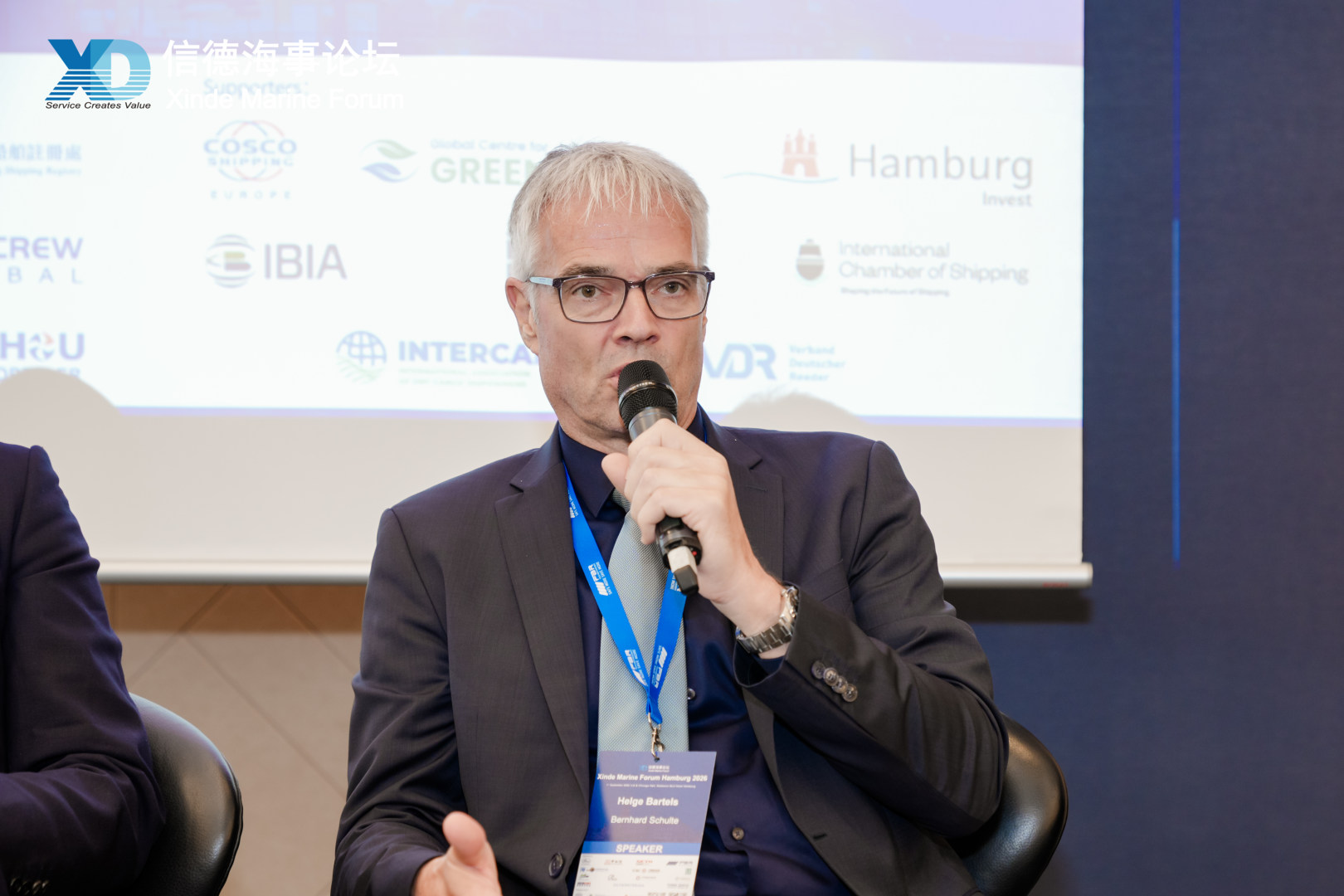
His example was the Joseph Schulte, the BSM-managed containership that remained trapped in Odesa following Russia’s invasion of Ukraine before eventually departing through Ukraine’s humanitarian corridor in 2023.
Resolving that situation required far more than a shipmanager.
It involved governments, industry organisations, technical partners and other institutions repeatedly attempting new solutions.
Bartels reduced that experience to three ideas:
cooperation, networks and connecting people.
The same challenge is now appearing in alternative-fuel shipping.
Companies can prepare crews for LNG, methanol or ammonia, but training centres, equipment manufacturers, flag and port-state authorities, certification systems and actual fuel availability do not necessarily develop at the same speed.
A dual-fuel vessel can be delivered on a fixed contractual date.
The people and regulatory systems required to operate it cannot always be scaled on the same timetable.
That creates another form of optionality: organisations need seafarers and shore teams capable of learning, retraining and moving between technologies as fleet requirements change.
China’s shipyards are increasingly building optionality into ships
China is central to this transition because so much of the next global fleet is being built there.
MPCC again provides a clear example.
Its newbuilding programme has included projects at Huangpu Wenchong, Fujian Mawei, Taizhou Sanfu and Jiangsu Hantong, covering ships from around 1,300 teu to 4,500 teu.
Many of these orders are paired with long-term charters.
Its six 3,700-teu vessels at Taizhou Sanfu, for example, were contracted with roughly 10-year employment attached. MPCC said the ships were designed for greater efficiency in regional and feeder trades, while retaining operational flexibility and readiness for alternative fuels and further emissions-reduction technologies.
Four 4,500-teu ships ordered at Jiangsu Hantong were also paired with decade-long charters and jointly optimised around the charterer’s network requirements.
These contracts illustrate how the product being purchased from a shipyard is changing.
A shipowner is no longer simply ordering “a 4,500-teu containership”.
Increasingly, the specification incorporates:
lower energy consumption;
alternative-fuel readiness;
future retrofit potential;
deployment flexibility;
compatibility with long-term charter economics;
and the ability to remain competitive under future carbon rules.
China’s shipyards are therefore not only supplying capacity.
They are helping owners manufacture future flexibility into the asset itself.
Shipping does not need certainty. It needs to reduce the cost of being wrong
The regulatory debate remains unresolved.
As the Hamburg forum was taking place, IMO’s ISWG-GHG 22 was meeting in London from September 1-4 to continue work on the global framework for reducing greenhouse-gas emissions from shipping.
The consequences extend far beyond regulation.
DNV estimates that demand for low-greenhouse-gas marine fuels by 2050 could vary dramatically depending on how strong and globally consistent the regulatory framework becomes — roughly 33 Mtoe under one pathway versus as much as 185 Mtoe under another.
That difference is large enough to change decisions on fuel-production plants, bunkering infrastructure, engines, vessel design, financing and ship valuations.
Yet owners cannot wait for the answer.
A vessel contracted in 2026 may not be delivered until 2028 or 2029 and could then remain in service for another two decades or more.
The industry’s response is increasingly visible.
Long-term charters reduce market exposure.
Stronger balance sheets increase capacity to survive the cycle.
Efficiency lowers costs under almost every fuel scenario.
Dual-fuel and fuel-ready designs preserve technological flexibility.
Terminal ownership and network redesign improve operational control.
Crew training and organisational capability make it possible to use those technologies when conditions change.
None of these measures tells a shipping company what 2050 will look like.
They do something more practical: they reduce the cost of being wrong.
For ships that may still be trading a quarter of a century from now, that flexibility is becoming an increasingly important part of asset value.

READ MORE
 Sustainability
Singapore Offers Up to S$250,000 for Electric Harbour Craft
 Sustainability
Greater Bay Area Launches First Zero-Carbon Container Shipping Route Between Guangzhou and Hong Kong
 Sustainability
1000Ton! CMB.TECH in World First Commercial STS Green Ammonia Bunkering
 Sustainability
MPA, CMA CGM and SLNG Join Forces on Bio-LNG Bunkering
 Sustainability
China Sets 2028 Targets for Electric and Methanol-Powered Inland Vessels
 Sustainability
China Merchants Takes Delivery of Third Methanol Dual-Fuel Car Carrier
 Sustainability
Alexander Saverys :Green Ammonia Will Be Cheaper Than Diesel—Sooner Than You Think
 Sustainability
Beihai Delivers First Ammonia-Powered Bulker as Mineral Europa Sets Sail
 Sustainability
World's First Ammonia Dual-Fuel Bulker Delivered in China
 Sustainability