


1000Ton! CMB.TECH in World First Commercial STS Green Ammonia Bunkering


MV.Mineral Europa receives 1,000 tonnes in Zhoushan as shipowner investment connects fuel production with ocean shipping
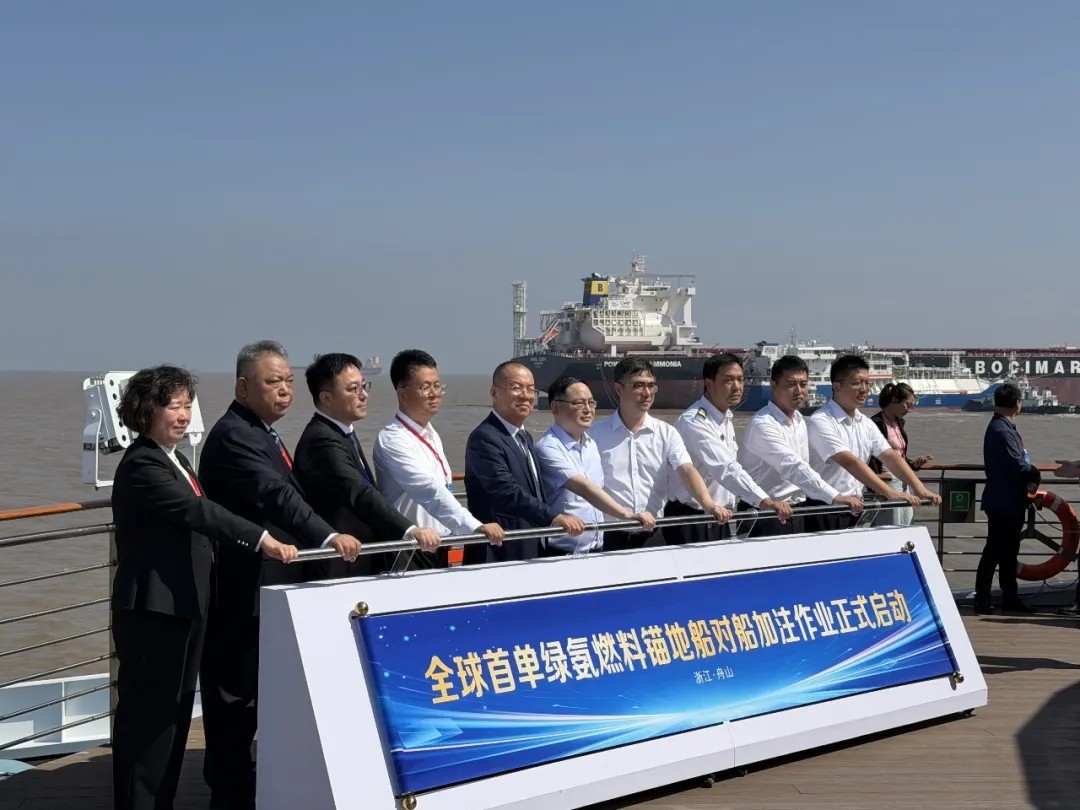
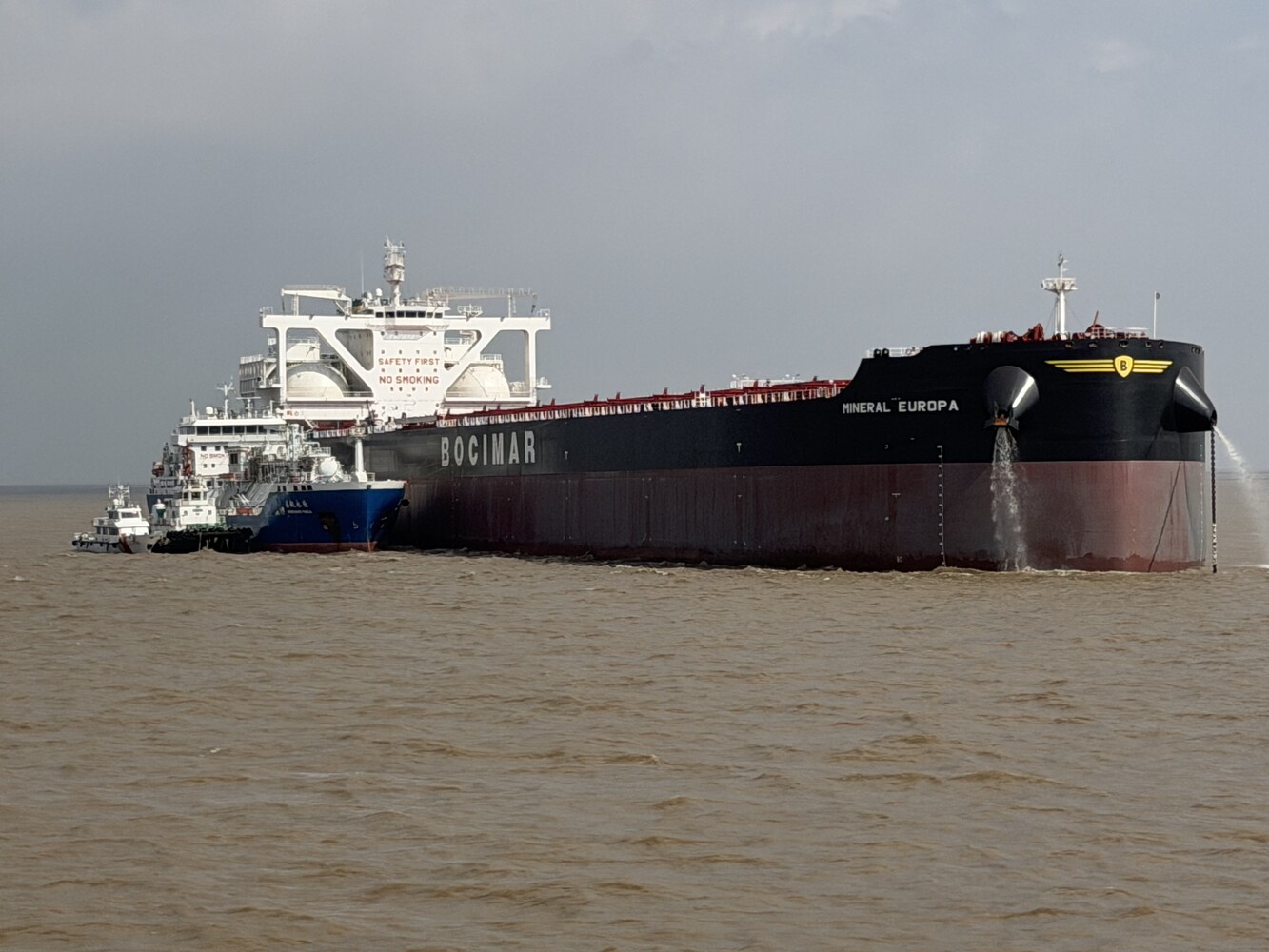
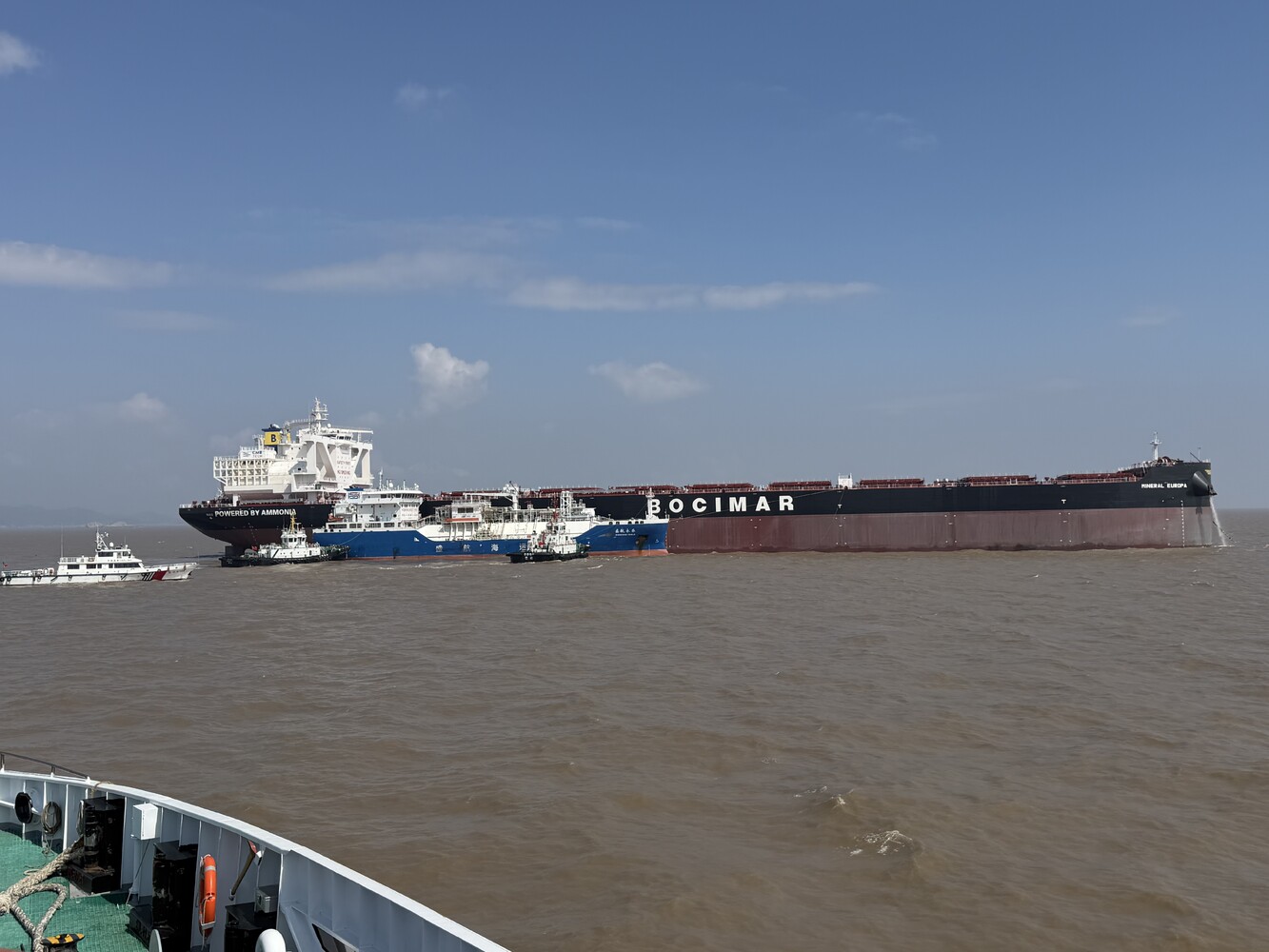
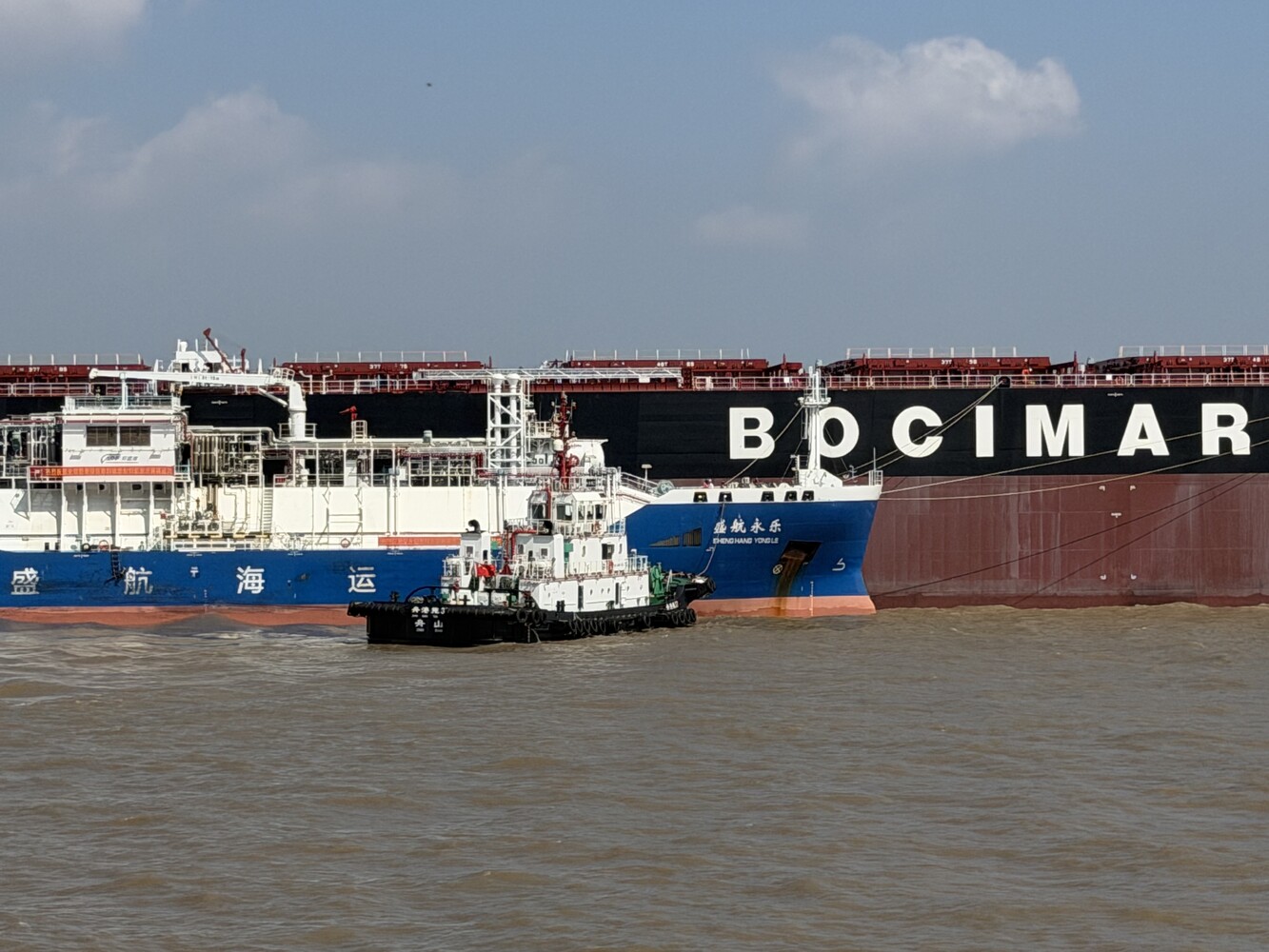
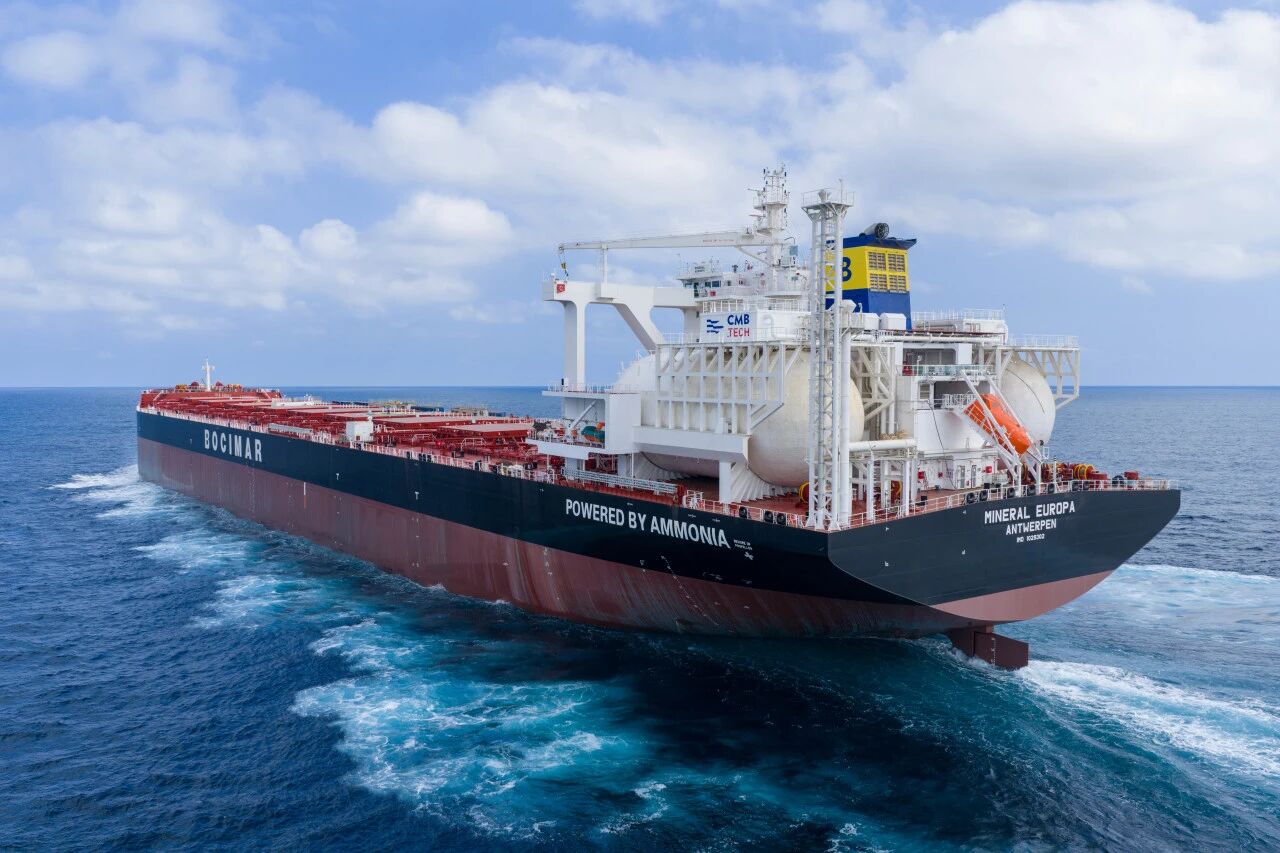
CMB.TECH’s newly delivered 210,000-dwt bulk carrier Mineral Europa received 1,000 tonnes of green ammonia in Zhoushan, China, on 13 October 2026, completing the world’s first commercial ship-to-ship (STS) bunkering of green ammonia. The fuel was transferred from Shenghang Yongle, the world’s first operational ammonia bunker vessel, bringing together two ships developed for the emerging ammonia fuel market.
The ammonia was produced at Energy China’s integrated green hydrogen, ammonia and methanol project in Songyuan, Jilin province, with Jiangsu Andefu organising transport, storage and bunkering. The delivery connected a renewable energy project in northeastern China with storage facilities in Nanjing and an ocean-going ship at a Zhoushan anchorage, just four days after the bulk carrier was handed over to its Belgian owner.
Xinde Marine attended the operation and the accompanying media briefing. Discussions with the participating companies showed how shipbuilding, engine development, fuel production and logistics had been coordinated ahead of the first delivery. With more ammonia-powered ships approaching service, the same companies now face the task of supplying fuel repeatedly, across more ports and at a competitive delivered cost.
A supply chain prepared before the ship arrived
The operation was developed jointly by China Energy Engineering Group Hydrogen Energy, the hydrogen business of Energy China, CMB.TECH and Jiangsu Andefu Energy Technology. Energy China supplied the green ammonia, Andefu organised its movement from the production plant to the receiving vessel, and CMB.TECH provided the shipping demand. Shenghang Yongle is operated by Jiangsu Andefu Energy Development, with Shenghang Shipping responsible for ship management.
Commercial preparations began well before Mineral Europa entered service. On 14 November 2025, Andefu and CMB.TECH signed a long-term agreement for green ammonia supplied through STS bunkering. The first phase of the Songyuan project entered production the following month, while Energy China, Andefu and CMB.TECH established arrangements to supply its output to international shipping.
The first green ammonia consignments left Songyuan by road in May 2026, using Andefu’s own vehicle fleet to reach its Nanjing storage facilities. That month, the company’s 49,000-cubic-metre refrigerated ammonia tank in Nanjing entered service, and its Zhoushan business obtained an ammonia bunkering licence. Shenghang Yongle completed its conversion for fuel supply in August and received ammonia bunkering class certification from China Classification Society (CCS).
On 15 September, the bunker vessel began loading ammonia at Qingjiang terminal in Nanjing’s Jiangbei New Area. The local maritime authority coordinated with the terminal, ship, cargo interests and other parties on navigation and operating arrangements covering berthing, loading and departure. The loading operation connected road deliveries from the inland production base with waterborne transport to Zhoushan.
Mineral Europa was delivered by CSSC Beihai Shipbuilding, together with China Shipbuilding Trading, on 9 October. Its 1,000-tonne bunkering operation followed on 13 October. Under the voyage arrangements announced for the event, the vessel was scheduled to proceed towards Australia after taking fuel.
Mineral Europa brings ammonia into large bulk shipping
Mineral Europa is the world’s first 210,000-dwt ammonia dual-fuel bulk carrier. Built by CSSC Beihai Shipbuilding, the Newcastlemax measures 300 metres in length and 50 metres in beam. Its size places ammonia propulsion directly in the market for long-distance transportation of major dry bulk commodities, where fuel availability and propulsion reliability are central to voyage planning.
Swiss engine designer WinGD developed the X72DF-A low-speed dual-fuel main engine, manufactured by CSSC Engine, while Qingdao SunRui supplied the ammonia fuel supply system. On 15 June 2026, WinGD announced completion of factory acceptance testing for the first X72DF-A engine intended for CMB.TECH ’s Newcastlemax series. Subsequent installation, sea trials and vessel delivery brought the propulsion system into commercial service.
CIMC Sinopacific Offshore & Engineering is supplying ammonia fuel tanks for ten ships in the series. Each ship has two independent Type C tanks, each with a design capacity of 3,000 cubic metres, giving a combined capacity of 6,000 cubic metres. The dual-fuel arrangement also allows Mineral Europa to operate on conventional marine fuel, giving the owner flexibility while ammonia bunkering coverage develops.
WinGD has reported greenhouse gas emissions reductions of more than 90% in ammonia mode compared with diesel operation during development testing, with a target pilot-fuel share of approximately 5% at full load. Commercial voyages will provide further evidence of fuel consumption, maintenance requirements and emissions across operating conditions. The Zhoushan delivery supplies the green ammonia needed to begin building that operating record.
A gas carrier converted for fuel delivery
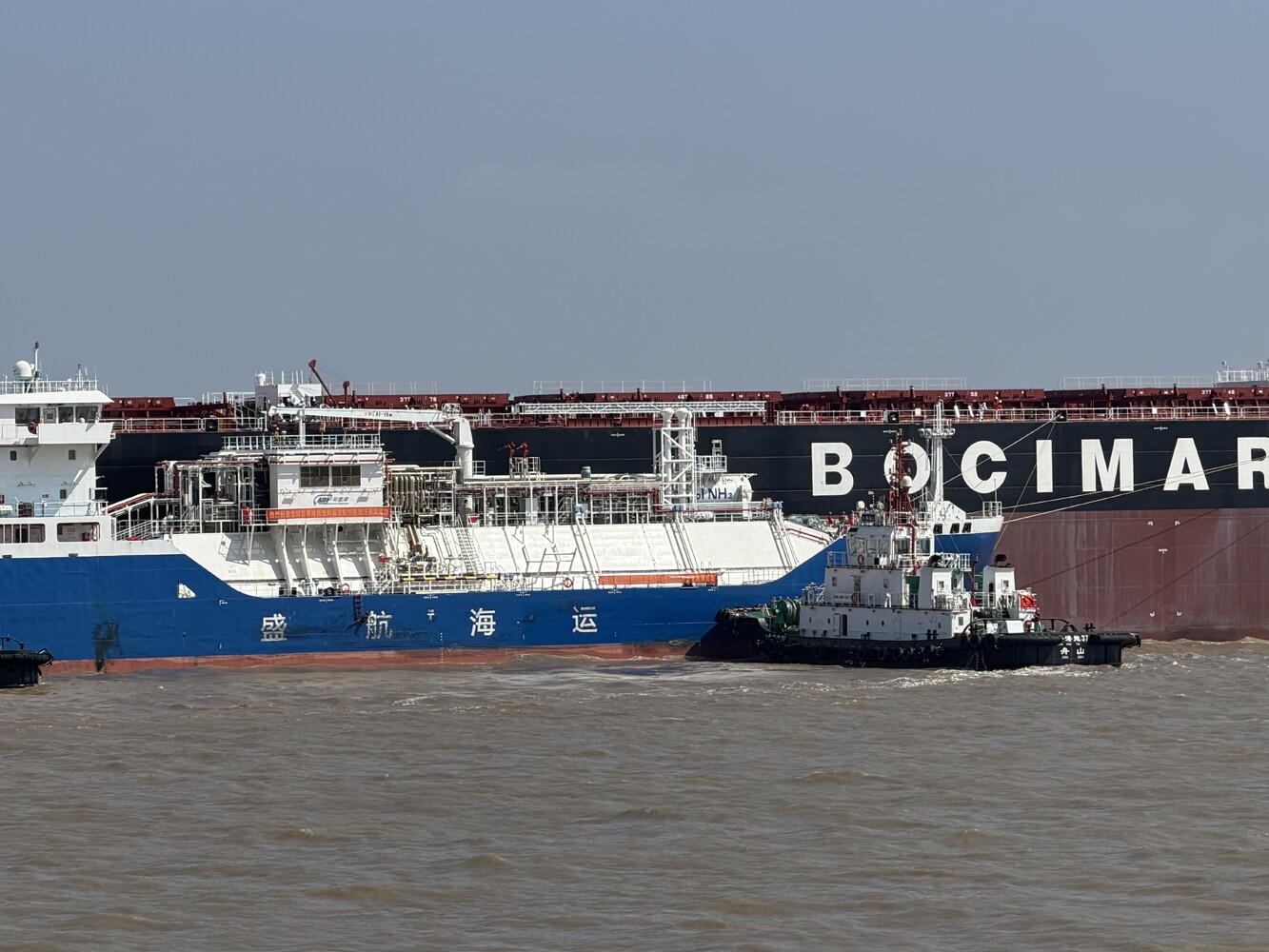
Shenghang Yongle provides the link between shore storage and the receiving ship. Built by China Merchants Jinling Dingheng Shipyard and placed in service in August 2024, the vessel is a semi-refrigerated, semi-pressurised gas carrier with a cargo capacity of 5,546.8 cubic metres and deadweight of 4,626 tonnes. It can carry ammonia, LPG and vinyl chloride monomer on unrestricted voyages. Its cargo tanks have a minimum design temperature of minus 48 degrees Celsius, supported by a reliquefaction system.
Andefu led the conversion and certification programme. Swedish ship designer FKAB, the vessel’s original designer, and cargo systems supplier Gloryholder provided technical documentation, working with CCS. The resulting vessel can perform both ammonia transportation and STS fuel supply, allowing an existing gas carrier to serve a new market.
The conversion covered bunkering equipment, operating procedures, risk assessment and emergency response arrangements. Particular attention was given to ammonia toxicity, material compatibility, low-temperature operations and leak detection. At the media briefing, Andefu also described the feasibility studies and development of operating and emergency plans required to prepare the vessel for its new role.
This approach offers a practical option for the early ammonia bunkering market. Suitable gas carriers can provide a starting point for conversion, subject to technical assessment and approval, while retaining transport work alongside fuel deliveries. Andefu said a second green ammonia bunker vessel is already under construction.

CMB.TECH invests directly in its fuel supplier
The relationship between CMB.TECH and Andefu extends beyond a fuel purchase contract. In December 2025, CMB.TECH announced an investment in the Chinese ammonia supply chain and an offtake agreement for green ammonia from Energy China’s Songyuan project. Its 2026 interim financial report subsequently confirmed that it acquired a 25% interest in Jiangsu Andefu Energy Technology in January 2026.
The same report disclosed two revolving working-capital financing arrangements with companies in the Andefu group. Approximately US$22 million had been drawn under those facilities by 30 June 2026. The combination of equity ownership, fuel offtake and working-capital support gives the shipowner a financial interest in the infrastructure and inventory needed to supply its vessels.
These arrangements address a practical challenge for early alternative-fuel projects. Shipowners need reliable supply before committing vessels to a fuel, while producers and logistics companies need credible demand before investing in production, storage and distribution. Long-term purchases help suppliers plan volumes, and the equity and financing links deepen the parties’ commitment to regular deliveries. The first 1,000 tonnes supplied in Zhoushan put those commercial arrangements into operation.
A growing fleet creates demand beyond the first delivery
CMB.TECH’s ammonia programme forms part of a broader strategy encompassing ships and fuel supply. The Antwerp-based group operates across dry bulk, crude oil tankers, chemical tankers, container shipping and offshore energy services. In its 9 October announcement, it described a fleet of approximately 235 vessels and a business supplying hydrogen and ammonia through its own production projects and third-party producers.
In earlier interviews covered by Xinde Marine, chief executive Alexander Saverys traced the company’s alternative-fuel work to 2016, initially focusing on hydrogen. Consideration of storage, range and logistics for larger vessels led it to pursue ammonia from around 2018. Hydroville, introduced in 2017, was an early hydrogen application and the first Lloyd’s Register-classed vessel to use hydrogen to power a diesel engine. CMB.TECH and WinGD announced their large ammonia engine development programme in 2023, followed by further cooperation with Beihai Shipbuilding and CSSC Engine.
The delivery schedule will substantially increase fuel requirements. CMB.TECH said on 9 October that it expected to take delivery of 21 ammonia-powered ships between then and 2029: 18 bulk carriers, one container ship and two chemical tankers. Most were expected within the following nine months. Suppliers will therefore need to move from supporting a first vessel to meeting the requirements of a growing fleet.
Long-term transport customers are already involved. In June 2026, Australian iron ore producer Fortescue and CMB.TECH agreed charter arrangements covering up to twelve 210,000-dwt Newcastlemax bulk carriers, including up to three with ammonia dual-fuel engines and nine ammonia-ready vessels. Japan’s Mitsui O.S.K. Lines (MOL) has also agreed to jointly own three ammonia dual-fuel Newcastlemaxes with CMB.TECH and charter them for twelve years each. Their wider cooperation includes six chemical tankers, comprising two ammonia dual-fuel and four ammonia-ready ships.
The 1,400-TEU Yara Eyde project extends the strategy into container shipping. Under the announced arrangements, CMB.TECH’s container shipping business Delphis owns the vessel, a joint venture between Norway’s North Sea Container Line and Yara Clean Ammonia operates it, and Yara Clean Ammonia provides the fuel. The planned service links Norway and Germany. CMB.TECH is also developing ammonia storage and bunkering facilities at Walvis Bay in Namibia, adding another prospective supply location for its future fleet.
These projects connect ship investment with identified customers, routes and fuel arrangements. Saverys has argued that green ammonia could eventually become cheaper than diesel. Actual voyages will test that expectation against fuel consumption, supply costs and vessel performance, while long-term charters give the early fleet a commercial base from which to operate.
Andefu targets the cost of moving ammonia to the coast
Andefu’s role draws on its established ammonia trading and logistics business. The company is expanding into green hydrogen and ammonia through activities spanning production investment, trading, terminal storage and road, rail and waterborne transport. It has also disclosed an investment in the Songyuan hydrogen industrial park project.
Its Nanjing storage facility is a key part of the current delivery route. The 49,000-cubic-metre refrigerated tank holds ammonia arriving by road and supports loading onto vessels. Storage allows the company to reconcile production and delivery schedules with the timing of ocean-going ships, while maintaining inventory for subsequent bunkering operations.
At the media briefing, Andefu identified long-distance road transport as a significant cost pressure. The journey from Songyuan to Nanjing is approximately 2,000 kilometres. Company representatives said the scope to reduce costs in storage, cargo aggregation and loading was more limited, making the route to the coast an important focus for improving the delivered fuel price.
Andefu is developing storage in Panjin, Liaoning province, and considering rail tank wagons and multimodal transport to reduce reliance on long road journeys. Its published plans envisage a 49,000-cubic-metre refrigerated tank and associated ambient-temperature pressure tanks in the first phase at Panjin, with completion expected in 2028. The location would give northeastern production bases closer access to coastal shipping and distribution to bunkering ports.
The company also discussed Tianjin and longer-term storage plans in Zhejiang and Guangxi. Qingdao and Shenzhen were identified as locations for future bunkering business. Together with its second bunker vessel, these plans would extend the service beyond the initial Songyuan–Nanjing–Zhoushan route. Their economics will depend on matching new capacity with sufficient fuel volumes, storage turnover and vessel utilisation.
Energy China connects renewable production with ocean shipping
All 1,000 tonnes delivered in Zhoushan came from Energy China’s integrated green hydrogen, ammonia and methanol project in Songyuan. The first phase began construction in September 2023 and entered production on 16 December 2025. According to the listed company’s announcement, investment totalled RMB6.946 billion, with 800 MW of renewable generation comprising 750 MW of wind and 50 MW of solar capacity.
The project combines direct renewable power supply, energy storage, water electrolysis and flexible ammonia synthesis. The company disclosed annual production capacity of 45,000 tonnes of green hydrogen and 200,000 tonnes of green ammonia and green methanol. Coordinating variable wind and solar output with chemical production is central to the design, requiring the power, hydrogen and synthesis systems to operate together.
In February 2026, Energy China’s hydrogen business reported that cumulative green ammonia production at Songyuan had exceeded 10,000 tonnes since commissioning. The offtake and logistics arrangements with CMB.TECH and Andefu connect that output with international shipping customers, providing a route from plant production to marine fuel use.
At the Zhoushan briefing, Li Jingguang, chairman of China Energy Engineering Group Hydrogen Energy, discussed the need to develop production, storage, transport and end use together. He said construction of the second phase of the Songyuan project was planned to begin on 20 October. Securing customers and efficient logistics alongside that expansion will influence the competitiveness of its additional output.
Hydrogen production and ammonia propulsion develop together
Green ammonia provides a route for renewable hydrogen into deep-sea shipping. Renewable electricity is used to produce hydrogen through water electrolysis, and that hydrogen is combined with nitrogen to make ammonia. In this supply chain, hydrogen is the essential upstream feedstock, while ammonia provides the form in which energy is stored, transported and used in the ship’s engine.
Existing ammonia production and transport infrastructure provides a basis for the new marine market. Shenghang Yongle’s conversion illustrates how experience from the chemical and fertiliser supply chains can be adapted for bunkering, with additional equipment, procedures and approvals. At the same time, vessel size, voyage length, refuelling frequency and fuel storage requirements influence where hydrogen or ammonia can be used most effectively.
Ammonia also imposes design and operating requirements. DNV estimates that it needs almost three times the volume of marine gas oil to provide the same energy. Tank capacity, voyage range and bunkering intervals must therefore be considered together. Its commercial performance will depend on the cost of completing the transport task, including fuel consumption, vessel investment, maintenance and delivery charges.
Environmental performance extends from electricity generation to engine operation. Renewable power sourcing, hydrogen and ammonia production, transport energy and pilot fuel all affect lifecycle emissions. Nitrous oxide requires particular attention because it is a potent greenhouse gas, while nitrogen oxides and ammonia slip also require control. Certification and operational measurements are needed to demonstrate the environmental performance of the resulting transport service.
Safety and certification support repeat deliveries
Ammonia’s toxicity makes personnel protection, leak detection, ventilation, emergency shutdown and response planning essential throughout storage and transfer. STS operations add the requirements of relative vessel movement, compatible connections and coordinated procedures. The conversion and operating preparations described by Andefu addressed these issues as part of bringing Shenghang Yongle into fuel service.
The International Maritime Organization’s Maritime Safety Committee approved interim guidelines for ships using ammonia as fuel in December 2024, with the associated circular issued in 2025. The guidance covers fuel containment, supply, bunkering and personnel safety, including emergency release, purging, shutdown communications and leakage management. Practical operations will add experience relevant to equipment design, crew training and operating procedures.
Green fuel deliveries also depend on traceability. Songyuan has obtained ISCC EU certification, with CMB.TECH’s procurement announcement specifically referring to ISCC EU RFNBO certification for renewable fuels of non-biological origin. Andefu Energy Development obtained ISCC EU certification in December 2025. These arrangements support documentation of renewable energy inputs, lifecycle greenhouse gas performance and the movement of fuel through the supply chain.
For the buyer, quantity and fuel quality must be accompanied by evidence of the product’s environmental attributes. As volumes grow, managing that information will become a routine part of marine fuel supply, alongside physical transport and safe transfer.
Zhoushan becomes a supply point for ammonia shipping
Bunkering at anchorage enables large ships to receive fuel without making a dedicated terminal berth call. Andefu highlighted this advantage at the briefing. The operation was supported by Zhoushan’s free trade zone coordination authority and other local departments responsible for the relevant port, vessel and waterside activities.
Earlier projects have helped establish experience with ammonia transfers at sea. In September 2024, the Global Centre for Maritime Decarbonisation conducted a 2,700-tonne ammonia transfer between two gas carriers at the Dampier outer anchorage in Australia as part of its lightering and simulated bunkering work. The Zhoushan operation delivered green ammonia as fuel to an ammonia-powered ocean-going merchant ship, connecting bunkering capability with commercial consumption.
Further deliveries will determine how that capability develops into a regular service. Shipowners need to know where ammonia is available, what inventory can be secured and how efficiently it can be supplied. Ports that can meet those requirements consistently will be better placed to serve ammonia-powered vessels as their trading patterns expand. Their access to inland production and coastal distribution networks will be part of that proposition.
The next test is regular commercial operation
The IMO’s 2023 greenhouse gas strategy calls for zero or near-zero emission technologies, fuels and energy sources to account for at least 5%, striving for 10%, of international shipping’s energy use by 2030, with net-zero greenhouse gas emissions by or around 2050. Meeting those ambitions requires fuel production and bunkering capacity to develop alongside the ships that will use them.
The Zhoushan delivery shows how those investments can be brought together around an actual vessel and voyage. CMB.TECH now needs to build operating experience across successive voyages; Energy China must connect expanding production with sustained demand; and Andefu must improve delivery economics as its storage network and bunker fleet grow. Equipment suppliers, classification societies and port authorities will gain further evidence from each operation.
For charterers and cargo owners, the commercial questions concern dependable transport, verifiable emissions reductions and total voyage cost. Long-term agreements with customers such as Fortescue and MOL give the early ammonia fleet a demand base, while operating results will influence further investment and customer commitments. Following its Zhoushan call, Mineral Europa was scheduled to continue towards Australia. Its subsequent voyages, and the ships due to follow it into service, will test how effectively this first supply chain can support regular ocean transport.


READ MORE
 Sustainability
China Sets 2028 Targets for Electric and Methanol-Powered Inland Vessels
 Sustainability
China Merchants Takes Delivery of Third Methanol Dual-Fuel Car Carrier
 Sustainability
Alexander Saverys :Green Ammonia Will Be Cheaper Than Diesel—Sooner Than You Think
 Sustainability
Greater Bay Area Launches First Zero-Carbon Container Shipping Route Between Guangzhou and Hong Kong
 Sustainability
Beihai Delivers First Ammonia-Powered Bulker as Mineral Europa Sets Sail
 Sustainability
World's First Ammonia Dual-Fuel Bulker Delivered in China
 Sustainability
UK & CHINA: NAVIGATING TOGETHER TOWARDS SAFER, GREENER SHIPPING
 Sustainability
India, EU launch coalition to develop green shipping corridor
 Sustainability
Global fleet of battery-equipped ships surpasses 2,000 vessels
 Sustainability