


Sogestran and Titan Back 6,000-cbm LNG Bunker Newbuild at China’s CIMC SOE
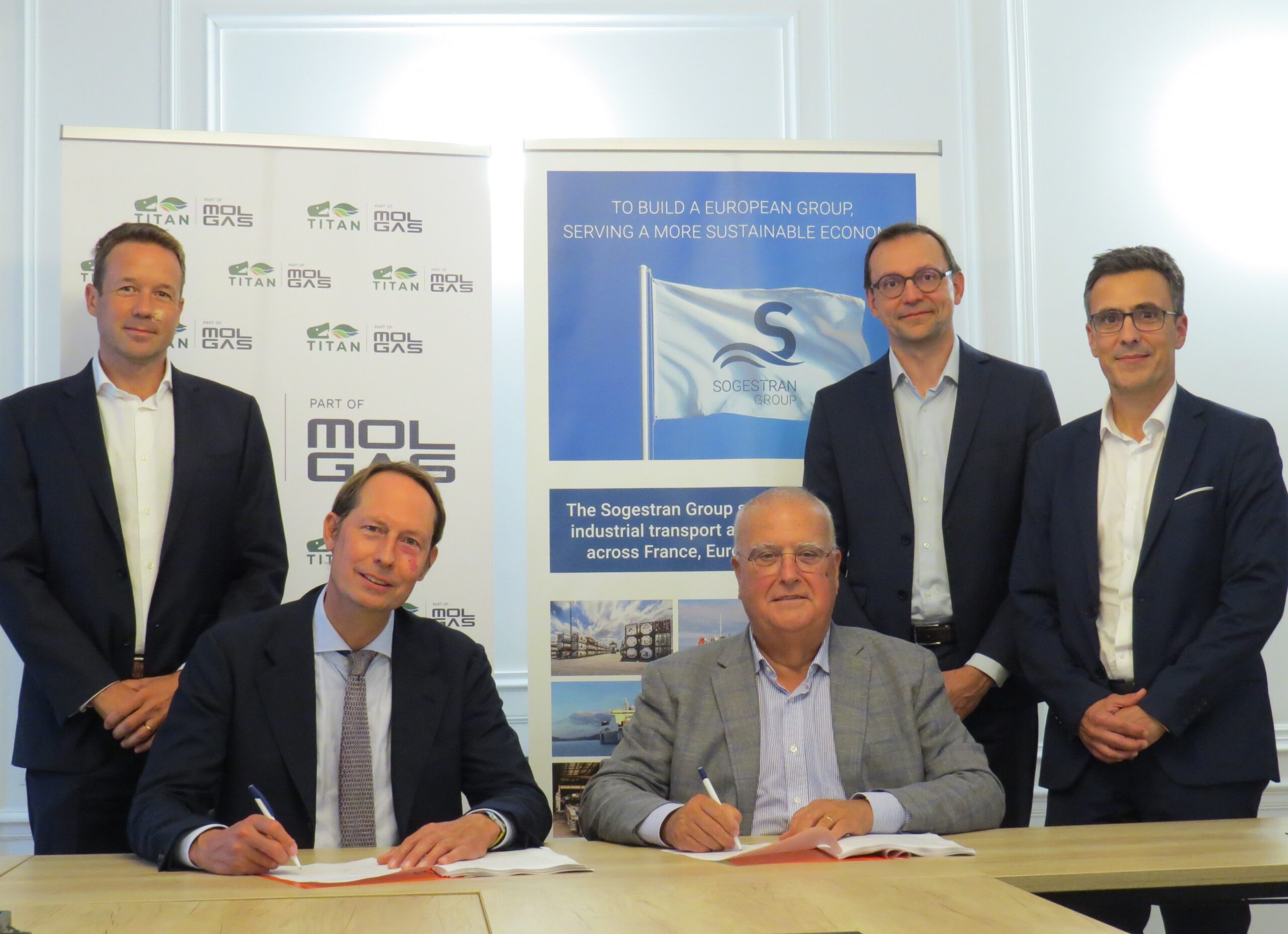

A previously undisclosed European owner behind a 6,000-cbm LNG bunker vessel order at Nantong CIMC Sinopacific Offshore & Engineering has been identified as France’s Sogestran Group, with Titan Clean Fuels set to charter and operate the vessel under a long-term agreement focused on the Western Mediterranean. The relatively compact newbuild will target LNG and liquefied biomethane bunkering, with a low-air-draft design tailored in part to the region’s cruise sector.
French shipowner Sogestran Group and Titan Clean Fuels have confirmed a long-term partnership covering the construction, charter and operation of a new 6,000-cbm LNG bunker vessel at Chinese shipbuilder Nantong CIMC Sinopacific Offshore & Engineering, or CIMC SOE.
The announcement identifies the owner behind a contract first disclosed by CIMC SOE on August 15, when the yard said only that it had signed a formal shipbuilding agreement with an unnamed European owner for one 6,000-cbm LNG bunkering vessel.
Under the newly disclosed arrangement, Sogestran will own the vessel while Titan, part of Molgas Group, will charter and operate it on a long-term basis.
Neither the contract value nor the delivery date, hull number or duration of the charter has been disclosed.
Titan plans to deploy the vessel across the Western Mediterranean, with operations expected to include Fos-Marseille, Barcelona and Genoa. The ship will be able to load LNG at a range of Mediterranean terminals and provide both LNG and liquefied biomethane, or LBM/bio-LNG, as well as gas-up and cool-down services for LNG-fuelled vessels.
Small capacity, highly targeted design
At 6,000 cbm, the vessel will be considerably smaller than the 18,000-20,000-cbm bunker vessels that have become increasingly common in major LNG supply programmes.
Its design, however, reflects a different operating requirement.
Titan and Sogestran said their technical teams jointly developed the vessel around the navigational, operational and commercial conditions of Western Mediterranean ports, LNG loading terminals and receiving ships.
One of the most distinctive features is its low-air-draft configuration, which Sogestran says will allow the vessel to bunker cruise ships without requiring a pontoon.
That matters in a region where berth configuration, terminal access, harbour restrictions and compatibility with large cruise ships can be as important as maximum cargo capacity.
The vessel itself will also be LNG/LBM-fuelled.
Rather than relying on a single large bunker ship to maximise cargo carried per voyage, the project appears geared towards flexibility across multiple ports and different receiving-vessel types.
That makes the 6,000-cbm newbuild less a scaled-down version of a large bunker vessel than a specialised regional unit.
Titan extends ship-to-ship supply into the Mediterranean
The project will also expand Titan and Molgas Group’s physical bunkering capability further into Southern Europe.
Titan says the vessel will join Molgas Group’s existing fleet of eight LNG bunker vessels operating across Northern Europe, comprising six in Titan’s fleet and two trading for Molgas Norway.
Titan already owns two 1,500-cbm FlexFueler bunker barges based in Amsterdam and Antwerp. Those smaller units were developed for ship-to-ship LNG and bio-LNG supply in the Amsterdam-Rotterdam-Antwerp region, illustrating how bunker vessel size can vary substantially depending on port conditions and customer profiles.
In the Mediterranean, Molgas already has truck-to-ship and wider downstream LNG distribution activities. The new vessel adds a dedicated ship-to-ship component to that network.
Sogestran brings local marine fuel experience of its own. The French group has been involved in conventional bunkering and coastal petroleum transport in the Mediterranean for decades, while its in-house engineering capability contributed to the development of the new vessel.
The combination is therefore relatively straightforward: Sogestran provides the shipowning platform and regional maritime experience, Titan provides the long-term bunker operation and fuel customer base, and CIMC SOE provides the vessel and gas-handling construction expertise.
Mediterranean ECA adds to the regulatory backdrop
The timing also comes against a tightening emissions regime in the Mediterranean.
The Mediterranean Sea became a Sulphur Oxides and Particulate Matter Emission Control Area under MARPOL Annex VI on May 1, 2025.
Ships operating in the area are now subject to a maximum fuel sulphur content of 0.10%, compared with the 0.50% global limit outside SOx ECAs.
The ECA does not require vessels to use LNG. Owners can comply through low-sulphur fuels, exhaust-gas cleaning systems and other permitted solutions.
It nevertheless strengthens the operating case for reliable bunker infrastructure for vessels that have already adopted LNG dual-fuel propulsion, particularly cruise ships, containerships, PCTCs and other large vessels trading regularly in the region.
The Mediterranean is also a particularly relevant market for cruise bunkering. IMO estimates that more than 17% of the global cruise fleet and around 24% of the wider global shipping fleet sail in the Mediterranean, which supports about 20% of seaborne trade.
That gives the new vessel’s cruise-oriented low-air-draft design a clear operational context, although there is no basis to claim that the ECA itself directly caused the order.
LNG bunker vessel fleet continues to expand
The Sogestran-Titan project comes as the global LNG bunker vessel fleet continues to grow.
SEA-LNG, citing DNV data in its 2026 mid-year market review, said 67 LNG bunker vessels were in operation globally, with another 42 on order.
Global LNG bunkering volumes averaged about 770,000 cbm per month between January and May 2026, around 13% higher than in the same period a year earlier, according to Kpler data cited by SEA-LNG.
Growth in LNG-fuelled shipping is driving part of that infrastructure requirement, but bunker vessel demand is becoming increasingly segmented.
Larger 18,000-20,000-cbm units are suited to high-volume supply at major hubs and long-distance LNG distribution, while smaller vessels can offer greater flexibility in ports where manoeuvrability, air draft, berth access and smaller individual deliveries are more important.
The new 6,000-cbm vessel falls firmly into the latter category.
Its LBM compatibility also matters commercially because the same cryogenic distribution infrastructure used for fossil LNG can handle biomethane-based marine fuel, allowing operators to offer lower-carbon methane fuels without replacing the entire physical bunkering chain.
CIMC SOE builds on a broad LNG bunkering track record
For CIMC SOE, the order adds another size class to an already extensive LNG bunker vessel reference list.
The Nantong-based yard is part of Hong Kong-listed CIMC Enric and specialises in small and medium-sized gas carriers, cargo containment systems and other gas-related marine equipment.
Its published vessel reference list shows that it has already delivered at least 10 LNG bunker vessels across several designs:

CIMC SOE’s reference list also shows 12,500-cbm, 18,900-cbm and 20,000-cbm bunker vessels under construction, giving the yard a product range extending from smaller regional bunkering ships to much larger supply units.
Its European customer base has also broadened.
Italian owner Fratelli Cosulich previously ordered two 8,200-cbm LNG bunkering vessels from CIMC SOE, while three 7,600-cbm vessels were built for Seaspan Energy.
Avenir LNG ordered two 20,000-cbm LNG bunker and supply vessels at the yard in 2024, scheduled for delivery in the fourth quarter of 2026 and first quarter of 2027. Avenir later fixed the first of those ships to Vitol on a seven-year charter, with extension options that could take the employment to 10 years.
More recently, CIMC SOE signed contracts with Purus for two 18,900-cbm LNG bunker vessels that are to be chartered to Shell, alongside a 2+2 ship programme of 20,000-cbm units for GSX Energy.
These orders are relevant because LNG bunkering vessels are a more specialised product than conventional bulk carriers or standard tankers.
They require integration of cryogenic cargo tanks, gas-handling equipment, transfer systems, dual-fuel propulsion and precise manoeuvring capabilities, often combined with customer-specific requirements for different ports and receiving ships.
CIMC SOE’s order history therefore shows not simply growing volume, but a widening range of vessel sizes and operating profiles.
A more specialised phase of LNG bunkering
The Sogestran-Titan order is small in deadweight and cargo capacity compared with the largest LNG bunker vessel projects now being built.
Its significance lies elsewhere.
As LNG bunkering infrastructure matures, the market is no longer focused only on putting enough large bunker vessels into major hubs. Operators are increasingly looking at how to serve specific ports, vessel types and trading patterns more efficiently.
At one end of the market are 18,000-20,000-cbm vessels designed for high-volume distribution. At the other are vessels such as this 6,000-cbm newbuild, designed around local port constraints and customers including cruise ships.
For Titan, the next test will be whether it can build sufficient LNG and LBM bunker volumes around Fos-Marseille, Barcelona and Genoa to support a regular ship-to-ship service.
For CIMC SOE, the more immediate indicators will be whether European bunker suppliers continue to return to the yard for repeat business and whether demand broadens further across the 6,000-20,000-cbm range.
The contract price, delivery date and charter duration remain undisclosed and will be among the next details to watch.

READ MORE
 Sustainability
Singapore Offers Up to S$250,000 for Electric Harbour Craft
 Sustainability
Greater Bay Area Launches First Zero-Carbon Container Shipping Route Between Guangzhou and Hong Kong
 Sustainability
1000Ton! CMB.TECH in World First Commercial STS Green Ammonia Bunkering
 Sustainability
MPA, CMA CGM and SLNG Join Forces on Bio-LNG Bunkering
 Sustainability
China Sets 2028 Targets for Electric and Methanol-Powered Inland Vessels
 Sustainability
China Merchants Takes Delivery of Third Methanol Dual-Fuel Car Carrier
 Sustainability
Alexander Saverys :Green Ammonia Will Be Cheaper Than Diesel—Sooner Than You Think
 Sustainability
Beihai Delivers First Ammonia-Powered Bulker as Mineral Europa Sets Sail
 Sustainability
World's First Ammonia Dual-Fuel Bulker Delivered in China
 Sustainability