


Liaoning Port Moves to Add Two 5,200-hp Electric Tugs
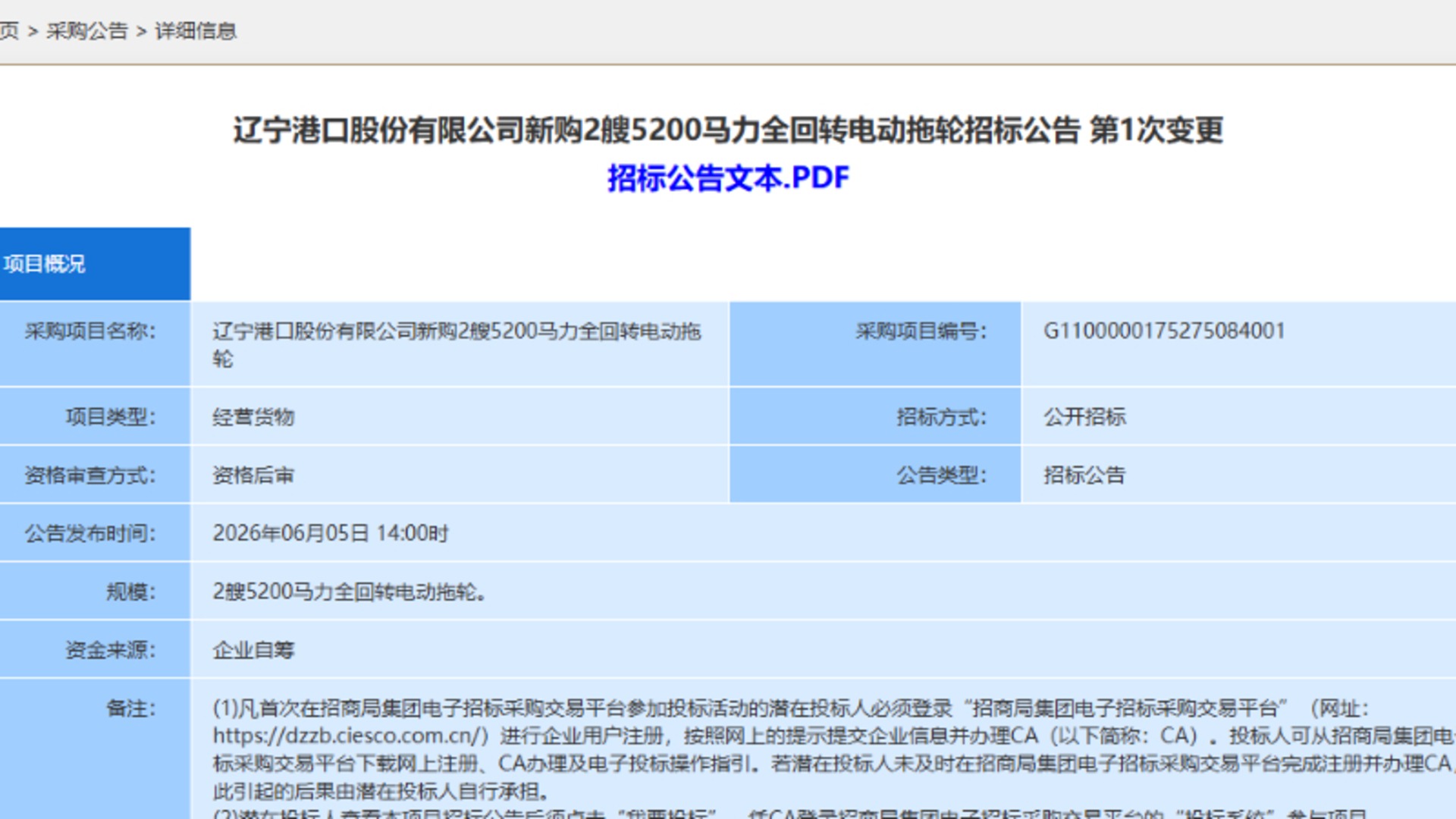

Liaoning Port Co., Ltd. is moving forward with the procurement of two 5,200-hp battery-electric azimuthing harbour tugs, as more Chinese ports introduce electric and hybrid propulsion into their towage fleets.
A bid evaluation notice published on 8 July named Jiangsu Zhenjiang Shipyard (Group) Co., Ltd. as the first-ranked bidder, followed by Lianyungang Hongyun Industrial Co., Ltd. Both bidders proposed a delivery period of 360 days.
The project remains at the bid evaluation and candidate-publication stage, and a final contract award has yet to be announced.
The procurement covers the vessels’ design and plan approval, equipment and material supply, construction, testing, sea trials, classification and statutory certification, registration, delivery and after-sales support. Liaoning Port has yet to disclose the battery capacity, propulsion motor output, bollard pull or intended operating area of the two tugs.
The listed company’s official English name is Liaoning Port Co., Ltd., rather than “Liaoning Port Group”. It operates port and logistics businesses across major port areas in Liaoning Province, including facilities in Dalian and Yingkou.
The project will add Liaoning to a growing list of Chinese coastal port regions deploying battery-electric, hybrid-electric and hydrogen fuel-cell tug technology.
At the Port of Qinhuangdao, the 4,400-hp hybrid-electric tug Qin Gang 28 entered service in early 2024. Built by Jiangsu Zhenjiang Shipyard, the vessel can switch between diesel-mechanical and electric propulsion modes and uses a DC power distribution system with onboard battery storage.
At the Port of Tianjin, four 5,400-hp battery-electric harbour tugs entered operation in August 2025. The vessels undertake port towage and ship-handling duties, including assisting ships during port entry, departure, berthing and unberthing.
Yantai Port, one of the four major port groups operated by Shandong Port Group, is preparing to receive its first battery-electric azimuthing tug. The 5,000-hp Yan Gang Dian Tuo 1 was launched at Jiangsu Zhenjiang Shipyard in 2026 and is designed for berthing, unberthing and turning assistance within the port.
Shandong Port Group’s Bohai Bay Port received the 4,000-hp battery-electric tug Bo Gang Dian Tuo 1 in December 2025. The vessel was deployed in the Weifang port area, one of the port areas covered by Bohai Bay Port.
At the Port of Qingdao, Shandong Port Group has introduced two alternative-propulsion tug designs. The 5,200-hp Qing Gang Tuo 1, commissioned in December 2022, uses a hybrid-electric propulsion system combining diesel engines, electric motors and lithium batteries. It was followed in 2025 by Qing Dian Tuo 1, which uses a hydrogen fuel-cell and lithium-battery hybrid power system.
The Port of Lianyungang has developed one of China’s largest established battery-electric tug fleets. Its first battery-electric tug entered operation in 2021, and the fleet had expanded to four vessels by February 2026 following the commissioning of Yungang Electric Tug No. 9. Lianyungang Hongyun Industrial has also built electric tugs for other Chinese ports.
The Port of Shanghai was among the earlier Chinese ports to introduce hybrid-electric tug technology. Hai Gang 711 became an early domestically integrated hybrid tug project, while the 5,000-hp Hai Gang 712 subsequently introduced a DC-grid electric propulsion system combining variable-speed generator sets, battery energy storage, permanent-magnet propulsion motors and azimuth thrusters. The latter completed its initial operational verification in 2024.
At Ningbo-Zhoushan Port, the 5,000-hp Yong Gang Tuo 80 entered service as a parallel hybrid-electric azimuthing tug in late 2023. The port has since moved into battery-electric tug construction, with one vessel launched and another two electric tug projects under construction. The proper English name of the combined port is Ningbo-Zhoushan Port, rather than “the Port of Ningbo and Zhoushan”.
Ningde Port operates Zhu Gang Tuo 20, an electric-propulsion tug previously deployed at the Port of Zhuhai. The vessel uses a DC power distribution system and onboard energy storage and was subsequently transferred to port operations in Ningde.
At the Port of Fuzhou, the 4,000-hp Fu Gang Tuo 31 entered service at the end of 2025. The vessel is more precisely described as a range-extended battery-electric tug, as it combines a lithium iron phosphate battery system with an auxiliary generator for extended operating range.
The Port of Xiamen operates one of China’s largest electrified harbour tug fleets. The fleet comprises the series-hybrid tug Xia Gang Tuo 30 and four battery-electric tugs—Xia Gang Tuo 31, 32, 33 and 34—which were delivered together in January 2026. In technical English, “串联式混合动力” is normally rendered as series-hybrid propulsion, rather than “serial-hybrid propulsion”.
At the Port of Guangzhou, the 4,000-hp battery-electric tug Sui Gang Dian Tuo 01 was delivered in April 2025. Built by Lianyungang Hongyun Industrial, it became the first battery-electric tug deployed in South China and is used for ship-handling, escort and other harbour duties.
At the Port of Shenzhen, the 5,000-hp battery-electric tug Shen Gang Dian Tuo 1 joined the fleet at Da Chan Bay in July 2025. The vessel is designed to assist ultra-large container ships during berthing and unberthing operations.
The Port of Zhuhai was the original operating port of Zhu Gang Tuo 20, which entered service there in 2023 before being transferred to Ningde. The vessel can therefore be included in Zhuhai’s historical electric-tug deployment, but should not be counted as an active tug in both ports at the same time.
Across China, the main propulsion descriptions should be distinguished as follows:
Battery-electric tug: propulsion energy is primarily supplied by onboard batteries.
Hybrid-electric tug: combines batteries and conventional engine-driven power generation or propulsion.
Series-hybrid tug: the propellers are driven electrically, while engines generate electricity rather than driving the propellers directly.
Hydrogen fuel-cell/battery hybrid tug: combines fuel cells with battery energy storage.
Range-extended battery-electric tug: operates primarily on batteries but carries an auxiliary generator to extend endurance.
The term azimuthing tug is appropriate when the vessel is equipped with fully steerable azimuth thrusters. Azimuth stern drive tug, commonly abbreviated as ASD tug, should only be used when the propulsion units are confirmed to be installed at the stern in an ASD configuration.
Liaoning Port’s two proposed 5,200-hp tugs have yet to receive a final contract award. More detailed information on their propulsion arrangement, battery system, bollard pull and operating deployment is expected after the tender process is completed.

READ MORE
 Shipbuilding
Yichang Changyun plans RMB120m inland bulker programme
 Shipbuilding
Steel Giant Shagang Eyes Shipbuilding as a Booming Market Draws Industrial Capital
 Shipbuilding
Hengli Secures 12 Tanker Orders, Retaining World’s Largest VLCC Orderbook
 Shipbuilding
Amid China’s Shipbuilding Boom, a State-Owned Yard Quietly Enters Liquidation
 Shipbuilding
Hengli Signs 11 VLAC Contracts in One Week
 Shipbuilding
China ZWI Enters Ocean Shipping with VLGC Acquisition and Chemical Tanker Newbuild Project
 Shipbuilding
World’s First 325,000-DWT Methanol Dual-Fuel Ore Carrier Delivered
 Shipbuilding
CIMC Raffles Extends NOCC Car Carrier Programme to 2030
 Shipbuilding
Grimaldi Advances New ConRo and Multipurpose Projects as Fleet Renewal Continues
 Shipbuilding