


Shipping’s Risk Equation Is Being Repriced as Finance, Insurance and Contracts Adapt
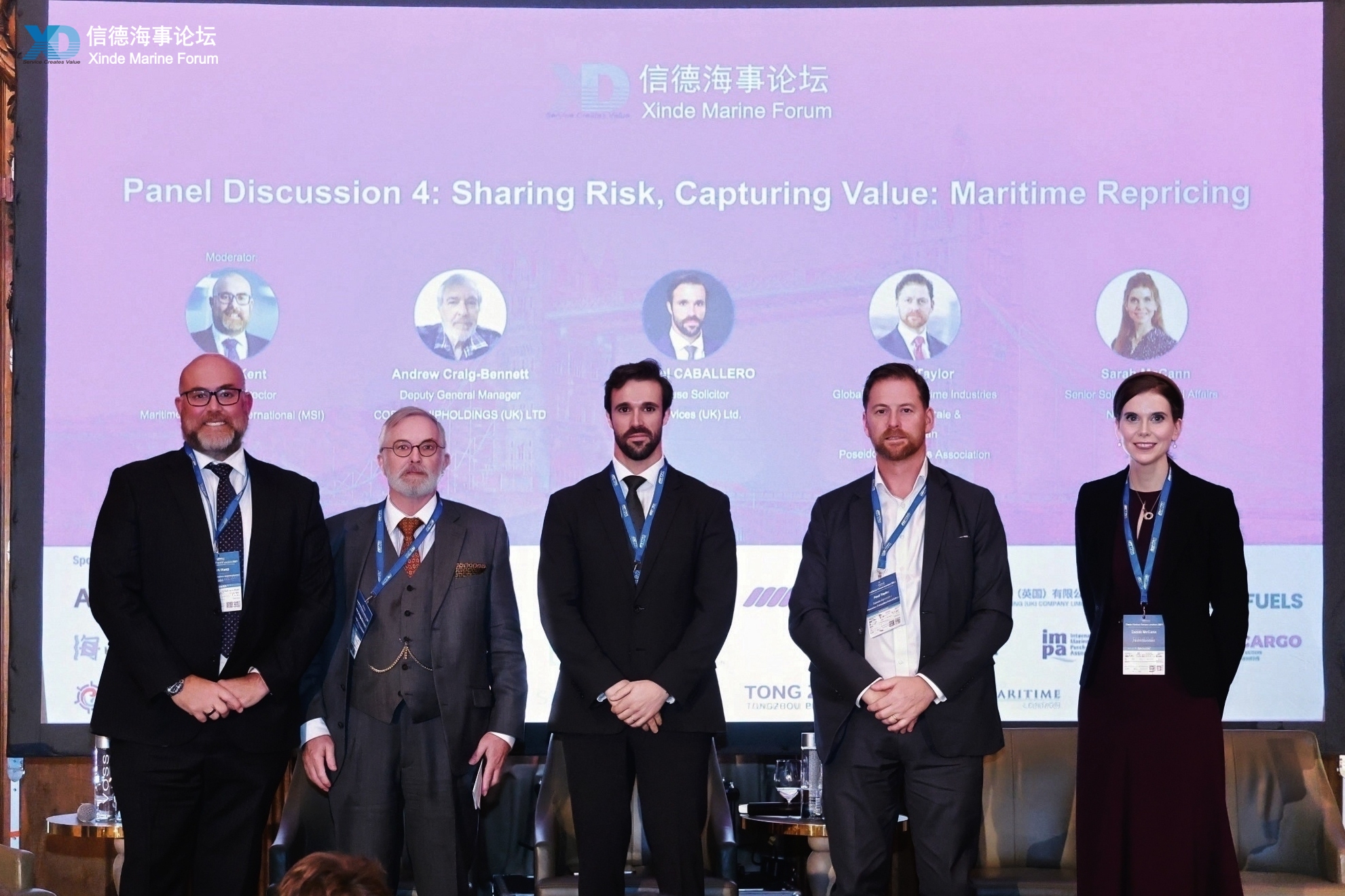
At Xinde Marine Forum London 2026, executives from shipowners, banks, insurers and maritime service providers discussed how geopolitical disruption, regulation and decarbonisation are changing the way shipping companies evaluate assets, allocate costs and make investment decisions.

A changing risk landscape for shipping
Shipping has always been a business built around uncertainty. Freight rates fluctuate, markets move in cycles and vessels are exposed to events far beyond an owner’s control.
But the industry is now dealing with a different type of uncertainty. Risks that were once considered separate — geopolitical disruption, sanctions, regulatory change, fuel transition and financing conditions — are increasingly affecting each other.
That was the focus of the fourth panel at Xinde Marine Forum London 2026, titled “Sharing Risk, Capturing Value – Maritime Repricing.” The discussion brought together representatives from shipowners, finance, insurance and legal services to examine how shipping’s traditional approach to risk is changing.
The central issue raised by moderator Adam Kent, Managing Director of Maritime Strategies International, was not simply whether shipping faces more risks than before, but whether the industry’s existing commercial mechanisms are still allocating those risks effectively.

The question has become increasingly important as shipowners make long-term decisions on fleet investment, financing and operations in an environment where the rules of the market are changing faster than before.
Strong markets can create the next challenge
Andrew Craig-Bennett of COSCO SHIPHOLDINGS UK began from a basic point: the physical business of shipping remains unchanged.

Ships still transport cargo between markets.
What has changed is everything surrounding that activity. Regulation, sanctions, geopolitical intervention and financial complexity have created a much more complicated operating environment.
Shipping’s cyclical nature also remains a challenge.
Craig-Bennett noted that higher risk can create higher returns, but strong markets can also encourage excessive investment. When large amounts of capital enter shipping because the sector appears attractive, the result can be too many ships being ordered and a later market correction.
This concern is particularly relevant in today’s market.
Many shipping segments have benefited from strong earnings in recent years, while shipyards have maintained high utilisation and newbuilding prices have increased. At the same time, large orderbooks in some sectors have raised questions about future fleet growth once new vessels enter service.
For owners, the challenge is not simply whether a ship can generate attractive returns today. The more difficult question is whether that asset will remain competitive when market conditions, regulations and customer requirements change.
Contracts are facing a more complicated world
The changing risk environment is also putting pressure on traditional shipping contracts.
Miguel Caballero from CPI Services UK explained that legal discussions are increasingly happening before problems arise. Companies are seeking advice on whether they can trade with certain counterparties, enter specific markets or continue operations under changing geopolitical conditions.

Sanctions, route changes and security concerns have created situations where responsibility is not always straightforward.
A vessel diverted because of a conflict, a cargo delayed because of restrictions, or a payment affected by sanctions can involve multiple parties with different interests.
Caballero noted that standard contracts remain important, but they cannot automatically resolve every situation involving war risks, sanctions, route closures or regulatory changes. Parties need to examine the details of agreements, including routeing rights, safe-port obligations, payment provisions and sanctions clauses.
For shipowners and charterers, this means commercial negotiations are increasingly focused not only on price and employment terms, but also on how unexpected events will be handled.
Banks are looking beyond freight earnings
The financial sector’s approach to shipping assets is also changing.
Paul Taylor from Societe Generale and the Poseidon Principles Association explained that lending decisions today involve a wider range of factors than traditional shipping finance.

Banks are increasingly considering carbon intensity, Carbon Intensity Indicator (CII) performance, fuel pathways, technology readiness and sanctions exposure when assessing shipping projects.
This does not mean financing decisions are based only on environmental performance. Commercial fundamentals remain central.
However, the definition of a strong shipping asset is becoming broader.
A vessel with attractive earnings today may face challenges in the future if it becomes less acceptable to charterers, more expensive to finance or more difficult to operate under new regulations.
The Poseidon Principles have provided a common framework for financial institutions to measure and improve the climate alignment of shipping portfolios. Taylor noted that the initiative is not about immediately restricting financing to alternative-fuel vessels, but about increasing transparency and encouraging gradual improvement.
Later in the discussion, Taylor pointed out that regulatory obsolescence is becoming a real commercial consideration. A vessel can remain technically compliant while losing competitiveness because of carbon pricing, charterer expectations, financing requirements or trading restrictions.
For owners, this changes how investment decisions are evaluated.
The question is no longer only whether a ship can earn money during its operational life, but whether it can continue to attract capital and employment as market requirements evolve.
Insurance moves closer to operational decisions
Insurance is also adapting to a more complex risk environment.
Sarah McCann from NorthStandard said insurers are increasingly helping members manage a wider network of regulatory, contractual and operational challenges.

Alternative fuels are one example.
As shipping explores LNG, methanol, ammonia, hydrogen and other lower-carbon options, insurers must evaluate risks that have limited historical experience.
These include:
-
fuel characteristics;
-
bunkering procedures;
-
crew competence;
-
machinery reliability;
-
liability allocation;
-
operational responsibilities.
McCann stressed the importance of cooperation across the industry because decarbonisation rules may place formal obligations on one party while costs, data and operational control sit elsewhere. Contracts therefore need clearer arrangements for information sharing, fuel decisions and responsibility allocation.
This represents a wider change in the role of insurance.
Rather than simply providing protection after an incident, insurers are becoming more involved in helping companies understand and manage emerging risks.
Decarbonisation introduces a verification challenge
The transition to alternative fuels also creates questions beyond technology.
Andrew Craig-Bennett highlighted that future fuels bring not only engineering challenges but also verification challenges.
For conventional marine fuels, quality and origin can generally be assessed through established methods. However, for hydrogen-derived fuels and environmental classifications such as “green” or “blue”, the environmental impact depends on the entire production chain.
As financial incentives increase, reliable certification and verification systems will become increasingly important.
The industry will need confidence that emissions reductions are measured accurately and that environmental claims reflect actual performance rather than simply fuel labels.
What it means for shipowners, including Chinese companies
The issues discussed in London are not limited to European owners or financial institutions.
Chinese shipowners and maritime companies operating internationally face the same changing environment.
China’s shipping industry has become deeply integrated into global markets, with companies participating across ownership, shipbuilding, leasing, finance and maritime services. As international regulations and commercial expectations evolve, Chinese companies must also consider how assets will perform under future financing, chartering and compliance conditions.
The ability to manage uncertainty is becoming increasingly important.
Owners with stronger balance sheets, flexible fleets and clearer investment discipline may have more room to respond when markets change. Meanwhile, companies making long-term commitments need to consider not only current market conditions but also how regulations, technology and customer expectations may develop during a vessel’s lifetime.
Shipping is learning to price uncertainty
The discussion at Xinde Marine Forum London 2026 did not suggest that shipping can remove risk.
Instead, it showed that the industry is changing how risk is understood and allocated.
Geopolitical disruption, energy transition and financial pressures are increasingly influencing decisions that were previously driven mainly by freight markets and asset prices.
The final message from the panel was that companies able to understand and price risk effectively will be better positioned to act when opportunities emerge. The discussion concluded that flexibility in assets and contracts, stronger data, disciplined leverage and reliable counterparties allow companies to take risk deliberately rather than accidentally.
For shipping, the next challenge may not be the presence of risk itself, but the ability to recognise its true cost before the market does.

READ MORE
 Finance
From RMB 1.87 Billion to RMB 4.55 Billion: What Changed at COSCO Shipping Energy in One Year?
 Finance
Net Profit Jumps 42% as NJTC Reshapes Its Liquid-Bulk Shipping Network
 Finance
Capital Is Available, but Ship Finance Is Repricing the Risk of Buying the Wrong Vessel
 Finance
Shandong Shipping and OSM Thome Form Singapore JV
 Finance
Plenty of Capital, Yet Ships Still Struggle for Financing: The Structural Mismatch Reshaping Ship Finance
 Finance
COSCO SHIPPING Specialized Posts $202 Million H1 Profit as Second-Quarter Earnings Double
 Finance
Revenue Tops $200m as Seacon Shipping’s Attributable Profit Jumps 44.7%
 Finance
Hengli Heavy Industries Posts RMB 23.5bn Revenue and RMB 3.6bn Net Profit as H1 Orders Reach 207 Ships
 Finance
Sinotrans underlying profit rises 17% as revenue contracts
 Finance