


Plenty of Capital, Yet Ships Still Struggle for Financing: The Structural Mismatch Reshaping Ship Finance
Top-tier shipowners are refinancing billions of dollars at ever-lower margins, while Chinese leasing has grown into an estimated $150 billion funding pool. Yet smaller owners, ageing vessels and first-of-a-kind green projects still struggle to secure affordable capital.

A striking contradiction is emerging in global ship finance. Large shipowners are using strong cash positions and elevated vessel values to drive loan pricing lower, while smaller operators, older ships and innovative decarbonisation projects remain outside the comfort zone of mainstream lenders. There is no general shortage of capital. The problem is that capital is increasingly concentrated around the strongest corporate credits, younger tonnage and proven technologies.
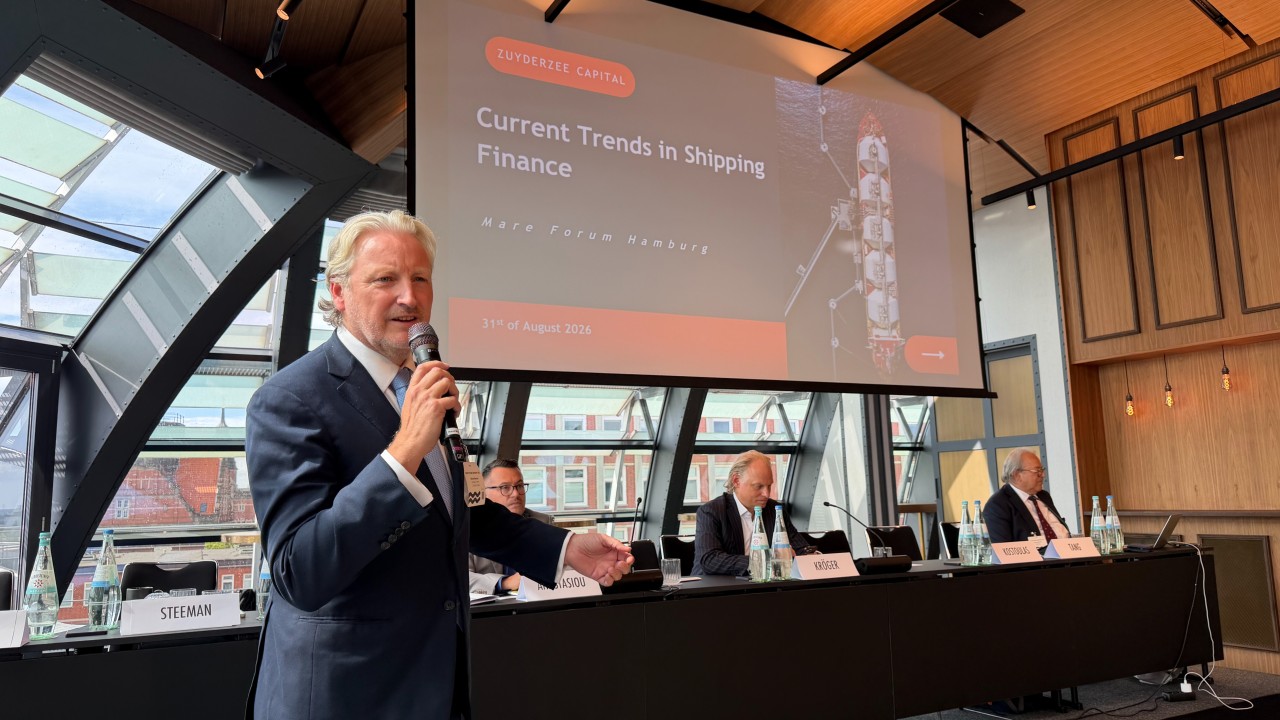
That was the central message from the ship-finance panel at the inaugural Mare Forum Germany in Hamburg. The session, titled “Money Talks: Capital Providers, Investments, Funds, Subsidies, Regulation,” brought together European banks, private-credit managers, export credit specialists, shipping advisers and representatives of the wider maritime industry.
The panel covered almost every major source of maritime capital: corporate bank debt, non-recourse asset finance, private credit, export credit agency support and Chinese leasing. By the end of the discussion, a clear picture had emerged. Ship finance remains abundant, but it is not evenly distributed. The institutions with the lowest cost of capital are competing fiercely for the same top-tier borrowers, while the projects most important to the industry’s future often remain difficult to finance.

Shipowners Are Taking Control of Loan Pricing
Michiel Steeman , Managing Partner of Zuyderzee Capital and moderator of the session, opened the discussion with data showing that loan pricing has fallen across several parts of the ship-finance market. This includes fully non-recourse asset-backed transactions, facilities for family-owned and medium-sized shipping companies, and corporate loans for large listed or privately owned groups.
The gap between pure vessel-backed financing and loans supported by a strong corporate balance sheet has also narrowed. High vessel values, low loan-to-value ratios, strong operating cash flows and a large supply of available capital have created a highly competitive lending environment.
Dr. Marco Albers , Managing Director and Head of Specialised Lending at DekaBank , argued that banks are no longer setting the price of many shipping loans. Cash-rich shipping companies are effectively dictating terms.
“Either you go with this trend or you are going to lose the business,” he said.
Current activity extends far beyond financing newbuilding deliveries. Shipping companies are restructuring their balance sheets, converting term loans into revolving credit facilities, extending maturities and demanding repricing from existing lenders. For banks that want to preserve long-standing client relationships, refusing these requests may mean losing the entire account.
Albers cited Frontline as an example. According to the company’s recently released second-quarter results, Frontline had refinanced and repriced approximately $2.5 billion of borrowings, reducing its average loan margin by 52 basis points within six months.
The transaction illustrates how leading shipowners are converting strong freight markets, high asset values and substantial liquidity into lower financing costs. Banks, however, may have to carry those low-margin loans through the next shipping downturn.
Michael de Visser , Managing Director and Head of Credit Investments at Seahawk Investments GmbH , described the large-corporate lending market as a “red ocean” characterised by cut-throat competition. The immediate credit metrics may appear highly attractive, but today’s low risk-weighted assets partly reflect unusually strong market conditions.

When vessel values are high, loan-to-value ratios remain low. When shipping companies are cash-rich, probabilities of default also appear limited. Both factors reduce the regulatory capital banks must allocate against their shipping portfolios.
A market correction could reverse those conditions. Vessel values may fall, leverage ratios may increase, borrower credit profiles may weaken and risk-weighted assets may rise. The interest margins on existing loans, however, will remain locked at the levels negotiated during the market peak.
The result could be a sharp deterioration in banks’ return on regulatory capital.
Banks May Be Accumulating Low-Return Cyclical Risk
De Visser, who previously worked in banking, warned that rising risk-weighted assets could eventually force banks to stop originating new loans or sell existing shipping exposure to release capital. Previous shipping cycles have repeatedly shown that banks often expand most aggressively when asset values are high and apparent credit risk is low, only to withdraw when markets weaken and shipowners need liquidity most.
Jens Dose, Director and Head of Shipping at Hamburg-based M.M.Warburg & CO, highlighted another side of the market. M.M.Warburg is a smaller specialist lender with a limited balance sheet. It primarily serves existing clients and established counterparties, while also providing operating accounts and related services to alternative lenders.
Dose said some private-equity-backed lenders continue to seek double-digit returns from ship finance. Yet as competition has increased and margins have declined, it has become harder to achieve those returns while maintaining high credit quality. In some cases, return expectations are pushing lenders towards weaker borrowers or more aggressive structures.
Traditional banks retain one important advantage: lending does not have to be their only source of revenue. They may also provide treasury products, payment services, operating accounts and other financial services. A smaller relationship bank can therefore step away from unattractive lending opportunities and continue serving the client in other areas.
Larger ship-finance banks face a more difficult balance. They must protect client relationships and market share while complying with increasingly strict European capital and prudential requirements. When major shipowners demand another repricing, the bank must choose between accepting a lower return or potentially losing a strategically important customer.
De Visser argued that lenders should sometimes “sit on their hands,” reduce their books and preserve capital for the next market correction. Private debt may be better positioned to act counter-cyclically because it is driven mainly by absolute returns and downside protection, rather than by the regulatory calculation of risk-weighted assets.
Private Credit Is Filling the Gap, but Scaling Remains Difficult
The expansion of private credit is closely linked to the retreat of traditional banks from parts of the shipping market. Many owners do not have the corporate balance sheets required by large international lenders. Their vessels may also be older than the preferred age limits of those institutions.
Private lenders can accept more complex ownership structures, higher vessel ages and transactions that do not fit standard bank criteria. Their returns may combine loan margins, upfront fees and other sources of income. De Visser noted that private-credit pricing is not confined to a single range such as 250 to 375 basis points over the reference rate. Returns vary significantly according to geography, asset type, vessel age and transaction risk.
Private lenders also argue that shipping volatility does not automatically translate into equally volatile loan performance. Risk can be reduced through conservative loan-to-value ratios, scheduled amortisation, financial covenants and diversification across borrowers, vessels and market segments. A shipping loan portfolio supported by physical assets and structured with sufficient downside protection can generate relatively resilient cash returns.
The Dutch market has produced several private ship-finance initiatives in recent years, including PROW Capital, Nesec and Direct Ship Finance. However, Steeman observed that their actual lending volumes have generally remained below some of the ambitions announced when those platforms were launched.
This demonstrates the continuing difficulty of scaling private ship finance. Investors must understand shipping cycles, vessel valuations and maritime enforcement procedures. Individual transactions are often relatively large and illiquid, while fundraising cycles do not always coincide with the moments when shipowners need capital.
Private credit can fill important gaps left by banks, but it cannot rapidly reproduce the scale or funding cost of a large deposit-funded banking system. Its strongest role may emerge during downturns, when bank capital becomes constrained, lending margins widen and asset values offer greater downside protection.
Chinese Leasing Has Become a $150 Billion Funding Pool
One of the most significant figures presented during the discussion came from Jerzy Majewski, Director at NorthCape AS. He estimated that Chinese ship-leasing institutions now hold a combined maritime portfolio of around $150 billion, making Chinese leasing the world’s second-largest pool of ship-finance capital after European shipping banks.
Majewski said there are approximately 25 Chinese lessors active in the market. They vary considerably in ownership, strategy, pricing and risk appetite and should not be treated as a homogeneous group.
Some Chinese leasing companies compete directly with major European banks and can offer pricing close to 100 basis points over the reference rate. Others operate further along the risk spectrum and may price transactions closer to 3%. The market includes recourse, limited-recourse and vessel-based structures. Most major lessors are connected to state-owned banks or large financial groups, although some relatively independent platforms also exist.
Chinese leasing initially expanded in response to the financing gap left by European commercial banks after the global financial crisis. It also supported the growth of China’s shipbuilding industry by providing financing to international owners ordering vessels from Chinese yards.
Over roughly 15 years, this combination of industrial capacity and financial support transformed Chinese leasing from a predominantly domestic shipbuilding instrument into a major source of international maritime capital. Chinese lessors increasingly finance owners and vessels outside the traditional China-linked transaction structure, although China-built ships may still have access to a broader range of financing options.
The model illustrates a capability that Europe is gradually losing: the ability to coordinate shipbuilding capacity, financial capital and long-term industrial objectives within one system. Europe retains deep maritime expertise, experienced lenders, export credit agencies and sophisticated capital markets. Its financing resources, however, are distributed across institutions operating under different regulatory, commercial and national priorities.
Chinese leasing still faces important tests. Much of its rapid expansion occurred during an improving shipping market characterised by strong earnings and rising vessel values. The combined portfolio has not yet passed through a full-scale shipping downturn.
Leasing structures also require careful consideration of legal ownership, cross-border enforcement, residual-value exposure and geopolitical risk. Majewski noted that concerns surrounding measures associated with the Office of the United States Trade Representative had already encouraged some owners to refinance Chinese leasing arrangements. Greek banks were among the institutions taking over parts of that exposure.
The growth of Chinese leasing therefore reflects both structural strength and emerging risk. Its scale demonstrates the power of coordinated industrial finance, while the next shipping downturn will test underwriting standards, portfolio concentration and residual-value assumptions across the sector.
Export Credit Agencies Are Again Becoming Strategic
Export credit agencies are also returning to the centre of shipping and shipbuilding finance.
Heleen Quint, Senior Export Credit Specialist at Atradius Dutch State Business, explained that greener and more technologically advanced ships are generally more expensive to build. Yet a shipyard’s commercial-bank guarantee capacity does not automatically increase in line with the contract value.
Shipyards must provide refund guarantees to shipowners and maintain sufficient working capital throughout construction. An ECA can support the commercial bank issuing those guarantees, allowing the yard to accept larger or more expensive contracts without exhausting its available banking lines.
ECAs can also insure the payment risk attached to shipowner loans. Where a project contains sufficient national economic content and meets sustainability requirements, the government-backed guarantee can improve credit quality, reduce the lender’s risk and potentially lower the owner’s financing cost.
Quint argued that unilateral European restraint would be commercially damaging while ECAs in competing shipbuilding countries continue to support their domestic yards. European shipbuilders retain capabilities in specialised vessels, energy-efficient designs and advanced green technologies, but those strengths must be accompanied by competitive financing.
Steeman challenged whether public credit support should be used for owners that could obtain normal commercial finance. He referred to transactions involving Canadian and UK owners receiving financing supported by Korea’s K-Sure, even though the borrowers appeared capable of accessing competitive bank loans without an ECA guarantee.
Such cases raise a difficult policy question. Public credit may be addressing a genuine market failure in one transaction, while simply reducing financing costs for an already-bankable owner in another. It can also result in taxpayers from one country supporting a foreign shipowner purchasing from an overseas shipyard.
Quint’s response reflected the realities of global shipbuilding competition. As long as other countries use export credit to support their yards, it would be unwise for Europe to withdraw unilaterally.
The debate shows how far ECAs have moved beyond their traditional role as providers of export-risk insurance. They are increasingly part of national shipbuilding strategies, green industrial policies and international competition for newbuilding orders. The challenge is to concentrate public guarantees on projects where private capital genuinely cannot absorb the risk, including first-of-a-kind technologies, smaller owners and strategically important industrial capacity.
The Poseidon Principles Are “Standing Alone in the Rain”
The sharpest differences during the panel emerged around green finance and the Poseidon Principles.
Tanja Georg, Director and Team Head of Origination and Structuring at KfW IPEX-Bank, argued that the Poseidon Principles have already integrated climate considerations into shipping banks’ lending decisions. Participating institutions are likely to favour greener vessels and ships capable of following a credible decarbonisation pathway, partly to manage reputational exposure and comply with their own climate targets.
The initiative also creates transparency by collecting emissions data across financed fleets. That information can show lenders and policymakers which technologies are becoming financeable and where additional regulation or public support remains necessary.
Jan-Henrik Hübner, DNV’s Global Head of Shipping Advisory Maritime, offered a more cautious assessment of the results.
The Poseidon Principles had a genuine impact when they were launched in 2019. Their use of the Annual Efficiency Ratio placed lenders ahead of international regulation, while the International Maritime Organization had yet to establish an equivalent operational carbon-intensity framework. Elements of that approach were subsequently reflected in the IMO’s Carbon Intensity Indicator.
DNV now supports roughly half of the Poseidon banks with reporting, giving it insight into the development of their portfolios. According to Hübner, the carbon intensity of financed fleets is typically improving by around 2% to 3% per year. The required decarbonisation trajectories, however, are falling by at least 4% annually.
The gap is therefore widening.
Looking across a full loan tenor, Hübner said DNV sees very few newbuilding projects that can credibly remain aligned with the Poseidon trajectories around 2034 or 2035. The problem extends beyond vessel technology. Alternative-fuel supply, green-premium sharing, long-term charter support and regulatory price signals have not developed at sufficient scale.
Hübner pointed to green-freight initiatives such as the Zero Emission Maritime Buyers Alliance. Such programmes are positive, but the volumes involved represent only about 0.1% of global container shipping. Even a rapid expansion from that base would remain insufficient to transform financing conditions across the wider fleet.
Banks are consequently being asked to move their loan portfolios along increasingly demanding decarbonisation pathways without receiving equivalent support from fuel markets, cargo owners or regulators. Hübner described them as being left “standing alone in the rain”.
Steeman suggested that the European Central Bank could provide capital relief for loan portfolios aligned with the Poseidon Principles. At present, a bank financing a greener vessel may have to apply capital calculations similar to those used for a conventional-fuel ship, even when the green project carries higher construction costs and additional technology risk.
Banks cannot absorb venture-capital-style risk while lending at conventional bank margins. Capital relief, public guarantees or other risk-sharing instruments could improve the economics of green lending and turn climate alignment from a disclosure requirement into a financing incentive.
Capital Is Abundant, but Bankable Green Projects Are Scarce
Gust Biesbroeck, Partner at PROW Capital, stressed that shipping’s decarbonisation trend will continue regardless of short-term regulatory delays. European banks have already incorporated ESG considerations into their internal strategies. The financing market must therefore match different types of capital with different borrowers and projects—“horses for courses”.
Large shipping groups can combine corporate bank loans, revolving credit facilities, bonds, leasing and ECA-backed financing. Smaller owners face a much more difficult environment. They have fewer vessels, more limited management resources and often older fleets, while still having to comply with increasingly complex environmental rules.
Boy Sleddering, CEO of Navaris, gave perhaps the clearest summary of the entire discussion.
“There is no lack of capital, but there is a lack of bankable projects,” he said.
Even where capital is theoretically available, smaller and medium-sized owners may struggle to reach it. Banks cannot be expected to take venture-capital risk at ordinary bank-loan pricing. Shipowners, charterers, cargo interests, technology providers, fuel suppliers and governments must share responsibility across the value chain.
A project may have a strong emissions-reduction case and still fail a bank’s credit assessment. Without long-term fuel supply, contractual support from charterers, clear regulations and an identifiable path to recovering the green premium, future cash flows remain uncertain.
This produces a deadlock. Shipowners want affordable long-term funding. Banks require predictable cash flows and proven technology. Cargo owners hesitate to commit to long-term green premiums, while fuel suppliers need dependable demand before investing in production and infrastructure.
Each participant waits for another part of the value chain to absorb the first loss or take the initial commercial risk. The result is a market in which capital is abundant, yet many of the projects required for the energy transition remain unfinanceable.
A Ship Needs Different Capital at Different Stages of Its Life
The transition debate must also account for the existing fleet.
Dose noted that disruptions to global trade are lengthening voyages and increasing tonne-mile demand. The industry still needs many vessels already in service, including ships between ten and 15 years old. Owners of those vessels often seek financing for another several years of operation, even though large banks and some leasing companies increasingly prefer younger tonnage.
An abrupt withdrawal of finance from middle-aged vessels could force economically useful ships out of service too early. Demolition and replacement construction also have environmental footprints. Extending a vessel’s working life can remain economically and environmentally rational when the ship is properly maintained, technically efficient and compliant with applicable regulations.
De Visser recalled a former client who divided a ship’s 20-year economic life among several sources of finance. A newbuilding could initially be financed in Asia for seven or eight years, then refinanced through a large European bank, followed by a smaller European lender and, at a later stage, private debt.
The example illustrates how ship finance functions as a multi-layered ecosystem. Different providers accept different vessel ages, borrower profiles, structures and levels of risk. Banks, Chinese lessors, ECAs and private-credit funds compete in some areas, but they also finance different stages of the same asset’s life.
Green-finance policy must therefore extend beyond zero-emission newbuildings. Existing-vessel retrofits, efficiency improvements and transitional financing for middle-aged ships will be essential. Many smaller owners cannot immediately order expensive alternative-fuel vessels. Their practical decarbonisation pathway may involve propulsion optimisation, energy-saving devices, wind-assisted systems, shore-power capability and digital efficiency management.
A green-finance system focused overwhelmingly on large newbuilding programmes risks concentrating capital among the biggest shipowners while leaving much of the existing fleet without a credible transition pathway.
Europe’s Competitiveness Will Depend on How It Organises Capital
Europe still has the world’s deepest ship-finance ecosystem. Its banks, export credit agencies, advisers, insurers, lawyers and asset managers possess extensive maritime expertise. Yet European bank shipping portfolios continue to shrink as Chinese leasing, Asian banks and alternative lenders take a larger share of the market.
The pressure reflects higher capital costs and stricter regulation, but also a lack of coordination between finance, shipbuilding and industrial policy.
A more effective system would allocate capital according to the characteristics of each project. Traditional banks can continue serving strong credits and proven technologies. Private debt can cover smaller owners, older vessels and more complex structures. ECAs and public funds can absorb part of the risk attached to first-of-a-kind green projects and strategically important industrial capacity. Regulators can introduce capital incentives that improve the risk-return profile of qualified green assets. Charterers, cargo owners and fuel suppliers can contribute long-term contracts that make future cash flows more predictable.
China’s estimated $150 billion leasing portfolio demonstrates that financial capacity has become an important component of both shipbuilding and shipping competitiveness. The continued success of Chinese yards reflects not only cost, capacity and delivery performance, but also the supporting network of leasing companies, banks and export credit institutions.
Chinese financial institutions must nevertheless remain disciplined. A portfolio built during a period of high vessel values and strong shipping cash flows may behave differently in a prolonged downturn. Credit concentration, residual values, borrower quality and geopolitical exposure will all require close management.
Global ship finance is entering a period in which capital is plentiful but increasingly selective. The strongest shipowners can borrow on terms that would have been difficult to imagine a decade ago. Smaller owners and green projects, meanwhile, are still searching for the first layer of long-term capital capable of carrying technology and policy risk.
The competitive advantage will belong to the countries and maritime clusters that can organise banks, leasing companies, ECAs, private capital, shipyards and energy suppliers into a coherent financing system.
The money is already available. The decisive question is how effectively the industry can direct it towards fleet renewal, existing-vessel upgrades and the technologies required for shipping’s transition.


READ MORE
 Finance
Shanghai links safety records to RMB5m maritime loan
 Finance
“We Are Buying Ships”: NORDEN Raises 2026 Profit Guidance for the Fourth Time
 Finance
Cetus Maritime Advances Oslo IPO Plans with $133.6 Million Seacon Deal
 Finance
Financing Above 90%: Why Abundant Capital Is Making Shipping Lenders Wary
 Finance
Overtaken by Shanghai, How Can London Keep Shipowners and Capital?
 Finance
Shipowners Have Made a Fortune. How Will They Spend It?
 Finance
HEIDMAR - Scaling for Growth: Capitalizing on Favorable Market
 Finance
Shipping’s Risk Equation Is Being Repriced as Finance, Insurance and Contracts Adapt
 Finance
Shandong Shipping and OSM Thome Form Singapore JV
 Finance