


Hengli Heavy Industries Posts RMB 23.5bn Revenue and RMB 3.6bn Net Profit as H1 Orders Reach 207 Ships
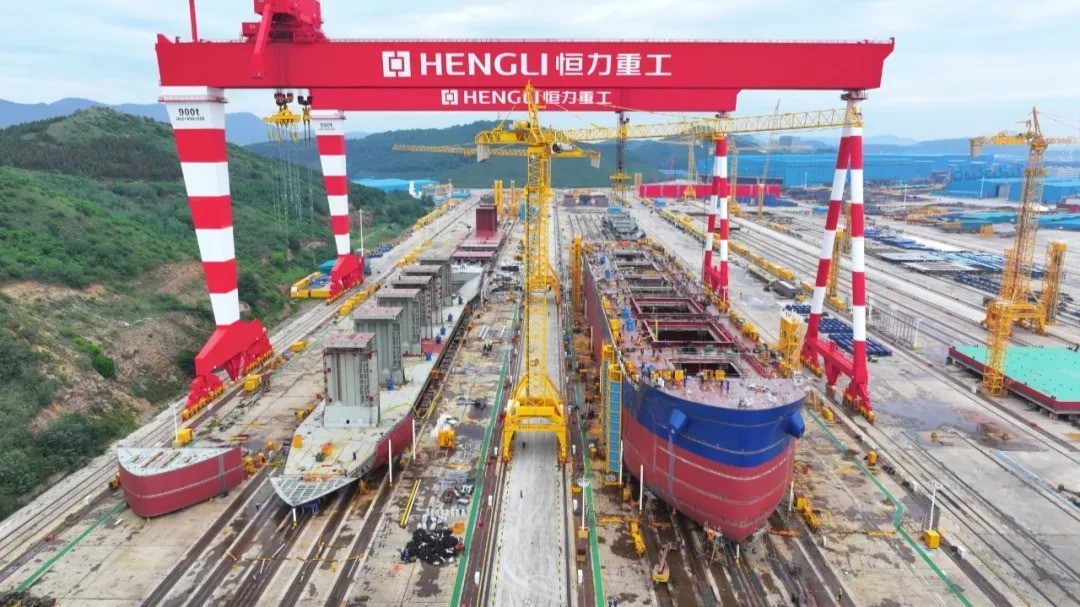
Hengli Heavy Industries’ rapidly expanding orderbook is translating into revenue, profit and cash flow at an accelerating pace.
Shanghai-listed Songfa Co. (603268.SH), whose core operating business is now Hengli Heavy Industries, reported revenue of RMB 23.50bn for the first half of 2026, up 251.87% year on year. Profit before tax increased 394.90% to RMB 4.34bn, while net profit attributable to shareholders surged 457.67% to RMB 3.61bn. Net profit excluding non-recurring items reached RMB 3.51bn, almost 30 times the adjusted figure recorded a year earlier.
The interim report provides the clearest picture yet of how Hengli’s rapid growth in new orders is moving through construction, delivery, earnings and capacity expansion.
Profit growth outpaces revenue as margins improve
The quality of earnings was one of the strongest features of the results. Adjusted net profit accounted for approximately 97.4% of attributable net profit, indicating that non-recurring items made only a limited contribution.
Based on the revenue and cost figures disclosed in the report, Hengli’s overall gross margin increased from approximately 20.89% to 23.66%, an improvement of 2.77 percentage points. The gross margin of its core operations rose more sharply, from around 18.66% to 22.52%. Revenue therefore expanded faster than costs as series construction, a higher-value vessel mix and greater utilisation of production facilities began to support profitability.
The year-on-year comparison requires one accounting qualification. Following a business combination under common control, Songfa retrospectively adjusted its figures for the first half of 2025. The reported revenue and profit growth rates are therefore based on adjusted comparative figures rather than being caused simply by the timing of Hengli’s consolidation into the listed company. Songfa nevertheless noted that the restated prior-period figures had not been audited.
Shipbuilding revenue should also be viewed in the context of accounting for construction progress. For eligible contracts, the company recognises revenue over time using an input method based on costs incurred as a proportion of estimated total costs. The RMB 23.50bn reported in the first half consequently reflects both the 40 vessels delivered during the period and the construction progress achieved across a much larger group of ships still on the building berths and in the docks.

New orders reach 207 ships, led by tankers and containerships
Hengli secured 207 new ship orders during the first six months of 2026, far exceeding the 115 vessels contracted during the whole of 2025.
The total comprised 94 tankers, 56 containerships, 49 bulk carriers and eight very large ammonia carriers. Tankers represented approximately 45.4% of the total, while containerships accounted for 27.1%. Combined, the two higher-value segments contributed 150 vessels, or about 72.5% of all new orders.
The figures show how far Hengli’s product portfolio has expanded since the shipyard resumed operations. Its early recovery was driven largely by Kamsarmax bulk carrier contracts. The current orderbook now covers VLCCs, Suezmax tankers, LR2 product tankers, medium and large containerships, Capesize and Kamsarmax bulkers, and VLACs.
This broader mix will shape the yard’s revenue and profitability for several years. Large tankers, containerships and gas carriers command higher contract values and require more complex engineering, while series orders allow the yard to benefit from standardised designs, bulk purchasing and repeat production. Hengli’s delivery schedule now extends into 2030, and the company says its VLCC orderbook is the largest held by any individual shipyard worldwide.
Production has accelerated alongside contracting activity. Hengli delivered 40 ships during the first half. Major milestones included four VLCCs leaving the same dock, six large vessels undocking on a single day, seven ships launched within one week in April, and the simultaneous naming and delivery of two VLCCs in June. The yard also launched a 93,000-cbm VLAC from a slipway, demonstrating a production method normally associated with less complex vessel types.
Parallel construction and concentrated undocking are becoming central to Hengli’s operating model. With several hundred ships contracted, the yard’s ability to maintain a stable production rhythm will determine how quickly its orderbook can be converted into revenue and cash.
Operating cash flow turns strongly positive as capital expenditure rises
Operating cash flow improved substantially. Net cash generated from operations reached RMB 8.51bn, compared with an outflow of RMB 202m in the first half of 2025. Songfa attributed the change to the higher number of ships under construction and delivered, together with stronger customer collections.
Contract liabilities, which largely represent advance and progress payments received from shipowners, more than doubled from RMB 5.35bn at the end of 2025 to RMB 12.04bn at the end of June. These payments are providing an important source of funding for the yard’s intensive construction programme.
The same expansion is visible across the working-capital accounts. Prepayments increased 133.10% to RMB 7.96bn, while contract assets rose 34.36% to RMB 13.95bn. Notes payable reached RMB 6.11bn and accounts payable RMB 8.82bn. The movements show that a large number of projects have entered procurement, block construction and active performance stages, sharply increasing financial flows among Hengli, shipowners, equipment suppliers, steel providers and contractors.
Capacity expansion is absorbing substantial capital at the same time. Investing activities produced a net cash outflow of RMB 10.13bn during the first half, mainly because of project construction and other capital expenditure. Construction in progress increased from RMB 1.52bn at the beginning of the year to RMB 8.75bn at the end of June. The green and intelligent high-end shipbuilding and supporting facilities project alone had a carrying value of approximately RMB 6.10bn and was 48.02% complete against its budget.
Hengli says it now has annual steel-processing capacity of approximately 3m tonnes, four very large building docks and major slipway capacity. Its engine assembly facilities are designed to produce 180 marine engines annually and cover LNG, LPG, methanol and ammonia dual-fuel technologies. Delivery of the Hengli 8G95 LNG dual-fuel engine indicates that its machinery strategy is progressing from capacity construction into commercial production.
Three-year profit commitment already covered, but leverage remains high
Under the performance compensation agreement signed during Songfa’s restructuring, Hengli committed to generating cumulative adjusted attributable net profit of at least RMB 4.8bn between 2025 and 2027.
Hengli reported RMB 2.58bn of adjusted attributable net profit on a consolidated basis in 2025, followed by RMB 3.52bn in the first half of 2026. On a simple cumulative basis, it has therefore generated approximately RMB 6.10bn in 18 months, equivalent to 127.1% of the entire three-year commitment. Final fulfilment will still be subject to a special review by a qualified accounting firm after the compensation period ends.
The speed of expansion is also placing pressure on the balance sheet. Total assets increased to RMB 74.61bn, while equity attributable to shareholders reached RMB 13.06bn. Total liabilities stood at RMB 61.55bn, producing a liabilities-to-assets ratio of approximately 82.50%, compared with about 80.87% at the end of 2025.
Short-term borrowings rose 80% to RMB 10.60bn and long-term borrowings increased 94.89% to RMB 7.10bn. Finance costs nearly tripled to RMB 665m. A significant part of Hengli’s liabilities consists of customer progress payments rather than conventional financial debt, so the headline leverage ratio should not be interpreted entirely as bank borrowing. The rapid increase in loans and financing expenses nevertheless reflects the funding cost of building a much larger industrial platform.
Hengli has demonstrated its ability to win large series orders, start projects quickly and release shipbuilding capacity at scale. The durability of its earnings will increasingly depend on execution: delivering several hundred vessels on schedule, maintaining margins on higher-value ship types, bringing major expansion projects into operation as planned, and ensuring that its workforce, subcontractors and supply chain can keep pace with the production programme.
Revenue of RMB 23.50bn and net profit of RMB 3.61bn in six months place Hengli firmly within the operating scale of the world’s major diversified shipbuilders. Its next phase of growth will be determined by delivery performance, cost control and cash-flow management as much as by the size of its orderbook.
Source: Songfa Co. 2026 interim report and related 2025 annual report disclosures.

READ MORE
 Finance
“We Are Buying Ships”: NORDEN Raises 2026 Profit Guidance for the Fourth Time
 Finance
Cetus Maritime Advances Oslo IPO Plans with $133.6 Million Seacon Deal
 Finance
Overtaken by Shanghai, How Can London Keep Shipowners and Capital?
 Finance
Shanghai links safety records to RMB5m maritime loan
 Finance
Shipowners Have Made a Fortune. How Will They Spend It?
 Finance
HEIDMAR - Scaling for Growth: Capitalizing on Favorable Market
 Finance
Shipping’s Risk Equation Is Being Repriced as Finance, Insurance and Contracts Adapt
 Finance
Shandong Shipping and OSM Thome Form Singapore JV
 Finance
From RMB 1.87 Billion to RMB 4.55 Billion: What Changed at COSCO Shipping Energy in One Year?
 Finance