


NVIDIA Enters Shipbuilding: Kawasaki Brings Physical AI to the Shipyard
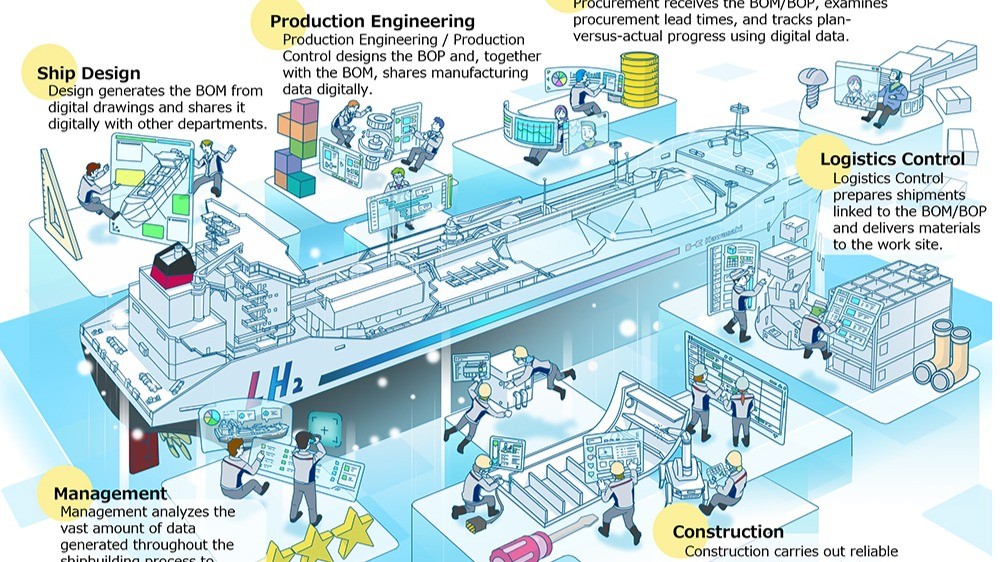

A new collaboration at Kawasaki Heavy Industries’ Sakaide Works shows how NVIDIA’s digital twins, robotics platforms and physical AI technologies could begin reshaping one of the world’s most complex manufacturing industries.
NVIDIA is moving into shipbuilding.
On July 16, Kawasaki Heavy Industries announced a collaboration with the US technology company to develop what it calls a “next-generation digital shipyard” at its Sakaide Works in Kagawa Prefecture, one of Kawasaki’s principal commercial shipbuilding facilities in Japan.
The significance of the project extends well beyond the introduction of another software platform into a shipyard. Kawasaki intends to combine ship design data, production information, digital twins, artificial intelligence and robotics within a continuous manufacturing system covering commercial ship design, procurement, construction and quality management.
NVIDIA will provide a physical AI technology stack that includes Omniverse, Isaac, Cosmos, Metropolis and Jetson. Kawasaki will contribute shipbuilding data, production knowledge and its own experience in robotics and large-scale industrial manufacturing.
The two companies aim to train and validate robots inside a virtual shipyard before deploying them in real production environments. Welding, painting, inspection and material handling are among the first shipbuilding processes being considered.
If the concept works as planned, the digital model of a shipyard will no longer serve mainly as a visualisation or planning tool. It will begin to influence how robots move, how production tasks are organised, how quality is assessed and how manufacturing decisions are made.
That is why NVIDIA’s entry into shipbuilding deserves attention.
From generative AI to physical AI
NVIDIA has become one of the central technology providers behind the global artificial intelligence boom. Its graphics processing units and computing platforms are widely used to train and operate large AI models.
The next stage of its expansion is increasingly focused on physical AI: systems that can perceive, understand and interact with the real world.
Shipbuilding provides one of the most demanding possible testing grounds.
Unlike an automotive assembly line, where similar products move through highly standardised workstations, a shipyard constructs extremely large and highly customised assets over long periods. The production environment changes continuously as steel blocks are assembled, equipment is installed and different trades enter and leave the worksite.
Workers and machinery must operate around curved steel surfaces, temporary structures, confined spaces, open areas and components that may vary from one vessel to another. Even ships belonging to the same series can be affected by design changes, equipment substitutions and differences in construction sequence.
Traditional industrial robots work best when their position, movement and operating conditions are predictable. A welding robot may perform efficiently on a standard production line, but shipbuilding often requires repeated programming, positioning and adjustment whenever the hull structure or weld location changes.
Kawasaki and NVIDIA are attempting to reduce that limitation by placing the shipyard inside a high-fidelity virtual environment.
Through NVIDIA Omniverse and Isaac, engineers can create digital representations of hull structures, equipment, workers, materials and robots. Robot paths can be generated and tested before machinery enters the actual work area. Potential collisions with steel structures, scaffolding or other equipment can be identified in advance.
Different operating positions and construction sequences can also be evaluated virtually. Once a task has been trained and validated, the resulting programme can be transferred to the physical robot.
Data generated during actual welding, painting, inspection or material-handling operations can then be returned to the digital environment. This creates a continuous loop connecting simulation, training, deployment, inspection and improvement.
The objective is not simply to automate one weld or one production line. It is to make robots more adaptable to the constantly changing conditions of ship construction.
A digital twin that participates in production
Kawasaki also plans to introduce agentic AI into commercial shipbuilding.
These AI systems could assist with design, procurement, manufacturing and quality management. When a design is changed, for example, an AI system could identify the affected materials, equipment, production tasks and inspection requirements.
Production schedules could also be adjusted according to the availability of docks, cranes, workshops, storage areas, personnel and materials.
For decades, the maritime industry has discussed digital twins primarily in relation to visualisation, monitoring and simulation. Kawasaki’s project points toward a more operational role.
The digital twin could gradually become the environment in which production activities are tested, organised and optimised before they take place in the physical shipyard. It could also provide the data foundation for robotic control and AI-assisted decision-making.
Kawasaki has said the project will begin with the identification of practical production challenges at the Sakaide Works. Technologies will be introduced and verified in stages before the company considers expanding them to other manufacturing sites handling large structures.
This remains a development and validation programme rather than a completed autonomous shipyard. Nevertheless, the direction is clear: digital shipbuilding is moving from showing what is happening inside a yard to helping determine what should happen next.
Building a data chain across the vessel’s life
The collaboration also extends beyond vessel construction.
Kawasaki plans to explore how data collected during design and construction can be used after delivery in vessel operation, maintenance, repair and conversion.
A modern ship produces extensive information before it ever enters service. Design specifications, equipment parameters, installation records, commissioning results, inspection findings and maintenance requirements are all generated during construction.
Much of this information, however, remains fragmented across different systems and organisations.
Connecting shipyard data with the systems used by shipowners, managers, equipment suppliers and repair yards could create a more continuous information chain across the vessel’s lifecycle.
A digitally delivered ship could arrive with structured records covering installed equipment, testing results, recommended maintenance, spare parts and future modification requirements. This could support maintenance planning, fault diagnosis and conversion projects throughout the vessel’s operating life.
For NVIDIA, this represents an opportunity extending far beyond robot simulation. Shipbuilding could become an entry point into a much broader maritime data ecosystem covering construction, operation and asset management.
Japan’s labour challenge accelerates automation
The project also reflects structural pressures facing Japanese shipbuilding.
Shipyards are dealing with an ageing workforce, difficulties recruiting skilled personnel and the loss of experienced workers. Welding, painting and material handling are physically demanding, while many tasks must be performed at height, in confined spaces or in environments involving heat, dust and hazardous substances.
Kawasaki has identified labour supplementation and productivity improvement as important objectives of its robotics programmes.
In a separate project involving Shin Kurushima Dockyard and Namura Shipbuilding, Kawasaki is developing legged and wheeled AI robots for welding, painting and quality confirmation around external hull blocks. The programme is intended to support autonomous movement and operation in open, elevated and curved working environments.
The official project description does not define the programme simply as a four-legged welding robot. Its scope is broader, covering legged and wheeled robotic systems capable of working around large ship structures.
These machines are unlikely to produce fully unmanned shipyards in the near term. Ship construction still involves manufacturing tolerances, temporary adjustments, space constraints and non-standard tasks that require experienced human judgement.
Robots will initially be more effective in repetitive, hazardous and clearly defined operations. Skilled workers will remain essential for complex fitting, troubleshooting, quality decisions and coordination between different production activities.
The nature of shipyard employment, however, is likely to change.
A welder may spend less time directly completing standard welds and more time setting parameters, checking robot paths and dealing with unusual joints. Painting personnel may supervise automated equipment and carry out local repairs. Inspectors may increasingly work with three-dimensional models, machine vision and laser-scanning data.
This transition will create demand for workers who understand both shipbuilding processes and digital systems. Robot commissioning, automation maintenance, digital production engineering and quality-data analysis are likely to become more important shipyard functions.
Shipbuilding becomes a new AI battleground
Kawasaki is not the only shipbuilder exploring NVIDIA’s technology.
South Korean shipbuilders and technology companies have also begun testing digital twins, humanoid robots and physical AI platforms in shipyard environments.
NdotLight and AeiROBOT have disclosed work connected with a humanoid-robot validation project for Hanwha Ocean. NdotLight is using NVIDIA Omniverse and Isaac Sim to create digital shipyard environments and simulation infrastructure, while AeiROBOT is testing its ALICE humanoid robot in activities such as heavy-material handling, autonomous movement, obstacle avoidance and tool operation.
The companies are members of the NVIDIA Inception ecosystem, although this should not be interpreted as meaning the shipyard project itself was formally commissioned by NVIDIA’s startup programme.
HD Hyundai has also been reported to be using NVIDIA Isaac Sim in the development of shipbuilding robots for processes including welding, painting and steel-plate forming. Public information on this programme has so far come mainly through Korean media rather than a dedicated corporate announcement, but it reinforces the same trend.
Robotics in shipbuilding is moving from remotely controlled or pre-programmed equipment towards machines capable of sensing their surroundings, planning tasks and operating with greater autonomy.
NVIDIA is positioning its technology at the centre of that transition.
China’s shipyards already have a strong digital foundation
China’s leading shipyards have spent years investing in digital design, automated production lines, intelligent logistics and smart manufacturing systems.
COSCO Shipping Heavy Industry subsidiaries have introduced portable welding robots, steel-profile robots, sub-assembly robots, intelligent pipe-processing lines and anti-corrosion robots. Dalian COSCO KHI has developed intelligent large-diameter pipe-processing capabilities, while Nantong COSCO KHI has worked on portable welding robots.
Shanghai Waigaoqiao Shipbuilding released its Digital Twin Shipyard 1.0 in November 2025. The platform can simulate block-storage positions, lifting routes, dock utilisation and berth planning, while mapping the status of workshops, storage yards, warehouses, equipment, logistics and personnel.
Chinese shipyards also have an important advantage in scale. Large orderbooks for container ships, bulk carriers, tankers and gas carriers provide repeated production scenarios in which new equipment and digital systems can be tested and improved.
The next challenge, however, is integration.
A shipyard may already have automated cutting lines, welding robots, digital warehouses and production-planning software, but these systems do not automatically form a unified intelligent factory.
Design models, bills of materials, process plans, procurement information, production records and quality data must remain connected around the same vessel throughout construction. Design changes must flow rapidly into purchasing, production and inspection tasks, while problems identified in the workshop must be fed back into engineering and process planning.
This is where the Kawasaki-NVIDIA model is particularly relevant.
Its central idea is not the acquisition of a single robot. It is the creation of a connected system in which the digital twin, AI agents, robot simulation and physical production operate as parts of the same data environment.
NVIDIA is entering a difficult industry at the right moment
Shipbuilding will not become fully autonomous simply because advanced AI platforms are available.
The industry’s complexity, production variability and safety requirements mean that implementation will be gradual. Digital models must accurately reflect physical shipyard conditions. Robots must operate safely around people and heavy structures. Data from different design, production and quality systems must be standardised and connected.
Shipyards will also need new rules for human-machine cooperation, equipment shutdown, fault handling and data governance.
Yet the timing of NVIDIA’s entry is important.
Shipbuilders in Japan and South Korea are under pressure to raise productivity amid labour shortages. Chinese shipyards are seeking to convert manufacturing scale into higher levels of efficiency, quality and technological capability. At the same time, increasingly complex vessels are generating more design, production and lifecycle data than traditional management systems can effectively use.
NVIDIA is entering shipbuilding as these pressures converge.
The Kawasaki project remains at an early stage, and its commercial impact will depend on how reliably virtual training can be transferred into real shipyard operations. But it marks an important shift in the industry’s digital transformation.
The next generation of shipyard competition will not be determined only by dock capacity, crane size, labour cost or the number of installed robots.
It will increasingly depend on whether design and production data can move through a unified system, whether robots can be trained and redeployed quickly, whether AI can make reliable decisions in changing physical environments, and whether workers can acquire the skills needed to supervise and improve these systems.
NVIDIA’s arrival suggests that shipbuilding is becoming a new frontier for physical AI.
The digital shipyard is beginning to move off the screen and onto the production floor.

READ MORE
 Shipbuilding
A New State-Owned Shipbuilding Group Is Born in China
 Shipbuilding
Breaking! Hengli Announces Deals for 52 Ultra-Large LNG Dual-Fuel Containerships
 Shipbuilding
Global Newbuilding Orderbook Matches 2008 Peak as Clarksons Flags Faster Fleet Growth
 Shipbuilding
Pavimar Returns to Newbuilding Market After a Decade With Four Hengli Kamsarmaxes
 Shipbuilding
COSCO SHIPPING Bulk Leads Order for 16 New 87,000-DWT Multipurpose Grain Carriers
 Shipbuilding
MISC Signs for Five More LNG Carriers at Hudong-Zhonghua
 Shipbuilding
Another Chinese Bridge Builder Moves Into Shipbuilding
 Shipbuilding
Amid China’s Shipbuilding Boom, a State-Owned Yard Quietly Enters Liquidation
 Shipbuilding
Yichang Changyun plans RMB120m inland bulker programme
 Shipbuilding