


Amid China’s Shipbuilding Boom, a State-Owned Yard Quietly Enters Liquidation
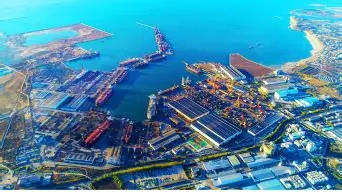

Shanhaiguan New Shipbuilding’s bankruptcy proceedings follow almost eight years of suspended operations. Historical disclosures reveal how terminated offshore rig contracts and heavy losses left the company struggling long before China’s latest shipbuilding boom.
Shanhaiguan New Shipbuilding Industry Co., Ltd., a state-owned shipbuilder in Qinhuangdao, northern China, is undergoing bankruptcy liquidation after suspending operations in October 2018.
Its administrator is seeking professional firms to audit the company and value its assets, while creditors face an October 20, 2026 deadline to file claims. The first creditors’ meeting is scheduled for November 5. The administrator has described the company as insolvent and unable to sustain operations.
The proceedings come as Chinese shipbuilding orders continue to expand. Yet the yard’s difficulties date back to an earlier offshore downturn, when four terminated drilling rig contracts left substantial capital tied up in equipment that required further investment to complete.
Its experience illustrates why an industry recovery may offer little immediate relief to a company burdened by unfinished projects, historical debt and years of inactivity.
Two companies with similar names
The company in liquidation, whose Chinese legal name is 山海关造船重工有限责任公司, must be distinguished from Shanhaiguan Shipbuilding Industry Co., Ltd. — 山海关船舶重工有限责任公司 — commonly known as SHGSIC.
They are separate legal entities with historical ownership links. A 2018 disclosure by Shanghai-listed China Shipbuilding Industry Co., Ltd., then known by its stock abbreviation China Heavy Industry, identified SHGSIC as a wholly owned subsidiary of Dalian Shipbuilding Industry Co., Ltd. and the holder of a 53.01% stake in the company now undergoing liquidation.
SHGSIC traces its origins to Shanhaiguan Shipyard, established in the 1970s. It continued to issue procurement notices in 2026, including for shiprepair management and information technology systems. The liquidation should therefore not be interpreted as the closure of the entire Shanhaiguan shipbuilding and repair operation.
The debtor company was incorporated on May 30, 2007, with registered capital of approximately RMB1.24 billion. Its ownership history spans centrally controlled state enterprises and provincial and municipal investors, making a simple description as a local government shipyard incomplete.
The administrator’s notices also identify share transfers that have not yet been reflected in corporate registration records, underscoring the need to distinguish registered shareholders from subsequent ownership arrangements.
Four rig contracts worth $872 million
The offshore projects provide an important explanation of the company’s financial difficulties.
In a December 2018 response to questions from the Shanghai Stock Exchange, China Heavy Industry disclosed that the owners had terminated contracts for four CJ50 jack-up drilling rigs being built by the yard. Their combined contract value was $872 million.
At that time, completing the rigs to a deliverable condition would have required another RMB966 million. The company said it had sought resale opportunities but had not found prospective buyers, citing the rigs’ high prices and highly customised specifications. These were assessments made in 2018, rather than statements about their present condition or value.
Jack-up rigs use legs resting on the seabed to elevate their hulls above the water for drilling operations. Their specialised equipment and operating requirements can make them harder to remarket than more standardised merchant ships.
For a builder, contract termination can create a difficult funding problem. Money already spent remains tied up in an unfinished asset; completing it requires additional capital; and securing a replacement customer may involve changes to equipment, specifications and price.
A large contract value consequently offers limited protection if payments stop before delivery. The commercial strength of an order depends on the customer’s ability to pay and the builder’s ability to convert construction milestones into cash.
The rig cancellations were a major historical setback. Public disclosures do not, however, establish them as the sole cause of the liquidation proceedings eight years later.
Financial distress was evident in 2018
The company’s balance sheet was already deeply impaired when production stopped.
An audited financial summary published in December 2018 showed assets of approximately RMB5.19 billion and liabilities of RMB6.68 billion as of October 31 that year, leaving negative net assets of about RMB1.49 billion.
It recorded a net loss of RMB745.2 million in 2017 and a further RMB226.6 million loss in the first ten months of 2018. These historical figures should not be treated as the liabilities or asset values being assessed in the current liquidation.
China Heavy Industry subsequently proposed transferring the 53.01% interest, alongside a stake in a separate offshore builder, to its controlling shareholder, China Shipbuilding Industry Corporation. The proposed zero-consideration transaction included debt-waiver and repayment arrangements covering both businesses.
An ownership transfer can change who bears financial exposure. It does not, by itself, produce buyers for unfinished equipment or provide the orders and working capital needed to restore production.
Asset values and creditor recoveries remain open
The court accepted a creditor’s liquidation petition on June 12, 2026. The case was taken over by the Qinhuangdao Intermediate People’s Court on July 10, and an administrator was appointed on August 12.
The subsequent recruitment of audit and valuation firms will help establish the company’s financial position and the value of assets available for disposal.
For an industrial business that has been inactive for years, historical expenditure and book value may differ substantially from achievable sale proceeds. Equipment condition, ownership, security interests, completion costs and buyer demand can all affect recoveries.
Past descriptions of docks, cranes and other facilities therefore cannot substitute for a verified inventory of the debtor’s assets.
The notices reviewed do not provide a complete current asset valuation, confirmed creditor claims or an expected recovery rate. They also do not establish that an investor has agreed to acquire the business or restart production.
A national boom cannot erase legacy problems
China’s Ministry of Industry and Information Technology reported that ship completions reached 36.5 million deadweight tonnes in the first half of 2026, up 51.2% year on year. New orders rose 173.1% to 121.06 million dwt, while the outstanding orderbook reached 363.25 million dwt at the end of June.
Those national figures describe expanding shipbuilding activity. They do not show that a long-idled offshore equipment builder can readily return to business.
Merchant ship demand and offshore drilling investment also follow different commercial drivers. More tanker or containership orders do not automatically create buyers for unfinished drilling rigs.
A restart requires functioning equipment, skilled personnel, suppliers, financing and credible delivery arrangements. Existing debt and unresolved project obligations may further complicate that process.
For shipbuilders, equipment suppliers and lenders, the case highlights the importance of customer credit, milestone payments and termination provisions, alongside technical capability and contract size. The ability to finance and remarket a project after cancellation can be critical to surviving a downturn.
For creditors in this case, the immediate priority is the October 20 claims deadline. The administrator’s notice permits supplementary filings before the distribution plan is submitted to the creditors’ meeting, but late claimants cannot demand additional payments from distributions already completed. English-language claim documents must also be accompanied by Chinese translations.
The forthcoming audit, valuation and creditors’ meeting should provide a clearer picture of what remains available for recovery — and how a business caught in an earlier offshore downturn will finally be wound down.


READ MORE
 Shipbuilding
Steel Giant Shagang Eyes Shipbuilding as a Booming Market Draws Industrial Capital
 Shipbuilding
Hengli Secures 12 Tanker Orders, Retaining World’s Largest VLCC Orderbook
 Shipbuilding
Hengli Signs 11 VLAC Contracts in One Week
 Shipbuilding
Yichang Changyun plans RMB120m inland bulker programme
 Shipbuilding
China ZWI Enters Ocean Shipping with VLGC Acquisition and Chemical Tanker Newbuild Project
 Shipbuilding
World’s First 325,000-DWT Methanol Dual-Fuel Ore Carrier Delivered
 Shipbuilding
CIMC Raffles Extends NOCC Car Carrier Programme to 2030
 Shipbuilding
Grimaldi Advances New ConRo and Multipurpose Projects as Fleet Renewal Continues
 Shipbuilding
COSCO Shipping Specialized Carriers Shifts Eight 60,000-DWT Heavy-Lift Ships from Chengxi to Dalian
 Shipbuilding