


Another Chinese Bridge Builder Moves Into Shipbuilding
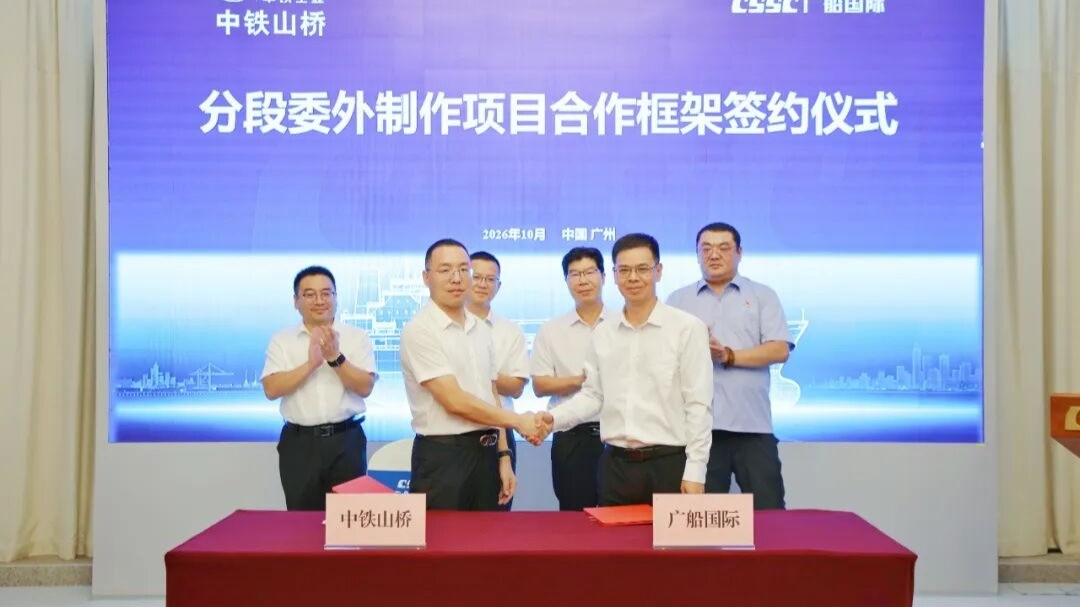

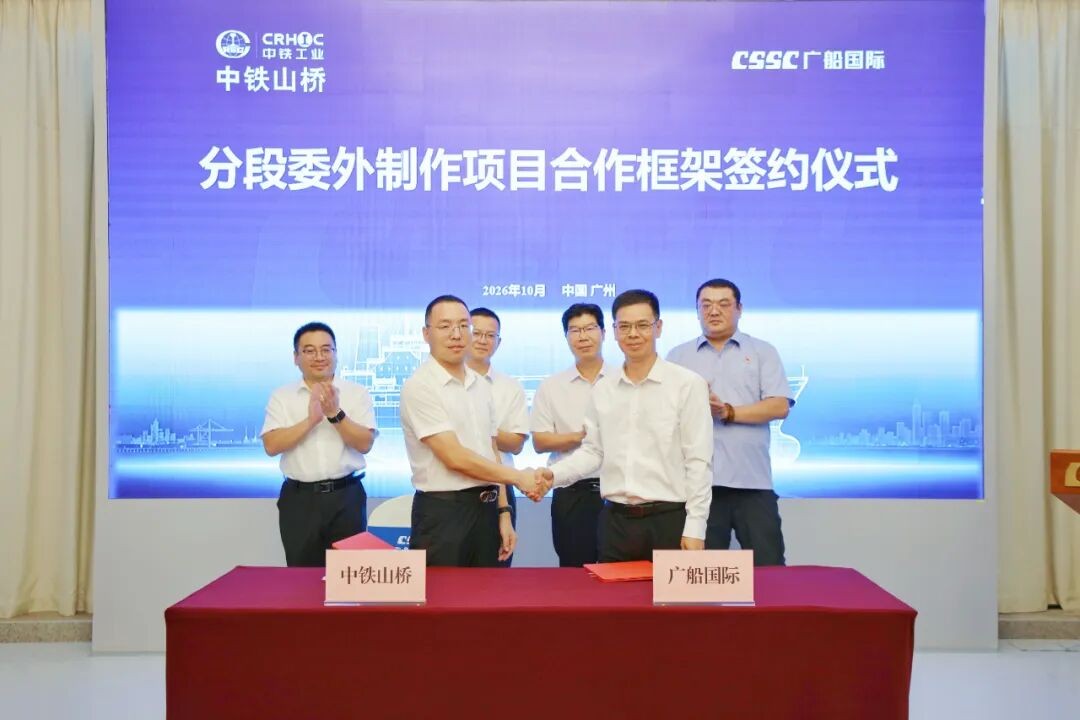
China Railway Shanhaiguan Bridge Group has signed a framework agreement with Guangzhou Shipyard International (GSI) covering outsourced ship-block fabrication, adding another major bridge manufacturer to China’s commercial shipbuilding supply chain.
The agreement, signed on 13 October 2026, brings together a steel-structure specialist with more than a century of manufacturing experience and a shipyard whose newbuilding commitments now extend into 2031. GSI, part of China State Shipbuilding Corporation (CSSC), expects its demand for hull blocks to rise over the coming years as its orderbook grows and its vessel portfolio develops.
The partnership follows two other moves this year. China Railway Baoji Bridge Group’s Yangzhou subsidiary began block fabrication for a 73,000 dwt deck carrier in June, while Jingjiang Heavy Industry started work on blocks for a 40,400 dwt bulk carrier in September. Together, the projects illustrate how established steel fabricators can enter shipbuilding through specific production packages, developing marine manufacturing capabilities alongside experienced shipyards.
A century of bridge manufacturing meets shipyard demand
In its announcement on 14 October, GSI said it was bringing in external manufacturing resources to meet growing production requirements. Shanhaiguan Bridge Group committed to allocating resources, meeting quality and safety requirements, and delivering against agreed schedules. The companies also intend to cooperate on manufacturing processes and technical development.
The framework announcement did not disclose the contract value, volume of blocks, vessels involved or the manufacturing site that would undertake the work.
Founded in 1894, Shanhaiguan Bridge Group is part of the listed China Railway Hi-tech Industry Corporation, within China Railway Group. Headquartered in Qinhuangdao, Hebei province, it also has manufacturing operations in locations including Nantong in Jiangsu and Zhongshan in Guangdong. Its portfolio includes work on the Hong Kong–Zhuhai–Macao Bridge, the Shenzhen–Zhongshan Link and Bangladesh’s Padma Bridge.
That experience provides a substantial industrial foundation for the partnership. Large bridge components require controlled cutting, assembly, welding, dimensional inspection, coating and heavy transport. Those capabilities can be adapted to ship-block production, provided the processes and quality arrangements meet the requirements of the vessel and the receiving shipyard.
For GSI, the attraction is access to an established manufacturing organisation with facilities, skilled workers and experience managing large structural projects. For Shanhaiguan, the agreement offers a route into marine fabrication through cooperation with an experienced shipbuilder.
Baoji Bridge Group already has a vessel project under way
China Railway Baoji Bridge Group, which also belongs to China Railway Hi-tech Industry, has already begun applying that model.
On 26 June, its Yangzhou subsidiary started hull-block production for a 73,000 dwt self-propelled deck carrier. The vessel measures 256 metres in length, 62 metres in breadth and 13.5 metres in depth. According to China Railway Group, the cargo-section hull structure comprises 11 rings and 110 blocks, with the largest individual block weighing approximately 190 tonnes.
The project brings several participants together. Jingjiang Nanyang Shipbuilding contributes construction planning and production coordination, while China Classification Society provides technical support and quality oversight. Baoji’s role centres on fabricating the specified hull blocks.
This gives the bridge manufacturer a defined production responsibility through which it can develop marine fabrication experience. Its existing heavy-steel facilities provide a starting point, while cooperation with shipbuilding specialists helps connect that capacity to vessel construction schedules and acceptance requirements.
Jingjiang sets its sights on complete vessels
Jingjiang Heavy Industry is pursuing a similar entry route, with a longer-term ambition to build complete ships.
The company, part of China Railway Construction Corporation’s bridge engineering business, began block fabrication for a 40,400 dwt bulk carrier on 9 September. The 179.9-metre vessel involves cargo-area blocks manufactured at Jingjiang and subsequently transported to a shipyard in Shanghai for assembly, according to local reporting.
Preparations included securing recognition from China Classification Society in December 2025, allocating 128,700 square metres for ship-block manufacturing and establishing three outdoor block-assembly lines. Supporting facilities include workshops, coating areas and material storage, with the production site located close to a heavy-cargo terminal.
Jingjiang’s background in bridge steelwork is therefore being combined with waterfront access and the surrounding shipbuilding industry. Management has outlined a progression from block fabrication to complete vessel construction, with smaller, higher-value ships as its intended focus.
The three bridge manufacturers are consequently at different stages. Shanhaiguan has established a cooperation framework with GSI; Baoji and Jingjiang have started work on specific vessel projects; and Jingjiang has also articulated a future role as a complete-vessel builder. Each step requires a broader set of technical and production-management capabilities.
GSI’s orderbook provides the demand
GSI’s search for additional block suppliers is supported by a substantial pipeline of contracted work.
In July, general manager Zhou Xuhui said the company held contracts worth close to RMB100 billion, with international orders accounting for more than 95% and production scheduled through 2030.
Further orders have since extended that horizon. In early September, China CSSC Holdings disclosed that GSI and China Shipbuilding Trading had signed contracts on 1 September for ten 8,200 CEU LNG dual-fuel car carriers. The contracts, worth more than US$1 billion in total, provide for delivery between 2029 and 2031.
Such commitments must be translated into coordinated design, procurement, steel fabrication, block assembly, outfitting, commissioning and delivery programmes. Additional block capacity can help support those programmes, but its usefulness depends on when the blocks arrive and whether they are ready for the next production stage.
Late deliveries can disrupt assembly. Blocks arriving substantially ahead of schedule can occupy valuable storage and handling space. The commercial value of an external supplier therefore rests on its ability to combine sufficient output with consistent quality and predictable delivery.
A long construction pipeline gives both partners a basis for planning investment, training workers and adapting production processes. It also makes early coordination important: manufacturing arrangements must be ready before individual vessel programmes reach their busiest stages.
Expanding facilities and the supplier network together
The Shanhaiguan agreement forms part of a broader pattern of capacity development at GSI, which is expanding through joint ventures, operating partnerships and external fabrication.
On 18 May, GSI signed an agreement with Guangdong Port and Shipping Group for a joint venture at the Xiaohudao shipbuilding base in Guangzhou’s Nansha district. The site covers approximately 360,000 square metres and includes slipway facilities and deepwater outfitting berths. The partners plan to develop a base focused on smaller and medium-sized specialist vessels, including oceangoing transport ships and aluminium ro-pax vessels, targeting annual industrial output above RMB5 billion.
A second project began construction on 21 September at northern Longxue Island in Nansha. Under its investment-and-operation structure, a consortium of four local state-owned groups is responsible for developing the infrastructure, while GSI will operate the completed base and bring in orders, technical systems, supply-chain resources and production teams.
The Longxue North project is scheduled to become fully operational in June 2029. Its planned product mix includes medium-sized and large containerships, LR2 tankers and Panamax bulk carriers, with a target output of 18 vessels a year.
These initiatives illustrate how GSI is broadening both its assembly facilities and the manufacturing resources that can support them. New docks, slipways and berths increase the space available for vessel construction, while external block suppliers can add production capacity upstream.
GSI has not publicly identified a specific connection between the Shanhaiguan agreement and either expansion project. Nevertheless, the initiatives share an operational requirement: the yard must coordinate a growing range of facilities, suppliers and production teams around its vessel schedules.
Why bridge manufacturers have a credible starting point
The Baoji and Jingjiang projects demonstrate the practical advantages available to some bridge manufacturers entering marine fabrication.
Their existing businesses involve large steel components, demanding dimensional tolerances and complex lifting and transport operations. Baoji’s vessel project, for example, applies controlled shrinkage allowances, common assembly references, balanced welding sequences and dimensional checks to manage distortion and block alignment. Ship-specific coating and tightness requirements add further demands to that established manufacturing base.
Waterfront access is another important asset. Baoji’s Yangzhou operation has heavy-lifting workshops, transport equipment and dedicated berths, while Jingjiang’s block-production area is close to its heavy-cargo terminal. Connecting fabrication, handling and shipment within one industrial location can make large-block supply more practical.
Location within an established shipbuilding region also matters. Yangzhou and Jingjiang sit within the Yangtze River manufacturing corridor, where shipyards and marine suppliers provide potential customers, technical partners and supporting services.
The opportunity therefore comes from a combination of transferable skills, usable facilities, transport access and identifiable demand. Where those elements align, a new entrant can focus investment on the capabilities it needs to add.
The test is reliable delivery
The next challenge is to turn these advantages into repeatable production performance.
A block fabricated outside the shipyard must fit structures made elsewhere and arrive with the required inspections and documentation completed. Dimensional accuracy must be maintained through manufacturing and transport. If extensive correction is required after arrival, the additional capacity may bring less benefit than expected.
The receiving yard also takes on a larger coordination task. Drawing revisions, materials, inspection stages, transport arrangements and assembly dates must remain aligned across company boundaries. Expanding the supplier network requires the shipyard to manage external production with sufficient visibility and control.
For a manufacturer seeking to progress into complete vessels, the requirements extend further. Machinery, electrical and piping systems must be installed and commissioned, followed by trials, delivery and after-sales support. Building that capability requires specialist teams, a wider supplier network and experience managing the interfaces between disciplines.
Investment decisions also need to account for the continuity of demand beyond the first contracts. For businesses with established bridge operations, the ability to deploy facilities and skills across several markets may help support utilisation through changing order cycles.
For international shipowners, the significance of these partnerships lies in the manufacturing capacity behind their contracted vessels. Established shipyards may gain access to a broader industrial base, while specialist fabricators can develop a lasting role in marine construction. The benefit will depend on whether those arrangements produce blocks of consistent quality, on schedule, and support dependable final delivery.


READ MORE
 Shipbuilding
Yichang Changyun plans RMB120m inland bulker programme
 Shipbuilding
Steel Giant Shagang Eyes Shipbuilding as a Booming Market Draws Industrial Capital
 Shipbuilding
Hengli Secures 12 Tanker Orders, Retaining World’s Largest VLCC Orderbook
 Shipbuilding
Amid China’s Shipbuilding Boom, a State-Owned Yard Quietly Enters Liquidation
 Shipbuilding
Hengli Signs 11 VLAC Contracts in One Week
 Shipbuilding
China ZWI Enters Ocean Shipping with VLGC Acquisition and Chemical Tanker Newbuild Project
 Shipbuilding
World’s First 325,000-DWT Methanol Dual-Fuel Ore Carrier Delivered
 Shipbuilding
CIMC Raffles Extends NOCC Car Carrier Programme to 2030
 Shipbuilding
Grimaldi Advances New ConRo and Multipurpose Projects as Fleet Renewal Continues
 Shipbuilding