


Sallaum Lines Accelerates China Strategy with Two New PCTCs Named and Four More 8,600 CEU Vessels Ordered
Xinde Marine News — Sallaum Lines’ fleet renewal programme in China has entered another important stage.
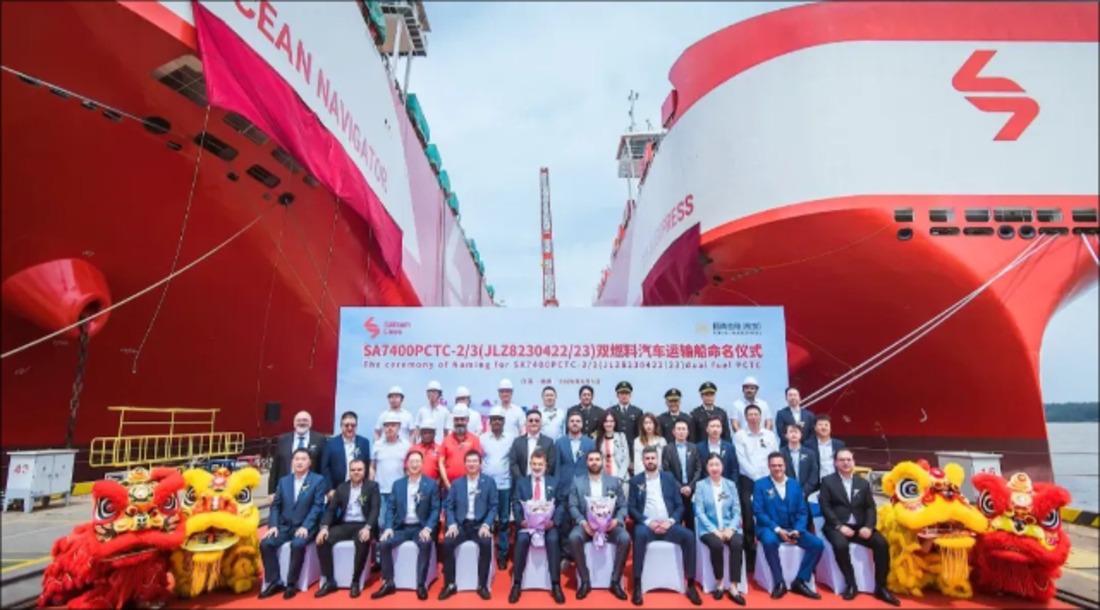
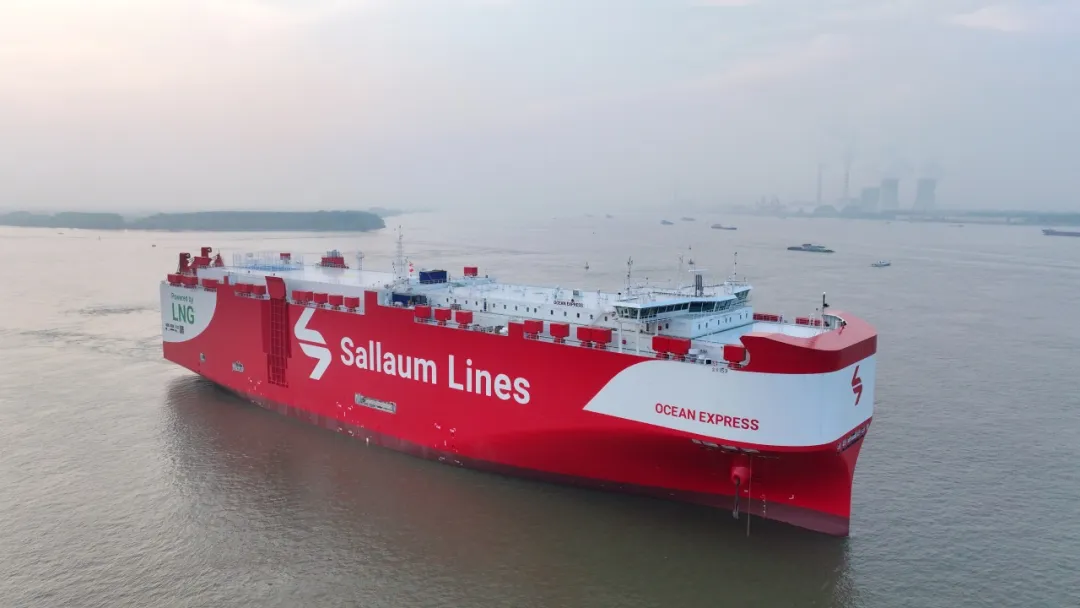
On 5 June, two 7,400 CEU dual-fuel Pure Car and Truck Carriers (PCTCs) being built for Sallaum Lines were named at China Merchants Jinling Shipyard’s Yizheng facility. The two vessels were named Ocean Express and Ocean Navigator.
Following the naming ceremony, the parties also held a delivery signing ceremony for the second vessel and conducted further discussions on deepening cooperation.
More importantly, Xinde Marine News has exclusively learned that on 8 June, Sallaum Lines signed a new contract with Xiamen Shipbuilding Industry for four 8,600 CEU PCTCs. The new vessels are understood to be designed with ammonia-ready propulsion capability, marking another step forward in Sallaum Lines’ long-term green fleet strategy.
From Mawei Shipbuilding to China Merchants Jinling Shipyard, and now to Xiamen Shipbuilding Industry, Sallaum Lines is moving quickly to build a new generation of car carrier capacity in China.
Two New Vessels Join the Ocean Class Series
The naming ceremony was attended by Ibrahim Sallaum, founder of Sallaum Lines; Sami Sallaum, Chairman of Sallaum Lines; Hassan Sallaum, General Manager of Sallaum Lines; Zheng Hehui, Deputy General Manager of China Merchants Shipbuilding and Chairman of Jinling Shipyard; and Jiang Jiazhong, General Manager of Jinling Shipyard.
At the ceremony, Sami Sallaum officially named the two vessels Ocean Express and Ocean Navigator, while Ibrahim Sallaum performed the ceremonial rope-cutting.
Sallaum Lines said the delivery of MV Ocean Express and MV Ocean Navigator represents the latest additions to its LNG-powered Ocean Class Series. As sister vessels to MV Ocean Legacy, both ships feature the same advanced technical specifications, propulsion system and cargo capacity, helping ensure operational consistency, efficiency and reliability across the company’s expanding LNG-powered fleet.
Hassan Sallaum said the naming of Ocean Express and Ocean Navigator follows a long-standing maritime tradition and marks the beginning of the vessels’ operational journey. He thanked all teams involved for their cooperation and said the completion of the two vessels is an important milestone in Sallaum Lines’ development, reflecting the company’s commitment to providing stable, efficient and dependable shipping services to customers worldwide.
From Orders to Deliveries: Sallaum Lines Expands Its Green PCTC Fleet
In June 2023, Sallaum Lines signed a contract with China Merchants Jinling Shipyard for four 7,400 CEU dual-fuel PCTCs. The first vessel in the series was delivered in February this year. The same-day naming of Ocean Express and Ocean Navigator indicates that this series is now entering a more intensive delivery phase.
The 7,400 CEU vessels measure 199.9 metres in length and 37.70 metres in breadth, with a design draught of 10.20 metres. They offer capacity for 7,400 car equivalent units and are based on a dual-fuel LNG design developed by Finland’s Deltamarin. Each vessel is fitted with 13 vehicle decks to support efficient cargo handling and improved operational performance.
In terms of environmental performance, the vessels comply with IMO Tier III requirements and are equipped with shore power capability to reduce emissions while in port. These specifications align with Sallaum Lines’ broader strategy of building a younger, cleaner and more efficient car carrier fleet.
For a shipping company focused on vehicle transportation, the delivery of 7,400 CEU LNG dual-fuel PCTCs means more than additional capacity. It strengthens the company’s ability to offer compliant, reliable and long-term transport solutions to global automotive customers.
China Becomes a Key Pillar of Sallaum Lines’ Fleet Renewal
Xinde Marine News has previously reported on Sallaum Lines’ growing engagement with China’s shipbuilding sector, shipping market and automotive export supply chain.
In 2022, Sallaum Lines placed orders at Fujian Mawei Shipbuilding for two 7,500 CEU LNG dual-fuel PCTCs. The company later ordered the 7,400 CEU dual-fuel PCTC series at China Merchants Jinling Shipyard. In 2025, Ocean Breeze, built by Mawei Shipbuilding, was delivered ahead of schedule and became a key milestone in the company’s China-built green PCTC programme. Ocean Explorer was later delivered, further strengthening the company’s new-generation fleet.
With the latest order for four 8,600 CEU ammonia-ready PCTCs at Xiamen Shipbuilding Industry, Sallaum Lines’ cooperation with Chinese shipyards is expanding from individual projects to a broader, multi-yard and multi-series fleet renewal programme.
The ammonia-ready design of the newly contracted 8,600 CEU vessels is particularly notable. It shows that Sallaum Lines’ green fleet strategy is moving beyond LNG dual-fuel technology and preparing for future alternative fuel pathways. For the car carrier sector, such future-fuel-ready designs will become increasingly important as emissions regulations continue to tighten over the coming decade.
Building Ships in China, Serving China’s Automotive Export Growth
The global seaborne vehicle logistics market has changed significantly in recent years. China’s automobile exports, particularly new energy vehicle exports, have grown rapidly, while car carrier capacity has remained one of the tightest segments in global shipping.
For Sallaum Lines, China is no longer just an important shipbuilding base. It is also becoming a key cargo source, customer market and strategic growth region.
This explains why the company has continued to place new-generation PCTC orders at Chinese shipyards.
Chinese shipyards have developed strong batch-building capabilities in the PCTC segment, covering LNG dual-fuel systems, vehicle deck arrangements, shore power, energy efficiency solutions and technical designs suitable for carrying new energy vehicles.
At the same time, as Chinese automakers accelerate their global expansion, vehicle logistics chains are being reshaped. Shipping companies seeking to serve this market need more than vessel capacity. They need to be closer to Chinese customers, understand the export rhythm of China’s automotive industry, and maintain a stable fleet renewal and operational support system.
Sallaum Lines’ recent moves in China reflect this wider industrial logic.
Fleet Quality Becomes the New Competitive Edge
The PCTC market has experienced an exceptional boom over the past two years. Yet competition in this sector is increasingly shifting from simple vessel availability to fleet quality.
Older car carriers face greater pressure in terms of energy efficiency, emissions performance, cargo handling efficiency and customer requirements. New-generation vessels equipped with LNG dual-fuel propulsion, shore power, future-fuel-ready designs and efficient vehicle deck arrangements are becoming more attractive to major automotive logistics customers.
By taking delivery of new Ocean Class vessels and signing for four larger 8,600 CEU ammonia-ready PCTCs, Sallaum Lines is using fleet renewal as a tool to enhance long-term competitiveness.
The naming of Ocean Express and Ocean Navigator is therefore more than the addition of two new vessels. It marks the acceleration of Sallaum Lines’ next-generation car carrier strategy in China.
As more China-built PCTCs join its fleet, Sallaum Lines is set to strengthen its position in the global vehicle transportation market, with larger green capacity, closer links to China’s automotive export chain, and a more future-ready fleet platform.

READ MORE
 Shipbuilding
Jianglong Adds $40m Offshore Vessel Order to 2026 Contract Run
 Shipbuilding
Hubei Firm Proposes RMB427m LNG and Methanol Vessel Programme
 Shipbuilding
4 More,totally 16 Since 2024: Why RCL Keeps Ordering at Huangpu Wenchong
 Shipbuilding
Chipolbrok Begins Construction of First 60,800 DWT Forward-Accommodation Heavy-Lift Vessel
 Shipbuilding
Zodiac Linked to First LNG Carrier Order at Hanwha Ocean
 Shipbuilding
RCL Adds Four Feeders to Its Huangpu Wenchong Programme
 Shipbuilding
X-Press Feeders CEO Shmuel Yoskovitz : “When You Own Your Own Vessels, You Control Your Destiny”
 Shipbuilding
DAB Group Enters Shipowning With First Ultramax Pair Ordered in China
 Shipbuilding
Union Maritime Adds Nine Ships Across Five Segments as Newbuild Programme Reaches 79
 Shipbuilding