


Hanwha Makes $1.2 Billion Bid for Austal USA in Major U.S. Naval Shipbuilding Push
The proposed acquisition shows how Washington is increasingly drawing on allied capital and industrial expertise to rebuild American shipbuilding—and create new long-term competitive pressure on China.
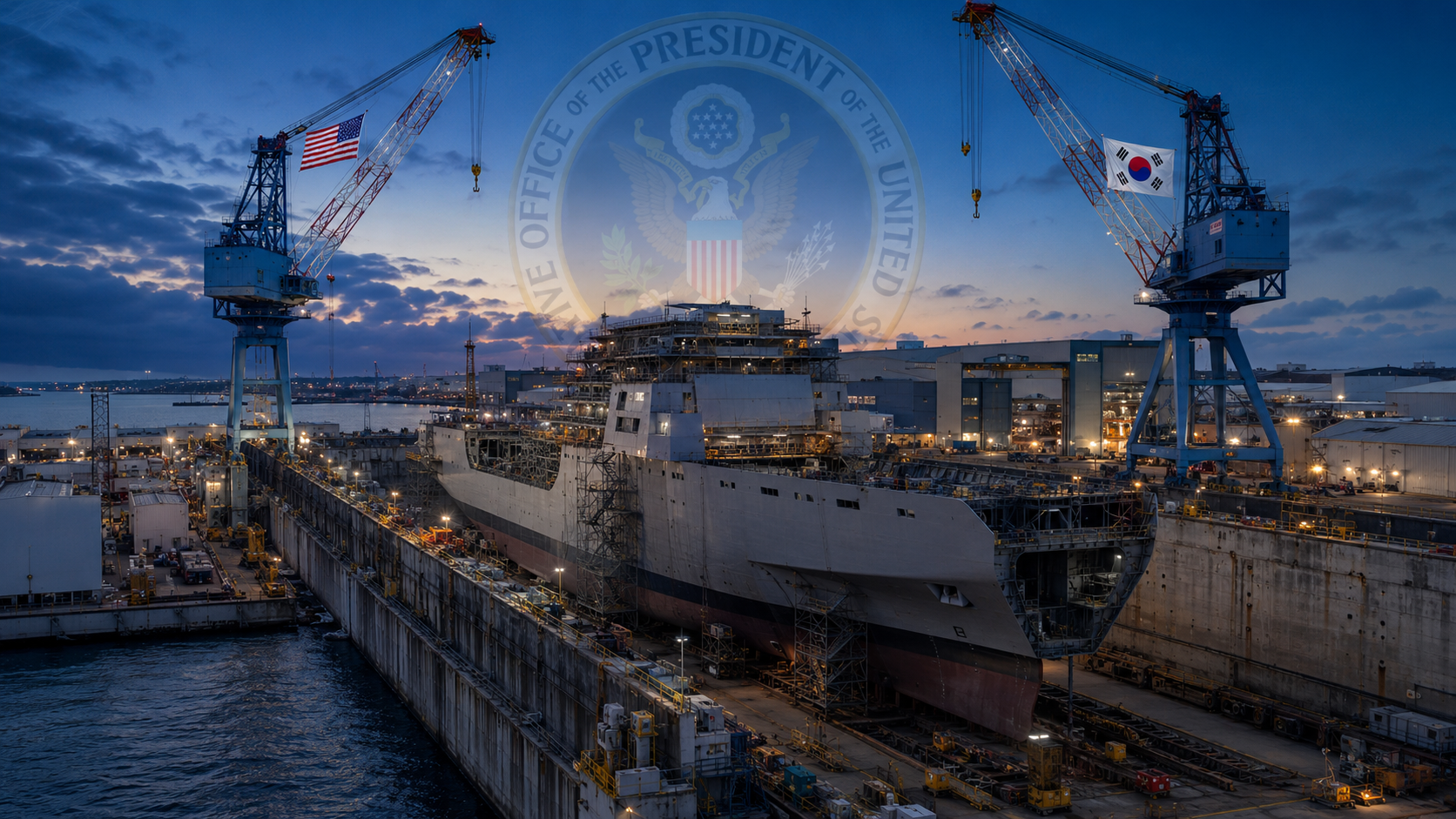

South Korea’s Hanwha Group has launched another bid for Austal.
Australian shipbuilder Austal confirmed on 11 August that Hanwha Defense USA had submitted an indicative, non-binding and conditional proposal to acquire Austal USA at an enterprise value of between US$1.05 billion and US$1.20 billion.
If completed, the transaction would give Hanwha control of one of America’s most strategically important private naval shipbuilding operations. Following its acquisition of Philly Shipyard in 2024, Hanwha would establish a two-yard U.S. network spanning Jones Act commercial ships, naval auxiliaries, surface vessels, Coast Guard cutters and modules for nuclear submarines.
The deal remains at an early stage. Nevertheless, it points to a broader shift in U.S. industrial policy: Washington is increasingly looking to South Korea, Japan and other allies for capital, engineering expertise, advanced production methods and shipyard management experience, while ensuring that the resulting capacity is located inside the United States.
What exactly is Hanwha offering?
According to Austal’s official announcement, Hanwha has proposed acquiring the business entities and operations of Austal USA at an indicative enterprise value of US$1.05 billion to US$1.20 billion.
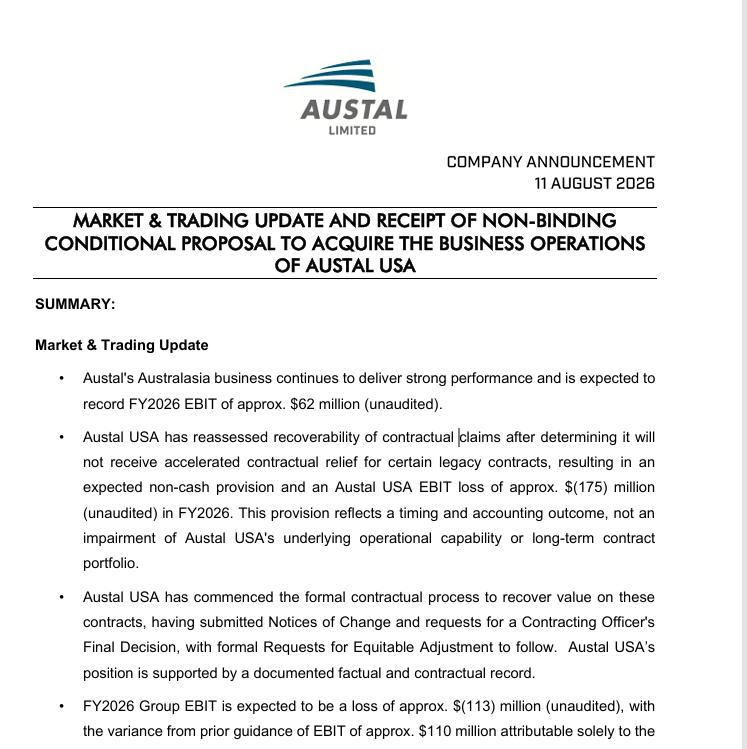
The offer is presented on a cash-free and debt-free basis and remains subject to a normalised level of working capital and other customary transaction adjustments. The acquisition could be implemented through the purchase of 100% of the shares in the relevant Austal USA holding entities or another structure agreed between the parties.
The proposal is not subject to a financing condition, suggesting that Hanwha already has the necessary funding capacity. It is, however, subject to several important conditions, including satisfactory due diligence, definitive transaction agreements and regulatory approvals.
Those approvals could include reviews by the Committee on Foreign Investment in the United States, or CFIUS; the U.S. Defense Counterintelligence and Security Agency; and the antitrust process under the Hart-Scott-Rodino Act.
Austal’s board has only concluded that the proposal merits further evaluation. Hanwha has been granted a four-week period, beginning when the requested information is made available, to review Austal USA’s contracts, financial position and newly disclosed trading update.
During this period, Hanwha is also expected to engage with key counterparties, including relevant U.S. government departments, the U.S. Navy and the U.S. Coast Guard. Austal stressed that there is no certainty Hanwha will submit a more definitive offer or that any subsequent proposal will lead to a binding agreement.
The transaction has also been carefully ring-fenced. Hanwha’s proposal does not include Austal’s publicly traded shares or its core operations in Australia, the Philippines and Vietnam.
Austal’s 15-year Strategic Shipbuilding Agreement with the Australian government would remain intact. That agreement covers major sovereign programmes, including 18 Landing Craft Medium vessels and eight Landing Craft Heavy vessels for Australia.
By targeting only Austal USA, Hanwha has avoided many of the Australian sovereignty and change-of-control concerns that complicated its previous attempt to acquire the entire Austal group.
Why Austal USA matters
Hanwha is pursuing much more than a shipyard.
Established in 1999 and headquartered in Mobile, Alabama, Austal USA employs around 3,500 people. In addition to its Mobile construction facilities, it operates a ship repair yard in San Diego and advanced technology operations in Virginia.
According to Austal USA, the company has delivered 34 ships to the U.S. Navy and has a contract backlog valued at approximately US$10 billion.
Its portfolio includes Independence-class littoral combat ships, expeditionary fast transport vessels, expeditionary medical ships, towing and salvage ships, landing craft, ocean surveillance ships, floating dry docks and offshore patrol cutters for the U.S. Coast Guard.
Originally best known for high-speed aluminium vessels, Austal USA has invested heavily in steel shipbuilding. It now operates both steel and aluminium production lines, broadening its role from a specialist high-speed craft builder into a more diversified defence shipbuilding contractor.
Its strategic importance also extends into the U.S. nuclear submarine industrial base.
In 2024, Austal USA was awarded a US$450 million contract by General Dynamics Electric Boat to expand submarine module production. The company is constructing a 369,600-square-foot manufacturing facility in Mobile that is expected to support approximately 1,000 jobs when fully operational.
The facility will produce modules for Virginia-class attack submarines and Columbia-class ballistic missile submarines. The investment supports the U.S. Navy’s long-term objective of delivering one Columbia-class and two Virginia-class submarines annually.
Austal USA is already producing Command and Control Systems Modules and Electronic Deck Modules for the two submarine programmes. It also participates in the Navy’s additive manufacturing network and operates advanced manufacturing facilities in Virginia.
The acquisition would therefore provide Hanwha with an established workforce, defence security credentials, government customer relationships, a substantial orderbook and direct access to some of the most sensitive programmes in the U.S. naval industrial base.
Building those capabilities from scratch would take many years. Acquiring Austal USA would give Hanwha a much faster route into the centre of American naval shipbuilding.
Newly disclosed losses will be central to due diligence
The proposal was disclosed alongside a sharp deterioration in Austal USA’s near-term financial outlook.
Austal reported A$108.5 million in group pre-tax profit for the 2025 financial year, with approximately 90% generated by its U.S. business.
For FY2026, however, Austal USA is now expected to record an EBIT loss of approximately A$175 million. As a result, Austal has revised its group guidance from an expected EBIT profit of about A$110 million to an EBIT loss of approximately A$113 million.
The deterioration is primarily related to legacy contracts covering Towing, Salvage and Rescue Ships, an Auxiliary Floating Dry Dock Medium and Landing Craft Utility vessels.
Austal had been seeking accelerated contractual relief from the U.S. government. After concluding that such relief would not be provided at this stage, the company was required to recognise forecast losses through to the completion of the affected programmes, including vessels scheduled for delivery as late as 2028.
Austal described the provision as a non-cash accounting outcome. It said the charge did not represent an impairment of Austal USA’s underlying operational capability or long-term contract portfolio.
Other activities, including submarine module manufacturing and support services, continue to operate profitably. Austal’s overall group orderbook remains at a record level of approximately A$17 billion.
The timing is significant. Hanwha submitted its initial proposal before Austal released the trading update. Hanwha subsequently said its due diligence would need to include the newly disclosed financial information and the underlying economics of Austal USA’s contracts.
The US$1.05 billion to US$1.20 billion valuation should therefore be treated as an initial range. The final price—if a binding offer is made—could be influenced by the legacy contract losses, the potential recovery of claims, the profitability of the remaining orderbook and the position of U.S. government customers.
A more targeted second attempt
This is Hanwha’s second major attempt to secure control of Austal assets.
In April 2024, Hanwha Ocean proposed acquiring the entire Austal group for A$2.825 per share, valuing the company at approximately A$1.02 billion.
Austal rejected the proposal, partly because it believed the structure was unlikely to receive approval from Australian and U.S. regulators due to the sensitivity of the company’s defence operations.
The transaction was not formally rejected by regulators. Austal’s board concluded that the regulatory risks were too high, and Hanwha subsequently withdrew the proposal.
Hanwha then changed its approach.
In December 2024, Hanwha Ocean and Hanwha Systems completed their US$100 million acquisition of Philly Shipyard, marking the first purchase of a major U.S. shipyard by a South Korean company.
The yard has historically focused on large Jones Act commercial vessels and training ships for the U.S. Maritime Administration. Hanwha is now attempting to expand it into LNG carriers, naval modules, auxiliaries and, eventually, naval ship construction.
In 2025, Hanwha announced a US$5 billion infrastructure plan for the yard. The programme includes two additional docks, three new quays and the possible construction of a block assembly facility.
Hanwha’s stated goal is to increase Philly Shipyard’s annual output from fewer than two vessels to as many as 20. Since completing the acquisition in December 2024, the group has already invested more than US$200 million in workforce development, facilities and production capacity.
In March 2026, Hanwha Defense USA and Hanwha Philly Shipyard secured their first U.S. Navy project since the acquisition, joining Vard Marine US as a subcontractor on the Navy’s Next Generation Logistics Ship programme.
Hanwha also continued to build its position in Austal. In 2025, it acquired a direct 9.9% stake in the Australian company and established additional economic exposure through a cash-settled equity swap covering another 9.9%.
Hanwha said in June 2025 that CFIUS had cleared an increase in its Austal shareholding up to 100%, signalling U.S. openness to a larger investment. Australia later approved Hanwha increasing its interest to 19.9%, but imposed strict conditions covering data access, governance and national security, while requiring Hanwha to remain a minority shareholder.
The latest proposal is much more targeted. It leaves Austal’s Australian sovereign shipbuilding operations and listed company structure untouched while focusing directly on the U.S. business that Hanwha values most.
A two-yard strategy: Philadelphia and Mobile
Philly Shipyard and Austal USA offer highly complementary capabilities.
Philadelphia provides a base in large commercial shipbuilding, Jones Act vessels and U.S. Maritime Administration programmes. Hanwha is investing heavily to introduce South Korean digital shipbuilding systems, automated welding, block construction, workforce training and supply-chain management.
Austal USA already possesses established Navy and Coast Guard contracts, defence security credentials, nuclear submarine module work and a workforce of approximately 3,500 people.
Philadelphia could serve as the centre for commercial vessels, Jones Act fleet renewal and long-term capacity expansion. Mobile would provide immediate access to surface shipbuilding, Coast Guard programmes, naval auxiliaries and the submarine industrial base.
The combination would significantly change Hanwha’s position in the United States. It would move beyond being a South Korean group that owns an American commercial yard and become a U.S.-based maritime industrial operator spanning merchant shipbuilding, naval construction, repair, advanced manufacturing and submarine components.
Washington is increasingly relying on Asian allies
Hanwha’s expansion closely follows the direction of U.S. maritime industrial policy.
In April 2025, the U.S. government issued the “Restoring America’s Maritime Dominance” executive order. The document acknowledged that the United States builds less than 1% of the world’s commercial ships, while China accounts for roughly half, and called for a comprehensive strategy involving government procurement, financing, workforce development and industrial investment.
The America’s Maritime Action Plan, released in February 2026, went further by explicitly incorporating allied investment into the U.S. shipbuilding strategy.
The plan calls for clearer pathways for foreign direct investment in American shipyards, suppliers and maritime infrastructure. It also proposes using tax incentives, loan guarantees and workforce programmes to attract major shipbuilders from trusted partner countries.
One of its most significant proposals is a “Bridge Strategy”. Under this model, the first vessels in a multi-ship programme could be constructed at an allied shipbuilder’s home yard while the company simultaneously invests in, acquires or partners with a U.S. shipyard. Construction would then gradually be transferred to the United States.
Hanwha’s current strategy closely resembles this model. Hanwha Ocean provides engineering, design, supply-chain and mass-production expertise from South Korea, while the group acquires and modernises U.S. shipyards to localise production.
The U.S.-South Korea strategic trade and investment arrangement announced in 2025 included US$150 billion of Korean investment in shipbuilding-related cooperation. In March 2026, South Korea’s National Assembly passed legislation providing a legal and financial framework for the broader investment programme.
Japan is moving in the same direction. In October 2025, the United States and Japan signed a memorandum of cooperation to align shipbuilding investment, procurement, workforce and technology initiatives.
Although U.S. Section 301 measures targeting China’s maritime, logistics and shipbuilding sectors are currently suspended for one year, Washington has explicitly said it will continue working with South Korea and Japan to revitalise American shipbuilding.
Hanwha’s bid for Austal USA should therefore be viewed as part of a broader state-supported industrial realignment rather than an isolated corporate acquisition.
The long-term pressure on Chinese shipbuilding
The acquisition of one American shipbuilder would not immediately alter the global commercial shipbuilding balance.
During the first half of 2026, Chinese yards completed 36.50 million dwt of vessels, equivalent to 62.2% of global output. They secured 121.06 million dwt of new orders, representing 82.3% of the world total, while their combined orderbook reached 363.25 million dwt, or 71.2% of the global market.
China’s scale, delivery efficiency and integrated supply chain across steel, engines, marine equipment, financing, ports and shipping remain extremely difficult to replicate.
Austal USA’s latest provisions also highlight the challenges facing American shipbuilding. Complex government contracts, high labour costs, workforce shortages, fragmented supply chains and project management problems cannot be solved simply by acquiring yards or announcing investment programmes.
Hanwha’s target of increasing Philly Shipyard’s output from fewer than two vessels to as many as 20 annually remains highly ambitious. Capital can secure physical assets, but it cannot instantly reproduce the productivity of a mature Asian shipbuilding ecosystem.
The longer-term competitive pressure will first emerge through market access and industrial policy.
Chinese shipbuilders dominate the global commercial market but have almost no access to U.S. Navy, Coast Guard, Jones Act or other security-sensitive government programmes. South Korean and Japanese companies can enter these markets through U.S. subsidiaries, local acquisitions and security arrangements supported by alliance relationships.
Korean shipbuilders are also gaining access to a combination of U.S. procurement, Korean state-backed investment, American industrial incentives and local workforce programmes. Their competitiveness will therefore be supported by more than the costs and productivity of their domestic yards.
Technology integration creates another dimension. Hanwha is transferring Korean smart-yard systems, automation, LNG engineering expertise and mass-production methods into the United States. In return, it could gain closer access to U.S. naval procurement, defence technology, submarine industrial programmes and government-funded research.
Over time, this combination could create new competitive platforms in naval auxiliaries, submarine modules, LNG carriers, unmanned vessels and advanced maritime equipment.
The competition is also moving into rules and market structure. Washington increasingly treats shipbuilding origin, supply-chain security, port policy and government procurement as matters of economic and national security. Cooperation with South Korea and Japan could support a more exclusive allied shipbuilding network from which Chinese yards are largely absent.
China’s industrial advantages will not disappear quickly. But global shipbuilding competition is developing along two parallel tracks: a commercial market driven mainly by price, technology and delivery performance, and a strategic market increasingly shaped by national security, alliance structures, procurement policy and public investment.
The deal is unfinished, but the direction is clear
The four-week due diligence period will determine whether Hanwha is prepared to assume the risks associated with Austal USA’s legacy contracts. It will also test the position of the U.S. Navy, Coast Guard and national security regulators on the proposed ownership structure.
Even if Hanwha submits a binding offer, the parties must still address contract claims, tax liabilities, sensitive data access, governance arrangements, customer consent and national security protections.
Previous CFIUS clearance provides a favourable signal, but it does not guarantee approval of this specific asset transaction.
If successful, however, Hanwha will have moved in less than two years from acquiring Philly Shipyard to entering U.S. Navy programmes and potentially controlling an established naval shipbuilder with a direct role in the nuclear submarine industrial base.
The United States is combining domestic capital, government procurement and defence demand with South Korean and Japanese industrial capabilities to build a new maritime manufacturing network anchored on American soil.
For China, the significance of the proposed US$1.2 billion transaction extends well beyond the ownership of a single shipyard. A new competitive structure—supported by U.S. policy and powered by allied Asian shipbuilding expertise—is gradually taking shape.


READ MORE
 Shipbuilding
RCL Adds Four Feeders to Its Huangpu Wenchong Programme
 Shipbuilding
X-Press Feeders CEO Shmuel Yoskovitz : “When You Own Your Own Vessels, You Control Your Destiny”
 Shipbuilding
DAB Group Enters Shipowning With First Ultramax Pair Ordered in China
 Shipbuilding
Zodiac Linked to First LNG Carrier Order at Hanwha Ocean
 Shipbuilding
Union Maritime Adds Nine Ships Across Five Segments as Newbuild Programme Reaches 79
 Shipbuilding
Fujian Guohang Plans RMB2.49bn Fleet Expansion into LR2 Tankers and Heavylift
 Shipbuilding
Swire Buys Four Heavy-Lift Ships in Latest Strategic Shift
 Shipbuilding
French Space Logistics Owner Selects China’s GSI for Next-Generation Ro-Ro Vessel Project
 Shipbuilding
Will Newbuilding Prices Still Be This High a Year From Now?
 Shipbuilding