


“The Whole World Is Asking for Chinese Cars”: Why PCTC Capacity Is Still Tight Despite Record Deliveries


New car carriers are entering service at the fastest pace in years, but China’s vehicle exports are growing even faster. The PCTC oversupply that many expected in 2026 has not disappeared—it has been pushed further down the road.
For the past two years, the car-carrier market has been waiting for what appeared to be an inevitable turning point.
Dozens of pure car and truck carriers ordered since 2021 have been leaving shipyards, bringing the sector into one of its heaviest delivery cycles in decades. According to the traditional shipping-cycle playbook, more ships should ease capacity pressure, weaken charter rates and eventually push the market towards oversupply.
Yet by mid-2026, that script had still not played out.
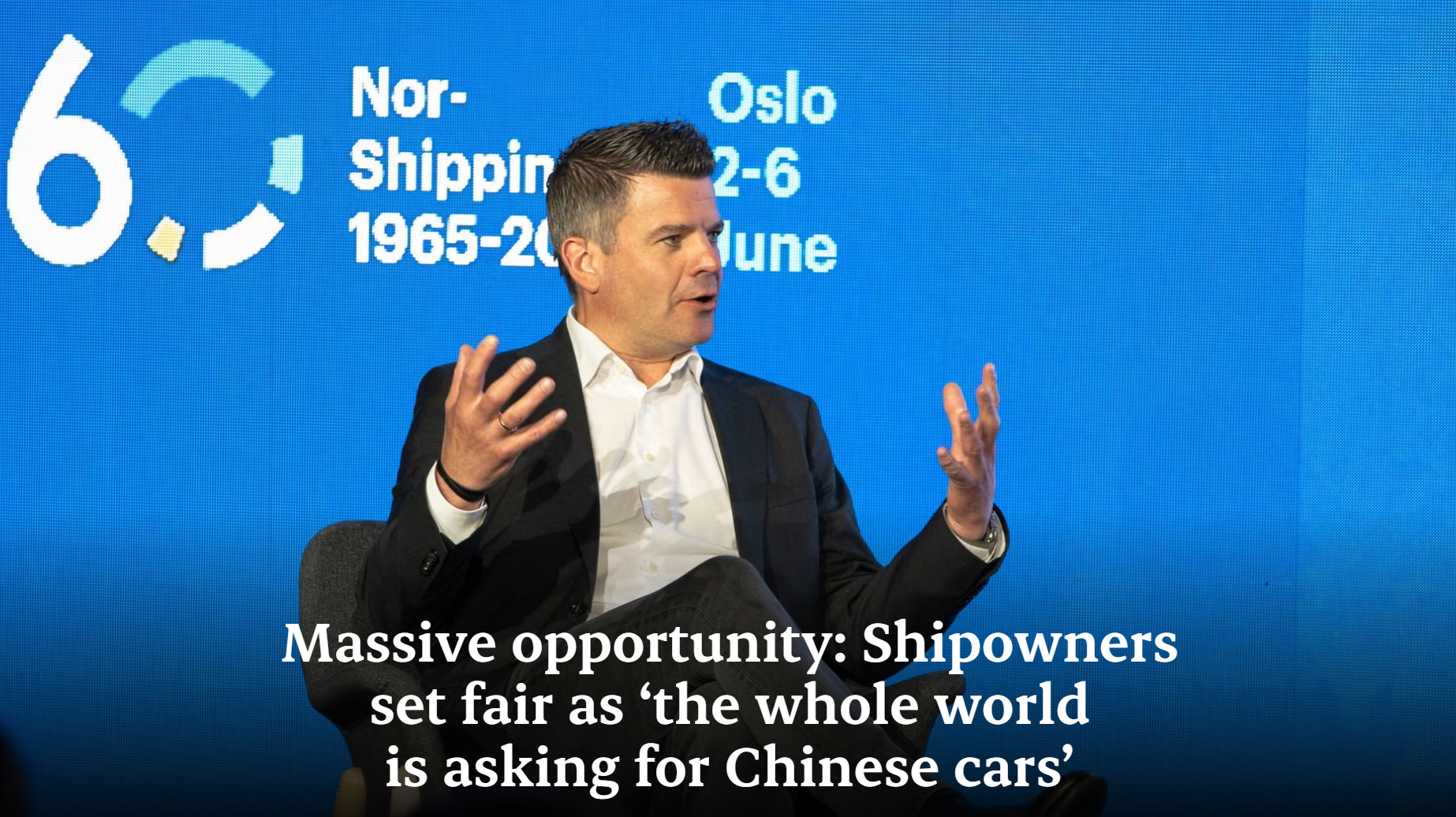
Wallenius Wilhelmsen chief executive Lasse Kristoffersen captured the reason in a striking phrase: “The whole world is asking for Chinese cars.”
 source: Tradewinds
The line may sound promotional, but the supply-and-demand figures behind it are difficult to ignore. The global PCTC fleet is expanding rapidly, yet surging vehicle exports from China and other Asian markets are absorbing almost every additional ship entering service.
Wallenius Wilhelmsen, one of the world’s largest vehicle-shipping and logistics groups, now expects tight PCTC capacity and high fleet utilisation to continue at least through the end of 2026. The important conclusion is not that oversupply risk has vanished. Rather, China’s export boom has delayed the point at which new vessel supply catches up with cargo demand.
China passed five million vehicle exports in six months
To understand why car-carrier capacity remains tight, it is necessary to grasp the speed at which China’s vehicle exports are growing.
China exported 5.096 million vehicles in the first half of 2026, an increase of 65% year on year, according to the Association of European Vehicle Logistics, or ECG, drawing on China Association of Automobile Manufacturers data.
June alone accounted for 1.037 million vehicles, the first time monthly exports had crossed the one-million mark. That was 75% higher than a year earlier.
New-energy vehicles were a major part of the acceleration. China exported 2.356 million NEVs in the first six months, up 120% year on year. Passenger cars represented 86.9% of total vehicle exports during the period.
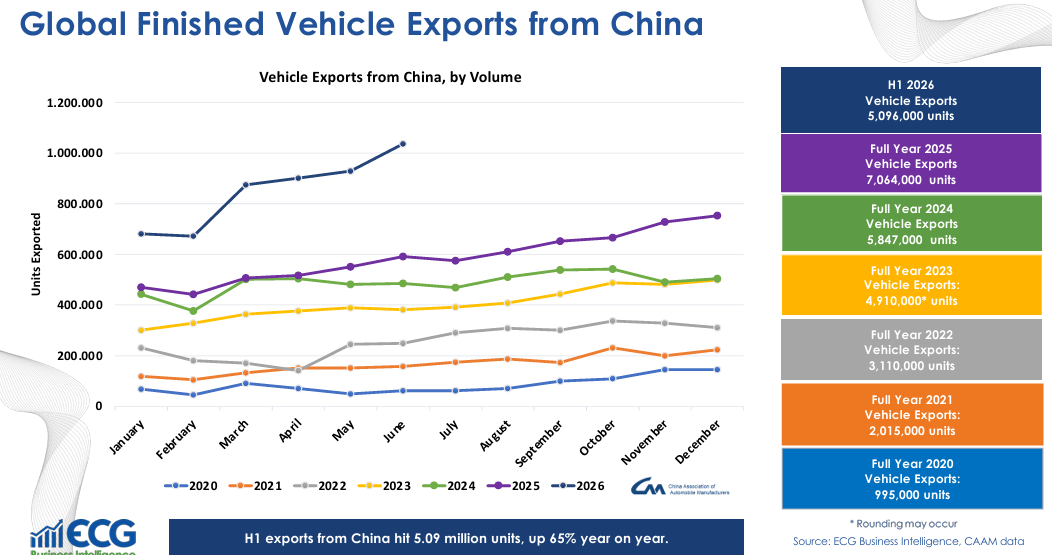
The figures mean China shipped an average of roughly 28,000 vehicles abroad every day in the first half.
Wallenius Wilhelmsen’s passenger-vehicle data tell the same story from another angle. In its second-quarter market presentation, the company estimated China’s rolling 12-month passenger-car exports at about 7.5 million units, up 31%, while domestic passenger-car retail sales fell 9% to around 21.5 million units.
That divergence matters. As China’s home market weakens, automakers have a stronger incentive to maintain factory utilisation by sending more production overseas.
The export push is also becoming broader. Chinese manufacturers are no longer competing on price alone. They have improved technology, range, software, equipment levels and design while retaining a major cost advantage. Chinese brands have taken about 70% of their domestic market and are winning share overseas, particularly where trade barriers are less restrictive than in the United States.
For a shipping company, however, export declarations are only half the story. Vehicles must also be sold after they arrive. If automakers were merely moving unsold inventory from Chinese ports into overseas storage yards, shipping demand would eventually falter.
Wallenius Wilhelmsen said it compared Chinese export data with vehicle registrations and examined inventories at its own facilities, particularly in the United Kingdom and Australia. Its conclusion was that registrations were broadly keeping pace with arrivals and that there was no clear sign of a major inventory build-up in those markets.
That gives shipowners more confidence that the present boom is being supported by end-user demand rather than by an export push alone.
The largest pool of potential PCTC demand is not on PCTCs
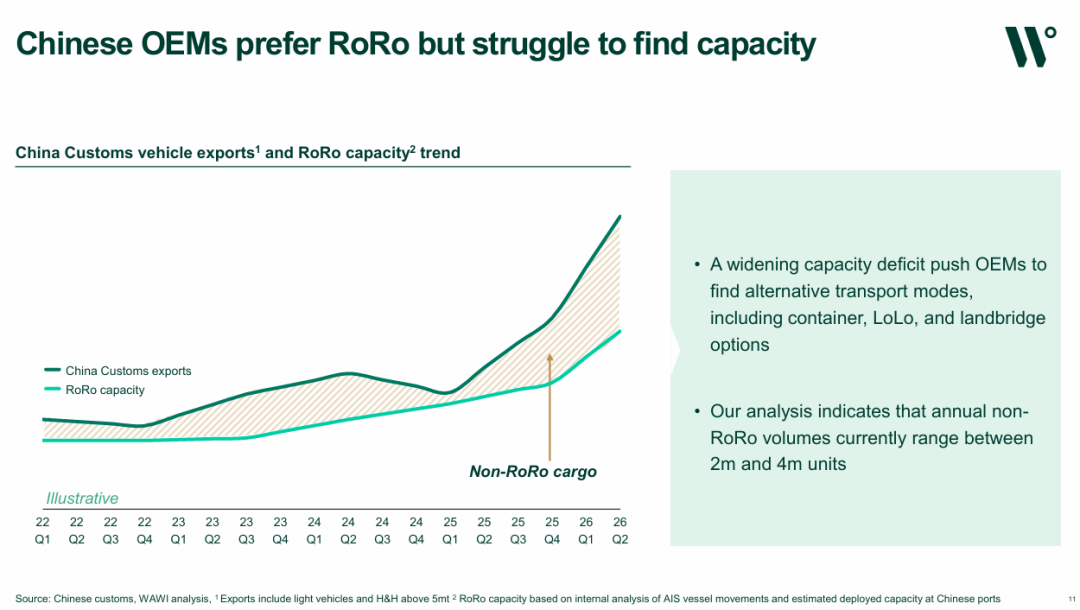
Perhaps the most revealing evidence of today’s capacity shortage is not the number of cars already moving on car carriers. It is the number that cannot secure space on them.
Using Chinese customs data, vessel AIS movements and estimates of RoRo capacity deployed at Chinese ports, Wallenius Wilhelmsen calculates that between two million and four million vehicles a year are leaving China by non-RoRo modes.
Those alternatives include containers, lift-on/lift-off vessels and landbridge services. Kristoffersen indicated that the true volume could be closer to four million than two million.
Not all of that cargo will inevitably migrate to PCTCs. Containers or rail can remain attractive for small batches, shorter routes and particular inland destinations. But for large, regular flows of completely built vehicles across oceans, PCTCs are normally more efficient: cars can be driven directly on and off the ship, avoiding extensive lifting, packing and disassembly.
The two-million-to-four-million-unit estimate therefore represents a form of hidden demand. The vehicles are already being exported, but insufficient specialist shipping capacity is forcing manufacturers to use less-preferred alternatives.
When a new PCTC enters a China-related trade, it may not need to wait for future export growth to find cargo. It can first capture demand that already exists outside the conventional RoRo system.
This helps explain the market’s apparent contradiction. Record numbers of new ships are arriving, yet the market is not becoming meaningfully looser. Vessel supply is growing quickly, but the pool of cargo suitable for those ships is growing even faster.
If 60 or more ships are arriving, why is capacity still scarce?
The supply expansion is substantial by any measure.
Global PCTC deliveries rose from just 12 ships in 2023 to 46 in 2024 and a record 75 in 2025, according to AXSRoRo-related data reviewed by Xinde Marine News. Those 133 ships added close to one million car-equivalent units of capacity in only three years.
Another 67 PCTCs, representing approximately 518,000 CEU, were originally scheduled for delivery in 2026, followed by around 50 ships in 2027 and 26 in 2028. Wallenius Wilhelmsen, allowing for actual construction and delivery progress, expects roughly 60 ships to join the fleet this year. (PCTC delivery data)
That is still a significant increase. But headline delivery numbers can overstate the capacity available during a particular year.
A ship delivered in October cannot contribute a full year of capacity. Wallenius Wilhelmsen counted 16 deliveries in the first quarter of 2026 and 14 in the second. A large share of the remaining vessels was due later in the year, including 12 in the fourth quarter. Their contribution to effective 2026 supply will therefore be much smaller than that of ships trading from January.
Trade imbalances further reduce fleet efficiency. Ships leaving Asia for Europe, Latin America and Oceania can be sold out, while European and US exports back to Asia remain relatively weak. A vessel may sail full in one direction and struggle to secure equivalent return cargo.
The ship’s nominal capacity has not changed, but the amount of commercially useful round-voyage capacity has.
Geopolitical disruption compounds the problem. Wallenius Wilhelmsen said in its second-quarter materials that the Strait of Hormuz and Bab el-Mandeb remained effectively closed or unavailable to its services at the time. Diversions and longer routings increase the number of days required to complete a voyage.
In shipping, every additional day at sea temporarily removes capacity from the market. A fleet can grow on paper while remaining tight in practice because each ship completes fewer voyages per year.
Freight and charter markets are voting with their feet
If PCTC capacity were becoming abundant, the first signs would normally appear in spot freight and time-charter rates. Instead, both strengthened during the second quarter.
Wallenius Wilhelmsen reported full fleet utilisation and rising freight and charter rates. Its assessed Asia-to-Europe spot freight indicator was about 79% above its level at the beginning of 2025. The company also cited a recently concluded two-year charter for a newbuilding at $80,000 per day.
These figures suggest that operators do not simply have many ships waiting for cargo. Freely available vessels are scarce, and ships entering service often have employment arranged quickly.
The strength of the underlying shipping market is also visible in Wallenius Wilhelmsen’s financial results. Second-quarter revenue reached $1.305 billion, up 4% from the previous quarter. Adjusted EBITDA was $361 million, down 7% quarter on quarter, largely because of higher bunker costs following the Middle East conflict.
Despite that cost pressure, the company maintained its full-year 2026 adjusted EBITDA guidance of about $1.6 billion and said solid volumes and high utilisation should continue in the second half.
The company’s own newbuilding programme illustrates how quickly fresh capacity is being absorbed. In July, Wallenius Wilhelmsen took delivery of Arctic Tern, the first of 14 Shaper-class vessels. The 9,300-CEU, dual-fuel and methanol-ready PCTC was set to enter EUKOR’s Asia–Europe service almost immediately.

source:Wallenius Wilhelmsen
Arctic Tern was not delivered into a market waiting for demand to appear. It entered a trade lane that was already short of space.
China is exporting cars—and generating shipbuilding demand
China’s vehicle-export boom is also producing a second major winner: Chinese shipyards.
Of the 276 PCTCs delivered or scheduled for delivery worldwide between 2023 and 2028, 219 are being built in China, equivalent to 79.4% of the total. Chinese yards also secured 35 of the first 37 car carriers ordered in 2026, giving them a share of almost 95% by vessel count. (2026 PCTC ordering analysis)
Price is only part of the explanation.
A modern PCTC is effectively a multi-storey floating garage, fitted with internal ramps, hoistable decks and complex cargo-handling systems. As battery-electric and plug-in hybrid vehicles make up a larger share of cargoes, owners are also paying greater attention to fire detection, ventilation, firefighting and emergency-response arrangements.
Successive series of large dual-fuel vessels have allowed Chinese builders to accumulate experience in PCTC construction, flexible deck layouts, alternative-fuel systems and the transport requirements of new-energy vehicles.
The broader industrial alignment is equally important. Vehicle manufacturing, car-carrier construction, RoRo terminals and ocean logistics are becoming parts of the same Chinese export infrastructure.
Only a few years ago, Chinese automakers frequently faced a “cars but no ships” problem. They are now addressing that constraint through owned fleets, long-term charters and purpose-built new tonnage.
Much of the world’s new car-carrier capacity is being constructed in China—and much of its first cargo is likely to be Chinese-made vehicles.
Oversupply has been delayed, not abolished
None of this means the PCTC sector has escaped the shipping cycle.
About 50 ships are still scheduled for delivery in 2027 and another 26 in 2028. Renewed ordering in the second quarter lifted the global orderbook to roughly 21% of existing fleet capacity. If older vessels remain in service rather than being recycled, new ships will represent net fleet growth instead of replacement tonnage.
There are also important limits on the demand side.
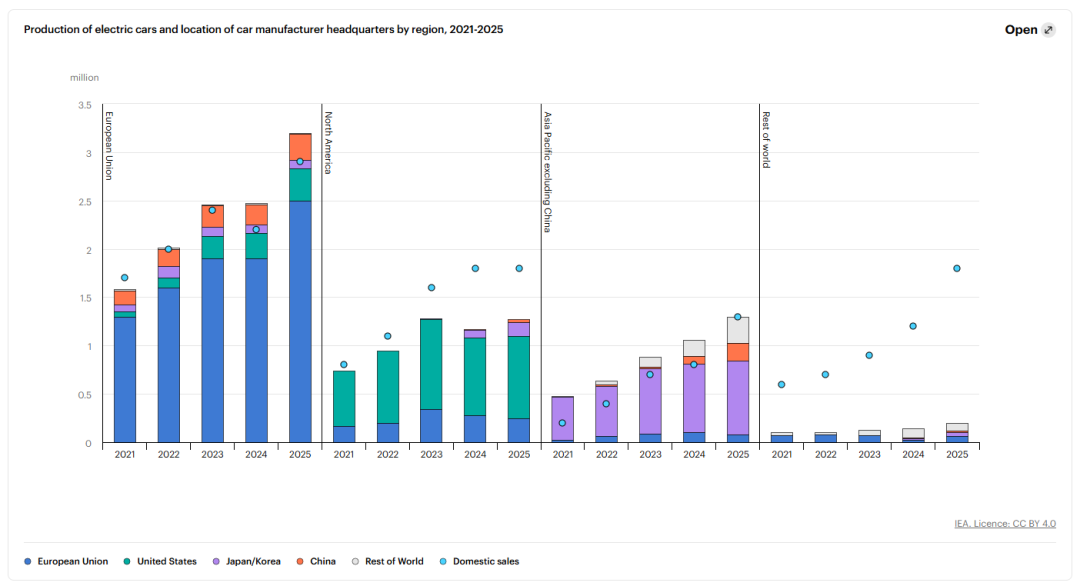
The International Energy Agency has warned that Chinese electric-car exports reported by CAAM exceeded estimated overseas sales by more than 25% in 2025, suggesting that inventories were rising in at least some destinations. Wallenius Wilhelmsen’s findings in Britain and Australia should not be treated as proof that every market is free of excess stock.
Tariffs and import restrictions are another risk. At the same time, Chinese automakers are investing in local production in Southeast Asia, Latin America and Europe. As overseas factories ramp up, some trade may shift from exports of completely built vehicles towards local assembly or shipments of knockdown kits, reducing the number of finished cars that require deepsea PCTC transport. (IEA Global EV Outlook 2026)
The routing environment could change too. If Red Sea and Suez Canal transits normalise, tonnage currently absorbed by diversions around the Cape of Good Hope could be released back into the market. Capacity may then appear to increase suddenly even if the number of ships and global vehicle sales remain unchanged.
The most defensible conclusion is therefore a measured one: through the remainder of 2026, rapid Chinese vehicle-export growth, unmet demand currently moving by non-RoRo modes, trade imbalances and longer voyages are likely to remain sufficient to absorb a large volume of new PCTC capacity.
The car-carrier market once feared that ships would arrive too quickly. For now, China’s vehicles are reaching world markets even faster.
Oversupply has not been cancelled. It simply has not yet caught up with China’s automotive export machine.


READ MORE
 Shipbuilding
Union Maritime Adds Nine Ships Across Five Segments as Newbuild Programme Reaches 79
 Shipbuilding
Fujian Guohang Plans RMB2.49bn Fleet Expansion into LR2 Tankers and Heavylift
 Shipbuilding
Swire Buys Four Heavy-Lift Ships in Latest Strategic Shift
 Shipbuilding
DAB Group Enters Shipowning With First Ultramax Pair Ordered in China
 Shipbuilding
French Space Logistics Owner Selects China’s GSI for Next-Generation Ro-Ro Vessel Project
 Shipbuilding
Will Newbuilding Prices Still Be This High a Year From Now?
 Shipbuilding
Guohang Enters Tankers with RMB 2.49bn Fleet Plan
 Shipbuilding
Henghui Reportedly Orders Up to Four Heavy-Lift Ships at ZPMC
 Shipbuilding
24 Firm Orders + 16 Options: Ren Yuanlin Accelerates Yangzijiang Maritime’s ‘Financial Shipowner’ Strategy
 Shipbuilding