


Up to $489 Million, 17 Yards in the Running: Why Norway’s High-End Wellboats Are Heading to China
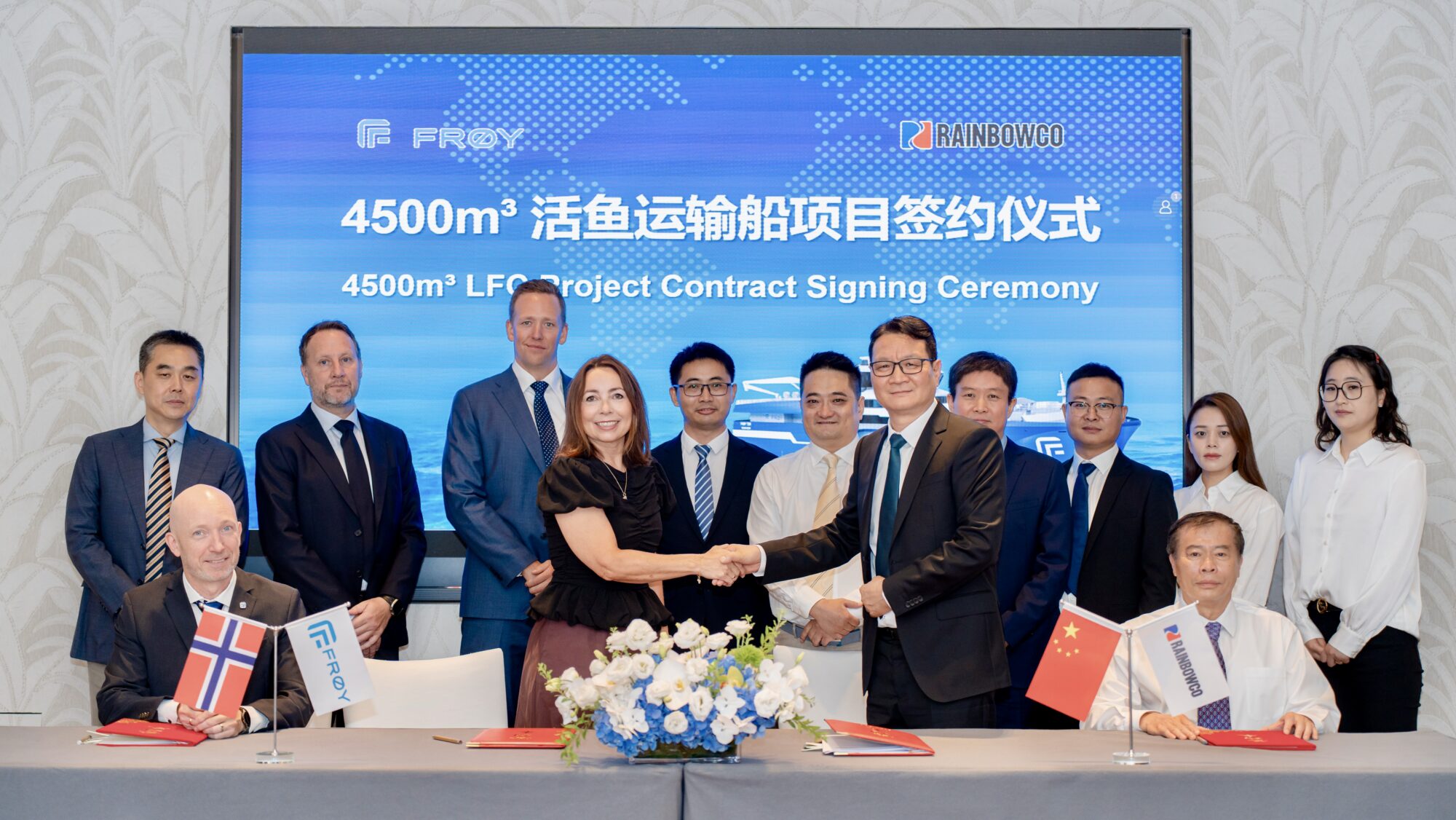

Frøy’s first wellboat order in China is more than a large contract for a Nantong shipyard. It is another sign that Chinese builders are moving into a specialist vessel segment long dominated by European yards.
At a glance
- Buyer: Norwegian aquaculture services group Frøy
- Builder: Nantong Rainbow Offshore & Engineering Equipment in China
- Firm order: Two 4,500-cubic-metre live fish carriers, or wellboats
- Options: Four additional vessels
- Delivery: The two firm vessels are scheduled for 2029
- Potential programme value: RMB 2.8 billion to RMB 3.3 billion ($415 million to $489 million) if all six vessels are built
- Important qualification: The four option vessels are not firm orders, while the wider contract remains subject to conditions including receipt of the first payment
A live fish carrier may sound like a simple transport vessel. In reality, it is closer to a mobile life-support system for aquaculture.
Its cargo is not steel, grain or containers, but large numbers of live fish that are highly sensitive to water temperature, oxygen levels, carbon dioxide, handling stress and exposure to pathogens. The vessel must navigate safely while keeping that living cargo healthy through loading, transport, treatment and discharge.
For decades, the advanced wellboats serving Norway’s salmon industry have largely been designed, equipped and built within Europe’s specialist maritime cluster. That makes Frøy’s decision to place its first Chinese wellboat order particularly significant.
The Norwegian aquaculture services group announced on 11 August that it had contracted Nantong Rainbow Offshore & Engineering Equipment to build two advanced 4,500-cubic-metre wellboats. Frøy also secured options for another four vessels. The two firm newbuildings are due for delivery in 2029.
The order is not merely another export contract for a Chinese yard. It is evidence that China’s shipbuilding industry is pushing beyond its established strength in bulk carriers, containerships and tankers and into a high-value specialist market in which European builders have traditionally held the strongest customer relationships and technical track records.
First, the numbers need careful handling
There are two complementary disclosures behind the transaction.
Frøy’s announcement clearly states that two vessels have been ordered and four more are covered by options, which the company aims to exercise in line with market conditions and customer demand.
A separate stock exchange filing by Jiangsu Rainbow Heavy Industries, the shipyard’s listed parent, does not identify the buyer. However, the yard, vessel type, 4,500-cubic-metre capacity, six-vessel total and option structure all match the Frøy project.
The Chinese filing puts the value of the potential six-vessel programme at RMB 2.8 billion to RMB 3.3 billion, equivalent to roughly $415 million to $489 million at the exchange rates used in contemporaneous reporting. It also states that deliveries will begin in the 29th month after the contract becomes effective.
Crucially, the RMB 2.8 billion to RMB 3.3 billion figure covers the two firm ships and four option vessels together. It is not the disclosed price of the first two ships, and it should not be presented as the value of six firm orders.
The filing also says the contract will take effect only after conditions including receipt of the buyer’s first payment have been met. The deal is denominated in foreign currency, creating exchange-rate exposure, while the exercise of the options remains uncertain.
Even with those qualifications, the programme is substantial. According to Rainbow’s 2025 annual report summary, the group generated revenue of RMB 6.85 billion last year. The potential six-vessel value is therefore equivalent to about 41% to 48% of that annual figure.
That comparison does not mean the contract will immediately become revenue or profit. Shipbuilding income is recognised over a multiyear construction period, and the options may never be exercised. It does, however, illustrate the project’s importance to yard capacity, future workload and earnings visibility.
Why wellboats are difficult to build
With a conventional cargo vessel, the central question is whether the cargo arrives on time and intact. A wellboat must also ensure that its cargo arrives alive and in good condition.
The vessel’s fish tanks must continuously manage water flow, temperature, dissolved oxygen and carbon dioxide. Filtration, ultraviolet treatment and other water-processing systems help maintain water quality and limit biological contamination. During pumping, counting, sorting, loading and discharge, the vessel must minimise stress and physical injury to the fish.
Many modern wellboats also carry out freshwater treatment and delousing operations. That makes them part of the salmon farmer’s production and health-management system, not simply a means of transport.
Biosecurity is one of the most demanding aspects. The Norwegian Veterinary Institute has identified the movement of live aquaculture animals by wellboat as an important potential route for spreading disease between regions.
Pipework design, water treatment, cleaning, disinfection and operating procedures can therefore affect not only the fish aboard one vessel but also the biological separation between different farms.
Frøy says the Chinese-built ships will be based on its NextGen platform, which is already under construction in Europe, and will incorporate further optimisation from ongoing projects and technology development.
As a reference point, Frøy’s published specifications for the European-built NextGen vessel show a ship measuring 87.7 metres in length and 20.6 metres in beam, with two 2,250-cubic-metre fish tanks. The equipment list includes high-capacity water circulation, filtration, ultraviolet treatment, carbon dioxide removal, oxygen systems, and heating and cooling.
Salt Ship Design’s description of that European project also highlights fish welfare, biosecurity, energy efficiency, modularity and cybersecurity.
Those specifications should not be treated as the final equipment list for the two Nantong newbuildings. Frøy has not yet disclosed their full machinery package, fuel solution, equipment suppliers or class notations. They do, however, demonstrate the complexity behind the headline capacity of 4,500 cubic metres.
The yard is not being asked to build a large floating tank. It must integrate a ship, a water-treatment plant, a fish-handling system and a data-driven operating platform capable of functioning reliably at sea.
A 17-yard tender—and more than a price decision
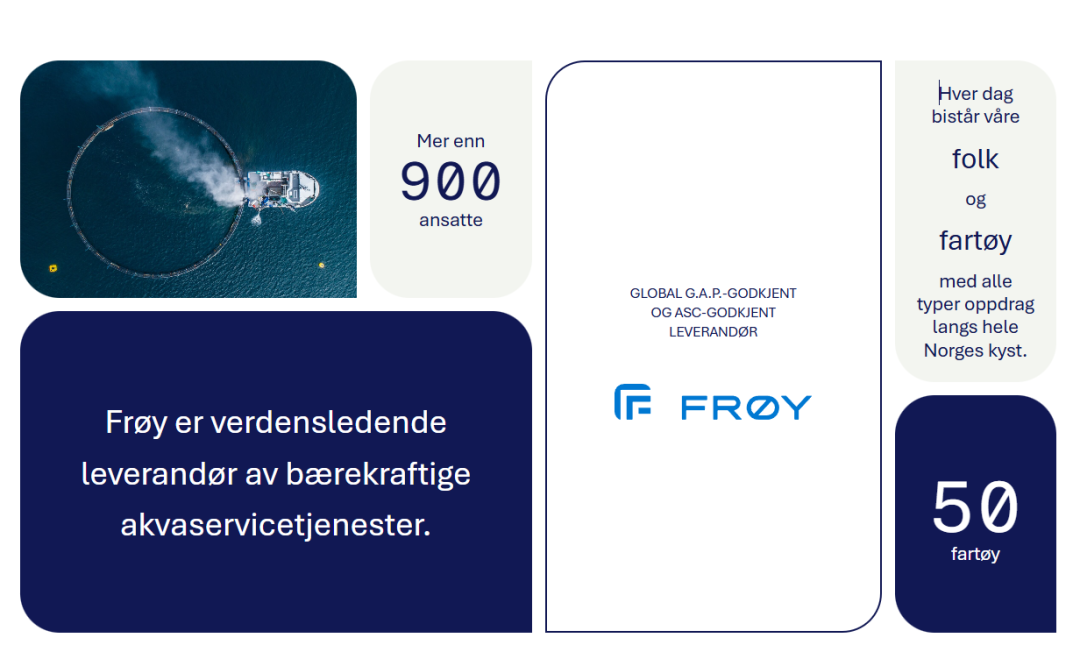
Frøy is not a newcomer searching for the cheapest available construction slot. The company describes itself as a world-leading provider of aquaculture services and says it operates about 50 vessels with more than 900 employees.
It also has extensive experience with European shipbuilding. In 2025, Frøy ordered another 4,500-cubic-metre NextGen wellboat from Spain’s Murueta Shipyard for delivery in 2027.
The decision to build in China followed an unusually broad comparison. Frøy said it conducted an international tender involving 17 shipyards during 2025, alongside technical, financial and integrity assessments supported by external advisers.
Nantong Rainbow therefore won more than a steel-price contest. The selection reflects the owner’s assessment of construction capability, quality control, financial terms, compliance, safety and execution risk.
China’s obvious advantages remain its deep marine supply chain, large-scale industrial capacity and competitive construction costs. Frøy chief executive Tonje Foss said the company wanted to use global capacity to build modern vessels more cost-effectively.
Yet a low price has little value in this segment if delivery, system integration or through-life reliability falls short. The year-long evaluation of 17 yards shows that Frøy was buying a controlled project outcome, not merely less expensive steel.
Chinese construction may also give owners access to capacity beyond the limited schedules of specialist European yards. For Nantong Rainbow, the challenge is to translate China’s strengths in engineering organisation, procurement and production efficiency into a vessel that fits the operational realities of Norwegian aquaculture.
The value of a wellboat is not concentrated in its hull. It lies in the way the hull, fish-handling equipment, water-treatment systems, automation and the owner’s operating knowledge work together.
“Norwegian expertise plus Chinese construction”
The contract does not mean the European supply chain is being replaced wholesale.
Frøy has emphasised that a large share of the value creation will remain in Norway through design, project management, technology development, construction supervision and deliveries from Norwegian equipment suppliers. Its stated ambition is to combine competitive Chinese yard capacity with Norwegian expertise in aquaculture, maritime technology and fish welfare.
This division of labour is already familiar in other high-end vessel segments. European companies retain key roles in design, core systems and operational know-how, while Chinese yards handle detailed engineering, procurement integration and efficient physical construction.
At first, the Chinese yard may capture mainly the construction share. A successful delivery, however, also produces harder-to-acquire assets: system-integration experience, relationships with specialist suppliers and a reference from a demanding owner.
The real barrier to a high-end niche is rarely the ability to build one vessel. It is whether the first project convinces the customer—and the wider market—to order the second series and the third.
Not China’s first deal, but a sign of momentum
The Frøy contract should not be described as the first Northwest European live fish carrier project won by a Chinese shipyard.
In May 2026, CIMC Raffles secured a contract from Pelican Aqua for four firm 5,000-cubic-metre live fish carriers, with options for as many as six more. Deliveries are also scheduled to begin in 2029.
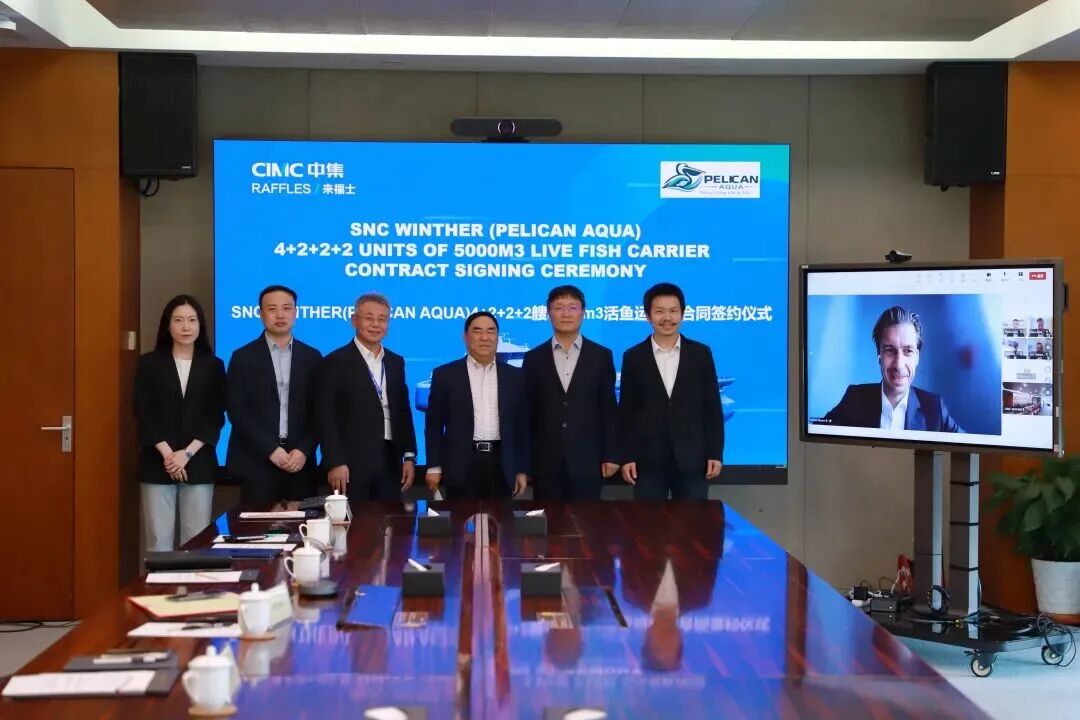
That earlier award makes the Frøy deal more interesting, not less. Within a matter of months, separate Norwegian-linked customers have selected Chinese yards for large, advanced live fish carrier programmes.
The market may therefore be moving beyond a one-off experiment. What is emerging is a repeatable model in which Nordic design and aquaculture technology are combined with Chinese shipbuilding capacity.
Frøy’s status adds weight to that trend. A mature operator with a large working fleet, deep operational experience and an active European newbuilding programme has tested the international market and decided that a Chinese yard can meet its requirements.
The decisive test comes after delivery
For China’s shipbuilding industry, the significance of the order is larger than the six potential hulls.
Chinese yards have steadily increased their presence in vehicle carriers, dual-fuel ships, offshore wind vessels and complex offshore tonnage. Wellboats are a smaller market, but they demand an unusually broad combination of biosecurity, marine engineering, automation, energy efficiency and operational reliability.
Winning Frøy’s approval is therefore an important entry ticket into the Nordic aquaculture equipment chain. But an entry ticket is not the same as a permanent position.
The contract still needs to satisfy its effectiveness conditions. The four options will depend on market demand, customer requirements and confidence in the initial programme. Construction will involve currency exposure, cross-border equipment interfaces, supply-chain coordination, quality supervision and schedule risk.
The answer will ultimately come from the vessels’ delivery performance and operating record after 2029.
If the two firm ships enter service successfully and Frøy subsequently exercises the four options, the programme will become more than a major order for Nantong Rainbow.
It will mark a shift in how some of Europe’s most experienced specialist owners view Chinese shipbuilding: not only as the world’s production base for large series of conventional merchant ships, but as a credible partner for the next generation of technically demanding niche vessels.

READ MORE
 Shipbuilding
Union Maritime Adds Nine Ships Across Five Segments as Newbuild Programme Reaches 79
 Shipbuilding
Fujian Guohang Plans RMB2.49bn Fleet Expansion into LR2 Tankers and Heavylift
 Shipbuilding
Swire Buys Four Heavy-Lift Ships in Latest Strategic Shift
 Shipbuilding
DAB Group Enters Shipowning With First Ultramax Pair Ordered in China
 Shipbuilding
French Space Logistics Owner Selects China’s GSI for Next-Generation Ro-Ro Vessel Project
 Shipbuilding
Will Newbuilding Prices Still Be This High a Year From Now?
 Shipbuilding
Guohang Enters Tankers with RMB 2.49bn Fleet Plan
 Shipbuilding
Henghui Reportedly Orders Up to Four Heavy-Lift Ships at ZPMC
 Shipbuilding
24 Firm Orders + 16 Options: Ren Yuanlin Accelerates Yangzijiang Maritime’s ‘Financial Shipowner’ Strategy
 Shipbuilding