


China’s First Arctic Container Service Reaches Europe
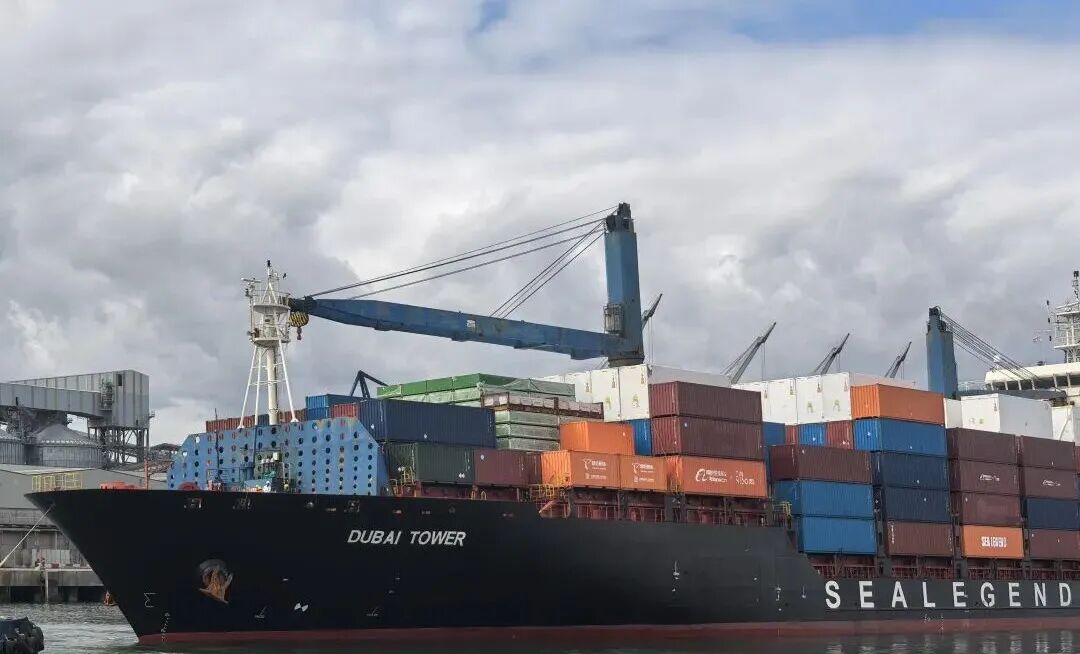

The Dubai Tower has completed a voyage from China to Britain via Russia’s Northern Sea Route, offering a real-world test of whether the Arctic can become a seasonal alternative to the Suez Canal for selected China–Europe cargoes.
The container vessel Dubai Tower arrived at Teesport in northeast England on September 9 after sailing from eastern China via the Arctic. The ship left China on August 15 and was reportedly carrying around 1,300 TEU of cargo, including electric vehicles, batteries and renewable-energy equipment.
The voyage, operated by Chinese company Sea Legend, has been described as China’s first regular container service to Europe through the Arctic. However, the operation remains a seasonal and experimental undertaking rather than a fully established year-round liner route.
A landmark voyage through the Northern Sea Route
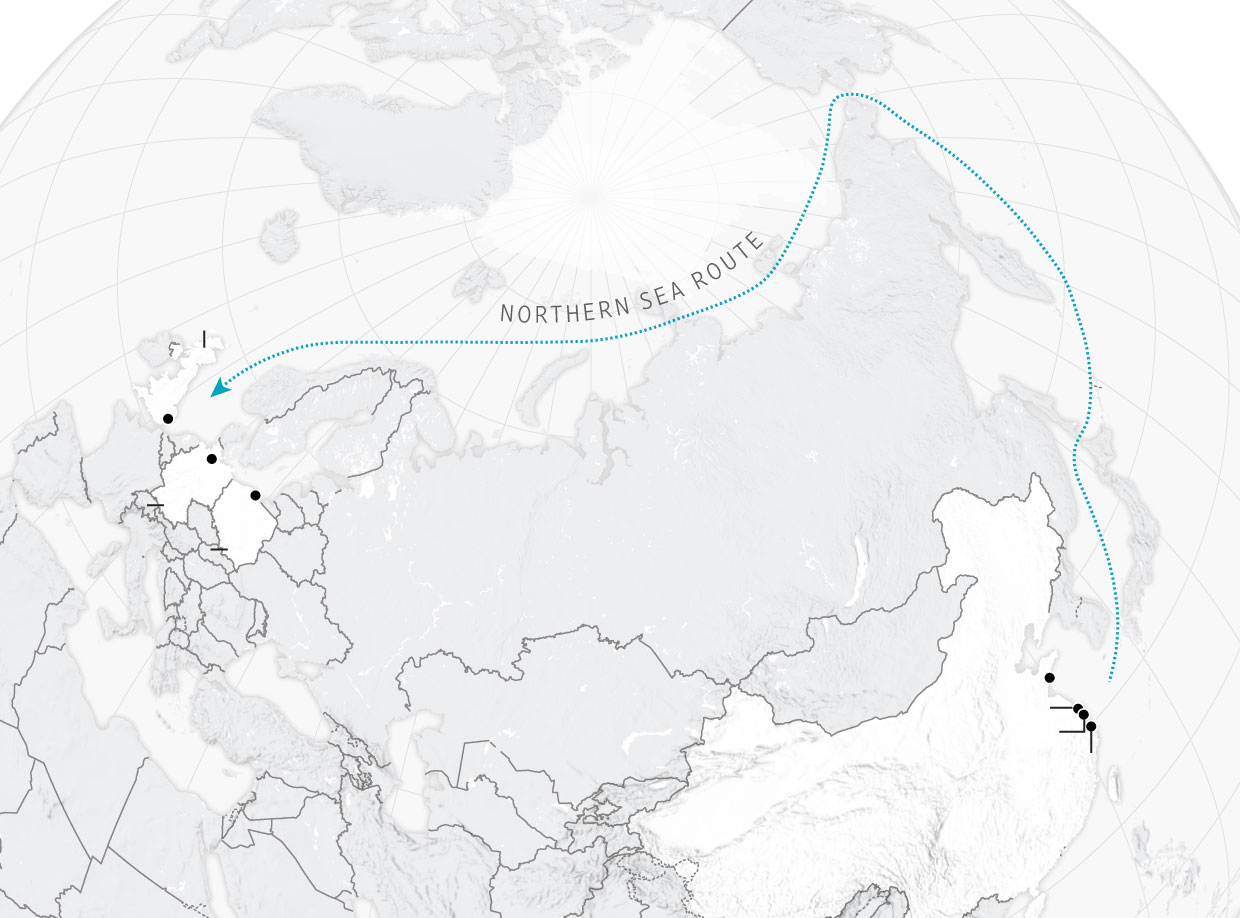
According to Reuters, the Dubai Tower reached Teesport after sailing from China along the Northern Sea Route, which follows Russia’s northern coastline before linking with the North Atlantic and European ports.
The original schedule reportedly envisaged a call at Felixstowe, followed by Rotterdam, Hamburg and Gdynia. The vessel’s arrival at Teesport indicates that the European port rotation may still be adjusted according to berth availability, cargo distribution, sailing conditions and operational requirements.
Planned ports of call of Dubai Tower container ship
Bering
Sea
Arctic
Ocean
Atlantic
Ocean
U.K.
Norwegian Sea
Felixstowe
Hamburg
Gdynia
Russia
Germany
Japan
Poland
Qingdao
East
China
Taicang
Shanghai
Ningbo
China
Note: Usual Northern Sea Route shown for illustrative purposes
Source: Sea Legend
Daniel Kiss/WSJ
Earlier route plans published by The Wall Street Journal showed a network linking Chinese ports including Ningbo, Shanghai, Taicang and Qingdao with Felixstowe, Hamburg and Gdynia.
The difference between the planned and actual port rotation is significant. Unlike established liner services, which generally operate according to a fixed network of port calls, an early-stage Arctic service may need to adapt its European gateway as the operator builds cargo volumes and tests local logistics connections.
Cargo linked to China’s export economy
The reported cargo mix is closely linked to China’s manufacturing export base. Electric vehicles, batteries and renewable-energy equipment are all high-value products for which transit time and supply-chain reliability can be commercially important.
A shorter China–Europe route could reduce inventory in transit and improve delivery times for selected exporters. It may also provide an alternative to routes through the Suez Canal and the Cape of Good Hope, particularly when security risks affect the Red Sea and adjacent waters.
The Arctic route, however, is unlikely to serve the same range of cargoes and ports as the Suez route. It offers fewer commercial port options and is better suited to point-to-point shipments with clearly defined origins and destinations.
The route may be particularly relevant to higher-value cargoes that can absorb more complex voyage planning and potentially higher insurance and handling costs. Le Monde noted that electric vehicles and lithium batteries may also attract interest because Arctic transit avoids some of the high-temperature conditions encountered on more southerly routes.
That does not make Arctic shipping inherently safer. Ice, poor visibility, severe weather and limited emergency-response capacity create a different and potentially more serious risk profile.
Shorter distance does not guarantee lower total cost
The main commercial attraction of the Northern Sea Route is its shorter distance between Northeast Asia and Northern Europe.
A trial voyage in 2025 reportedly completed the journey in around 20 days, compared with approximately 27 days for a comparable non-stop route via the Suez Canal. The time advantage is even more pronounced when compared with voyages diverted around the Cape of Good Hope.
The shorter route can reduce sailing time and fuel consumption. It also avoids several strategic chokepoints affected by geopolitical tensions, including the Red Sea and the Bab el-Mandeb Strait.
But fuel savings are only one part of the transport equation. Arctic voyages may involve additional costs related to:
- ice-class or ice-strengthened vessels;
- specialised ice routing and forecasting;
- Northern Sea Route permits;
- icebreaker assistance;
- higher insurance premiums;
- polar navigation training;
- limited repair and emergency-response facilities; and
- sanctions and compliance screening linked to Russian services.
The commercial calculation therefore depends on the total cost per container, not simply the number of nautical miles saved.
Seasonality remains the central constraint
The Northern Sea Route is not yet a year-round alternative to the Suez Canal. Its most commercially accessible navigation window is concentrated in late summer and early autumn, when sea-ice conditions are more manageable.
Sea Legend is reportedly planning eight Arctic crossings in 2026. In practice, that represents an approximately eight-week seasonal operating window rather than a conventional year-round liner schedule.
This distinction matters for cargo owners. A route that is shorter but vulnerable to ice conditions, weather delays or changes in sailing restrictions may not offer a reliable advantage over a longer route with more predictable schedules.
The return leg is another unresolved issue. China can provide substantial export cargo for westbound sailings, but a viable container service also needs sufficient cargo from Europe back to Asia. Without balanced two-way demand, vessels may face low utilisation or empty repositioning costs.
Le Monde’s report cited industry analysis suggesting that the service would represent only a very small share of Asia–Northern Europe container volumes, particularly because it would operate for a limited number of weeks each year.
Russian control creates a separate layer of risk
The Northern Sea Route runs largely along Russia’s Arctic coastline. Rosatom, Russia’s state nuclear corporation, is responsible for managing the route’s infrastructure and administering navigation permissions.
That makes Arctic container shipping not only a technical and commercial issue, but also a regulatory and geopolitical one.
Vessels may need to assess the implications of Russian port calls, bunkering, icebreaker assistance and other support services. These issues can affect European cargo owners, insurers, banks and logistics providers even when the cargo itself is unrelated to Russia.
Le Monde reported that companies using Russian ports or receiving Russian maritime support could face additional sanctions-compliance scrutiny.
This is one reason why major international carriers have not yet embraced the route on a broad scale. A shorter transit time must be weighed against insurance, financing, compliance and reputational considerations.
A seasonal supplement, not a Suez replacement
The Dubai Tower is a relatively small container vessel. Earlier reports put its maximum capacity at around 1,740 TEU, far below the capacity of today’s largest vessels, which can exceed 20,000 TEU.
The scale of the operation limits its immediate impact on global liner shipping. The Arctic route cannot currently replicate the extensive port coverage, cargo aggregation and schedule density provided by major Asia–Europe services through the Suez Canal.
Its more realistic role is as a seasonal supplement for:
- time-sensitive, high-value cargoes;
- shippers seeking to avoid Red Sea risks;
- China–Northern Europe point-to-point traffic;
- electric vehicles, batteries and specialised equipment; and
- operators testing polar navigation and logistics infrastructure.
For Chinese shipowners, the development may support demand for medium-sized ice-strengthened container vessels and specialised seasonal services. For Chinese shipyards, it could create opportunities in ice-class ships, polar-support vessels, navigation systems and cold-weather equipment.
Ports will also compete for a role in the emerging network. Teesport’s arrival suggests that ports outside the traditional UK gateway system could seek to position themselves as Arctic service destinations, provided they can offer suitable cargo-handling, inland-transport and dangerous-goods capabilities.
The next test will be whether the service can operate repeatedly and reliably over several seasons. Key indicators will include annual navigable days, schedule reliability, total cost per container, cargo utilisation and the availability of return cargo.
The Dubai Tower has demonstrated that a Chinese container vessel can complete a commercial Arctic voyage to Europe. Whether that achievement develops into a viable shipping service will depend on far more than the route’s shorter distance. It will require predictable ice conditions, adequate infrastructure, acceptable insurance and compliance costs, and a sustainable two-way cargo base.

READ MORE
 Containers
What Kind of Company Is Seaspan Today?
 Containers
With an Orderbook Above 45% of the Fleet, Why Are Container Lines Still Paying Up for Ships?
 Containers
HMM Approves $1.62 Billion Plan to Add 12 Containerships
 Containers
Ningbo Containerized Freight Index Weekly Commentary Freight Rates Continued Their Divergent Trend; Composite Index Edged Up
 Containers
Buy Again! From Ships to Ports: Inside the Maersk Family’s Infrastructure Buying Spree
 Containers
CMA CGM Updates eBL Templates to Clarify Electronic Original Status
 Containers
Bigger Fleets, Wider Networks: China’s Provincial Shipping Companies Step Up Expansion
 Containers
2,824-TEU GFS PRIDE Sinks in Hormuz; All 21 Crew Safe
 Containers
Zhonggu Orders Its First 14,000 TEU Ships as Annual Newbuilding Tally Reaches 20
 Containers