


Container Fleet Nears 34m TEU — With More Than 14m TEU Still on Order
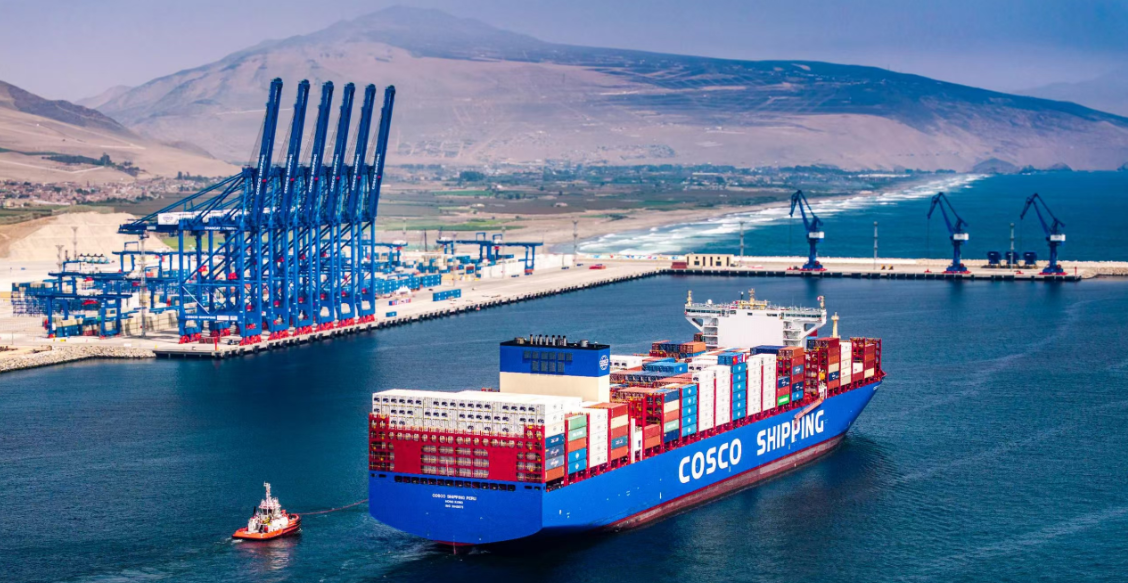

Global containership capacity is about to pass 34 million TEU after adding 10 million TEU in just five and a half years. Yet the more consequential number may be what comes next: more than 14 million TEU of new capacity is scheduled for delivery by the end of 2030, with Chinese shipyards sitting at the centre of the current ordering cycle.
Global containership capacity is set to cross 34 million TEU for the first time, marking the latest milestone in an expansion cycle that has accelerated dramatically since early 2021.
At the beginning of September, the fleet was just 8,000 TEU short of 34 million TEU under BIMCO’s calculation. Another 46 containerships with a combined capacity of 286,000 TEU are scheduled for delivery during September, meaning only a handful need to enter service for the threshold to be passed.
The pace of growth is striking. The fleet has added 10 million TEU, or 42%, in just five and a half years, rising from around 24 million TEU. The previous increase of 10 million TEU — from 14 million to 24 million TEU — took slightly more than ten and a half years.
The 34 million TEU figure varies slightly between fleet databases because of methodology and timing. Alphaliner, for example, put the fleet at about 34.16 million TEU by mid-August, while BIMCO’s dataset had not yet crossed the 34 million mark at the start of September. The difference does not alter the broader trend: global containership capacity is expanding at one of the fastest sustained rates seen in the modern liner era.
Record deliveries, almost no recycling
The expansion has been driven by an unusual combination of record newbuilding deliveries and exceptionally weak ship recycling.
Less than 300,000 TEU of containership capacity has been recycled over the past five and a half years, according to BIMCO. The last comparable period of such limited recycling was between early 2004 and mid-2009, when the global fleet was only around one-third of its present size.
The vessels entering the fleet are also significantly larger.
Ships above 12,000 TEU accounted for roughly two-thirds of the 10 million TEU added since early 2021. Their share of total fleet capacity has risen from about 30% to 40%, while the average containership size has increased by 14%.
That matters because new capacity does not enter every trade evenly. Ultra-large and neo-panamax vessels are initially concentrated on the major east-west routes. The ships they replace can then cascade into secondary and regional trades, spreading the impact of newbuilding deliveries well beyond the Asia-Europe and transpacific corridors.
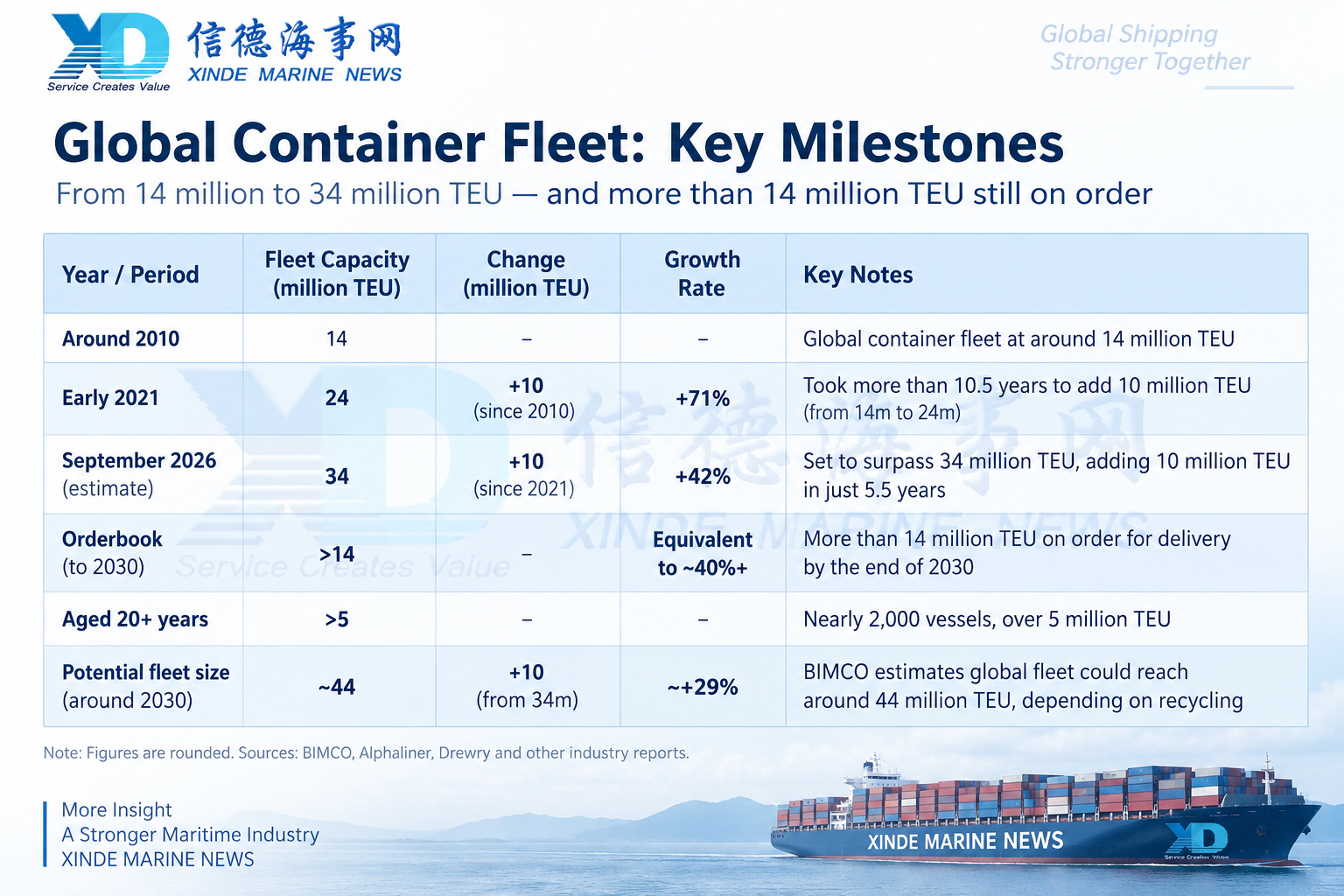
Sources: BIMCO and industry reporting based on BIMCO data.
More than 14m TEU is still coming
The bigger issue for the market is not the 34 million TEU already afloat, but the capacity still sitting in the orderbook.
By mid-August, Alphaliner data showed 1,724 containerships totalling 13.97 million TEU on order, against an existing fleet of about 34.16 million TEU. That put the orderbook-to-fleet ratio at around 40%.
Further contracting has continued since then. BIMCO now says the orderbook contains more than 14 million TEU scheduled for delivery by the end of 2030.
There is a sizeable pool of ageing tonnage that could eventually leave the fleet. Nearly 2,000 containerships representing more than 5 million TEU are already at least 20 years old. During the next five years, these vessels will reach or exceed the historical average recycling age of around 25 years.
But the arithmetic remains demanding.
Even if every vessel currently aged 20 years or more were recycled by the end of the decade — an aggressive assumption — potential removals of around 5 million TEU would remain far below the more than 14 million TEU currently scheduled to arrive.
BIMCO estimates that, depending on recycling activity, the global fleet could add another 10 million TEU over the next five years and approach 44 million TEU.
That does not mean the industry is automatically heading for a 10 million TEU surplus. The distinction between nominal fleet capacity and effective available capacity remains critical.
Why 14m TEU of orders does not equal 14m TEU of oversupply
The Red Sea crisis has provided perhaps the clearest demonstration of how geography can change vessel supply without adding or removing a single ship.
Diversions around the Cape of Good Hope lengthened Asia-Europe voyages and required carriers to deploy more ships to maintain weekly service frequencies. Sea-Intelligence has estimated that a return to normal Suez Canal routings would release around 2.1 million TEU of nominal capacity, equivalent to about 6.5% of the global fleet at the time of its analysis.
That is effectively the equivalent of introducing another very large liner fleet into the market without taking delivery of any new vessels.
Port delays are absorbing another significant block of capacity.
Sea-Intelligence said in August that around 5% of global deep-sea capacity, or roughly 1.7 million TEU, was being tied up by vessel delays. The normal pre-pandemic level between 2011 and 2019 was around 2.2%, meaning approximately 1 million TEU of capacity is currently being absorbed above the historical baseline.
This makes the future supply-demand balance dependent on several variables moving simultaneously: cargo demand, vessel speeds, port congestion, recycling, network design and, above all, whether major services return from the Cape of Good Hope to the Suez Canal.
A market with 36 million or 38 million TEU of nominal capacity can behave very differently depending on how much of that capacity is physically available to move cargo.
Carriers are taking greater control of the fleet
The latest expansion cycle is also changing who owns the ships.
Liner operators accounted for around 85% of the 10 million TEU of capacity added over the past five and a half years, according to BIMCO. Their share of controlled global capacity has consequently risen from around 57% in early 2021 to 65% today.
That shift could have longer-term implications for the independent containership-owner and charter markets.
The world's largest carriers have continued to secure sizeable newbuilding pipelines. MSC is approaching 7.4 million TEU of operated capacity, while CMA CGM had reached around 4.39 million TEU by mid-2026 and had approximately 1.8 million TEU on order, compared with Maersk's 4.73 million TEU fleet and around 1.2 million TEU orderbook at that point.
COSCO SHIPPING Holdings has also accelerated its expansion sharply in 2026.
Its latest contracts cover 12 LNG dual-fuel containerships of about 22,000 TEU and six 3,200 TEU vessels, representing investment of approximately RMB20.27 billion ($2.99 billion). The deal lifted the group's owned newbuilding pipeline to around 100 ships and 1.46 million TEU, according to its end-July fleet position adjusted for the latest orders.
For COSCO SHIPPING Holdings alone, 2026 contracting has reached 48 containerships with roughly 676,800 TEU of nominal capacity, illustrating how rapidly the orderbook can continue to expand even while a record number of ships are already entering service.
China sits at the centre of the new supply cycle
The newbuilding wave has another defining characteristic: an increasingly large proportion of the ships are being built in China.
Lloyd's List reported in April that Chinese yards accounted for approximately 75% of the global containership orderbook. Of 120 containerships ordered worldwide during the first quarter of 2026, 96 were placed at Chinese yards.
The concentration strengthened further as the year progressed. Clarksons Research data cited by ChosunBiz showed that Chinese shipyards secured more than 80% of global new containership orders in the first half of 2026, with roughly 380 ships contracted worldwide during the period.
China's position is no longer primarily based on bulk volume or smaller standardised vessels.
Its yards now compete across virtually the entire containership spectrum, from feeder and regional vessels to 14,000-17,000 TEU ships and LNG- or methanol-capable megamaxes above 20,000 TEU.
That industrial progression can be seen in projects such as the 24,000 TEU-class CMA CGM Grand Palais, delivered by CSSC's Hudong-Zhonghua Shipbuilding in Shanghai in March 2026, as well as the large orderbooks held by yards including Jiangnan Shipyard, Shanghai Waigaoqiao Shipbuilding, Hudong-Zhonghua, Yangzijiang Shipbuilding and the reactivated Hengli Heavy Industries.
MSC provides one of the clearest illustrations. Clarksons data cited in July showed that the carrier had 128 containerships on order, all at Chinese shipyards at that stage.
For Chinese yards, the challenge is therefore shifting from simply winning orders to executing increasingly dense delivery schedules through 2028-2030 while maintaining margins, productivity and the ability to build increasingly sophisticated dual-fuel tonnage.
The real test begins after 2026
Crossing 34 million TEU is a milestone, but it is not the most important number for the next phase of the market.
The industry has just added 10 million TEU in five and a half years, recycling less than 300,000 TEU along the way. It now has more than 14 million TEU of additional ships scheduled to arrive by the end of the decade.
The critical question is how much of that new supply the market will actually have to absorb.
If Cape diversions persist, port delays remain elevated and recycling accelerates as older ships approach 25 years of age, a meaningful portion of nominal fleet growth can continue to be absorbed.
The supply picture would look very different if those factors move in the opposite direction.
A broad return to Suez could release millions of TEU of effective capacity; improving port reliability would free further ships; and limited demolition combined with a concentrated 2027-2029 delivery programme would make the underlying newbuilding pipeline much more visible in freight and charter markets.
For that reason, the variables worth watching are increasingly measurable: annual newbuilding deliveries, demolition volumes, Suez routings, schedule delays and container trade growth.
The 34 million TEU milestone records what has already happened. The more important test is how the market absorbs the next 14 million TEU.

READ MORE
 Containers
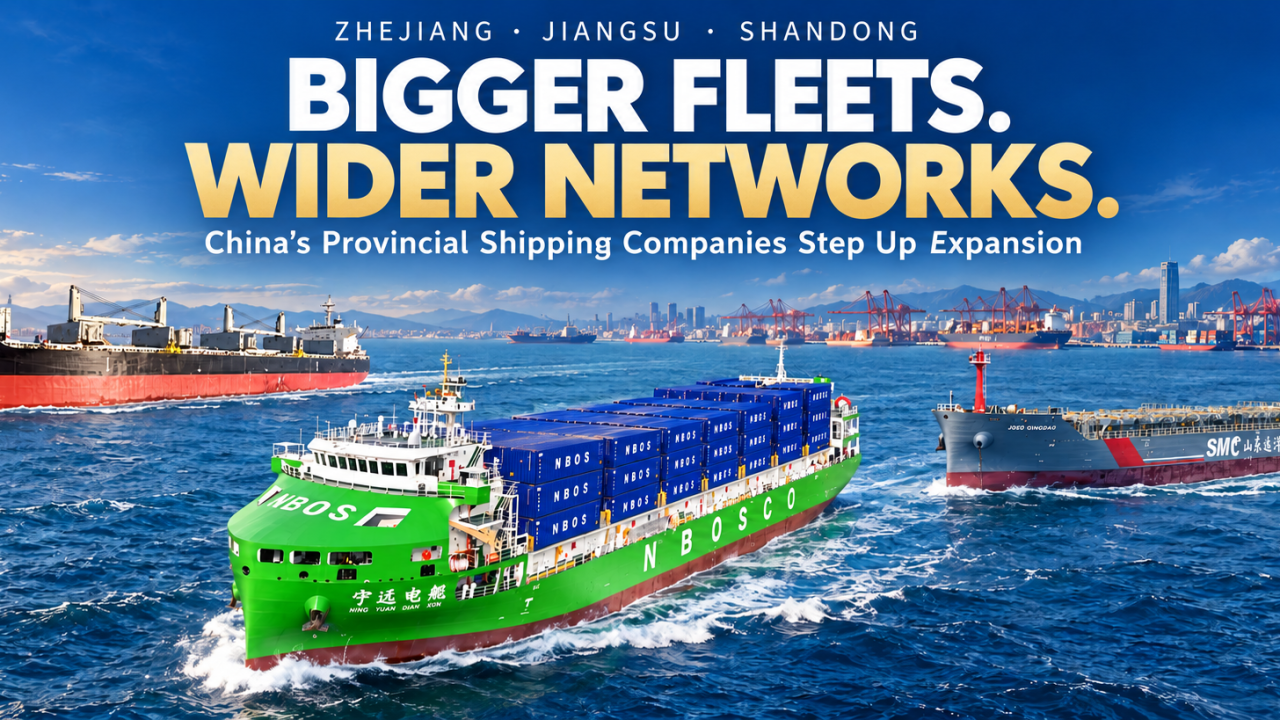
Bigger Fleets, Wider Networks: China’s Provincial Shipping Companies Step Up Expansion
 Containers
2,824-TEU GFS PRIDE Sinks in Hormuz; All 21 Crew Safe
 Containers
Zhonggu Orders Its First 14,000 TEU Ships as Annual Newbuilding Tally Reaches 20
 Containers
CMA CGM Updates eBL Templates to Clarify Electronic Original Status
 Containers
CMA CGM Expands Biomethane Push with Singapore Supply Partnership
 Containers
sakos Returns to Containership Ordering After Four Years with Hengli Deal
 Containers
Global Ambitions, Provincial Roots: China’s State-Owned JOSCO Expands Overseas
 Containers
China Merchants links container and bulker businesses in Australia trial
 Containers
Ningbo Containerized Freight Index Weekly Commentary North America Freight Rates Remained Elevated; Composite Index Decline Narrowed
 Containers