


CIMC Container Volumes Rise, but Profit Slumps as Pricing and FX Pressure Bite
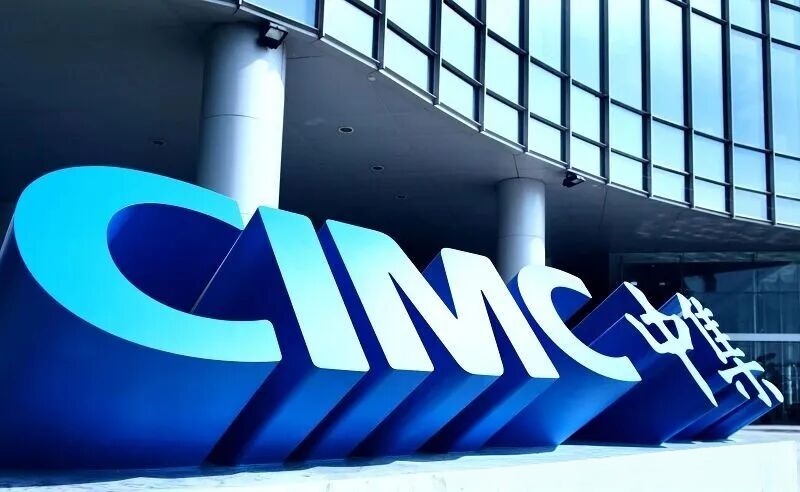

China International Marine Containers sold nearly 1.25 million TEU of dry and reefer containers in the first half of 2026, but net profit from container manufacturing plunged 81% to RMB272 million. The divergence between volumes and earnings highlights a much leaner container manufacturing cycle, just as offshore engineering emerges as a stronger profit contributor for the Chinese equipment giant.
China International Marine Containers (Group) Co., Ltd. (CIMC) shipped more containers in the first half of 2026, but earned substantially less from making them.
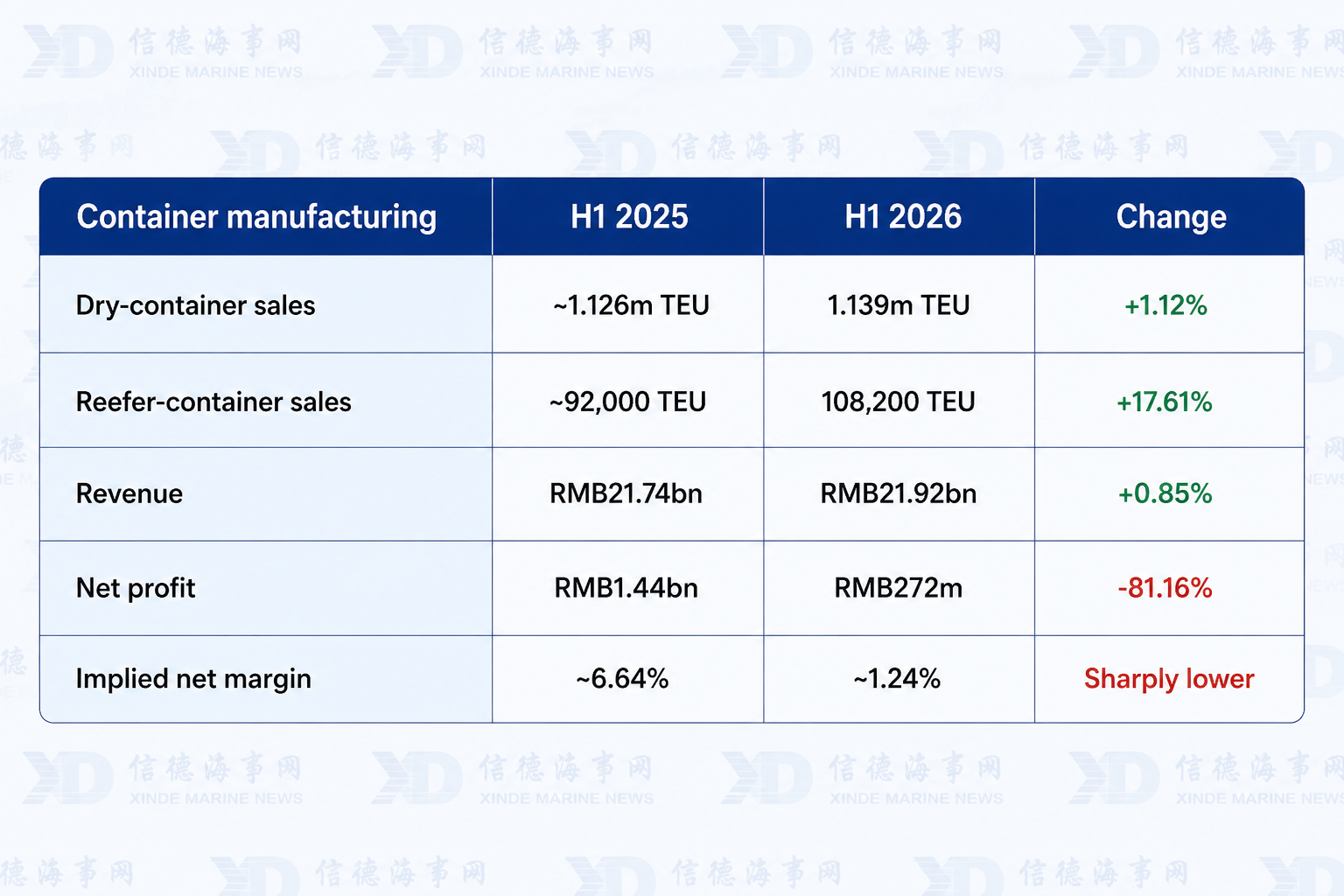
The Shenzhen-headquartered group sold 1.1385 million TEU of ordinary dry containers, up 1.12% year on year, while reefer sales increased 17.61% to 108,200 TEU. Combined sales of the two main categories reached nearly 1.25 million TEU.
Yet revenue from container manufacturing edged up just 0.85% to RMB21.92 billion ($3.1 billion), while segment net profit fell from RMB1.44 billion a year earlier to just RMB272 million, a decline of 81.16%.
The numbers reveal one of the clearest changes in today's container equipment market: demand is still there, but the extraordinary profitability seen during the pandemic-era container shortage is not.
CIMC has led global container sales for decades and says its dry-container market share has historically remained at 50% or above, making its results a useful barometer of conditions in the global box manufacturing industry.
More boxes, much thinner margins
The first-half performance was not the result of a collapse in demand.
Global container trade remained resilient, while continued disruption to shipping networks — including longer voyages, geopolitical risk and congestion at major ports — kept equipment tied up for longer periods and supported replacement and incremental demand.
Reefer containers were particularly strong, with CIMC's sales rising by nearly 18%. Dry-box volumes also remained slightly above last year's level.
The problem was the amount of profit attached to those volumes.
Based on the reported segment figures, the container manufacturing business generated a net margin of only around 1.24% in the first half, compared with approximately 6.64% a year earlier.
CIMC attributed the earnings pressure in part to lower year-on-year prices for standard containers and foreign-exchange effects.
The contrast with the pandemic boom is striking.
In 2021, when severe port congestion, equipment dislocation and slow empty-container repositioning produced an acute global box shortage, CIMC's container manufacturing business generated RMB65.97 billion in revenue and RMB11.33 billion in net profit. Its dry-container sales reached 2.51 million TEU that year.
That implies a full-year segment net margin of roughly 17% in 2021, although the comparison with a half-year period five years later is not strictly like-for-like because of changes in product mix and market conditions.
It nevertheless illustrates how far container manufacturing economics have normalised.
For manufacturers, rising box volumes are no longer enough. Pricing power has become the critical variable.
Currency losses add pressure at group level
Foreign exchange was another major drag on CIMC's first-half earnings.
Group revenue rose about 3.7% to RMB78.91 billion, while net profit attributable to shareholders and other equity holders fell about 42% to RMB740 million.
Foreign-exchange losses increased sharply from roughly RMB47 million to RMB803 million.
That does not mean the entire RMB803 million currency loss should be attributed to container manufacturing. CIMC is a diversified global equipment group with operations spanning containers, road transport vehicles, energy and chemical equipment, offshore engineering and logistics, and the disclosed group-level FX figure has not been broken down entirely by business segment.
The distinction matters.
Lower standard-box pricing directly affected container manufacturing economics, while currency movements added another layer of pressure across the wider group.
CIMC is listed in both Shenzhen and Hong Kong and has expanded well beyond the container business that established its global position.
Offshore engineering moves in the opposite direction
The most striking contrast in CIMC's results came from offshore engineering.
The segment generated RMB718 million in net profit in the first half, up 155.52% year on year, overtaking container manufacturing as the group's largest profit contributor among its principal business segments.
Its orderbook also continued to expand.
CIMC Raffles secured around $3.2 billion of new orders during the first six months of the year, compared with just $106 million in the same period of 2025, while its backlog reached a record $7.62 billion.
That pipeline increasingly extends beyond the drilling rigs historically associated with China's offshore engineering sector.
CIMC Raffles has built positions in FPSOs and FLNG units, offshore renewable-energy equipment, specialised vessels and, more recently, conventional large merchant ships.
In March, the company secured contracts from Bruton Ltd for four 319,000-dwt VLCCs. Construction began in May, with the contract taking effect on March 20 and a planned project duration of 28 months.
The group has also expanded its FPSO work. CIMC Raffles has previously won hull EPC contracts for Petrobras-linked FPSO projects through Seatrium, including the P-84 and P-85 units, as deepwater oil development drives renewed investment in floating production infrastructure.
The shift does not mean CIMC is becoming less important in containers. Container manufacturing remains one of its largest businesses by revenue and CIMC retains enormous scale in the global equipment market.
But the group's earnings mix is beginning to look very different from its revenue mix.
Containers still provide scale. Offshore engineering is providing an increasing share of profit growth.
US antitrust case adds a separate uncertainty
CIMC is also dealing with a US criminal antitrust case unrelated to the immediate pricing and foreign-exchange pressures disclosed in its first-half results.
The US Department of Justice announced in May that CIMC and three other container manufacturers, together with seven executives, had been indicted over an alleged conspiracy to restrict production and fix prices for standard dry shipping containers.
The alleged conduct ran from as early as November 2019 until at least January 2024, according to the department. The DOJ said the case involves alleged violations of Section 1 of the Sherman Antitrust Act.
The allegations remain criminal charges, not findings of liability, and the case is ongoing.
That distinction is particularly important when assessing CIMC's current profitability. There is no disclosed basis for treating the US proceedings as the cause of the 81% decline in first-half container manufacturing profit.
The more immediate drivers disclosed by the company are weaker standard-container pricing and foreign-exchange pressure.
A different profit engine is emerging
CIMC's first-half results therefore tell two stories at once.
The first is about the normalisation of container manufacturing. Global trade, supply-chain disruption and equipment replacement continue to generate substantial demand, but manufacturers are operating with far less pricing power than during the exceptional 2021 cycle.
The second is about CIMC itself.
The company remains the dominant global container manufacturer, but an increasingly important part of its earnings growth is being generated by businesses tied to offshore oil and gas, floating production, LNG infrastructure and high-value marine engineering.
That does not yet amount to a complete transformation of the group. A $7.62 billion offshore orderbook is not the same as $7.62 billion of future profit: contract margins, project execution, cost inflation, customer concentration and the timing of revenue recognition will determine how much value ultimately flows through to earnings.
But the direction is increasingly visible.
For investors and shipping industry customers, the next set of results may therefore be judged on more than how many containers CIMC sells.
Three variables matter most: whether standard box prices recover, whether the FX drag eases, and how efficiently CIMC Raffles converts its record offshore backlog into profitable revenue.
If those trends continue to diverge, CIMC's profit engine may shift well before its revenue profile does.


READ MORE
 Containers
China Merchants links container and bulker businesses in Australia trial
 Containers
Ningbo Containerized Freight Index Weekly Commentary North America Freight Rates Remained Elevated; Composite Index Decline Narrowed
 Containers
CMA CGM’s $1.4bn FedEx Supply Chain Deal: How Its Global Logistics Network Is Taking Shape
 Containers
Global Ambitions, Provincial Roots: China’s State-Owned JOSCO Expands Overseas
 Containers
CMA CGM vs Maersk: A New Arms Race Begins!
 Containers
COSCO SHIPPING Sets Group Methanol Bunkering Record with 7,500-Tonne Delivery
 Containers
Up to 30 New Feeders: Inside Contships’ Fleet Renewal Strategy
 Containers
COSCO SHIPPING Holdings to Launch Third Far East–ECSA Service in December
 Containers
CMA CGM Expects Car Carrier Fleet to Reach Around 21 Vessels
 Containers