


World First: Maersk to Install 35-Metre Rotor Sail on 8,700-TEU Containership
The mid-2027 pilot will test whether wind-assisted propulsion can deliver measurable fuel and emissions savings without compromising cargo capacity, port operations or schedule reliability.
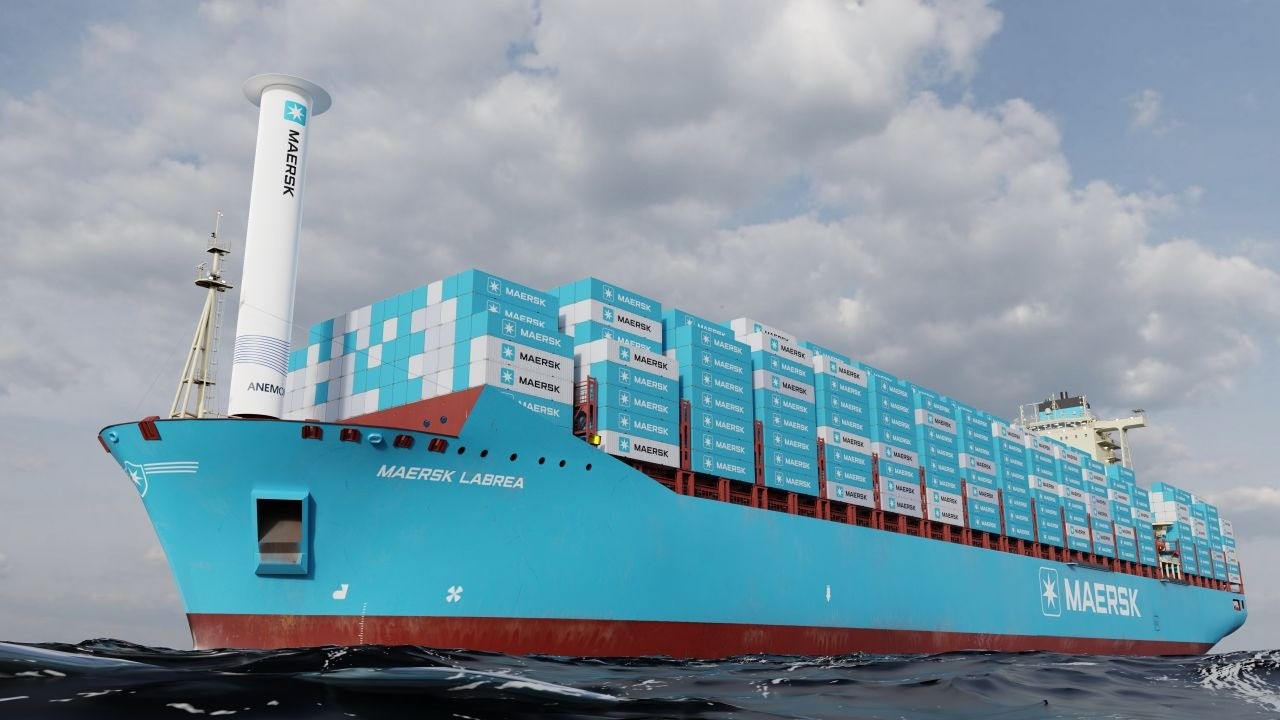

A.P. Moller–Maersk is bringing wind-assisted propulsion into its containership fleet, selecting UK-based Anemoi Marine Technologies to install a Rotor Sail on an 8,700-TEU Maersk Lima-class vessel.
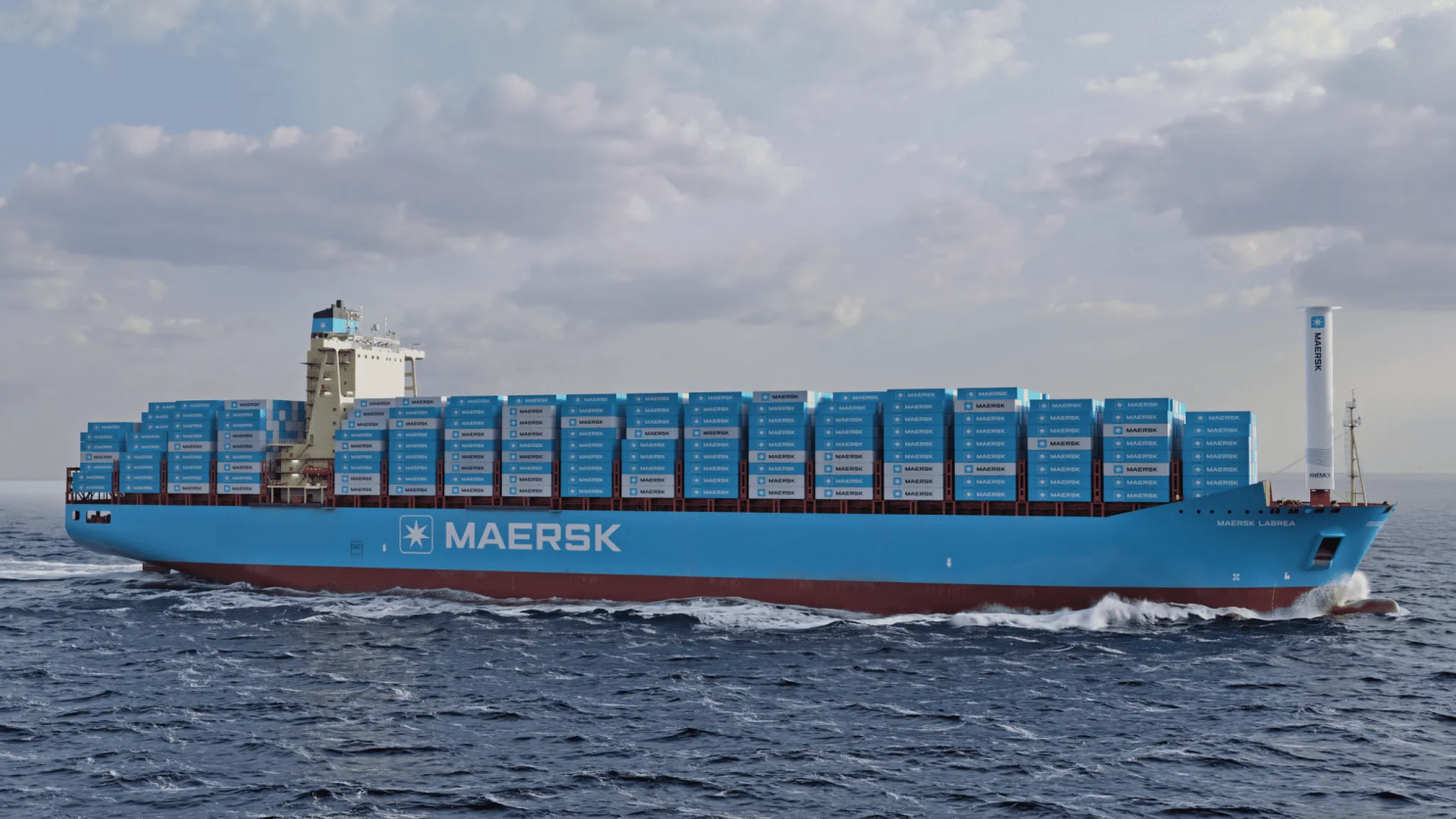
Under the agreement, Anemoi will design, manufacture and deliver a fixed Rotor Sail measuring five metres in diameter and 35 metres in height. Installation is scheduled for mid-2027, after which the system will be tested during the vessel’s normal commercial operations, primarily on expected North and South Atlantic voyages.
According to Anemoi, the project will mark the first installation of a Rotor Sail on a containership. The technology has already been deployed in other shipping segments, particularly on bulk carriers, tankers and general cargo vessels, but its application in container shipping has remained extremely limited.
The Maersk pilot will initially involve only one Rotor Sail. Anemoi typically installs three to five units on a large commercial vessel, making this a relatively controlled technology trial rather than a full-scale wind-propulsion installation. Maersk will use the project to examine how the system interacts with containership design, cargo operations, service speeds and liner schedules, while collecting the long-term operational data required to assess its potential across a wider fleet.
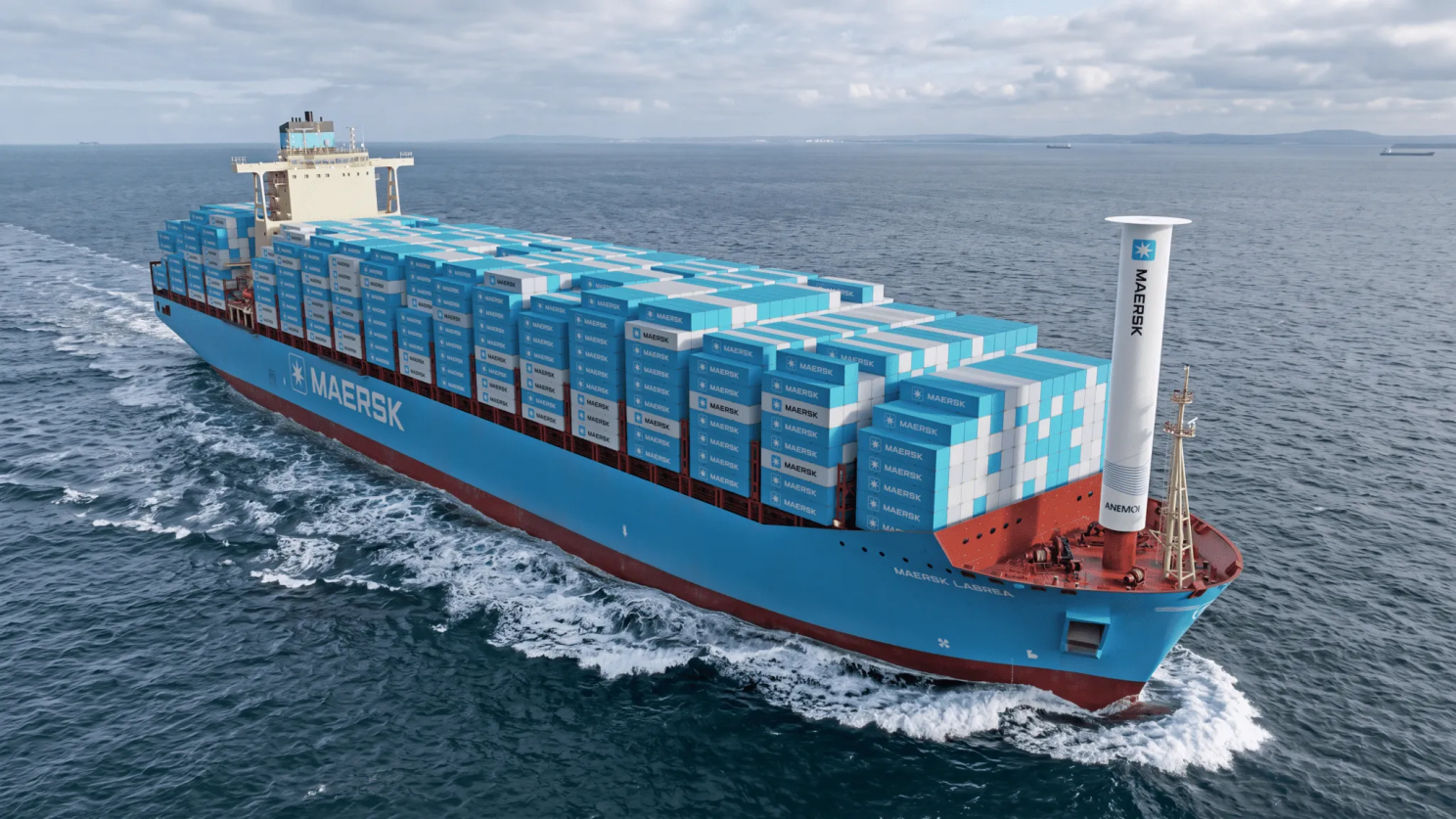
Rotor Sail technology enters container shipping
The system selected by Maersk is also known as a Flettner Rotor Sail. Instead of using canvas sails, masts and conventional rigging, it consists of a tall vertical cylinder driven by an electric motor.
When wind passes across the rotating cylinder, the difference in air pressure around its surface generates aerodynamic lift through the Magnus effect. By controlling the direction and speed of rotation, part of that lift can be converted into additional forward thrust. Under favourable wind conditions, the ship can reduce the power required from its main engine while maintaining speed, thereby lowering fuel consumption and associated emissions.
Rotor Sails supplement a ship’s conventional propulsion system. When the wind direction or operating conditions are unsuitable, the vessel continues to operate normally using its main engine. Automated controls can adjust or stop the Rotor Sail according to wind speed, wind direction, the ship’s heading and its operating profile.
Anemoi will support Maersk throughout the engineering and installation process, including integration with the vessel’s existing onboard systems. Installing a 35-metre rotating structure on an operational containership requires careful consideration of structural loads, deck arrangements, electrical supply, control systems, navigational visibility and possible interaction with cargo-handling operations.
Ole Graa Jakobsen, Head of Fleet Technology at Maersk, described wind-assisted propulsion as one of several promising maritime solutions capable of improving vessel efficiency and reducing emissions. The technology has already been tested in other parts of shipping, he said, and the Anemoi pilot will allow Maersk to build practical experience and assess its relevance both to the company’s fleet and to container shipping more broadly.
Maersk has also emphasized that the vessel will remain in regular commercial service throughout the trial. The company intends to collect real-world performance data rather than evaluate the technology only under controlled or specially selected operating conditions.
Containerships have remained largely absent from the wind-propulsion market
Wind-assisted propulsion systems—including Rotor Sails, rigid wing sails and suction sails—have gradually entered commercial service on bulk carriers, tankers, general cargo vessels and some passenger ships.
Bulk carriers and tankers generally have relatively large and open deck areas, providing greater flexibility in the positioning of wind-propulsion equipment. Their operating speeds and voyage patterns can also be more compatible with the use of wind-generated thrust.
Containerships present a more complicated engineering and operational environment. Their decks must accommodate large numbers of containers, while any additional structure could occupy valuable cargo space or interfere with quay cranes and container handling. Container stacks can disturb the airflow around a sail, potentially reducing its effectiveness.
Large containerships also tend to operate at higher service speeds and under strict schedules. The propulsion contribution of a Rotor Sail can vary considerably according to route, heading, wind conditions, season, vessel speed and loading condition. A system that performs strongly on one passage may contribute much less on the return voyage or during a different season.
DNV’s Maritime Forecast to 2050—2026 edition highlights this gap. As of August 2026, approximately 90 ships were operating with wind-assisted propulsion systems and a further 91 were on order or awaiting installation. Most were bulk carriers, tankers and general cargo vessels.
DNV described adoption in the container segment as “almost non-existent”, with only one feeder containership equipped with a wind-assisted propulsion system at the time. Limited deck space and restricted access to unobstructed airflow were identified as major barriers.
The choice of an 8,700-TEU ship therefore makes the Maersk project particularly relevant. This is a representative medium-to-large deep-sea containership operating within a demanding commercial network. If the 35-metre fixed Rotor Sail can function reliably alongside normal container loading, port calls and Atlantic services, the trial could help establish whether wind-assisted propulsion can move beyond feeder vessels and special demonstration projects into larger liner fleets.
One Rotor Sail represents a cautious commercial trial
Anemoi normally installs between three and five Rotor Sails on each large vessel, with individual units reaching up to 35 metres in height. The company provides a general reference figure of approximately one tonne of fuel and three tonnes of CO₂ saved per Rotor Sail per day.

Those figures should not be interpreted as a guaranteed result for the Maersk vessel. The project announcement does not provide a specific expected saving, and the actual performance of the installation will depend heavily on the ship’s route, wind conditions, heading, service speed, engine operation and the aerodynamic effects created by its container stacks.
The use of a single Rotor Sail indicates that Maersk is taking a measured approach. The company can evaluate the integration, reliability and commercial impact of the technology without immediately committing to the cost and deck requirements of a multi-sail installation.
DNV similarly cautions that wind-assisted propulsion should be evaluated as a route-dependent and probabilistic efficiency measure rather than as a technology with one fixed saving percentage. Propulsion gains can differ substantially between seasons, with winter conditions on some routes producing several times the contribution achieved during summer. Average performance can also vary from year to year on the same route.
A reliable investment assessment therefore requires multi-year weather data, voyage-specific modelling and verified operational measurements. Peak savings achieved during a particularly favourable passage may not represent the system’s long-term commercial performance.
The North and South Atlantic should provide Maersk with a diverse testing environment. Differences in prevailing winds, seasonal weather systems and voyage direction will help the company identify where the technology delivers the strongest and most consistent contribution. Maintaining normal commercial operations will also test whether the equipment can coexist with schedule reliability, frequent port calls and container-handling requirements.
The pilot must ultimately answer several practical questions: how much average propulsion assistance can one Rotor Sail provide; whether it affects cargo capacity or terminal operations; how reliably its mechanical and control systems perform; and whether the combined fuel and carbon-cost savings justify the installation, maintenance and any operational limitations.
Energy efficiency is gaining clearer economic value
Maersk’s decision reflects a broader shift in shipping’s decarbonization priorities. Low-GHG fuels remain expensive, their future availability is uncertain, and the outcome of global regulatory negotiations remains difficult to predict. Energy-efficiency improvements can deliver immediate benefits under almost every regulatory and fuel-market scenario.
Every tonne of fuel that a vessel avoids consuming reduces operating expenditure and emissions. It also lowers the quantity of more expensive low-GHG fuel that may be required in the future.
DNV estimates that energy-efficiency measures and speed reductions could cut the global fleet’s energy consumption by as much as 16% in 2030 compared with a business-as-usual scenario. That would represent approximately 40 million tonnes of fuel and 120 million tonnes of CO₂-equivalent emissions annually.
At an assumed fuel price of $580 per tonne, the potential annual saving would amount to roughly $23 billion. By 2050, the reduction in fleet energy consumption could reach between 25% and 28%.
Wind-assisted propulsion forms only one part of a much broader efficiency portfolio. Hull-form optimization, upgraded propellers and rudders, low-friction coatings, air-lubrication systems, shaft generators, waste-heat recovery, variable-frequency drives, weather routing, voyage optimization and regular hull and propeller cleaning can all reduce energy demand.
These measures can be integrated at the newbuilding stage or installed progressively during scheduled dry-dockings. They allow owners to improve the performance of existing ships while retaining flexibility as future fuel technologies and regulations develop.
Wind propulsion may also provide direct regulatory value in Europe. FuelEU Maritime includes a Wind Reward Factor that can improve the calculated greenhouse-gas intensity performance of qualifying vessels equipped with wind-assisted propulsion. As FuelEU requirements become more stringent and the EU ETS increases the cost of maritime emissions, the commercial value of Rotor Sails could include both direct fuel savings and lower compliance exposure.
Maersk is testing an efficiency route alongside its fuel transition
Maersk has already committed heavily to methanol dual-fuel containerships and has positioned methanol as a major component of its fleet transition. The Anemoi pilot shows that its decarbonization strategy also includes reducing the total amount of energy required to operate its ships.
Low-GHG methanol can reduce lifecycle emissions, while wind-assisted propulsion lowers overall fuel demand. The two solutions could eventually be combined on the same vessel, allowing the emissions benefit of a low-GHG fuel to be amplified by greater vessel efficiency.
This combination is commercially significant because low-GHG methanol, green ammonia and synthetic fuels are expected to remain more expensive than conventional marine fuels. Every percentage point of efficiency improvement reduces the amount of premium-priced fuel required to complete a voyage. Energy-efficiency technologies can therefore lower total transition costs and ease pressure on the still-limited supply of low-GHG fuels.
DNV has repeatedly emphasized that full shipping decarbonization will require a portfolio of solutions. Alternative fuels will play a central role, but they will be supported by technical and operational efficiency, wind-assisted propulsion, shore power, hybridization, onboard carbon capture and possibly other technologies.
The Maersk pilot fits this portfolio approach. The company is not committing its fleet to Rotor Sails at scale before obtaining operating evidence. It is creating an opportunity to test whether the technology can produce dependable savings in the highly demanding container shipping environment.
If the results are compelling, Maersk could consider installations on additional Lima-class vessels, increase the number of Rotor Sails per ship, optimize their positioning or incorporate wind-ready arrangements into future newbuilding designs. A successful trial would also give Anemoi access to a potential market far larger than its existing bulk carrier and tanker applications.
Real-world data will determine the project’s wider impact
A single 35-metre Rotor Sail will not transform the emissions profile of global container shipping on its own. Its significance lies in the questions the project is designed to answer.
The commercial prospects of wind-assisted propulsion are strengthening as fuel prices, EU carbon costs and the cost of low-GHG fuels become more prominent in vessel lifecycle calculations. Technologies once treated as auxiliary environmental equipment are increasingly being assessed as tools for protecting fleet competitiveness and controlling operating costs.
The future of this project will depend on the data collected after installation in 2027. Maersk will need to separate the contribution of the Rotor Sail from changes in weather, vessel speed, loading condition, hull performance and engine operation. Consistent measurement and verification will be essential if the company is to establish a credible business case for wider deployment.
If the system can reduce main-engine load without sacrificing cargo capacity, port efficiency or schedule reliability, the pilot could become a decisive step towards bringing wind-assisted propulsion into large-scale container shipping.
For an industry searching for practical emissions reductions while waiting for low-GHG fuel markets to mature, Maersk’s return to wind may prove highly relevant. Modern container shipping will continue to depend on powerful engines, yet part of the energy required to cross the oceans could once again come directly from the wind.
Sources: A.P. Moller–Maersk; Anemoi Marine Technologies; DNV, Maritime Forecast to 2050—2026 edition.


READ MORE
 Containers
Bigger Fleets, Wider Networks: China’s Provincial Shipping Companies Step Up Expansion
 Containers
2,824-TEU GFS PRIDE Sinks in Hormuz; All 21 Crew Safe
 Containers
Zhonggu Orders Its First 14,000 TEU Ships as Annual Newbuilding Tally Reaches 20
 Containers
CMA CGM Updates eBL Templates to Clarify Electronic Original Status
 Containers
CMA CGM Expands Biomethane Push with Singapore Supply Partnership
 Containers
sakos Returns to Containership Ordering After Four Years with Hengli Deal
 Containers
Global Ambitions, Provincial Roots: China’s State-Owned JOSCO Expands Overseas
 Containers
China Merchants links container and bulker businesses in Australia trial
 Containers
Ningbo Containerized Freight Index Weekly Commentary North America Freight Rates Remained Elevated; Composite Index Decline Narrowed
 Containers