


Record $5.3 Million Panama Canal Bid: SK Gas Secures Transit Slot for G.SPIRIT
The unprecedented auction price shows how geopolitical disruption, canal capacity constraints and the value of the next LPG cargo are turning schedule certainty into a multimillion-dollar asset.
South Korea’s SK Gas has agreed to pay a record $5.3 million in a Panama Canal Authority auction to secure a September 1 northbound transit slot for the very large gas carrier G.SPIRIT, according to Bloomberg, which cited people familiar with the matter.
The reported bid exceeds the previous record of $4.6 million, set by G.ARETE in mid-August, by $700,000, or 15.2%. It is also about 96 times the roughly $55,000 median auction price recorded before February this year.
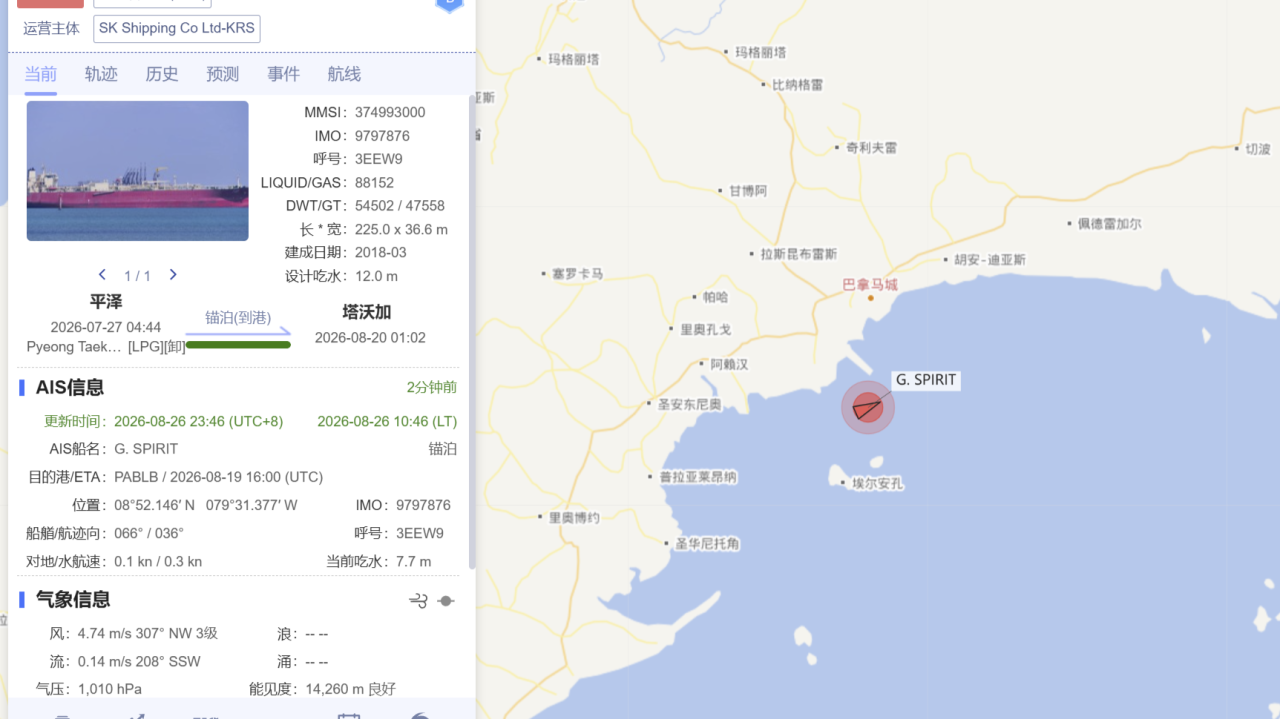
G.SPIRIT is waiting on the Pacific side of the canal and is due to sail northbound toward the Caribbean. Neither SK Gas nor the Panama Canal Authority had publicly confirmed the exact transaction amount at the time of publication, but the reported price has already become the clearest measure yet of the pressure building across the US–Asia LPG supply chain.

A $5.3 Million Price for Schedule Certainty
The widely used description of the payment as a “queue-jumping fee” is convenient but incomplete. The $5.3 million is the winning bid for a reserved transit slot, not the canal’s standard toll, and the vessel must still pay the normal transit charge as well as applicable tug, security and other service fees.
Under the current tariff, the regular reservation fee for a Neopanamax vessel is $100,000, while an auctioned slot is awarded to the highest bidder. For an LPG carrier of G.SPIRIT’s size, the basic Neopanamax toll consists of a $300,000 fixed component plus $1.85 for each cubic metre of cargo capacity.
Applying that formula to the vessel’s approximately 83,864 cubic metres produces a laden toll of about $455,100. A ballast vessel is charged 85% of the laden amount, giving an estimated basic toll of roughly $386,900. The reported auction premium alone is therefore about 13.7 times the vessel’s estimated basic transit toll, and its final canal bill will be higher still.
That extraordinary premium does not mean the ship will pass through the locks immediately. Public AIS data show that G.SPIRIT arrived at Balboa and the Pacific anchorage on August 19. A September 1 transit would still leave roughly 13 days between arrival and passage.
What SK Gas reportedly bought was a firm date, converting an open-ended delay into a timetable that can be incorporated into the vessel’s next employment. The Panama Canal Authority has stated that its reservation system is the only mechanism that guarantees a transit date. New rules issued on August 20 also suspended the Last-Minute Transit Reservation service, leaving vessels that require short-notice certainty more dependent on the auction market.
In a trade built around tightly defined loading windows, the distinction between waiting indefinitely and waiting until a known date can be worth millions of dollars.
Three Different Parties Behind G.SPIRIT
The corporate structure behind the vessel requires careful distinction. G.SPIRIT is a 2018-built VLGC constructed by Hyundai Heavy Industries. The Panama-flagged ship, IMO 9797876, is approximately 225 metres long and 36.6 metres wide, with a deadweight of 54,502 tonnes and cargo capacity of about 83,864 cubic metres.
Shipping databases list the registered owner as the single-ship company VLGC 5 Shipholding S.A., while SK Shipping is identified as both its safety manager and commercial manager. Bloomberg identified SK Gas as the party paying for and commercially controlling the transit. The registered owner, vessel manager and reported bidder are therefore three separate legal or commercial roles, even though their interests converge on the same voyage.
SK Shipping should not be described simply as a subsidiary of SK Gas. Hahn & Company acquired control of SK Shipping in 2018, although the shipping company and SK Gas retain a longstanding LPG transportation relationship.
SK Shipping says it operates VLGCs in the 78,000–84,000-cubic-metre range and provides transportation services to major traders, including SK Gas. SK Gas, meanwhile, says it has six VLGCs on long-term charter for its trading operations. These disclosures help explain how SK Gas may control the commercial employment of G.SPIRIT without appearing as its registered owner or technical manager.
The specific charterparty, however, is not public, and neither the allocation of canal costs nor the contractual responsibility for the auction payment can be established from available information.
The voyage also fits the scale and geography of SK Gas’s wider trading system. The company operates a combined 470,000 tonnes of LPG storage capacity in South Korea, comprising 270,000 tonnes at Ulsan and 200,000 tonnes at Pyeongtaek. Its international trading network includes SK Gas International in Singapore and a US platform in Houston, while its American operation has participated in US LPG exports and trading since 2015.
A VLGC moving between Asia and the US Gulf therefore links supply, freight and terminal operations across a portfolio whose value extends well beyond the economics of a single ship.
A Ballast Voyage Reveals the Value of the Next Cargo
AIS records indicate that G.SPIRIT called at Pyeongtaek from July 24 to 26, made a brief stop at Yeosu and arrived at Balboa on August 19. Its reported draught of approximately 7.7 metres is substantially below its summer laden draught of about 12 metres.
Together with its northbound movement from the Pacific toward the Atlantic, the data strongly suggest that the vessel is on a ballast repositioning leg. The most plausible commercial explanation is that it is returning toward a US Gulf loading area for another LPG cargo.
Its next loading port, cargo interest and fixture have not been disclosed, so a US loading remains an inference based on the vessel’s track, draught and SK Gas’s trading structure rather than a confirmed itinerary.
The auction price nevertheless provides a strong signal about the value attached to whatever comes next. A ballast VLGC earns no freight while repositioning, but its ability to reach the right loading area before the agreed laycan determines whether the next cargo can be performed.
Missing that window may force a trader to find replacement supply, create a ship–cargo mismatch, trigger demurrage or other contractual exposure, and allow a profitable US–Asia LPG spread to disappear before the vessel is ready.
The bid is therefore protecting much more than 11 or 13 days of vessel time. It is protecting the next cargo, the associated freight, the integrity of a trading programme and the ability to place US-origin LPG into an Asian supply system at a commercially useful moment. In this market, a ship’s position at a specific time has become a standalone asset.
Eleven Days of Lost Earnings Do Not Explain the Bid
Baltic Exchange data underline how far the $5.3 million premium exceeds a conventional calculation of vessel time.
On August 21, the Houston–Chiba BLPG3 assessment stood at $269.50 per tonne, with an equivalent time-charter return of $156,469 per day. Even if an unbooked Neopanamax vessel faced the full 11-day waiting period used as the relevant benchmark, the implied loss of vessel earnings would be about $1.72 million—less than one-third of the reported winning bid.
The standard BLPG3 cargo is 44,000 tonnes, which means a $5.3 million canal premium adds approximately $120.45 per tonne. That is equivalent to 44.7% of the benchmark freight rate before the normal canal toll and associated services are counted.
The arithmetic shows why a pure TCE or daily-hire comparison understates the commercial value of the slot. The bidder is also pricing the loading window, commodity arbitrage, contract performance, downstream inventory security and the risk that market conditions will move during an uncertain delay.
Those pressures are already changing physical trade. OPIS reported in early August that higher canal auction costs and rising VLGC freight had narrowed the US–Asia LPG arbitrage, contributing to the cancellation of at least four US cargoes scheduled for August loading.
Bloomberg later reported that exporters including Chevron were testing a relay model in which Panamax ships transit through the older locks and transfer cargo off Balboa to Neopanamax vessels. Such ship-to-ship operations reduce the need for the largest VLGCs to compete directly for scarce Neopanamax slots, although they introduce additional operational complexity and cost.
Persian Gulf Disruption and El Niño Converge at Panama
The record bid reflects a simultaneous increase in demand for the US–Asia route and a reduction in available canal capacity.
Disruption in the Persian Gulf and restrictions around the Strait of Hormuz have weakened the flow of traditional Middle Eastern energy supplies to Asia, encouraging buyers to secure more barrels from the United States. Kpler data show that about 60% of US LPG exports have gone to Asia so far in 2026, compared with 55% for the whole of 2025.
That shift generates traffic in both directions: laden VLGCs move westbound from the US Gulf to Asia, while ballast vessels return northbound through Panama to load again. Container ships and gas carriers are consequently competing for capacity at a time when canal traffic is already expanding.
During the first nine months of fiscal 2026, the Panama Canal recorded 10,726 transits, up 5.2% year on year, with an average of 35 vessels per day. PC/UMS tonnage rose 7.2% to 389.96 million tonnes, led by container ships and LPG carriers.
Capacity on the waterway is moving in the opposite direction. El Niño conditions and insufficient rainfall across the canal watershed have tightened the freshwater constraint that governs lock operations.
For reservation dates from September 4, the authority has reduced daily Neopanamax slots to nine and Panamax slots to 25, for a combined total of 34. From September 15, the Panamax allocation falls again to 23, taking total daily reservations to 32.
The authority has also delayed the effective date for a maximum Neopanamax draught of 48 feet until September 2 and postponed the 47.5-foot restriction until October 1. Each adjustment affects the volume, timing and vessel combinations that traders can use, reinforcing the value of a guaranteed passage when cargo schedules are already exposed to geopolitical and market disruption.
The Canal Is Pricing Supply-Chain Reliability
The $5.3 million bid remains an extreme transaction rather than a new standard tariff. The Panama Canal Authority has stressed that exceptionally high auction results reflect short-term market conditions and should not be interpreted as a uniform price for future transits.
Its broader significance is still unmistakable. When Persian Gulf disruption, increased US energy exports, limited freshwater and fewer reservation slots occur at the same time, transit time ceases to be a routine voyage-planning assumption. It becomes a scarce commodity whose ceiling is set by the value of the cargo arbitrage, the loading commitment, contractual liabilities and the cost of protecting downstream supply.
There is also a natural limit. Once the cost of a canal slot exceeds the commercial value it preserves, traders will cancel cargoes, reroute around the Cape of Good Hope, divide the voyage between smaller and larger ships, or use ship-to-ship transfers near Balboa. The market is already testing each of those responses.
What makes the case of G.SPIRIT particularly revealing is that the vessel appears to be in ballast: the reported bidder was willing to pay $5.3 million before the next cargo was even loaded. The transaction assigns a visible price to being in the right place at the right time.
In that sense, the Panama Canal’s auction hammer has become a real-time gauge of stress across the global LPG supply chain, translating geopolitics, climate risk and schedule uncertainty into the cost of one ship, one passage and one cargo.


READ MORE
 Ports & Terminals
Ningbo Port’s September Box Volumes Rebound 9.3%
 Ports & Terminals
Germany Blocks COSCO’s Zippel Deal, Testing Inland Logistics Expansion
 Ports & Terminals
Keep buying!Inside the Maersk Family’s Infrastructure Buying Spree——From 70-Plus Ships to 50-Plus Terminals
 Ports & Terminals
Vietnam’s Cai Mep Terminals Open 1,200-Metre Shared Berth
 Ports & Terminals
US Fees on Chinese-Built Ships May Be Delayed Until January, Pending USTR Action
 Ports & Terminals
COSCO SHIPPING and Shanghai Post Launch 28-Day Postal Sea Route to Peru via Chancay
 Ports & Terminals
Pinglu Canal opens a new river-to-sea route for southwest China
 Ports & Terminals
China’s $10.7bn Pinglu Canal to Open Sept. 16, Cutting Southwest–ASEAN Shipping Route by 560 km
 Ports & Terminals
Northern Europe Port Strikes Add New Pressure to Asia–Europe Container Schedules
 Ports & Terminals