


China’s $10.7bn Pinglu Canal to Open Sept. 16, Cutting Southwest–ASEAN Shipping Route by 560 km
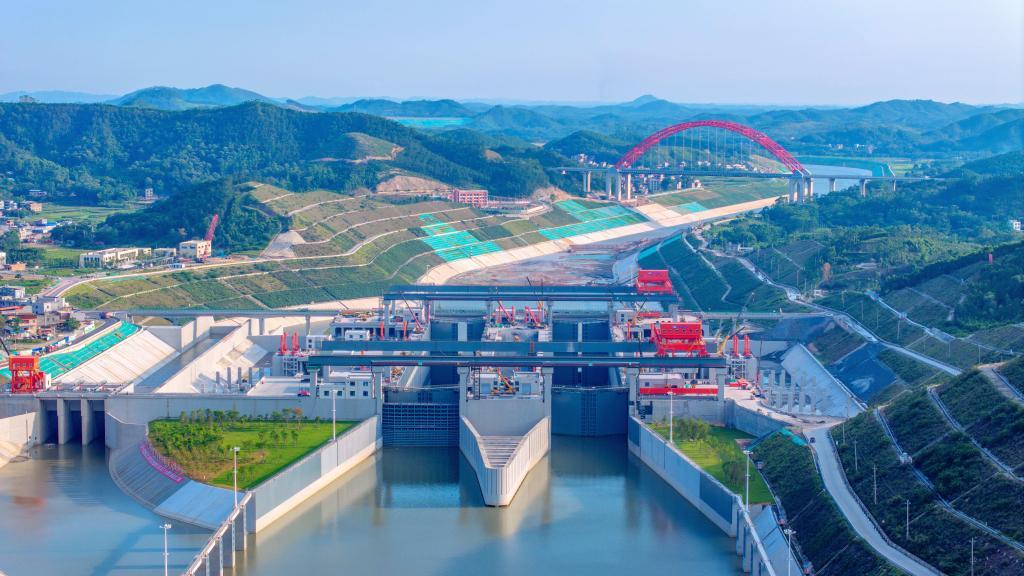

China’s 134-km Pinglu Canal will open to navigation on September 16, giving cargo from the country’s southwest a new waterborne route to the Beibu Gulf. The project could shorten inland shipping distances by more than 560 km and cut logistics costs by 18%–30%, while strengthening Beibu Gulf Port’s role as a maritime gateway to Southeast Asia.
China will open the Pinglu Canal in Guangxi Zhuang Autonomous Region to commercial navigation on September 16, bringing into operation a RMB72.7 billion ($10.7 billion) waterway that could materially alter how cargo from Southwest China reaches the sea.
The 134.2-km canal links the Xijiang River shipping system with the Beibu Gulf and is designed for 5,000-tonne-class vessels. It is China’s first major river-to-sea canal project planned and coordinated at the national level since 1949.
For shipping and logistics companies, however, the significance lies less in the canal’s scale than in the route it creates.
Cargo moving by water from parts of Southwest China has traditionally had to travel east along the Xijiang and Pearl River systems before reaching the coast around the Pearl River Delta. The Pinglu Canal provides a southbound outlet instead, allowing eligible traffic to reach the Beibu Gulf without the long detour towards Guangzhou.
Official estimates put the resulting reduction in inland waterway distance at more than 560 km, with total logistics costs potentially falling by 18% to 30%. Annual savings in overall logistics costs have been estimated at more than RMB5 billion.
A new southbound outlet for Southwest China
The canal runs from the Xijin Reservoir area in Hengzhou, near Nanning, south through Qinzhou before entering the Beibu Gulf.
Three major navigation hubs — Madao, Qishi and Qingnian — use double-lane ship locks to overcome an elevation difference of about 65 metres. The waterway has a designed annual one-way capacity of around 89 million tonnes.
In practical terms, the project closes a long-standing gap between Guangxi’s extensive inland waterway network and its seaports.
Before the canal, the province had major navigable rivers as well as a coastline, but no direct high-capacity inland shipping connection between the Xijiang system and the Beibu Gulf. The new route effectively gives the river system a second maritime outlet — this time facing south towards Southeast Asia rather than east towards the Pearl River Delta.
That distinction matters for cargo flows.
The Beibu Gulf is geographically the closest maritime outlet for much of western and southwestern China. Shortening the inland leg could improve the economics of moving bulk commodities, industrial materials and certain containerised cargoes through Guangxi rather than routing them farther east.
Trial voyage demonstrates the river-to-sea concept
The route has already undergone a significant real-world test ahead of the official opening.
On September 7, the Panama-flagged Beigang Nanning Borun sailed from Qinzhou Port through the Pinglu Canal and arrived at the Liujing operating area of Nanning Port at 11:15 pm.
The 100-metre vessel has a deadweight of 4,443 tonnes, a beam of 22 metres and a draught of 4.23 metres. It carried 70 empty export containers during the trial and passed through all three major locks before reaching Nanning.
The voyage was particularly notable because it demonstrated that suitably designed vessels can move between the Beibu Gulf and an inland port without a conventional cargo transshipment at the coast.
Authorities said the trial lays the groundwork for a planned foreign-trade service linking Nanning with Can Tho in Vietnam.
That does not mean every 5,000-dwt seagoing vessel will be able to sail through the canal. The Chinese designation refers to the canal’s navigation class, while individual ships must still comply with restrictions on dimensions, draught, air draught, certification and operating areas.
But the trial illustrates a potentially important commercial model: river-sea shipping that reduces handling and transshipment between inland production centres and short-sea markets in Southeast Asia.
Beibu Gulf Port enters the equation
The canal’s impact will depend heavily on what happens at its southern end.
Beibu Gulf Port has expanded rapidly over the past decade and handled more than 10 million TEU in 2025, compared with 2.28 million TEU in 2017.
The port is therefore no longer simply a regional outlet waiting for inland cargo. It already has a sizeable container base and an expanding international network.
By May 2025, Beibu Gulf Port operated 84 container services, including 52 international routes, connecting the port with markets across Asia as well as the Americas, Africa, India and Pakistan. Its rail-sea intermodal network also links the coast with inland industrial centres including Chongqing, Chengdu and Guiyang.
The Pinglu Canal adds a new layer to that network.
Rail has been central to the New International Land-Sea Trade Corridor, China’s multimodal programme connecting western provinces with the Beibu Gulf and overseas markets. The canal does not replace those trains. Instead, it gives cargo owners another option: rail-water, road-water, conventional river shipping or, where vessel specifications permit, direct river-sea transport.
That could extend Beibu Gulf Port’s effective cargo catchment deeper into Guangxi and parts of Yunnan, Guizhou, Sichuan and Chongqing.
Bulk cargo may provide the first test
The cargo most likely to establish the canal’s initial commercial base may not be high-value containers.
Pinglu Canal Group has identified non-ferrous metals, building materials, mineral products and agricultural and forestry products among the main cargo categories being targeted in Guangxi and the wider Southwest China hinterland.
Authorities are also seeking containerised import and export cargo linked to ASEAN trade.
The emphasis on bulk and industrial cargo reflects basic transport economics.
Commodities such as ores, construction materials, metals and agricultural products tend to move in larger lots and are generally more sensitive to transport costs than to transit time. They are therefore natural candidates for a longer waterborne leg if the canal can deliver lower door-to-door costs.
Containerised manufacturing cargo is more complicated.
For a shipper of electronics, machinery or automotive parts, the cheapest nautical route is not necessarily the cheapest supply-chain option. Sailing frequency, port productivity, inventory costs, reliability, transshipment requirements and total transit time can outweigh a saving in inland distance.
The canal’s long-term container potential will therefore depend on whether operators can build regular, reliable and commercially competitive services, rather than on the 560-km distance saving alone.
Will Beibu Gulf Port take cargo from the Pearl River Delta?
This is likely to become one of the most closely watched consequences of the project.
The official 560-km comparison is itself based on cargo using the new canal rather than following the existing waterway route towards Guangzhou Port.
In that sense, the canal clearly creates a new competitive route for some Xijiang basin cargo.
But it would be premature to conclude that large volumes will immediately shift away from Guangzhou, Shenzhen or the wider Pearl River Delta port system.
Port choice is determined by much more than inland distance.
The Pearl River Delta has dense liner connectivity, established logistics clusters, mature freight-forwarding networks and longstanding shipper relationships. Rail services through the New International Land-Sea Trade Corridor have also developed into a significant alternative for western China.
The more important change is that Beibu Gulf Port can now compete for certain inland cargoes with a waterborne route that did not previously exist.
For shippers, the decision will ultimately come down to door-to-door economics: freight rates, sailing frequency, lock waiting times, cargo handling, transit reliability and the availability of onward liner services.
If those variables prove competitive after the canal settles into regular operations, cargo patterns could begin to shift.
The ASEAN connection
The canal’s international relevance becomes clearer when viewed against the growth of China–ASEAN trade.
China and ASEAN recorded bilateral trade of RMB4.34 trillion in the first half of 2026, up 18.2% year on year, according to Chinese customs data cited by Xinhua.
Guangxi sits directly on that trade axis.
The province borders Vietnam and operates the Beibu Gulf ports of Qinzhou, Fangchenggang and Beihai, placing it at the intersection of inland Chinese supply chains and Southeast Asian maritime routes.
The Pinglu Canal could therefore support two-way flows: metals, machinery, manufactured goods and other Chinese exports moving south, while agricultural products and other ASEAN imports move further inland.
The commercial opportunity is particularly relevant for short-sea and regional shipping if direct or semi-direct services between inland Guangxi and ports in Vietnam and other ASEAN markets can be developed at sufficient scale.
RMB72.7bn project now faces the cargo test
The canal’s opening will not by itself deliver the projected cost savings or cargo volumes.
Those figures remain planning and modelling estimates.
The more important indicators will emerge after September 16: actual cargo throughput, lock utilisation, waiting times, vessel deployment, freight rates, route frequency and the proportion of traffic genuinely diverted from existing logistics corridors.
Guangxi has also introduced an incentive designed to accelerate early adoption.
The formal trial toll for the Madao, Qishi and Qingnian locks is RMB1 per gross tonne per lock passage, but commercial vessels will temporarily be exempt from the charge from opening day through December 31, 2026. The trial tariff will then apply from January 1, 2027, with operators permitted to offer differentiated discounts.
That gives shipping companies and cargo owners several months to test the route without lock charges.
For now, September 16 answers the infrastructure question: Southwest China will have a new river-to-sea route.
The much more important commercial question comes next.
Will enough cargo choose to use it?

READ MORE
 Ports & Terminals
Chancay Port: Defending Legitimate Investment Through the Rule of Law
 Ports & Terminals
Chancay Port: A Gateway for Trade, Competition and Shared Prosperity
 Ports & Terminals
Can a 134-Kilometre Canal Redraw China’s Shipping Map?
 Ports & Terminals
HONG KONG MARITIME WEEK 2026 10TH ANNIVERSARY 15-21 NOVEMBER
 Ports & Terminals
Yantian Port plans RMB3.79bn Zhangjiagang terminal
 Ports & Terminals
Vietnam’s Cai Mep Terminals Open 1,200-Metre Shared Berth
 Ports & Terminals
Ningbo Port’s September Box Volumes Rebound 9.3%
 Ports & Terminals
Germany Blocks COSCO’s Zippel Deal, Testing Inland Logistics Expansion
 Ports & Terminals
Keep buying!Inside the Maersk Family’s Infrastructure Buying Spree——From 70-Plus Ships to 50-Plus Terminals
 Ports & Terminals