


Northern Europe Port Strikes Add New Pressure to Asia–Europe Container Schedules
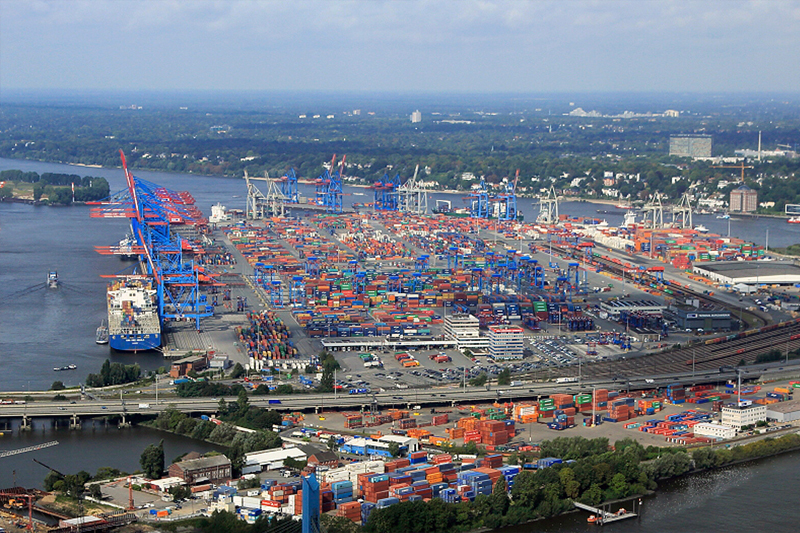

A 48-hour walkout across six German seaports is set to be followed almost immediately by industrial action at Rotterdam, Amsterdam and Zeeland, adding another disruption risk to a North European port network already dealing with congestion and deteriorating liner schedule reliability.
Northern Europe’s container supply chain is facing a concentrated period of labour disruption, with strikes at major German ports being followed by industrial action in the Netherlands just as carriers are still working through congestion and schedule slippage elsewhere in their networks.
Workers at Hamburg, Bremen, Bremerhaven, Wilhelmshaven, Emden and Brake were called out for a 48-hour warning strike beginning with the night shift on September 2. The action is due to run through September 4.
Dutch unions, meanwhile, have called on workers at port companies in Rotterdam, Amsterdam and Zeeland to stop handling ships between 11:15 and 19:00 on September 4.
The two actions have different causes, but their timing creates a common operational problem: a succession of stoppages affecting some of Northern Europe’s most important gateways at a time when vessel schedules are already under strain.
Six German ports hit by 48-hour strike
Germany’s United Services Union, ver.di, called the latest warning strike after workers rejected an employers’ wage proposal in an ongoing collective bargaining round covering about 11,000 German seaport employees.
The dispute covers Hamburg, Bremen and Bremerhaven as well as Wilhelmshaven, Emden and Brake. German public broadcaster NDR reported that the walkout began with the night shift on September 2 and was scheduled to last 48 hours.
The employers’ association, the Central Association of German Seaport Operators, or ZDS, had proposed a 5.1% increase in collectively agreed wages over an 18-month term, together with a guaranteed increase of at least €1.20 per hour across wage groups. Its proposal also included higher holiday pay and an increased allowance for employees in container operations.
Ver.di is seeking an 8.2% wage increase, with a minimum increase of €2.50 per hour designed to provide greater gains for lower- and middle-income groups.
The disruption is already affecting cargo operations.
CMA CGM told customers that Hamburg, Wilhelmshaven and Bremerhaven would be affected from 23:00 on September 2 for 48 hours. It said truck and rail deliveries and pick-ups would not be possible during the strike period and that vessel operations would be delayed.
Hamburg is particularly significant because the dispute reaches into the country’s largest container port. NDR reported that major facilities including HHLA’s Container Terminal Altenwerder, Container Terminal Burchardkai and Container Terminal Tollerort, as well as the Eurogate terminal, could be affected.
Dutch ports set for follow-on action
The German stoppage will be followed closely by industrial action in the Netherlands.
Dutch union CNV has called for port work to stop at companies in Rotterdam, Amsterdam and Zeeland between 11:15 and 19:00 on Friday, September 4. The unions say no vessels should be handled during the action period, with loading, unloading, cargo securing, towage and cargo inspection among the activities expected to face delays.
The Dutch dispute is not a port wage negotiation.
CNV and other unions are campaigning against planned reductions in social security provision, including changes affecting unemployment benefits under the WW system and disability-related WIA benefits. The September port action forms part of a broader national labour campaign.
It is important, however, not to equate the union call automatically with a complete shutdown of Rotterdam, Amsterdam and Zeeland.
Modern port operations depend on multiple employers and services, including terminal operators, towage, pilotage, mooring, rail, inland barge and road transport. The extent of the disruption will therefore depend on participation across individual companies and operational functions.
The ports were already under pressure
What makes the timing particularly relevant for container shipping is that Northern Europe’s port network was not operating from a fully normal baseline before the strikes.
Hapag-Lloyd’s Week 35 operational update, last updated on August 30, showed elevated yard utilisation at several major Rotterdam terminals.
ECT was running at around 80%–85% yard utilisation, Rotterdam World Gateway at 80%–85%, and APM Terminals Maasvlakte II at 85%–90%. In Hamburg, Container Terminal Altenwerder was at around 70%–75%, with Hapag-Lloyd continuing to flag congestion related to ongoing construction. Bremerhaven’s NTB terminal was operating at around 80%–85% yard utilisation.
Hapag-Lloyd has also been omitting Hamburg’s CTA terminal on its AL4 service because of modernisation works, while offering Wilhelmshaven and Bremerhaven as alternative ports. That arrangement predates the current strike, but it illustrates how little operational slack may be available when disruption affects several German gateways at the same time.
The broader liner network is also carrying an unusually large amount of delay.
Sea-Intelligence estimated on August 19 that 5.0% of global deep-sea container capacity was effectively being absorbed by vessel delays, equivalent to about 1.7 million TEU.
That figure should not be interpreted as 1.7 million TEU of ships physically sitting at anchor outside ports. It is a measure of capacity effectively removed from normal cargo-carrying circulation when the share of delayed vessels is combined with the duration of those delays.
For comparison, Sea-Intelligence calculated that delays absorbed an average of only 2.2% of global container capacity during 2011–2019.
Asia–Europe schedules are already carrying delays westward
The pressure is not confined to Europe.
Sea-Intelligence reported that global container schedule reliability fell by 6.1 percentage points month on month to 56.4% in July, the lowest level recorded so far in 2026. Average delays for late vessels increased by 0.59 days to 6.06 days, the highest since January 2024.
A subsequent analysis published on September 2 identified congestion at major Asian ports as the principal driver of the deterioration.
Among China’s largest gateways, schedule reliability at Ningbo fell 20.1 percentage points to 34.6% in July, while Shanghai dropped 19.2 percentage points to just 21.0%. Yantian and Hong Kong also suffered sharp declines.
Carrier operating changes illustrate how those delays are propagating through Asia–Europe services.
Hapag-Lloyd’s latest Asia operational update shows a series of port omissions and rotation changes on Gemini Cooperation Asia–North Europe services, including calls involving Shanghai, Yantian and Ningbo. Some cargoes are being rerouted through transshipment hubs as carriers attempt to restore schedules.
These changes were not caused by the German or Dutch strikes. But they are important to understanding the potential transmission mechanism.
Ships already arriving late from Asia have less schedule buffer when they reach Europe. If those vessels then encounter reduced berth availability or terminal productivity at Hamburg, Bremerhaven or Rotterdam, delays can carry forward into subsequent port calls and eventually into the vessels’ next eastbound rotations.
Why a 48-hour stoppage can last longer than 48 hours
For container shipping, the duration of a strike and the duration of its operational consequences are not necessarily the same.
Once vessels accumulate outside a port, terminals have to restore berth windows and crane allocations after operations resume. Import containers discharged in a concentrated period then need to move through rail, barge and truck networks, while export boxes compete for yard space and loading slots.
A containership that misses its planned berth window may also arrive late at the next port in its rotation. Carriers can respond by increasing sailing speeds, changing port sequences, omitting calls or transferring cargo through alternative hubs, but each option carries operational and commercial costs.
That is why the key measure of the current disruption will not simply be how many hours workers remain on strike.
The more important question is how quickly the backlog clears after operations restart.
At present, there is not enough evidence to conclude that the strikes have caused widespread blank sailings or systematic port omissions on the main Asia–North Europe trades. The immediate risks are more specific: vessel delays, disrupted truck and rail windows, terminal appointment changes and potential knock-on effects on individual services.
What to watch next
Three developments will determine whether the disruption remains a short-lived port event or becomes a more significant problem for the Asia–Europe liner network.
The first is the pace at which Hamburg, Bremerhaven and Wilhelmshaven clear accumulated cargo and vessels after the German strike ends.
The second is the actual scope of participation in the September 4 action at Rotterdam, Amsterdam and Zeeland, particularly across container terminals, towage and other marine services.
The third is whether major carriers begin issuing additional port omission, diversion or schedule-adjustment notices for North European services.
With Asian port delays already feeding into westbound rotations and yard utilisation elevated at several major European terminals, the system has less room than usual to absorb another interruption.
For Asian exporters and European importers, the most useful indicators over the coming days will therefore be vessel waiting times at Hamburg, Bremerhaven and Rotterdam, carrier schedule changes, and whether delayed arrivals from Shanghai, Ningbo and other Asian gateways begin clustering at North European terminals.


READ MORE
 Ports & Terminals
Chancay Port: A Gateway for Trade, Competition and Shared Prosperity
 Ports & Terminals
Can a 134-Kilometre Canal Redraw China’s Shipping Map?
 Ports & Terminals
Yantian Port plans RMB3.79bn Zhangjiagang terminal
 Ports & Terminals
Chancay Port: Defending Legitimate Investment Through the Rule of Law
 Ports & Terminals
Vietnam’s Cai Mep Terminals Open 1,200-Metre Shared Berth
 Ports & Terminals
Ningbo Port’s September Box Volumes Rebound 9.3%
 Ports & Terminals
Germany Blocks COSCO’s Zippel Deal, Testing Inland Logistics Expansion
 Ports & Terminals
Keep buying!Inside the Maersk Family’s Infrastructure Buying Spree——From 70-Plus Ships to 50-Plus Terminals
 Ports & Terminals
US Fees on Chinese-Built Ships May Be Delayed Until January, Pending USTR Action
 Ports & Terminals