


Global No. 2 Changes Hands: Ningbo-Zhoushan Overtakes Singapore for the First Time in H1
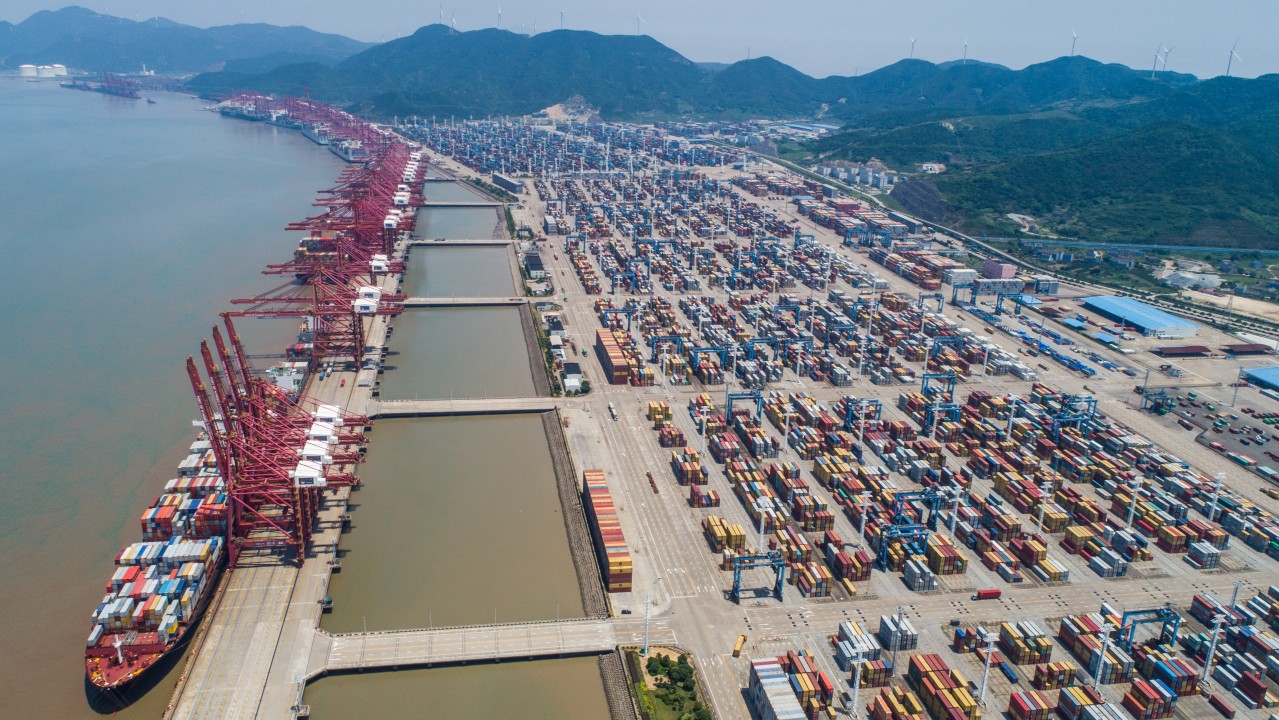

Ningbo-Zhoushan Port handled 22.90 million TEU in the first half of 2026, up 8.8% year on year, overtaking Singapore to become the world’s second-busiest container port for the first time over a full six-month reporting period. Its lead was only 158,310 TEU, but the change reflects the combined effects of China’s expanding and diversifying exports, stronger cargo generation across the Yangtze River Delta, and continued investment in Ningbo-Zhoushan’s terminal capacity and international shipping network.

According to the latest Alphaliner Weekly Newsletter, Shanghai remained firmly at the top of the global container port rankings with throughput of 28.737 million TEU in the first half of 2026. Ningbo-Zhoushan moved into second place with 22.90 million TEU, while Singapore slipped to third with 22.742 million TEU.
This marks the first time Ningbo-Zhoushan has surpassed Singapore over a complete half-year reporting period. The established order of Shanghai, Singapore and Ningbo-Zhoushan has therefore changed—at least temporarily—to Shanghai, Ningbo-Zhoushan and Singapore.
The shift did not result from a contraction in Singapore. Both ports recorded growth, but Ningbo-Zhoushan added substantially more volume. Its throughput increased by 8.8%, compared with Singapore’s 4.7% growth. In the first half of 2025, Singapore handled 21.715 million TEU, leading Ningbo-Zhoushan by approximately 665,000 TEU. Over the following 12 months, Ningbo-Zhoushan added 1.85 million TEU, while Singapore added about 1.03 million TEU. That difference in incremental growth was enough to erase Singapore’s previous lead and place Ningbo-Zhoushan 158,310 TEU ahead.
A Narrow Lead With Symbolic Importance
A gap of 158,310 TEU is equivalent to only one or two days of container handling at a port of Ningbo-Zhoushan’s scale. It is far too narrow to establish a decisive long-term advantage, particularly when part of the global port ranking is still based on estimates that may be adjusted once final figures are available.
Singapore also retained second place in the full-year 2025 ranking. It handled 44.664 million TEU, up 8.6%, compared with Ningbo-Zhoushan’s 43.87 million TEU, up 11.6%. The annual difference was still approximately 794,000 TEU. Ningbo-Zhoushan had nevertheless been closing the gap steadily, and the first-half 2026 result represents the first occasion on which it completed the statistical reversal.
The full-year 2026 ranking will depend heavily on second-half cargo flows. China’s peak export season, inventory replenishment in Europe and North America, changes in US trade policy, adjustments to liner shipping networks and the pace at which regular Suez Canal transits recover could all influence the growth rates of both ports. It is therefore more accurate to say that the global No. 2 position changed hands in the first half of 2026, rather than to conclude that Singapore has definitively lost its annual ranking.
Even with that qualification, the result carries considerable industry significance. Ningbo-Zhoushan and Singapore represent two different foundations of port competitiveness. Ningbo-Zhoushan is supported by one of the world’s largest manufacturing and export hinterlands, while Singapore has built its position through international transshipment, dense mainline and feeder connections, bunkering and a highly developed maritime services ecosystem. Ningbo-Zhoushan’s rise indicates that the cargo-generating power of China’s industrial hinterland is becoming even more concentrated at the top of the global port league table.
China’s Export Growth Strengthens the Cargo Base
Ningbo-Zhoushan’s first-half performance was underpinned by continued expansion in China’s foreign trade. China’s total goods trade reached RMB25.47 trillion in the first half of 2026, increasing by 16.9% year on year and exceeding RMB25 trillion for the first time in the same period. Exports rose by 13.4% to RMB14.73 trillion.
The composition of that growth was particularly relevant to container shipping. Exports of mechanical and electrical products increased by 20.1% to RMB9.36 trillion, accounting for 63.5% of China’s total exports. High-technology product exports rose by 39% to RMB3.26 trillion. Trade with Belt and Road partner countries increased by 14.8% and accounted for 50.9% of China’s total foreign trade, while trade with Latin America, Africa and the European Union grew by 16.2%, 19.6% and 10.2%, respectively.
These figures point to a continuing diversification of both China’s export products and overseas markets. Ningbo-Zhoushan is well positioned to capture those cargo flows. In addition to Zhejiang, the port serves a vast manufacturing hinterland across the Yangtze River Delta. Its export base includes machinery, electrical equipment, automobiles and components, household appliances, solar products, lithium-ion batteries, textiles and consumer goods.
The relationship between trade value and container throughput is not linear, but rapid growth in machinery, technology products and Chinese-brand exports generates additional demand for ocean freight bookings, terminal handling and direct international services. This locally generated cargo gives Ningbo-Zhoushan a different foundation from ports that depend predominantly on transshipment volumes and liner network decisions.
Its performance was also part of a broader expansion across China’s container ports. Chinese ports handled approximately 180 million TEU in the first half of 2026, up 5.9%, including around 161 million TEU at coastal ports. Shanghai processed 28.74 million TEU, an increase of 6.2%; Shenzhen handled 18.56 million TEU, up 7.7%; Qingdao reached 17.56 million TEU, up 7.2%; and Tianjin recorded 13 million TEU, up 6.1%.
Six of the world’s seven busiest container ports in the first-half ranking were located in China, with Singapore the sole exception. The figures underline the scale of China’s position in global container trade and the growing concentration of port throughput along its coastline.
New Capacity and Services Support Ningbo-Zhoushan’s Expansion
Rising trade volumes require sufficient terminal capacity and shipping connections, and the Jintang port area became an important contributor to Ningbo-Zhoushan’s growth during the first half.
Jintang handled 1.495 million TEU of import and export containers, up 23.4% and setting a new record for the period. It also added 17 international services to destinations including the Red Sea and Africa, bringing its total number of foreign-trade routes to 46. These services now connect Jintang with more than 60 major ports in 33 countries and regions.
Exports moving through the port area are dominated by machinery and electrical products, while electric vehicles, lithium-ion batteries and solar products—the categories often described in China as the “New Three”—have become increasingly important sources of growth.
Following the completion of the second phase of the Jintang development, five container berths have been brought under integrated operation. The project has expanded terminal capacity while improving berth allocation and the ability to handle ultra-large container vessels. The combination of new berths and direct international services allows more cargo from the Yangtze River Delta to be loaded onto mainline vessels without first passing through another transshipment hub.
By the end of 2025, Ningbo-Zhoushan’s container shipping network had expanded to 309 services, connecting more than 700 ports in over 200 countries and regions. Its growing coverage of Africa, Latin America, the Middle East and Southeast Asia has strengthened the port’s ability to organise cargo for markets that are accounting for a rising share of Chinese trade.
The port’s hinterland network is equally important. Sea-rail intermodal services, river-sea shipping, inland feeder services and road transport connect Ningbo-Zhoushan not only with Zhejiang but also with Jiangsu, Anhui, Jiangxi and regions further upstream along the Yangtze River. Its container business consequently extends well beyond local trade and increasingly serves a cargo collection and distribution system covering the wider Yangtze River Delta and parts of central and western China.
The competition between major ports has therefore moved beyond berth numbers and quay cranes. Shipping connectivity, inland transport corridors, cargo organisation, customs efficiency, digital services and the reliability of the wider logistics chain have all become decisive components of port competitiveness.
Singapore Retains Its Wider Maritime Strength
Ningbo-Zhoushan’s higher first-half throughput does not imply a corresponding decline in Singapore’s status as an international maritime centre. Around 90% of Singapore’s container volume consists of transshipment cargo, making its performance closely connected to global liner networks, mainline-feeder coordination and carrier hub strategies.
Singapore handled a record 44.66 million TEU in 2025. Vessel arrivals reached 3.22 billion gross tonnes, while marine fuel sales climbed to 56.77 million tonnes, maintaining Singapore’s position as the world’s largest bunkering hub. More than 200 international shipping groups have established operations in the city-state, which also ranked first in the 2026 Xinhua-Baltic International Shipping Centre Development Index for the 13th consecutive year.
These indicators demonstrate why container throughput alone cannot fully measure the strength of an international maritime centre. Shipping finance, insurance, arbitration, ship management, bunkering, maritime technology and access to professional services remain central to Singapore’s competitive position.
Singapore is also creating substantial additional container-handling capacity through Tuas Port. The first phase is scheduled to become fully operational in 2027, with 21 deepwater berths and annual capacity of 20 million TEU. When the entire development is completed in the 2040s, Tuas is expected to provide capacity of 65 million TEU and consolidate Singapore’s container operations in a single, highly automated port complex.
The project gives Singapore room to handle considerably larger volumes and improve operating efficiency. Its fall to third place in the half-year ranking should therefore be viewed as the beginning of a closer contest rather than evidence of structural decline.
Global Port Competition Is Becoming a Contest of Systems
The first-half 2026 ranking was shaped by both trade growth and geopolitical disruption. Chinese ports including Ningbo-Zhoushan, Shanghai, Shenzhen and Qingdao benefited from expanding exports and the diversification of trade markets. Elsewhere, regional security risks and the resulting changes to liner networks caused much sharper shifts.
The Strait of Hormuz crisis, for example, contributed to a decline of more than 90% in Jebel Ali’s second-quarter throughput. Its first-half volume fell from 7.77 million TEU a year earlier to 3.14 million TEU, sending the port from 10th to 32nd place globally. The reversal illustrates how security conditions, route diversions and carrier deployment decisions can rapidly reshape port volumes.
Ningbo-Zhoushan’s rise to second place reflects the combined strength of China’s manufacturing exports, the Yangtze River Delta cargo base, expanding international services and investment in terminal infrastructure. Singapore continues to grow and retains one of the world’s most sophisticated transshipment and maritime service ecosystems. The future contest between the two ports will consequently involve far more than the number of containers crossing the quay.
Ningbo-Zhoushan will seek to convert its scale into stronger international transshipment capabilities, higher-value maritime services and greater influence over the allocation of global shipping resources. Singapore, meanwhile, will rely on Tuas Port, automation and its integrated maritime services cluster to reinforce the connectivity and commercial appeal of its hub.
The present difference of 158,310 TEU could disappear within weeks, but Ningbo-Zhoushan has crossed an important symbolic threshold. The global top three is evolving from a relatively stable order into a structure in which Shanghai remains clearly ahead while Ningbo-Zhoushan and Singapore compete at close range for second place.
As Chinese exports extend further into Africa, Latin America, Southeast Asia and Belt and Road markets, Ningbo-Zhoushan’s sources of growth are likely to become more diversified. As new capacity at Tuas comes online, Singapore will have greater room to expand its transshipment operations. The global No. 2 ranking may therefore change hands more than once. The broader movement of container port activity towards Asia—and particularly towards China’s coastline—has nevertheless become increasingly difficult to overlook.
Data note: The global port ranking in this article follows the statistical basis used by Alphaliner and China’s Ministry of Transport. Ningbo-Zhoushan Port’s first-half 2026 throughput was 22.90 million TEU. The separately reported figure of 27.691 million TEU for Ningbo Zhoushan Port Company Limited reflects the listed company’s operating scope, including terminals in which it has invested or which it operates in locations such as Wenzhou, Jiaxing and Taizhou. It should not be used for a direct comparison with the throughput of Singapore as a single port.


READ MORE
 Ports & Terminals
Ningbo Port’s September Box Volumes Rebound 9.3%
 Ports & Terminals
Germany Blocks COSCO’s Zippel Deal, Testing Inland Logistics Expansion
 Ports & Terminals
Keep buying!Inside the Maersk Family’s Infrastructure Buying Spree——From 70-Plus Ships to 50-Plus Terminals
 Ports & Terminals
Vietnam’s Cai Mep Terminals Open 1,200-Metre Shared Berth
 Ports & Terminals
US Fees on Chinese-Built Ships May Be Delayed Until January, Pending USTR Action
 Ports & Terminals
COSCO SHIPPING and Shanghai Post Launch 28-Day Postal Sea Route to Peru via Chancay
 Ports & Terminals
Pinglu Canal opens a new river-to-sea route for southwest China
 Ports & Terminals
China’s $10.7bn Pinglu Canal to Open Sept. 16, Cutting Southwest–ASEAN Shipping Route by 560 km
 Ports & Terminals
Northern Europe Port Strikes Add New Pressure to Asia–Europe Container Schedules
 Ports & Terminals