

Up to 14 More PCTCs: Höegh Doubles Down on China as Aurora Programme Could Grow to 26 Ships
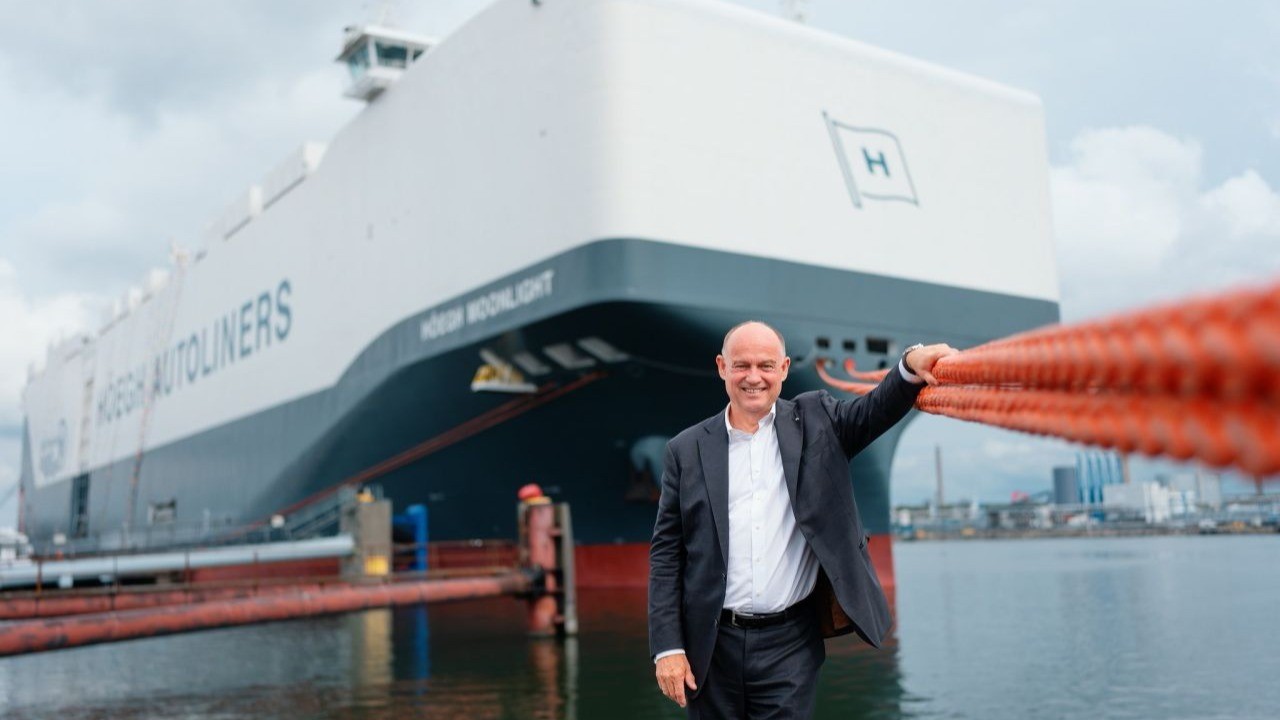
Even with the global PCTC orderbook standing at around 21% of the existing fleet, Höegh Autoliners has expanded its firm Aurora-class programme from 12 to 18 vessels and retained a pathway to 26. The decision is underpinned by the rapid growth of Chinese vehicle exports, an ageing legacy fleet and the significantly lower unit cost of operating large, standardised newbuildings. As the scarcity premium in car shipping gradually gives way to cost competition, the Aurora class is becoming the foundation of Höegh’s future fleet.
Norwegian car-carrier operator Höegh Autoliners is placing another major bet on Chinese shipbuilding. On 25 August, the company announced an order for six additional 9,100-CEU Aurora-class pure car and truck carriers at China Merchants Heavy Industry (Jiangsu), or CMHI. The LNG dual-fuel, zero-carbon-ready vessels are scheduled for delivery between 2029 and 2031, increasing the number of firm Aurora-class vessels already delivered or on order from 12 to 18.
Höegh has also secured options for four further vessels on the same terms, exercisable within six months, together with slot reservations for another four vessels at the same yard, with notice due by 31 December 2027. If both layers of expansion are eventually converted into firm contracts, the programme could reach 26 vessels with combined nominal capacity of 236,600 CEU, all built at CMHI Jiangsu.
The figure of 26 requires careful qualification. Eighteen vessels are currently firm: eight were already in operation by the end of the second quarter of 2026, four remain to be delivered under the original programme and six form the newly announced order. On that basis, ten further deliveries are now contractually secured.
The next four vessels are time-limited options, while the final four are slot reservations, a progressively lower level of commitment. Höegh’s announcement explicitly states that the four option vessels are available on the same terms as the latest order, but it does not say that the four reserved slots carry the same price.
The 26-vessel figure should therefore be treated as a strategic ceiling for the programme rather than as the current firm orderbook. This three-tier structure allows Höegh to secure scarce long-dated capacity at a proven Chinese yard while retaining the ability to adjust its exposure as vehicle exports, freight markets and financing conditions evolve.

New Ships Are Arriving, Yet the Market Remains Tight
The most obvious challenge to Höegh’s investment case is the approaching PCTC supply cycle.
Citing Clarksons data, the company said in its second-quarter presentation that the global PCTC orderbook comprised 147 vessels for delivery through 2030, equivalent to approximately 21% of the existing fleet. Fifteen vessels ranging from 2,450 to 10,800 CEU were delivered during the second quarter alone, with another 21 scheduled to arrive during the remainder of 2026.
The exceptional shortage that drove car-carrier earnings over the past several years is gradually being relieved, creating a clear risk of softer freight rates and lower utilisation as more ships enter service.
Höegh’s counterargument rests on demand growing faster than previously expected. Factory-new light-vehicle exports from Asia increased by 31% year on year in the first half of 2026, led by a 68% increase from China. By the end of July, Chinese vehicle exports had reached 6.1 million units, also up 68%, and Höegh expects the full-year figure could reach 10.5 million units.
Using an assumption that one 7,000-CEU PCTC transports around 25,000 new vehicles annually, the company estimates that the 2026 increase in Chinese deep-sea exports could represent demand equivalent to roughly 100 car carriers, compared with approximately 65 new vessels expected to be delivered during the year.
That estimate reflects Höegh’s own market view and should not be treated as an industry-wide forecast. The charter market, however, continues to support the argument that capacity remains tight. The one-year time-charter index for a 6,500-CEU Panamax car carrier reached $80,000 per day in July 2026, up 60% from $50,000 per day in the first quarter and more than four times the 2010–2020 average of $19,400 per day.
Charter rates have remained elevated despite heavy newbuilding deliveries, indicating that the additional capacity is being absorbed by Chinese export growth, longer sailing distances and shifts in global trade flows.
There is also a sizeable pool of vehicle cargo currently moving outside the conventional RoRo system. Höegh estimates that containers account for 25%–30% of Chinese deep-sea vehicle exports in 2026, equivalent to roughly two million to three million units. As PCTC availability improves, some of this cargo could return to dedicated car carriers, particularly where large-volume shipments make RoRo safer and more economical.
Containerised vehicle exports therefore act as a potential buffer for PCTC demand. They also demonstrate why the orderbook cannot be assessed solely by counting ships; modal substitution, voyage distance and trade imbalances all influence the amount of effective vessel capacity required.
The Strategic Bet Is on the Cost Curve
Chief executive Andreas Enger set out the financial logic clearly in the order announcement. By investing in newbuildings, Höegh can secure capacity at a competitive cost and support profitable operations even during future periods of lower freight rates.
The company’s second-quarter presentation, released five days before the order, quantified that advantage. On an estimated cash-cost basis including operating and financing expenses, chartered 7,000-CEU capacity costs approximately $80 per cubic metre, a conventional 7,000-CEU newbuilding about $33 per cubic metre and a 9,100-CEU Aurora-class vessel approximately $26 per cubic metre.
On Höegh’s assumptions, the Aurora’s unit cash cost is around 68% below the cost of chartering in the current market and approximately 21% below that of a smaller newbuilding.
Economies of scale, lower fuel consumption, greater effective cargo space and the efficiencies of serial construction all contribute to this cost gap. The result is a different form of protection against the shipping cycle. Höegh does not need today’s exceptionally high charter rates to persist indefinitely if its owned fleet can remain profitable at materially lower freight levels.
Chartering a 6,500–7,000-CEU vessel in the current market involves both a high daily hire and uncertainty over renewal prices and future availability. Owning a large newbuilding fixes a substantial part of the company’s core capacity cost over the asset’s operating life.
The first eight Auroras have also moved the programme beyond prototype risk. Their earnings performance, carbon efficiency, cargo flexibility and future conversion capability have been tested in commercial service.
Replicating a proven design allows the owner to standardise spare parts, crew training, maintenance and ship–shore management, while the yard benefits from a stable design, repeat procurement and a more efficient production process. Höegh said the attractive terms for the additional vessels reflected its strong relationship with CMHI, scale benefits and the favourable economics of repeat construction. The programme is therefore creating operational and organisational economies that extend beyond the size of each ship.
Those economies still depend on utilisation. A 9,100-CEU vessel can lower the cost per vehicle substantially when it is full or close to full, but the advantage narrows if route density weakens, port rotations become excessively fragmented or backhaul cargo is insufficient.
Höegh’s contract structure provides a degree of protection. Approximately 80% of the volume carried in the first half of 2026 was covered by contracts, the average duration of the contract backlog was 3.2 years, and the company added $631 million of new contracts during the second quarter. Spot cargo accounted for only about 6% of year-to-date volume.
This reduces dependence on the short-term market and supports more predictable load factors. The six newly ordered vessels will not arrive until 2029–2031, however, which extends beyond the current average backlog duration. Contract renewals with established manufacturers and the development of additional Asian customers will therefore be central to turning the new capacity into sustainable earnings.
A 26-Ship Ceiling Matches Höegh’s Replacement Needs
The scale of the Aurora programme becomes clearer when set against the age profile of Höegh’s existing fleet.
The company operated 44 vessels during the second quarter of 2026, of which 37 were owned, while eight Auroras were already in service. At the end of 2025, Höegh’s older owned fleet included ten 7,850-CEU vessels with an average age of 20.8 years, nine vessels of around 6,500 CEU averaging 21.9 years and four owned ships below 6,000 CEU averaging 19.5 years.
Those three groups comprise 23 owned vessels. By the time the newly ordered Auroras are delivered between 2029 and 2031, their average ages will have moved into a range of approximately 24 to 28 years, increasing the economic pressure to sell, recycle or redeploy them away from core deep-sea routes.
The potential 26-ship Aurora fleet is strikingly close to the size of this ageing cohort. The 18 firm Auroras represent 163,800 CEU and a vessel count equivalent to roughly 41% of the 44 ships operated by Höegh in the second quarter. A 26-vessel programme would equal approximately 59% of the current operating fleet by ship count and about 70% of the present owned fleet.
These comparisons do not represent the eventual fleet mix, since older ships will be sold, charter exposure will change and the overall business may continue to grow. They nevertheless show that Aurora has evolved from a newbuilding series into Höegh’s future core fleet platform.
Cargo flexibility is critical to that replacement strategy. The Aurora design has 14 vehicle decks, with strengthened decks and upgraded internal ramp systems allowing electric vehicles to be carried on every deck while also accommodating construction machinery, heavy vehicles and project cargo.
Deep-sea vehicle trades are structurally imbalanced, and a vessel relying only on outbound automotive cargo can struggle to secure profitable return employment. Greater capacity for High & Heavy and breakbulk cargo expands the backhaul cargo pool and improves round-voyage economics.
The vessels also carry DNV ammonia-ready and methanol-ready notations, LNG dual-fuel propulsion and provision for future conversion to ammonia. Höegh says the class can reduce carbon emissions per vehicle transported by up to 58% compared with conventional PCTCs.
Ready notation, however, is not the same as zero-emission operation. Actual carbon performance will depend on the availability, price and lifecycle emissions of biomethane, green ammonia and other low-carbon fuels. Vessels nine to twelve in the original programme are scheduled to enter service with ammonia-capable engines from 2027, while the six vessels announced on 25 August are described as LNG dual-fuel ships retaining future ammonia-conversion flexibility. That distinction in initial configuration is important.
A $150 Million Equity Raise Turns the Order into a Balance-Sheet Commitment
The financing announcement released alongside the order demonstrates that Höegh has already incorporated the six vessels into its capital plan.
The company is considering an accelerated private placement to raise the Norwegian-krone equivalent of approximately $150 million. Net proceeds, together with debt financing, are intended to fully finance the expanded newbuilding programme. Largest shareholder Leif Höegh & Co AS has pre-committed to subscribe in line with its 36.04% holding, while chief executive Andreas Enger, through Damgård Invest AS, has committed to participate in proportion to his 0.28% stake.
Höegh also said its dividend policy remains unchanged, with available cash above its targeted minimum balance continuing to be assessed for distribution each quarter.
At 30 June 2026, Höegh held $215.6 million in cash and cash equivalents, had total interest-bearing debt of approximately $972.5 million and net interest-bearing debt of $756.8 million, while its equity ratio stood at about 53%.
The company refinanced its loan facilities in June, extending maturities and reducing margins, so the proposed equity raise does not indicate immediate financial distress. Combining new equity with debt limits the effect of future yard instalments on liquidity and leverage, while preserving room for dividends and potential option exercises. The controlling shareholder’s pro-rata commitment also signals a willingness to share the long-term risk of the expansion.
The proposed $150 million placement should not be confused with the contract value of the six ships. Höegh has not disclosed the price of the newbuildings. The equity proceeds represent one part of the financing package, and exercising all eight additional option and slot positions could require further capital arrangements.
China Merchants Is Building a Long-Term Industrial Platform
Concentrating the entire Aurora programme at CMHI Jiangsu gives the relationship a value far beyond the latest six-ship order.
The collaboration began with a framework in 2021 and the first construction contract in 2022. The programme subsequently grew from four firm ships to 12, and now to 18, with a possible ceiling of 26. China Merchants Industry-owned Deltamarin contributed to the vessel design, while the Jiangsu yard has handled construction, bringing design, engineering and manufacturing capabilities together within the same industrial group.
With eight vessels already trading, operational feedback can be incorporated into later units, while the yard can convert experience into tighter production processes, quality control and supply-chain management. This cycle of continuous improvement is more difficult for competitors to replicate than the delivery of a single high-specification ship.
It also shows how Chinese PCTC shipbuilding has progressed from competing on price and berth availability to demonstrating repeat-delivery capability, alternative-fuel integration and the ability to win follow-on orders from major international owners.
According to earlier AXSMarine data, approximately 276 PCTCs were scheduled for global delivery between 2023 and 2028, with 219—or close to 80%—being built in China. When a leading international operator repeatedly assigns its core future vessel type to one Chinese yard and extends its planning horizon into 2031, the yard is becoming part of the owner’s long-term fleet strategy.
If the Aurora programme reaches 26 vessels, the accumulated design standards, supplier network, serial-construction experience and in-service data will create a powerful reference for China Merchants in the next round of large, green PCTC orders. The relationship could also extend into conversion work, equipment support and lifecycle services.
The “Super-Fleet” Era Will Be Decided by Unit Economics
The strategy still carries substantial risks. The 147-vessel global orderbook will continue to add supply. Tariffs, trade restrictions and overseas localisation by Chinese automakers could alter the growth trajectory of vehicle exports. Large vessels require dense cargo networks and efficient port rotations, while commercial supplies of green fuels may develop more slowly than ship technology.
Höegh’s estimate that incremental Chinese exports are equivalent to demand for 100 PCTCs is based on specific assumptions about annual cargo throughput and cannot simply be projected through 2031. The options and slot reservations give the company room to adjust its investment pace if these assumptions change, while avoiding an immediate capital commitment to all 26 vessels.
The broader direction of competition is nevertheless becoming clearer. PCTC profits over the past several years were driven largely by a shortage of ships. As newbuildings enter service, competitive advantage will increasingly depend on unit transportation cost, long-term cargo access, fleet standardisation, backhaul optimisation and emissions performance.
Höegh is using the 9,100-CEU Aurora platform to move lower on the industry cost curve, while relying on high contract coverage and Asian cargo growth to support utilisation. China Merchants, meanwhile, is using the repeated construction of one sophisticated vessel class to extend China’s shipbuilding advantage into design, fuel-system integration and long-term technical support.
The 18 firm ships are already sufficient to reshape Höegh’s asset base. A 26-vessel programme would produce a more profound transformation. By the early 2030s, Aurora could become the dominant class in the fleet, moving Höegh towards a highly standardised deep-sea transportation platform with low unit costs, broad cargo flexibility and future-fuel optionality.
That is the strategic meaning of the “6+4+4” structure. Höegh is betting that the centre of automotive seaborne trade will continue shifting towards Asia and that a large, efficient owned fleet can remain profitable even after freight rates normalise.
The delivery wave will not end competition in the car-carrier market; it will change the basis on which that competition is fought. Scarce tonnage determined the winners of the previous phase. The next phase will favour operators capable of combining lower costs, stronger cargo contracts and more flexible vessels to perform through the full cycle.

READ MORE
 Car Carriers
Another Chinese Shipowner Enters PCTC Market — and Another Chinese Yard Moves into 5,000-CEU Construction
 Car Carriers
Up to 26 PCTC! Höegh Autoliners Signs 6 More Aurora Car Carriers with China Merchants
 Car Carriers
917 Chinese Vehicles Arrive at Chancay as COSCO SHIPPING Expands Rack-Based Auto Logistics
 Car Carriers
Ningbo Ocean Shipping Plans Two More PCTCs to Expand Its Car Carrier Fleet
 Car Carriers
BYD Orders Another 10 x 9,200 CEU-CEU Car Carriers?
 Car Carriers