

Another Chinese Shipowner Enters PCTC Market — and Another Chinese Yard Moves into 5,000-CEU Construction
China’s car carrier market has gained another new entrant, while the country’s PCTC shipbuilding base is expanding again beyond the established major yards.
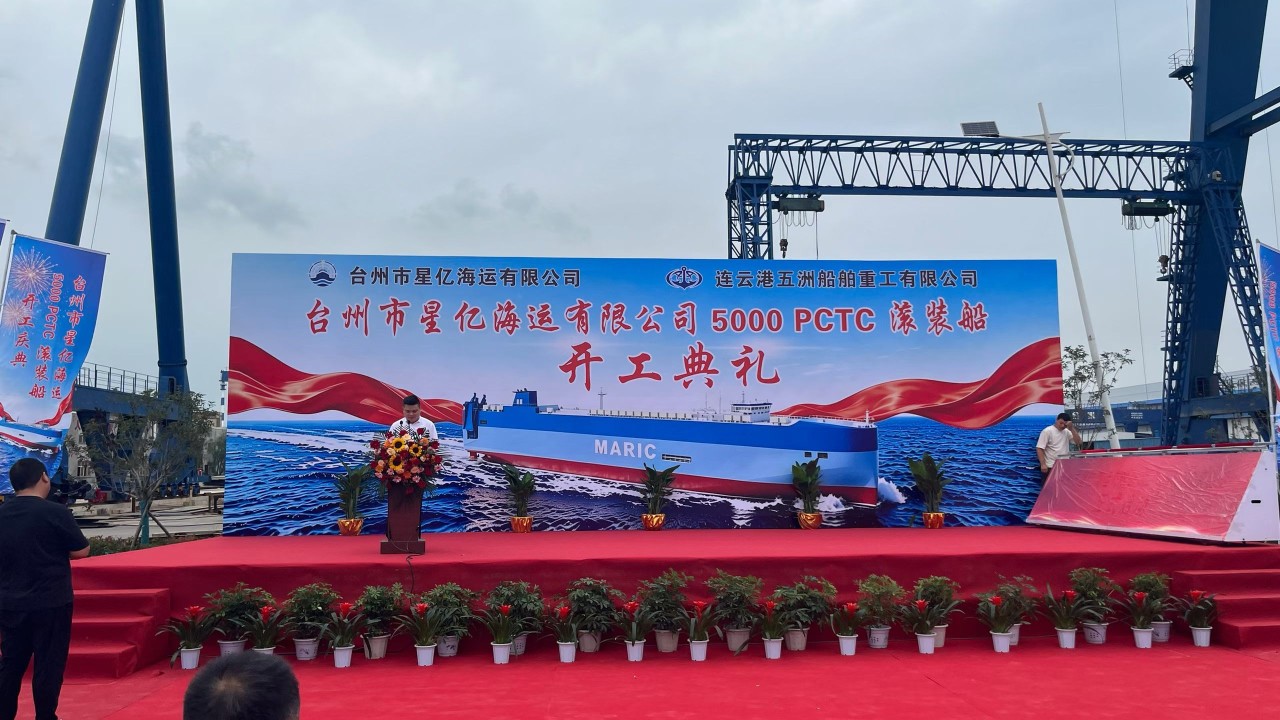
On 24 September, construction officially started on a 5,000-CEU pure car and truck carrier for Taizhou Xingyi Shipping Co., Ltd. at Lianyungang Wuzhou Shipbuilding Heavy Industry Co., Ltd. The vessel is part of a two-ship programme, with both 5,000-CEU PCTCs to be built by Wuzhou Shipbuilding and designed by the Marine Design & Research Institute of China, or MARIC.
For Xingyi Shipping, a company that has previously had relatively limited visibility in the international PCTC market, the project marks a significant move into car carrier tonnage. For Wuzhou Shipbuilding, it represents another step in the yard’s transition from conventional bulkers and tankers into more technically demanding specialised vessels.
Taken together, the project reflects two trends now unfolding simultaneously in China: more Chinese shipowners are entering the vehicle logistics market, while more Chinese shipyards are developing the capability to build medium-sized PCTCs.
Another Chinese shipowner moves into car carriers
The most notable aspect of the project is the identity of the investor.
China’s car carrier expansion in recent years has largely been associated with well-known names including COSCO Shipping, SAIC’s Anji Logistics, BYD and other major automotive and logistics groups. Xingyi Shipping, by contrast, has not previously been a prominent name in the international PCTC market.
Its decision to order two 5,000-CEU vessels therefore broadens the group of Chinese shipping investors allocating capital to the vehicle transportation sector.
The timing is also important.
Xingyi is not entering the market during the peak of the 2022–2024 car carrier shortage, when exceptionally tight vessel supply and record charter rates made PCTC investment an obvious trade. It is entering at a time when a substantial newbuilding pipeline is already being delivered and the global PCTC fleet is expanding rapidly.
That changes the investment logic.
The future economics of these ships will depend much less on pure vessel scarcity and much more on cargo access, route design, utilisation and long-term customer relationships. In other words, owning a PCTC will no longer be enough. The important question will increasingly be whether a new entrant can secure sufficient automotive volumes and develop a commercially sustainable network around those ships.
That makes Xingyi’s move more interesting than a simple two-vessel order.
It raises the possibility that a wider group of privately owned Chinese shipping companies is beginning to view automobile logistics not as a temporary high-rate opportunity, but as a permanent shipping segment worth entering.
Why 5,000 CEU matters
The choice of vessel size is equally revealing.
Much of the attention in the global PCTC newbuilding market has focused on increasingly large ships of 7,000, 8,600, 9,000 and even more than 10,000 CEU. For major global operators with extensive customer portfolios and large hub-to-hub networks, those vessels offer obvious scale advantages.
But larger is not always better.
A 9,000-CEU vessel requires substantially larger and more stable cargo volumes to achieve high utilisation. It also places greater demands on port infrastructure, terminal capacity and cargo concentration at individual load and discharge ports.
A 5,000-CEU ship occupies a different commercial position.
It is large enough for long-haul international deployment, but smaller and potentially more flexible than the latest generation of very large PCTCs. That may make it better suited to regional trades, emerging export markets, multi-port rotations or routes where individual port volumes do not justify a 9,000-CEU ship.
For a new entrant, this can be particularly important. A medium-sized PCTC reduces the cargo concentration required per voyage and may offer greater flexibility in matching vessel capacity with the actual scale of customer demand.
As Chinese vehicle exports become increasingly diversified across the Middle East, Latin America, Southeast Asia, Africa and other markets, medium-sized car carriers could retain an important role even as the global fleet continues to move towards larger ship sizes.
The strategic question for Xingyi will therefore be where these two ships are eventually deployed and whether the company intends to operate them itself, charter them out, or link them to specific automotive export contracts.
Another Chinese shipyard enters the 5,000-CEU PCTC market
The second important development is on the shipbuilding side.
Lianyungang Wuzhou Shipbuilding is not one of the Chinese yards traditionally associated with large-scale PCTC construction. Its historical product mix has been much more closely linked to bulk carriers, chemical tankers and product tankers.
In recent years, however, the yard has been steadily moving up the value chain.
Wuzhou has expanded from conventional bulk carriers into approximately 50,000-dwt oil and chemical tankers, MR-type tonnage and larger product tanker projects exceeding 100,000 dwt. It has also moved into substantially larger dry bulk vessels.
The 5,000-CEU PCTC project adds a new dimension to that product portfolio.
Car carriers are structurally and operationally very different from standard bulk carriers. Their construction involves extensive thin-plate fabrication, multiple vehicle decks, ramp systems, complex ventilation arrangements, specialised fire protection and increasingly demanding requirements associated with the carriage of electric vehicles.
For a yard without a long PCTC track record, completing such a project is therefore not simply a question of building a larger hull. It requires a different level of production control, outfitting integration and specialised supply-chain coordination.
If the two vessels are successfully delivered, Wuzhou will gain something potentially more valuable than the revenue from a two-ship contract: a reference project.
In shipbuilding, the question is often not whether a yard is technically capable of building a particular vessel type, but whether it can demonstrate that it has already done so. A successful 5,000-CEU delivery would therefore strengthen Wuzhou’s position when competing for future PCTC and ro-ro contracts.
PCTC capability is spreading beyond China’s largest yards
The project also fits into a broader shift within Chinese shipbuilding.
The first wave of China’s recent PCTC expansion was concentrated among large and well-established yards. Guangzhou Shipyard International, Xiamen Shipbuilding Industry, China Merchants Industry, Shanghai Waigaoqiao Shipbuilding, CIMC Raffles, Mawei Shipbuilding and others secured significant programmes as global demand for new car carriers surged.
Several of these yards were themselves relative newcomers to large PCTC construction only a few years ago.
What is changing now is that this capability is beginning to spread further down the shipbuilding hierarchy.
Recent projects involving 4,000–5,000-CEU vessels at regional Chinese yards indicate that PCTC construction is no longer confined to a small group of major state-owned or top-tier private builders.
This is an important industrial development.
The real strength of China’s PCTC sector is increasingly not just that several individual yards can build these ships, but that a broader industrial ecosystem now exists around them.
Chinese design houses have developed increasingly mature PCTC platforms. Domestic suppliers can provide shaft-generation systems, electrical equipment, ventilation systems and other key components. Experience in thin-plate fabrication, vehicle deck construction and ro-ro integration has also expanded considerably across the industry.
The Xingyi project illustrates this industrial model clearly. MARIC provides the vessel design, specialist suppliers provide major systems, while Wuzhou Shipbuilding undertakes construction and integration.
As design and equipment supply chains become more mature, the entry barrier for additional qualified yards becomes lower.
That is how a ship type evolves from a niche capability concentrated in a handful of yards into a broadly industrialised product.
China is building not only PCTCs, but a PCTC ecosystem
This may ultimately be the more important story behind the two ships.
China’s rise in the car carrier market initially reflected a simple combination of two forces: rapidly increasing Chinese vehicle exports and an acute global shortage of PCTC capacity.
The first response was to secure shipping capacity.
Chinese automotive groups signed long-term transport contracts. Shipping companies ordered new vessels. Automotive manufacturers including BYD began developing their own fleets. Chinese shipyards then captured a very large share of the resulting global PCTC orderbook.
The market is now moving into a second phase.
The number of Chinese shipowners participating in vehicle transportation is expanding, while the number of Chinese yards capable of building PCTCs is also increasing. At the same time, design, marine equipment, financing, ports and logistics networks are becoming more deeply connected to the same ecosystem.
That suggests the impact of China’s automobile export boom is moving well beyond the automotive sector itself.
It is reshaping shipping investment, fleet ownership and shipbuilding capacity.
In that context, Xingyi Shipping’s two 5,000-CEU vessels should not be viewed merely as another pair of PCTC newbuildings.
They represent another Chinese shipowner entering the car carrier business — and another Chinese shipyard establishing itself in 5,000-CEU PCTC construction.
For Xingyi, the real test will come after delivery: securing cargo, building routes and keeping the ships productively employed in a market that will be far more competitive than it was three years ago.
For Wuzhou Shipbuilding, however, the significance may begin even earlier. If the yard successfully delivers the two ships, it will have crossed another important threshold in its product upgrade — from conventional bulkers and tankers into specialised vehicle carriers.
And for China’s wider maritime industry, the message is becoming increasingly clear: PCTC capacity is no longer concentrated in a small number of owners and yards. It is spreading across a much broader shipping and shipbuilding base.

READ MORE
 Car Carriers
917 Chinese Vehicles Arrive at Chancay as COSCO SHIPPING Expands Rack-Based Auto Logistics
 Car Carriers
BYD Orders Another 10 x 9,200 CEU-CEU Car Carriers?
 Car Carriers
Up to 14 More PCTCs: Höegh Doubles Down on China as Aurora Programme Could Grow to 26 Ships
 Car Carriers
Up to 26 PCTC! Höegh Autoliners Signs 6 More Aurora Car Carriers with China Merchants
 Car Carriers
PCTC Are Running Short: COSCO Moves 13,052 Chery Vehicles to Europe in Containers, Tapping Boxship and Multipurpose Vessel Networks
 Car Carriers