


917 Chinese Vehicles Arrive at Chancay as COSCO SHIPPING Expands Rack-Based Auto Logistics
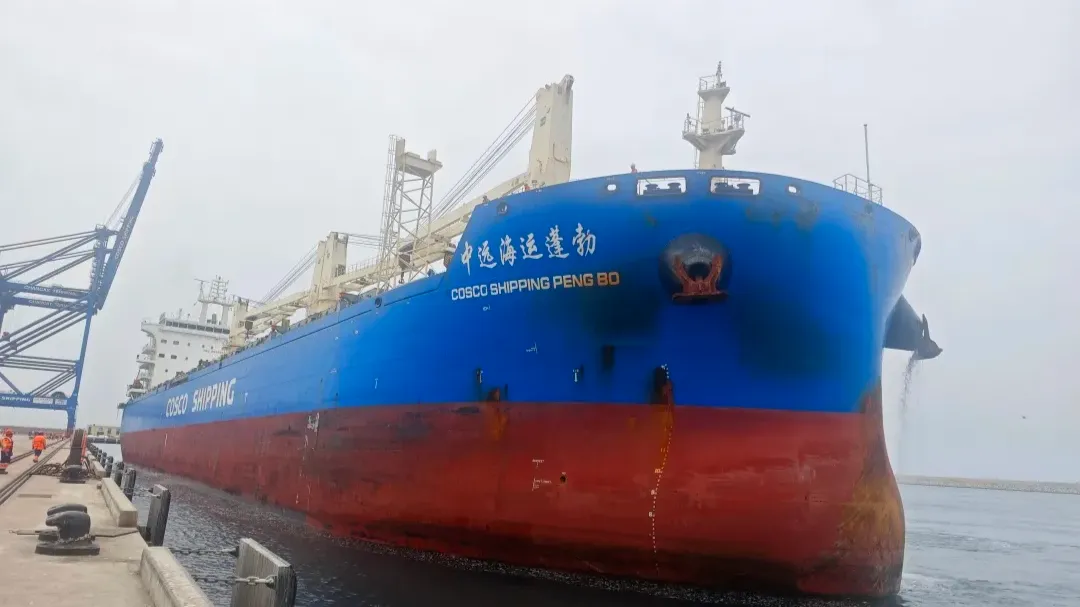

As China’s vehicle exports continue to expand rapidly, a transport solution once regarded mainly as a temporary alternative during shortages of dedicated car-carrier capacity is becoming an increasingly established part of COSCO SHIPPING Specialized Carriers’ automotive logistics portfolio.
Recently, the 62,000-dwt multipurpose pulp carrier COSCO SHIPPING Prosperity called at Chancay Port in Peru after transporting 917 Chinese-made vehicles. The shipment marked COSCO SHIPPING Specialized Carriers’ first vehicle-rack operation at Chancay.
The project was coordinated by the company’s South America team, together with its Pan-America business unit, Chancay Port and COSCO SHIPPING’s Peru operation. The service covered the full transport chain, including cargo booking, technical support, ocean transportation, port handling, inland distribution and the recovery of empty transport racks.
A shipment of 917 vehicles is not especially large when compared with the hundreds of thousands of cars now handled annually by COSCO SHIPPING Specialized Carriers. Its significance lies elsewhere. The operation connects two increasingly important elements of COSCO SHIPPING’s automotive strategy: the development of Chancay as a regional vehicle logistics hub on the west coast of South America, and the continued expansion of the company’s “multipurpose vessel plus vehicle rack” transport model.
A Pulp Carrier Carrying 917 Vehicles to South America
The COSCO SHIPPING Prosperity is not a pure car and truck carrier. Delivered in 2023, the vessel is a 62,000-dwt multipurpose pulp carrier measuring about 201.8 metres in length and 32.26 metres in beam, with cargo capacity of roughly 72,500 cubic metres and onboard lifting equipment.
The ability to carry large volumes of vehicles on this type of ship depends on a transport system developed by COSCO SHIPPING Specialized Carriers around dedicated vehicle racks.
Since 2022, the company has increasingly deployed 48-foot foldable vehicle racks. Cars are driven onto the racks, secured, and then lifted as complete units into the box-shaped cargo holds of multipurpose pulp carriers using either shore cranes or vessel cranes.
A typical 48-foot rack can carry three passenger vehicles side by side. On a 62,000-dwt multipurpose vessel, the racks can be stacked in several tiers, allowing a ship originally designed mainly for pulp, steel products, project cargo and breakbulk to carry more than 1,000 vehicles on a single voyage. After discharge, the empty racks can be folded and stacked for return or repositioning, reducing the space required for equipment recovery.
COSCO SHIPPING Specialized Carriers later extended the concept through the development of its V-RACK system, designed for larger vehicles including trucks, buses and tractors. Although wider than a standard container, the system can still be handled through lifting interfaces compatible with conventional container terminal equipment.
The importance of the rack system therefore goes well beyond simply placing cars on steel platforms. It effectively creates a standardized interface between vehicles and multipurpose vessels, allowing ships not originally designed as car carriers to generate meaningful automotive capacity.
The latest Chancay operation demonstrates that this interface has now been successfully extended to another important South American port.

From Taicang to Chancay
Rack-based vehicle transport is not a newly developed product for COSCO SHIPPING Specialized Carriers.
In August 2022, Xinde Marine News reported that the company used the COSCO SHIPPING Wisdom together with its independently developed 48-foot vehicle racks to carry more than 1,100 vehicles from Taicang to South America. At the time, China’s rapidly rising automotive exports coincided with tight global PCTC capacity, and the system initially served as an important source of additional carrying capacity.
The model was subsequently expanded to other trades. In the same period, the COSCO SHIPPING Harmony carried 2,387 Chinese vehicles to Italy, supporting a dedicated Taicang–Mediterranean automotive service. In South America, the company also deployed the Tian Shou on a Taicang–Vitória vehicle service to Brazil.
The business has since moved well beyond the experimental stage.
COSCO SHIPPING Specialized Carriers disclosed that its rack-based transport volume reached approximately 107,000 vehicles in 2024, while the company transported 346,000 vehicles in total during the year, up 45.8% year on year. Its automotive logistics offering has also expanded beyond ocean transportation into rail terminals, overseas warehousing, pre-delivery inspection, distribution and inland logistics.
Importantly, the rise of dedicated car-carrier capacity has not displaced the rack model.
In the first half of 2026, COSCO SHIPPING Specialized Carriers transported 394,600 vehicles, up 63% year on year. Of that total, 333,300 vehicles were carried by dedicated car carriers, an increase of 75%, while another 61,300 vehicles were transported by new-generation multipurpose vessels using rack systems, up 44%.
Those figures show that rack-based transportation is no longer simply an emergency solution for periods of PCTC shortage. It has become an established part of the company’s automotive transport portfolio.
Why Use Vehicle Racks When More PCTCs Are Entering the Market?
The answer starts with the scale of China’s automotive exports.
According to data released by China’s Ministry of Industry and Information Technology based on figures from the China Association of Automobile Manufacturers, China exported 7.153 million vehicles during the first eight months of 2026, up 66.7% year on year.
New-energy vehicle exports reached 3.435 million units, an increase of 124.3%. In August alone, China exported 1.01 million vehicles, including 526,000 new-energy vehicles.
China’s automotive export logistics market is therefore moving towards annual volumes of 10 million vehicles or more.
Dedicated PCTCs remain the most efficient tool for transporting large volumes of finished vehicles on major deep-sea routes, and COSCO SHIPPING Specialized Carriers itself is rapidly expanding its car-carrier fleet.
But automotive logistics cannot be reduced to a simple calculation of total exports divided by the carrying capacity of a 7,000- or 9,000-CEU PCTC.
Automakers operate from different production bases, ship in different batch sizes, serve an expanding range of destination markets and face different delivery schedules. Trade lanes are also affected by seasonal demand, last-minute export surges, market shifts and varying port infrastructure.
Not every shipment and not every destination is best served by waiting for a large dedicated car carrier.
That is where multipurpose vessels and vehicle racks retain strategic value.
They allow COSCO SHIPPING Specialized Carriers to use its existing global multipurpose and pulp-carrier network to provide additional automotive capacity. They can also serve ports without mature roll-on/roll-off infrastructure but with conventional breakbulk or container handling facilities.
The model is particularly useful when passenger cars, commercial vehicles, construction machinery and other manufactured products need to move within the same broader trade network. Multipurpose vessels can accommodate mixed cargoes in a way that pure car carriers cannot.
COSCO SHIPPING Specialized Carriers has already summarized its automotive transport offering as a combination of “car-carrier roll-on/roll-off services, heavy-lift vessel operations and dedicated vehicle racks deployed on new-generation multipurpose vessels”. The company has also identified ports including Bremerhaven and Chancay as future international vehicle transshipment hubs.
The latest Chancay project therefore brings together two strategic lines: diversified ship-type capacity and overseas automotive logistics hubs.
Why Chancay Matters
Chancay has a particularly important role in this strategy.
The port, which began operations in November 2024, is COSCO SHIPPING’s first major green and smart port investment in South America. Its first phase includes four berths — two container berths and two multipurpose berths — with designed annual handling capacity of around 1 million TEU, 6 million tonnes of bulk and general cargo, and approximately 160,000 vehicles.
The port is also connected to the Pan-American Highway through a tunnel of roughly 1.8 kilometres, giving it direct access to inland transport networks.
COSCO SHIPPING does not view Chancay simply as a gateway to Peru. The group has positioned the facility as a hub for the west coast of South America and has specifically identified the development of a South American vehicle distribution centre as part of the port’s strategic role.
Direct Shanghai–Chancay services can reduce sailing times to around 23 days, significantly shortening transit compared with traditional routing options.
Automotive cargoes had already begun flowing through Chancay before the latest shipment. In early 2025, the port handled its first containerized vehicle shipment, when 200 Geely vehicles arrived in 50 containers. Dedicated PCTC cargoes later followed.
With the arrival of vehicle racks on a multipurpose pulp carrier, Chancay can now receive Chinese vehicles through three different maritime logistics channels: dedicated car carriers, container ships and multipurpose vessels equipped with vehicle racks.
That combination is strategically important.
PCTCs provide scale. Container shipping provides frequency and network reach. Multipurpose vessels and racks provide flexibility, additional capacity and access to a broader range of ports.
All three modes can ultimately converge at the same logistics hub, where vehicles can enter local storage, road transport, PDI and regional distribution networks across Peru and neighbouring markets.
More Than a 917-Vehicle Shipment
The operational significance of the project therefore extends beyond the simple completion of discharge.
COSCO SHIPPING Specialized Carriers emphasized that its South America unit, Pan-America business team, Chancay Port and COSCO SHIPPING Peru worked together across the full process, from cargo booking and technical preparation to ocean transport, terminal operations, inland delivery and equipment recovery.
This matters because introducing rack-based vehicle operations at a new port requires the entire handling process to be validated.
The terminal must confirm lifting procedures, yard organization, rack dismantling and vehicle release processes. Inland movement must be coordinated, while empty racks need to be stacked, stored and eventually repositioned. Cargo damage control and operational safety also need to be incorporated into standardized procedures.
Once those workflows have been tested successfully, however, they can be repeated.
In that sense, a single 917-vehicle shipment may serve as the operational foundation for larger and more regular flows in the future.
From Carrying Cars to Controlling the Automotive Logistics Chain
The Chancay operation also reflects a broader shift in COSCO SHIPPING’s automotive logistics strategy: the group is pushing further beyond the ocean leg.

For a traditional shipowner, the principal product is vessel space. For an automaker, however, logistics does not end when a car moves from one port to another.
Vehicles must be transported from factories to terminals by road or rail, stored in yards, inspected, customs-cleared and loaded. At destination they must be discharged, stored, processed, cleared, transported inland and, in many cases, redistributed to other markets.
As export volumes rise, the efficiency of the interfaces between these stages becomes increasingly important to total logistics cost.
COSCO SHIPPING’s advantage is that it can combine container shipping, specialized shipping, ports, overseas subsidiaries and inland logistics assets within the same broader group network.
In the Chancay project, the ship is operated by COSCO SHIPPING Specialized Carriers, the transport equipment is part of its rack system, the destination port is a COSCO SHIPPING investment, and the local logistics chain involves COSCO SHIPPING’s Peruvian operation.
The competitive unit therefore becomes larger than the freight rate of a single vessel.
It becomes the entire supply chain linking a Chinese vehicle factory with the South American market.
China has already exported more than 7 million vehicles in the first eight months of 2026, while new-energy vehicle exports have more than doubled. COSCO SHIPPING Specialized Carriers moved almost 400,000 vehicles in the first half alone, while its rack-based vehicle business still grew by 44% despite the rapid expansion of its dedicated car-carrier fleet.
Taken together, those figures point towards a more diversified model for automotive shipping.
Dedicated PCTCs provide scale. Container networks provide reach. Multipurpose vessels and vehicle racks provide flexibility. Overseas ports provide transshipment and regional distribution capability.
The latest 917-vehicle shipment at Chancay is only one new node in that network.
But as Chancay develops into a vehicle distribution hub for the west coast of South America, COSCO SHIPPING Specialized Carriers’ rack-based transport system is also entering another stage of development — moving from simply finding additional ships to carry cars overseas, to using multiple vessel types, standardized transport equipment and proprietary overseas logistics nodes to move vehicles continuously across global markets.


READ MORE
 Car Carriers
BYD Orders Another 10 x 9,200 CEU-CEU Car Carriers?
 Car Carriers
Up to 14 More PCTCs: Höegh Doubles Down on China as Aurora Programme Could Grow to 26 Ships
 Car Carriers
PCTC Are Running Short: COSCO Moves 13,052 Chery Vehicles to Europe in Containers, Tapping Boxship and Multipurpose Vessel Networks
 Car Carriers
Up to 26 PCTC! Höegh Autoliners Signs 6 More Aurora Car Carriers with China Merchants
 Car Carriers
Ningbo Ocean Shipping Officially Enters the Car Carrier Market
 Car Carriers