


Why MOL Is Moving Beyond the Traditional Shipowner Model
Japan’s Largest Shipping Company No Longer Wants to Be Just a Shipowner Understanding MOL’s Strategic Transformation
From a traditional shipping giant with nearly 1,000 vessels to a “Global Social Infrastructure Company”, Mitsui O.S.K. Lines is redesigning how a major shipping group makes money
What comes next for a shipping company once its fleet approaches 1,000 vessels?
That is one of the questions Mitsui O.S.K. Lines, or MOL, has been trying to answer over the past several years.
By 2025, MOL operated around 935 vessels across virtually every major shipping segment, including dry bulk carriers, tankers, LNG carriers, car carriers, containership-related businesses and ferries. By any conventional measure, MOL is already one of the world’s largest and most diversified shipping groups. Its scale, global network and breadth of operations mean that simply adding more ships is no longer enough to define the company’s next stage of growth.
Over the past several years, MOL has therefore been expanding the boundaries of what it considers its core business.
Its activities now stretch from LNG shipping into LNG infrastructure, from chemical tankers into onshore tank terminals, and from conventional ocean transportation into logistics, offshore wind, ammonia, methanol and other low-carbon energy businesses. The group also has growing exposure to real estate, cruises, terminals, offshore projects and other infrastructure assets.
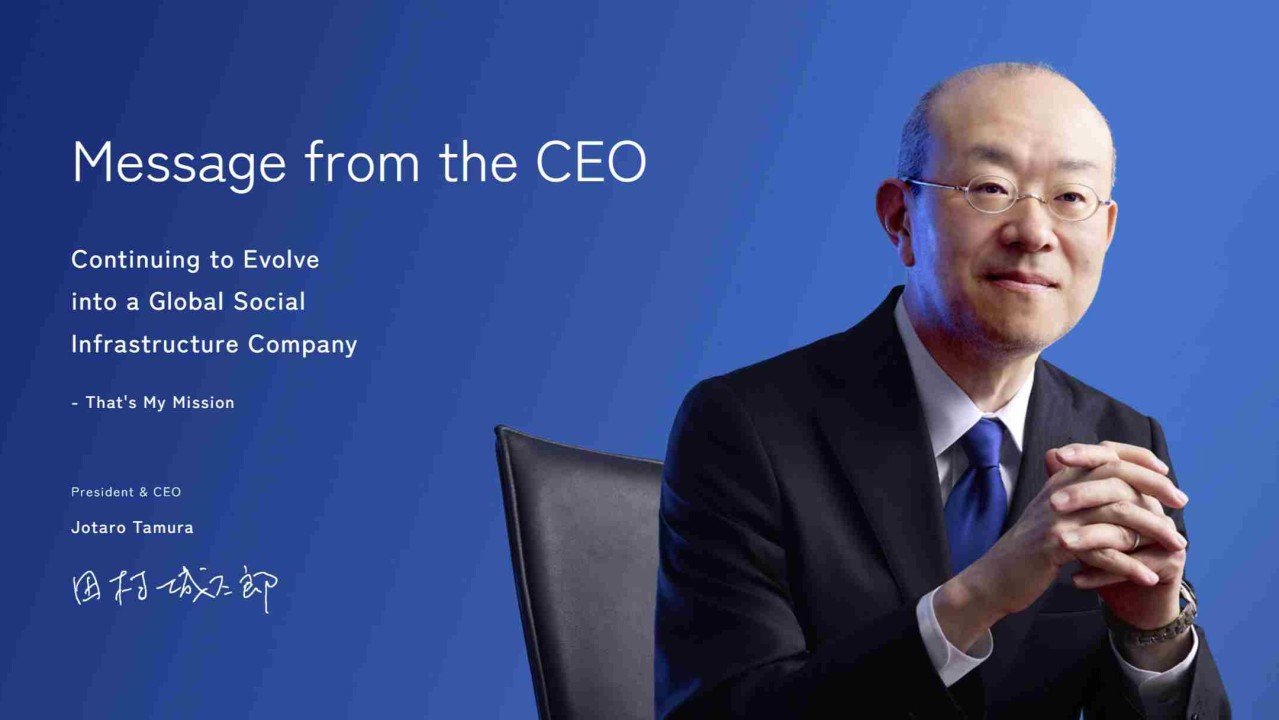
Under its long-term management plan, BLUE ACTION 2035, MOL has set out a clear destination. The company wants to evolve from an integrated shipping company into what President and CEO Jotaro Tamura describes as “a diversified conglomerate originating in shipping”, with the ultimate goal of becoming a “Global Social Infrastructure Company”.
That ambition goes far beyond conventional diversification.
At the heart of MOL’s transformation lies a much more fundamental question faced by every major shipping group: how can a company continue to capture the extraordinary earnings available during shipping upcycles while reducing the damage caused by the next downturn?
MOL is trying to redesign its earnings structure around that problem.
Why does MOL need to transform?
The origins of MOL’s current strategy can be traced back to the shipping boom of the 2000s and the severe downturn that followed the global financial crisis.
During the years before 2008, global trade expanded rapidly and shipping markets enjoyed an extended period of strong freight rates. Shipowners responded in the most predictable way: they ordered more ships. High earnings, rising vessel values and confidence in future demand encouraged aggressive fleet expansion across much of the industry.
When the financial crisis struck, however, global economic growth slowed while large volumes of previously ordered tonnage continued to enter the fleet. Shipping markets moved from boom to prolonged oversupply, leaving many owners with fleets built for a demand environment that no longer existed.
For MOL, that period became a lasting lesson in capital allocation.
Tamura has said in his latest CEO message that the company drew an important conclusion from the post-2008 downturn: reinvesting all earnings from a strong shipping market back into more ships can amplify exposure to the next downturn.
Ships are long-lived assets. A large commercial vessel may remain in service for 20 to 30 years, meaning a fleet expansion decision taken near the top of a cycle can affect a company for many years after market conditions have changed.
That lesson became particularly relevant again during the extraordinary shipping boom of 2021 and 2022.
Pandemic-related supply chain disruption sent container freight rates to unprecedented levels. Ocean Network Express, in which MOL holds a 31% stake, generated exceptional earnings along with the rest of the liner industry. Across fiscal 2021 and fiscal 2022, MOL recorded approximately JPY1.5 trillion in cumulative ordinary profit, far above its historical earnings levels.
For a traditional shipping company, this could have been the ideal moment to launch another major fleet expansion.
MOL chose a different approach.
The group began allocating a much larger share of its capital toward businesses backed by long-term contracts, infrastructure assets, logistics operations and other sources of relatively stable cash flow. That shift eventually became the foundation of BLUE ACTION 2035.
The decision does not reflect a loss of confidence in shipping. It reflects decades of experience with shipping cycles. MOL has concluded that a global shipping group cannot rely indefinitely on fleet size, asset prices and freight markets alone to deliver sustainable growth.
BLUE ACTION 2035: redesigning the earnings structure
MOL launched BLUE ACTION 2035 in 2023 as a long-term management plan extending well into the next decade.
The strategy covers a wide range of businesses, including LNG, chemical logistics, offshore wind, ammonia, methanol, carbon-related businesses, logistics, terminals, real estate and cruises. Yet the underlying logic connecting these investments is relatively straightforward: MOL wants to reduce the group’s dependence on a single shipping cycle while using its existing maritime expertise, customer relationships, technology and global network to move further along the value chain.
The traditional shipowner business model is relatively simple. The owner provides a vessel, carries cargo from one port to another and earns freight or charter income.
MOL wants to extend that relationship.
In LNG, the company is moving beyond vessel ownership into LNG-related infrastructure. In chemicals, it is expanding beyond ocean transportation into onshore storage terminals. In the energy transition, it is positioning itself not only to transport future fuels, but also to participate in the infrastructure and supply chains surrounding ammonia, methanol, offshore wind and other low-carbon energy sources.
This is closely connected to MOL’s transition from an “asset owner” toward a broader “service provider”.
Ships remain central to the company, but MOL wants customers to buy more than transportation capacity. It wants to provide longer-term logistics and infrastructure solutions that generate deeper customer relationships, recurring revenue and more predictable cash flow.
The acquisition of LBC, a major operator of liquid bulk storage terminals in Europe and the United States, illustrates this strategy clearly. MOL already had significant chemical shipping operations. Through LBC, it has added onshore storage and terminal capabilities, extending its involvement beyond the sea leg of a chemical cargo movement.
The commercial relationship can therefore continue after a cargo has been discharged, through storage, terminal services and downstream logistics. That is a much longer value chain than the traditional shipowner model.
Phase 1: nearly JPY2 trillion invested to reshape the portfolio
MOL defined the 2023-2025 period of BLUE ACTION 2035 as Phase 1, under the theme “Transformation and Expansion”.
The priority during this period was to reshape the group’s asset portfolio.
MOL initially planned to invest approximately JPY1.2 trillion over the three years. Actual investment ultimately reached around JPY2 trillion, of which roughly JPY1.6 trillion was directed toward what the company classifies as stable-revenue businesses.
That allocation reveals how significantly MOL’s approach to capital has changed.
The company has continued to invest in ships. Dry bulk carriers, tankers, LNG carriers, car carriers and other vessel classes remain central to the portfolio. At the same time, a much larger proportion of capital has been directed toward assets whose earnings are less dependent on spot freight markets.
LNG shipping is one of the clearest examples. Many LNG carriers operate under long-term charter arrangements lasting well over a decade, providing far greater revenue visibility than traditional dry bulk or tanker spot exposure. Terminals, logistics operations, energy infrastructure and certain real estate assets can provide similar characteristics.
These assets are intended to create a stronger earnings floor beneath MOL’s traditional shipping activities.
During a strong shipping market, container shipping, dry bulk, tankers and car carriers can still generate substantial upside. During a weaker market, LNG contracts, terminals, logistics and infrastructure businesses can support group earnings and cash flow.
MOL says the rebalancing of its portfolio during Phase 1 progressed faster than originally planned. The company had targeted an asset mix of roughly 40% market-driven businesses and 60% stable-revenue businesses. At the same time, average pretax profit during fiscal 2023-2025 reached approximately JPY329 billion, comfortably above the JPY240 billion target initially set for the period.
Phase 1 therefore established the asset base for the next stage of MOL’s transformation.
Phase 2: from buying assets to making them deliver
BLUE ACTION 2035 entered Phase 2 on 1 April 2026.
On the same day, Jotaro Tamura became MOL’s President and CEO, while Takeshi Hashimoto moved into the chairman role. The leadership transition neatly coincides with a broader change in strategic emphasis.
Under Hashimoto, MOL established the direction of BLUE ACTION 2035 and accelerated large-scale investment, portfolio restructuring and acquisitions. By the time Tamura took over, many of those investments had already been committed.
Phase 2 carries a different theme: “Value Realization”.
The focus for the 2026-2030 period is increasingly on returns.
Tamura has made the point clearly in MOL’s latest report: acquiring assets does not create value by itself. The ships ordered, companies acquired and infrastructure projects developed during the first phase now need to generate earnings and cash flow.
That changes how investors and the shipping market should assess MOL over the next five years.
During Phase 1, the important questions were where MOL was investing, what it was buying and which new markets it was entering.
During Phase 2, the more important questions will be how much those assets earn, whether stable-revenue businesses materially increase their contribution to group profits, and whether the approximately JPY2 trillion invested during the first phase generates adequate returns on capital.
The strategic direction established under Hashimoto remains intact. Tamura’s challenge is to convert that direction into measurable financial performance.
Learning to manage the shipping cycle
One of the most important changes under Phase 2 is MOL’s new classification of its business portfolio.
The company previously divided its operations largely between market-driven businesses and stable-revenue businesses. Under the latest framework, it now uses three categories: Market Driven Business, Hybrid Business and Stable Revenue Business.
Container shipping sits in the market-driven category.
Dry bulk, tankers and car carriers are treated as hybrid businesses, reflecting the mix of market exposure and longer-term contracts within those sectors.
Long-term LNG shipping contracts and many non-shipping infrastructure businesses sit within the stable-revenue category.
This framework reveals an important point about MOL’s strategy: the group still wants exposure to shipping cycles.
Shipping volatility creates risk, but it also creates extraordinary profit opportunities. The container boom of 2021-2022 demonstrated that clearly, while the strong tanker markets seen in 2026 provide another example of how quickly maritime assets can generate exceptional returns when vessel supply becomes tight.
Eliminating market exposure entirely would remove much of that upside.
MOL is therefore pursuing what it calls “Cyclical Growth”.
The concept is designed to combine two different sources of earnings. During strong markets, market-driven and hybrid businesses can capture freight-rate upside. During downturns, long-term contracts, LNG shipping, terminals, logistics and other stable-revenue businesses can provide downside protection.
The objective is simple in principle: retain substantial upside when shipping markets are strong while reducing the depth of earnings deterioration when markets weaken.
For a traditional shipowner, success has often depended on calling the cycle correctly and buying or selling ships at the right time.
MOL is moving toward a broader portfolio-management model in which the company tries to make the cycle work for the group rather than allowing the cycle to determine the group’s financial performance.
Why China, India and overseas markets matter more
There is also a geographic dimension to MOL’s transformation.
Japan alone is unlikely to provide enough long-term growth for a group of MOL’s scale.
Tamura uses the phrase “Win on away ground” to describe the challenge. MOL wants to become more capable of winning customers, investing capital and building businesses independently in overseas markets, rather than relying primarily on Japanese customers, Japanese cargoes and the domestic economy.
Under Phase 2, the Indo-Pacific is one of the most important regional growth areas, covering Southeast Asia, South Asia and extending toward East Africa.
This helps explain MOL’s growing emphasis on markets such as Singapore, India and China.
In India, MOL has continued to expand long-term energy transportation partnerships. In China, its relationships increasingly extend across Chinese shipyards, shipowners, energy companies and international commodity players.
China’s role in MOL’s strategy is also becoming more diverse. It remains one of the world’s most important shipbuilding centres and cargo-generating markets, but for MOL it can increasingly function simultaneously as a shipbuilding partner, energy partner, automotive supply-chain market, logistics market and infrastructure investment destination.
MOL’s involvement in QatarEnergy’s QC-Max LNG carrier programme and the construction of major LNG vessels at Chinese shipyards are examples of a relationship moving beyond straightforward vessel procurement toward deeper industrial cooperation.
For a company that wants to become a Global Social Infrastructure Company, this ability to operate locally in overseas markets will be critical. Future growth increasingly depends on MOL’s ability to find projects, customers and acceptable returns outside Japan.
Decarbonisation is forcing MOL to plan decades ahead
Shipping cycles explain why MOL wants to reduce earnings volatility. Decarbonisation explains why it is thinking so far ahead.
Shipping has an unusually difficult investment problem: ships remain in service far longer than energy technologies remain static.
A vessel ordered today could still be trading in 2045 or even 2050, while the dominant marine fuel mix for the next 20 years remains uncertain. LNG, methanol, ammonia, biofuels, wind-assisted propulsion and other low- or zero-carbon solutions are developing in parallel.
No major shipowner can know with certainty which technologies will dominate.
MOL’s response has been to build exposure across multiple pathways.
The group has invested in LNG, ammonia, methanol, offshore wind, carbon-related businesses and energy-efficiency technologies such as its Wind Challenger hard sail system. The intention is to participate not only in the transportation of future energy commodities, but also in the infrastructure and supply chains surrounding them.
Tamura has also indicated that Phase 3 of BLUE ACTION 2035, covering 2031-2035, could involve another major wave of ship investment.
Although the pace of global decarbonisation has moderated in some areas, the long-term direction remains unchanged. As regulatory requirements tighten during the 2030s, large parts of the existing fleet may require replacement or significant upgrading.
That creates another important objective for Phase 2: generate cash, improve earnings quality and preserve balance-sheet capacity ahead of potentially heavy fleet renewal expenditure in the next decade.
MOL has indicated that it wants to maintain an equity ratio of around 40%, giving the group financial flexibility for future investment.
The valuation problem behind the transformation
MOL is also trying to address a problem that has affected shipping companies for decades: persistent valuation discounts.
Shipping earnings are difficult to forecast. A company may earn enormous profits during one year of strong freight markets and see those profits fall sharply once rates weaken. Even when a shipowner has substantial vessels, cash and net assets on its balance sheet, investors often apply a discount because of the uncertainty surrounding future earnings.
At the end of March 2026, MOL’s price-to-book ratio stood at around 0.78 times.
Tamura has explicitly linked the company’s strategic transformation to the need to change how capital markets value MOL. If the group can increase the contribution of stable-revenue businesses, reduce earnings volatility and maintain a more predictable shareholder distribution policy, management believes investors may begin to treat MOL differently from a conventional cyclical shipping stock.
Beginning in fiscal 2026, MOL introduced a progressive dividend policy and combined it with share buybacks, targeting a total annual shareholder return ratio of around 40%.
Tamura has also indicated that the company wants to move its P/B ratio above 1.0 over the medium to long term, and believes a range of roughly 1.2 to 1.5 times is achievable.
The logic creates a direct connection between operating strategy and valuation: a greater contribution from stable-revenue businesses should reduce earnings volatility; lower volatility should improve cash-flow visibility; stronger visibility should support more predictable dividends; and that, in turn, could support a higher valuation.
MOL’s transformation is therefore taking place across three interconnected markets: freight markets, shipping asset markets and capital markets.
From Hashimoto to Tamura: five years that will test the strategy
The 2026 leadership transition comes at a critical point in this process.
Takeshi Hashimoto became CEO in 2021 and played a central role in developing BLUE ACTION 2035. During his tenure, MOL accelerated strategic investment and shifted capital toward LNG value chains, chemical logistics, offshore wind, terminals, real estate and other infrastructure-related businesses.
That period established the direction of travel.
Jotaro Tamura inherits a different challenge.
Tamura has deep experience in container shipping, overseas operations and corporate strategy, and he was already closely involved in MOL’s strategic planning before becoming CEO. His appointment therefore represents continuity rather than a change in direction.
Over the next five years, however, he will have to demonstrate that the investments made during Phase 1 can produce adequate returns.
The performance of LBC following its acquisition, the profitability of MOL’s expanding LNG portfolio, the contribution from logistics and infrastructure assets, and the ability of its regional strategy to create sustainable growth outside Japan will all become increasingly important tests of Phase 2.
Hashimoto’s era established where MOL wanted to go.
Tamura’s era will be judged by whether that transformation creates sufficient value.
Changing the way a shipping company survives the cycle
Taken together, MOL’s ship orders, acquisitions, energy investments, infrastructure projects and management statements point to a coherent long-term strategy.
Shipping remains at the centre of the group. With a fleet approaching 1,000 vessels, maritime transportation continues to provide MOL with its most important industrial capabilities, customer relationships and global reach.
Yet the economic model around those ships is becoming broader.
MOL wants a future earnings structure in which ships remain central, while long-term contracts, energy infrastructure, logistics, terminals, low-carbon energy businesses and supply-chain services extend the value created around them.
In a strong shipping market, containers, dry bulk, tankers and car carriers can continue to deliver significant cyclical upside.
In a weak market, LNG contracts, energy infrastructure, chemical logistics, terminals and other stable-revenue businesses are expected to support group cash flow.
When the next major wave of green fleet renewal arrives in the 2030s, MOL hopes to use the cash generation and balance-sheet strength created during Phase 2 to fund another generation of vessels.
That is the essence of MOL’s “Cyclical Growth” concept.
The company is trying to build a business model capable of living with shipping cycles without allowing those cycles to dictate the fate of the entire group.
For the wider shipping industry, the transformation is also worth watching closely. In the past, the strength of a major shipowner was often measured first by fleet size, deadweight tonnage and market share. Over the next decade, competitive advantage may increasingly depend on something broader: the stability of cash flows, the length of the value chain, the depth of customer relationships and the ability to allocate capital through changing freight markets, geopolitical disruptions and the energy transition.
BLUE ACTION 2035 is MOL’s attempt to build that model.
From a shipping group with nearly 1,000 vessels to a “Global Social Infrastructure Company”, MOL is trying to show that a 140-year-old shipping company can still capture the upside of maritime cycles while building a business capable of surviving the downside.
The 2026-2030 Phase 2 period may prove to be the most important test of that transformation.

READ MORE
 People
PIL Names Wan Chee Foong as Next CEO: A New Chapter Driven by Ports, Logistics and Strategy
 People
DNV’s Norbert Kray: China’s Shipbuilding Edge Now Extends Far Beyond Cost and Scale
 People
Exclusive Interview with Hapag-Lloyd’s Rajiv Ghose: How Gemini’s 90% Schedule Reliability Is Reshaping Shipping Resilience
 People
What John Lee’s Speech Signals for Hong Kong’s Maritime Industry over the Next Five Years
 People
Martin Roolvink has been appointed Managing Director of Bernhard Schulte Shipmanagement (Deutschland),
 People
Tung Chee-hwa Dies at 89: From Shipping Executive to Hong Kong’s First Chief Executive
 People
India Declares Its Maritime Ambition in Hamburg: Becoming a Global Shipping and Shipbuilding Power
 People
Euroseas Ltd.: Sustained Earnings, Disciplined Growth and Further Upside
 People
Nautical Institute (Singapore) Conference 2026 Brought Seaworthiness and the Future of Seafarers to Centre Stage
 People