


Euroseas Ltd.: Sustained Earnings, Disciplined Growth and Further Upside
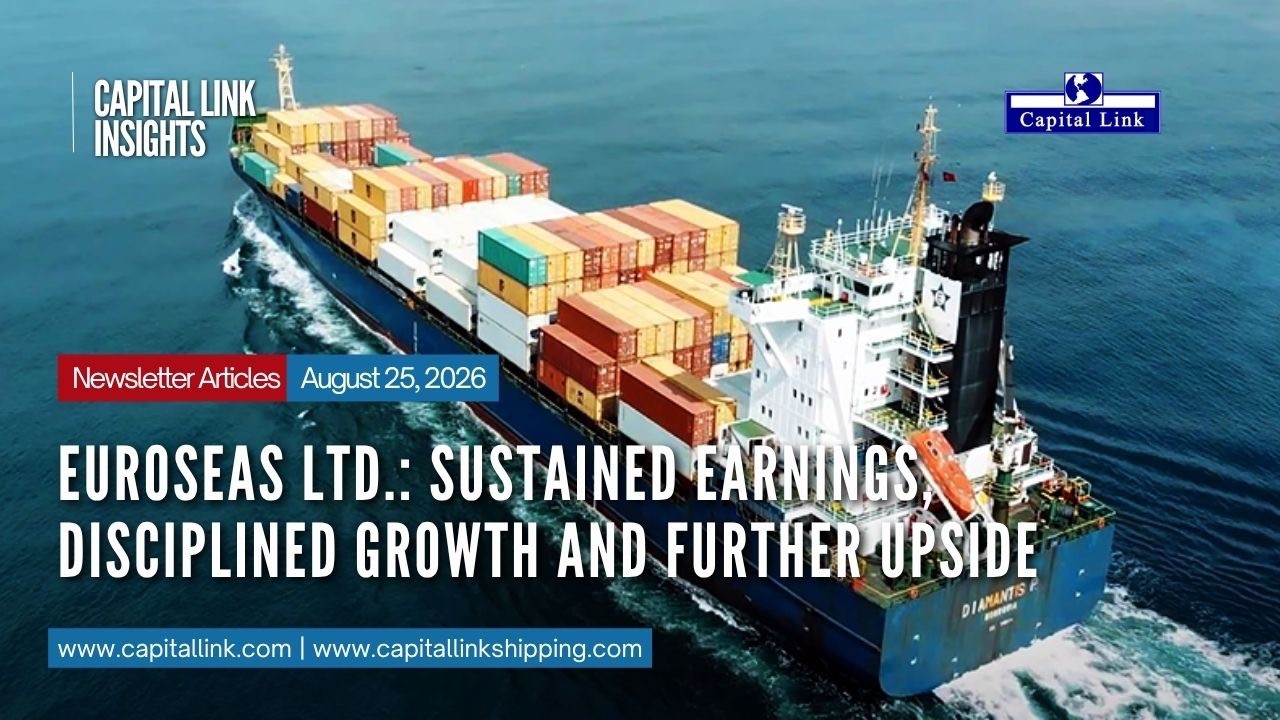

In this episode of Capital Link’s Trending News Podcast, Chairman and CEO of Euroseas Ltd. , Aristeidis Pittas , shares his perspective on the Company’s earnings outlook, market conditions, newbuilding program and fleet growth, chartering strategy, and the opportunities shaping its next phase of growth.
Watch the full discussion: youtube.com/watch?v=fdMpknHxshI
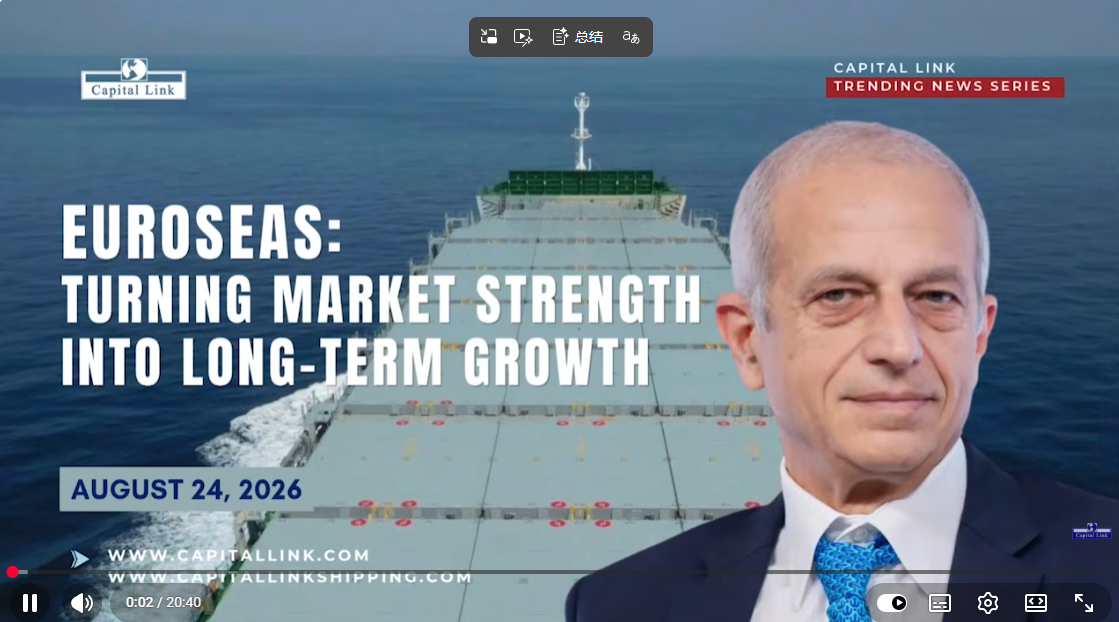
Euroseas Ltd. (NASDAQ: ESEA) expects its present earnings level to hold onto the next year, with nearly its entire fleet fixed at rates concluded at very profitable levels for periods of one to four years. The Company generated net revenues of $56.5 million for the second quarter of 2026, net income attributable to controlling shareholders of $33.2 million, or $4.74 per diluted share, and adjusted EBITDA of $40.1 million. An average of 21 vessels earned a TCE rate of $30,306 per day, reinforcing the strength and visibility of the Company’s earnings profile.
He described the first and second quarters of 2026 as two of the most profitable consecutive quarters Euroseas has posted in fifteen years. In fact, he went further, expressing confidence that returns of these levels could be sustained over the next four to six quarters. This confidence is grounded primarily in the Company’s substantial contract coverage rather than any forecast for the spot market. Euroseas has fixed 96% of its available days for the remainder of 2026, 81% for 2027 and 47% for 2028, at average contracted rates of $30,900, $31,700 and $32,300 per day. Charters concluded at these levels set a strong earnings floor regardless of where renewal rates ultimately land, though he stressed that the markets currently continue to be extremely hot.
Newbuildings over Secondhand Tonnage
Six years of firm markets have driven asset values to levels Mr. Pittas has not seen before. Three, four- and five-year-old ships now change hands at prices above the cost of ordering a newbuild, a distortion he expects the market to correct at some point. This assessment has narrowed the conditions under which he would consider acquiring vessels in the water. Paying today's elevated prices for a vessel without employment leaves the buyer exposed to the full extent of the residual risk. By contrast, a vessel secured by a long-term charter at current rates can mitigate a significant portion of that risk before any market correction occurs, but such projects are difficult to find.
The alternative has been to order newbuildings. Euroseas currently has 12 newbuildings under construction, comprising 8 feeders and 4 intermediates with deliveries scheduled from the third quarter of 2027 through the first quarter of 2029. The program will expand the fleet from 21 vessels totaling 61,000 teu to 33 vessels totaling 97,400 teu, positioning the Company with one of the youngest feeder and intermediate fleets in the market. The two most recent orders were announced together with the quarterly results and consist of a pair of 1,800 teu vessels contracted with Nantong CIMC Sinopacific for $64.5 million in total. They are scheduled for delivery in December 2028 and March 2029.
The estimated full cost of the program is $560.0 million, of which the Company is contemplating that about 60% will be financed with bank debt. Of the $230 million equity required, approximately $74.0 million had been advanced as of June 30. Four of the 12 newbuildings already have employment secured, fixed for four to five years at rates in the low thirties. Charterers are committing ships that will not be delivered for another year or more, driven by concerns that quality tonnage will not be available when needed.
Older Ships Earn a Reprieve
The same scarcity has changed the outlook for the oldest vessels in the fleet. Three of them are due to open for rechartering toward the end of the year, and Mr. Pittas reported charterer interest for two to three years, at rates above their previous fixtures. Two of the three had been modeled for demolition, being older than 25 years. Instead, they will undergo their special surveys and stay in service. “Such is the strength of the market,” he noted.
Discounts on older tonnages have narrowed to levels that reflect little more than the fuel consumption differential relative to modern ships. Forward fixing, once largely reserved for newer vessels, is now extending further down the age curve.
Outside Capital at the Vessel Level
In May, Euroseas formed a joint venture with investors represented by NRP Project Finance for its intermediate newbuilding Thrylos, due for delivery in the first quarter of 2028. NRP investors acquired 49% for $12.2 million, with the transaction structured on the assumption of at least 60% debt financing. The first capital contribution has been paid. Mr. Pittas framed the structure as serving two purposes: bringing in financing at NAV values while simultaneously familiarizing Norwegian investors with deep shipping expertise with Euroseas.
Duration Over Rate
Geopolitical disruption has become a standing feature of global trade, and Mr. Pittas has responded by mitigating risk on two fronts. The first is the balance sheet, where he described net debt as very close to zero. As of June 30, outstanding debt stood at $208.1 million, against $164.3 million of cash and restricted cash, plus a further $38.9 million held in bonds and conservative structured equity products as part of short-term liquidity management. The second is securing longer charters. Offered $35,000 per day for one year or $25,000 per day for two years, he would favor the two-year charter. If Red Sea routings and trade patterns normalize, sailing distances would shorten, ton-mile demand would decline, and the number of ships needed would fall accordingly. Long term charters and low leverage are the hedge against that potential outcome.
Euroseas expects a market correction to arrive at some point. In the smaller vessel segments the impact should be cushioned by the age profile of the fleet. In segments up to 8,000 teu, vessels over 20 years old outnumber the current order book. As rates soften, these ships become increasingly costly to maintain and are more likely to be sent for demolition. Their removal from the fleet would again tighten supply, therefore the market correction when it occurs will probably be short lived.
Dividends, Buybacks and the Growth Bill
The Board declared a quarterly dividend of $0.80 per share for the second quarter of 2026, payable on September 16 to holders of record on September 9, representing an annualized yield of approximately 4.2% to 4.5%, based on the recent range in which the share price has traded. Mr. Pittas outlined the Boards policy of maintaining the dividend at a meaningful stable or gradually increasing rate over time, a course maintained for the past 4 years. In good times, as currently, the balance of earnings is kept to fund Company growth. There is also a buyback program in place, but it has been used more selectively in recent periods as the share price continues to appreciate. Nevertheless, since May 2022 the Company has repurchased 480,460 shares, representing 6.8% of shares outstanding, for an aggregate of $11.36 million.
The Gap Investors Have Not Closed
Seven years ago, the stock traded at around $3.00 per share. Today, it trades at $73.00, however, still below the significantly more than $100.00 per share, Mr. Pittas estimates the Company’s net asset value.
Asked what investors may be missing over the next 12 to 18 months; Mr. Pittas broadened the discussion beyond Euroseas. He noted that while all listed container vessel owners have taken meaningful steps to protect themselves against an eventual downturn by securing longer term charters while retaining the capacity to grow through a possible downturn in the cycle, none of them is trading anywhere near their underlying asset value. His closing message to shareholders was straightforward: “sleep calmly, let the dividends come and hopefully valuations will improve towards the underlying levels of their assets.”
About Euroseas Ltd.
Euroseas Ltd. was formed on May 5, 2005 under the laws of the Republic of the Marshall Islands to consolidate the ship owning interests of the Pittas family of Athens, Greece, which has been in the shipping business over the past 140 years. Euroseas trades on the NASDAQ Capital Market under the ticker ESEA. Euroseas operates in the container shipping market. Euroseas' operations are managed by Eurobulk Ltd., an ISO 9001:2008 and ISO 14001:2004 certified affiliated ship management company, which is responsible for the day-to-day commercial and technical management and operations of the vessels. Euroseas employs its vessels on spot and period charters and through pool arrangements. The Company has a fleet of 21 vessels, including 15 Feeder containerships and 6 Intermediate containerships. Euroseas’ 21 containerships have a cargo capacity of 61,144 teu. After the delivery of twelve containership newbuildings gradually from the third quarter of 2027 until the first quarter of 2029, Euroseas’ fleet will consist of 33 vessels with a total carrying capacity of 97,396 teu.


READ MORE
 People
PIL Names Wan Chee Foong as Next CEO: A New Chapter Driven by Ports, Logistics and Strategy
 People
DNV’s Norbert Kray: China’s Shipbuilding Edge Now Extends Far Beyond Cost and Scale
 People
Exclusive Interview with Hapag-Lloyd’s Rajiv Ghose: How Gemini’s 90% Schedule Reliability Is Reshaping Shipping Resilience
 People
What John Lee’s Speech Signals for Hong Kong’s Maritime Industry over the Next Five Years
 People
Martin Roolvink has been appointed Managing Director of Bernhard Schulte Shipmanagement (Deutschland),
 People
Tung Chee-hwa Dies at 89: From Shipping Executive to Hong Kong’s First Chief Executive
 People
India Declares Its Maritime Ambition in Hamburg: Becoming a Global Shipping and Shipbuilding Power
 People
Nautical Institute (Singapore) Conference 2026 Brought Seaworthiness and the Future of Seafarers to Centre Stage
 People
Klaus-Michael Kühne, one of the most influential figures in global shipping and logistics, has died at the age of 89
 People