


Houthi Blockade Turns Violent: Saudi Tanker Hit as Red Sea Traffic Falls
.
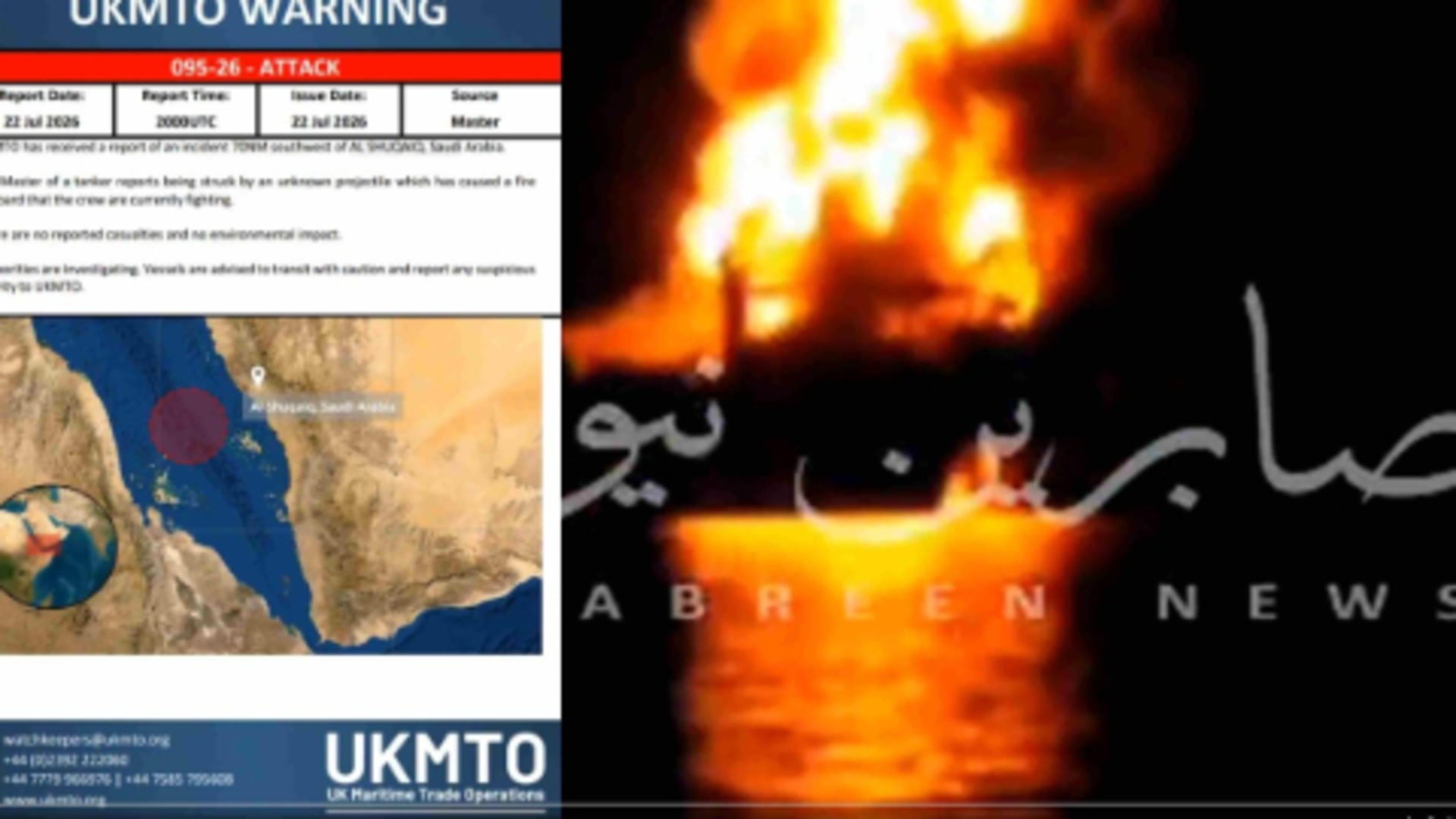

The Houthis claim they attacked the Saudi tankers ENCELIA and LAYLA after the vessels breached their maritime embargo. Only the strike on ENCELIA has been independently corroborated. Meanwhile, ships are diverting, holding position or repeatedly changing course, and daily transits through Bab el-Mandeb have fallen from 38 to 27.
As a Saudi tanker burned in the Red Sea, two very large crude carriers carrying Saudi oil to China were sailing south along the Yemeni coast towards the Bab el-Mandeb Strait.
The two developments capture the increasingly complex situation facing commercial shipping following the Houthis’ declaration of a maritime embargo against Saudi Arabia.
The threat has moved beyond political statements, emails to shipping companies and voluntary route changes. A tanker has now been struck and set on fire. Yet Bab el-Mandeb remains open, and shipowners are responding in different ways: some vessels are turning back, some are anchoring or waiting for instructions, while others are resuming their voyages after temporarily reversing course.
One tanker confirmed hit, second attack remains unverified
The Houthis said they had used ballistic missiles, cruise missiles and drones against two Saudi tankers, ENCELIA and LAYLA, after accusing them of violating the group’s newly declared maritime embargo.
The Houthis claimed that both vessels were hit and caught fire. They also said their forces had compelled around 10 ships to retreat. That wider claim has not been independently verified.
The attack on ENCELIA has, however, been corroborated by several external sources.
UK Maritime Trade Operations said it received a report at 2000 UTC on July 22 that the master of a tanker approximately 70 nautical miles southwest of Al Shuqaiq, Saudi Arabia, had reported being struck by an unknown projectile. The impact caused a fire, which the crew was fighting. No casualties or environmental impact were reported at the time.
Saudi Arabia’s state news agency later reported that an attack caused a fire on ENCELIA’s bow. All crew members were safe, while authorities had secured the vessel and taken measures to protect the marine environment. Vanguard separately reported that the ship had been struck on its starboard side by an unknown projectile.
ENCELIA is a 109,250-dwt Saudi-flagged Aframax/LR2 tanker built in 2003. LAYLA is a Saudi-flagged, 317,821-dwt VLCC built in 2007.
There has so far been no confirmation from UKMTO, the shipowner, the flag state or another independent maritime security source that LAYLA was hit.
The most accurate assessment at this stage is therefore that ENCELIA was attacked and caught fire, while the reported strike on LAYLA remains unconfirmed.
From embargo declaration to armed enforcement
The Houthis declared a maritime embargo against Saudi Arabia on July 20, describing it as a response to restrictions imposed on Yemen.
The Houthi-controlled Humanitarian Operations Coordination Center subsequently sent emails to multiple shipping companies stating that vessels were prohibited from loading or discharging cargo at any Saudi port. The measure took effect at 1201 GMT on July 20.
The warning was not limited to Saudi-flagged or Saudi-owned ships. Its wording potentially covers any merchant vessel participating in trade through a Saudi port, regardless of flag, ownership, management or cargo type.
Ships involved in Saudi trade were warned that they could be targeted anywhere within the operational reach of Houthi forces. That potentially exposes tankers, containerships, vehicle carriers, bulkers and other internationally owned vessels calling at Saudi terminals.
The attack on ENCELIA marks the first externally corroborated strike since the embargo was announced. The sequence has moved rapidly from a political declaration to direct notices to shipping companies, the cancellation of transit assurances, vessel diversions and now an actual attack.
Tankers divert, anchor or wait for instructions
The warning was already affecting shipping before ENCELIA was hit.
Five tankers changed course in the Red Sea on July 22, according to vessel-tracking data. Two indicated the Suez Canal as their new destination. Clarksons said the threat of Houthi action against Saudi Arabia had begun to affect tanker activity more broadly, with some ships turning north and others holding position while awaiting instructions.
The products tanker PHILOXENIA anchored near the Suez Canal while continuing to display Yanbu as its destination. The Dynacom-managed tanker ALEXANDROS also anchored near Suez after previously appearing in fixtures for a Yanbu loading.
The vehicle carrier LIU JIANG KOU also appeared to turn away in the Gulf of Aden after previously signalling Jeddah as its next destination. The 7,500-ceu ship is managed by China’s COSCO Shipping group.
Industry reporting indicated that the vessel had earlier received a Houthi transit clearance, which was subsequently withdrawn after the embargo was announced. The ship was instructed not to continue towards a Saudi port.
The case is significant because it shows that a vessel’s Chinese ownership, management or commercial connections do not automatically provide protection when the voyage itself involves Saudi trade.
The EU’s Aspides naval operation has assessed ships linked to Saudi Arabia, the United States or Israel as facing a higher risk of attack. It advised such vessels to avoid the Red Sea and Gulf of Aden until the threat level declines.
Ships that recently called at, loaded or discharged at Saudi ports were also advised to reduce their electronic footprint by limiting AIS transmissions and other publicly available information that could facilitate targeting.
Two China-linked VLCCs resume their southbound voyages
The movement of vessels has not been uniformly away from Bab el-Mandeb.
The VLCC XIN LONG YANG initially turned north and paused in the central Red Sea after loading approximately 2 million barrels of Saudi crude at Yanbu. It subsequently reversed course again and resumed its southbound voyage along the Yemeni coast, with Qinzhou in southern China still listed as its destination.
The VLCC COSNEW LAKE followed behind, carrying another 2 million barrels of Saudi crude to Huizhou in Guangdong.
Both vessels are managed by COSCO Shipping, chartered by Sinopec’s trading arm Unipec and carrying a combined 4 million barrels of oil. AIS information also indicated that both had Chinese crew members on board.
Their voyages will provide an important test of how broadly and aggressively the Houthis intend to enforce the embargo.
The ships combine three characteristics relevant to the latest warning: they loaded Saudi crude, are managed by a Chinese company and are delivering oil to Chinese refiners.
A safe transit could suggest that commercial or diplomatic distinctions remain possible. Any further warning, interception or attack would have much wider implications for China-bound Saudi trade and for the assumption that some third-country vessels may receive more favourable treatment.
XIN LONG YANG’s repeated course changes also underline how quickly operational decisions are evolving. A shipowner may reverse a vessel, wait for new intelligence, consult insurers and charterers, and then resume the voyage within hours.
A Hong Kong-flagged VLCC was also reported to be holding position in the Gulf of Aden while awaiting further instructions.
Several regional containerships displayed similar behaviour, initially changing direction before later continuing towards Bab el-Mandeb. The result is a highly fluid operating environment rather than a uniform withdrawal of shipping.
Bab el-Mandeb traffic falls almost 30% in one day
The change in sentiment is already visible in overall traffic volumes.
Twenty-seven vessels crossed Bab el-Mandeb on July 22, down from 38 a day earlier, a decline of around 29%. The vessels completing the transit included five oil tankers and one LPG carrier.
The figures confirm that the strait remains open to commercial traffic, but activity is contracting.
Current vessel behaviour can broadly be divided into three groups. Some Saudi-linked ships are turning north, abandoning port calls or stopping before entering higher-risk waters. Others are anchoring around Suez, in the Red Sea or near the Gulf of Aden while waiting for instructions. A third group is proceeding after reassessing the threat.
The situation is therefore better described as selective disruption and differentiated access, rather than a complete closure of Bab el-Mandeb.
Vessels without recent Saudi links are still transiting. Ships calling at Saudi ports, carrying Saudi cargoes or maintaining identifiable Saudi commercial connections face a higher risk of attack, mistaken identification, insurance restrictions and crew resistance.
Hormuz remains closer to a commercial shutdown
Conditions at the Strait of Hormuz are even more severe.
Only three vessels passed through Hormuz on July 22, compared with four a day earlier and 18 on the previous Wednesday.
Two vessels entered from the Gulf of Oman, including a tanker carrying dirty petroleum products and a dry bulk carrier operating in dark mode with its AIS signal switched off.
The previous day also saw just three commodity vessels transit the strait: a laden general cargo ship sailing out, a ballasting dry bulker entering the Gulf and a vessel carrying refined palm olein. No visible VLCC or LNG carrier transit was recorded that day.
AIS data cannot capture every movement because some vessels are switching off their tracking signals. Nevertheless, conventional movements by VLCCs and LNG carriers remain exceptionally limited.
As of July 20, 253 laden liquid bulk carriers remained inside the Gulf, including 102 oil tankers, 64 LNG carriers and 66 LPG carriers.
Compared with Bab el-Mandeb, where dozens of vessels are still completing transits, Hormuz is much closer to a commercial standstill.
Saudi Arabia’s Hormuz bypass is under pressure from the other end
Saudi Arabia has increasingly relied on its East-West Pipeline and the Red Sea port of Yanbu to maintain exports while traffic through Hormuz remains heavily disrupted.
Crude can be transported by pipeline from eastern Saudi Arabia to the Red Sea, loaded aboard tankers at Yanbu and shipped without passing through Hormuz.
The Houthi embargo is now placing pressure on the opposite end of that contingency system.
Oil can still reach Yanbu by pipeline. The question is whether a suitable vessel can load the cargo, obtain insurance, secure crew acceptance and then leave the Red Sea safely.
European-bound cargoes can sail north towards the Suez Canal. Asian-bound cargoes would normally sail south through Bab el-Mandeb towards China, India, South Korea and other markets.
Analysts estimate that more than 3 million barrels per day of Saudi crude currently move through the Red Sea to Asia. A severe interruption at Bab el-Mandeb could delay some deliveries by around a month.
A detour could add 10,000 nautical miles and 34 days
Tankers unwilling to sail through Bab el-Mandeb face an exceptionally long alternative route.
A vessel carrying Saudi crude from Yanbu to Asia could sail north through the Suez Canal, enter the Mediterranean, pass Gibraltar and then sail around the Cape of Good Hope before continuing east.
Braemar estimates that this route would add approximately 10,000 nautical miles and 34 sailing days. Additional freight costs could exceed $5 million per voyage, excluding fuel and insurance, while Suez Canal transit charges could add roughly another $1 million per vessel.
The situation is more complicated for a fully laden VLCC.
At maximum draught, a VLCC cannot ordinarily pass through the Suez Canal. It may need to discharge part of its cargo at Ain Sokhna, with the oil transported through the SUMED pipeline to Sidi Kerir on the Mediterranean coast. The tanker could then transit the canal and reload the cargo on the other side.
Alternatives include loading the VLCC below capacity or using Suezmax and smaller tankers to shuttle crude from the Red Sea to the Mediterranean for transfer to larger vessels.
A prolonged disruption could therefore change the vessel mix supporting Saudi exports. Direct VLCC shipments to Asia could decline, while demand for Suezmax tankers, shuttle movements, SUMED capacity and Mediterranean transshipment increases.
Longer voyages would also keep ships occupied for more time, reducing immediately available tonnage and increasing tonne-mile demand, freight costs, fuel consumption and demurrage exposure.
Insurance and oil prices respond
Shipping costs began rising immediately after the embargo was declared.
Indicative Red Sea war-risk premiums increased from around 0.3% of a vessel’s value to approximately 0.75%. For a ship valued at $100 million, that change represents an additional premium of about $450,000 for a voyage.
The confirmed attack on ENCELIA is likely to trigger closer scrutiny of every voyage involving Saudi ports or cargoes.
Even without another attack, insurers may restrict cover, crew members may resist sailing, banks may object to elevated exposure and charterers may reconsider whether a port or route remains legally and commercially safe.
Oil markets have also reacted. Brent crude rose above $96 per barrel on July 23, reaching its highest level in more than six weeks, while US West Texas Intermediate climbed above $88.
The market was simultaneously pricing in the risks surrounding Hormuz and the emergence of an armed threat to Saudi exports through the Red Sea.
Three major energy corridors are under pressure
The current risk extends beyond the relationship between Hormuz and Bab el-Mandeb.
The Persian Gulf-Hormuz corridor is facing a sharp reduction in VLCC and LNG carrier movements.
The Red Sea-Bab el-Mandeb-Suez corridor is now seeing tanker attacks, vessel diversions and a targeted embargo against Saudi-linked trade.
The Black Sea energy corridor remains exposed to attacks on ships, ports and export infrastructure.
Shipments linked to the Caspian Pipeline Consortium account for close to 2% of global oil supply. Simultaneous pressure across the Red Sea, Black Sea and Persian Gulf reduces the ability of refiners and traders to replace disrupted cargoes from other regions.
When one route is disrupted, the market can respond by changing loading ports, switching crude grades, drawing down inventories or diverting vessels.
When several major energy corridors become unstable at the same time, the number of available loading points, safe routes, suitable tankers, insurers and willing crews all declines.
The central question for the energy market is increasingly whether cargo can be loaded, matched with a suitable vessel, insured and delivered safely and on schedule.
A partial blockade is already taking shape
Bab el-Mandeb has not been completely closed.
Twenty-seven vessels still crossed the strait in a single day. Two China-linked VLCCs carrying approximately 4 million barrels of Saudi crude continued south. Saudi Red Sea terminals remain operational, and some regional containerships have resumed voyages after initially changing course.
The embargo has nevertheless produced measurable commercial effects.
Ships have turned back, anchored, cancelled port calls, reduced AIS activity and requested new instructions. Transit assurances have been withdrawn. ENCELIA has become the first tanker externally confirmed as having been struck since the new embargo was announced.
A waterway does not need to be physically sealed to lose part of its commercial usefulness.
A voyage can be stopped when the shipowner, insurer, charterer, financing bank or crew decides that the risk is no longer acceptable. The resulting uncertainty and the continuous need to reconsider routes are themselves part of the blockade’s impact.
The next major indicators will be whether XIN LONG YANG and COSNEW LAKE complete their transits safely, whether the reported attack on LAYLA is independently confirmed, and whether daily traffic through Bab el-Mandeb continues to fall.
Those developments will determine whether the Houthi campaign remains a targeted threat against Saudi-linked shipping or develops into a wider disruption across the Red Sea.


READ MORE
 Safety
US Says It Disabled Hong Kong-Owned Bulker off Oman
 Safety
Attacked Just 42Days After Delivery: George Prokopiou’s 115,000-Dwt Tanker Hit in Hormuz
 Safety
Five Seafarers Reported Dead as Puntland Retakes Hijacked Tanker Honour 25
 Safety
Middle East war leaves mounting toll on merchant shipping
 Safety
China-U.S. Consensus Highlights Free Navigation: No Country or Entity Should Impose Transit Fees on International Waterways
 Safety
1 seafarer killed, Fatal attack in the Strait of Hormuz: Capesize bulker CAPE DAO hit by unknown projectile
 Safety
25 Crew Abandon MSC Container Ship in the South China Sea — All Rescued, Vessel Still Adrift
 Safety
MSC Hermes III Adrift Unmanned in South China Sea After 25 Crew Abandon Ship
 Safety
Dangerous Goods Container Fire Reported at NPCT1 Terminal in Jakarta
 Safety