


New Worker Death Deepens Scrutiny of HD Hyundai During Safety Probe

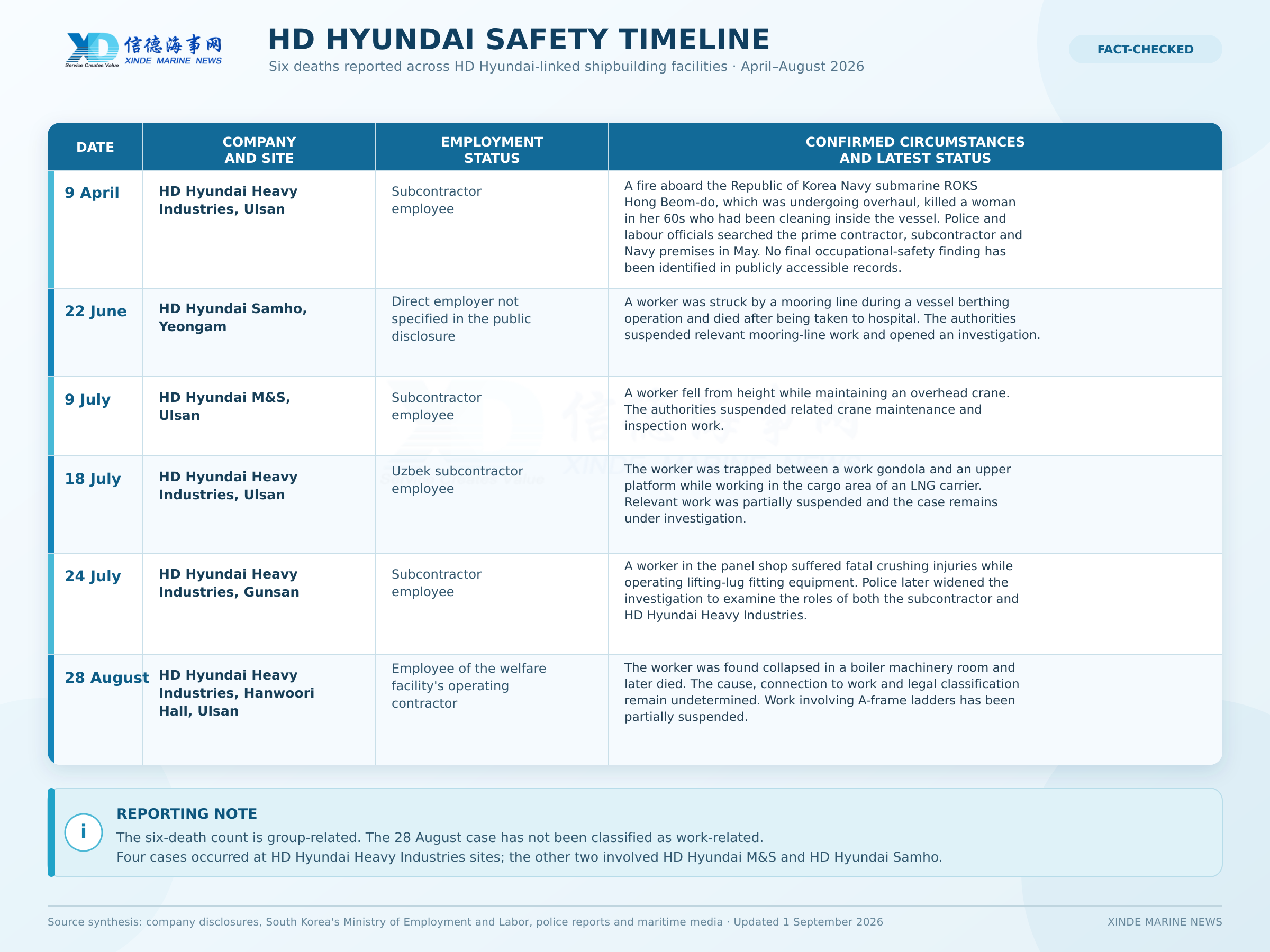
An employee of a subcontractor died after being found collapsed at an employee welfare facility while a 62-member government team was inspecting HD Hyundai Heavy Industries. The case brings the number of deaths reported across HD Hyundai-linked shipbuilding facilities since April to six, although the latest death has not been classified as work-related.
HD Hyundai Heavy Industries is facing renewed scrutiny after an employee of a facilities contractor died during an intensive government review of the South Korean shipbuilder’s safety management system.
The worker was found collapsed in a boiler machinery room at Hanwoori Hall, an employee welfare centre in Ulsan, on 28 August. The worker was taken to hospital but later died, according to a company disclosure reported on 31 August.
The cause of death has not been established. Police and the Ministry of Employment and Labor are reviewing the scene and related records, while the company has said it remains unclear whether the case meets the definition of a serious accident under South Korea’s Occupational Safety and Health Act.
The local labour authority issued a partial stop-work order on 30 August covering all work involving A-frame ladders at HD Hyundai Heavy Industries’ sites. That order shows investigators are examining ladder-related risks, but it does not establish that the worker fell from a ladder or that a workplace accident caused the death.
Why the six-death count needs qualification
TradeWinds described the latest case as the sixth death in less than five months at an HD Hyundai-linked shipbuilding facility.
The figure is supportable as a group-related count, but not as six confirmed occupational fatalities at HD Hyundai Heavy Industries itself.
Four of the deaths occurred at sites operated by HD Hyundai Heavy Industries, including the latest case at Hanwoori Hall. One occurred at subsidiary HD Hyundai M&S, and another at HD Hyundai Samho, a separate shipbuilder within the group. The first five cases involved identifiable work activities; the work-related status of the 28 August death remains undetermined.
Supervision has moved beyond individual accident sites
The two crushing fatalities at Ulsan and Gunsan on 18 and 24 July occurred six days apart. HD Hyundai Heavy Industries subsequently held a three-day “safety shutdown” from 29 to 31 July.
The first day was used for company-wide safety training. Production was halted for the following two days while risk assessments were repeated, high-risk processes re-examined and safety equipment and working conditions reviewed. The company also designated the period through 31 August as a special safety campaign.
On 18 August, the Ministry of Employment and Labor began what it described as an intensive inspection equivalent to a special supervision programme. The ministry said the 62-member team would examine the Ulsan and Gunsan yards, corporate headquarters and factories previously classified as high risk.
The scope extends beyond crushing hazards. Inspectors are reviewing controls for collisions, falls, fire, explosions and asphyxiation, as well as whether earlier corrective measures were implemented, whether the headquarters-level safety management system is functioning and whether risk assessments are effective in practice.
The 28 August death occurred while that review was under way and outside a conventional shipbuilding production area. Hanwoori Hall, opened in 1992, contains catering, sports and other employee facilities and is operated by an external contractor, according to the Seoul Economic Daily.
This expands the immediate governance question from docks, workshops and vessel interiors to contractor-run ancillary facilities. Investigators will need to establish whether the shipbuilder’s risk assessment, work authorisation and emergency response systems extend consistently to such locations.
A governance question, not yet a legal conclusion
The available evidence does not establish that HD Hyundai Heavy Industries breached safety law in the latest case. Nor does it show that all six deaths had a common technical cause.
The events involved fire, a mooring-line strike, a fall from height, two crushing hazards and one unexplained collapse. Treating them as a single accident type would obscure the facts that investigators must establish in each case.
The sequence nevertheless raises a measurable question about the reach of group-level controls. Training, production stoppages, a special safety period and government supervision were introduced in succession, yet another death was reported at an associated workplace before the special safety period ended.
Four findings will determine how the latest case should be treated: the medical cause of death; the task the worker was carrying out before being found; the evidence behind the A-frame ladder suspension; and whether the case is formally recognised as work-related or as a serious industrial accident. Regulators must also disclose which corrective actions from the five earlier cases have been completed and independently verified.
Until those findings are available, the 28 August death should be reported as the sixth death across HD Hyundai-linked shipbuilding facilities since April—not as a sixth confirmed workplace fatality attributable to HD Hyundai Heavy Industries.

READ MORE
 Safety
US Says It Disabled Hong Kong-Owned Bulker off Oman
 Safety
Attacked Just 42Days After Delivery: George Prokopiou’s 115,000-Dwt Tanker Hit in Hormuz
 Safety
Five Seafarers Reported Dead as Puntland Retakes Hijacked Tanker Honour 25
 Safety
Middle East war leaves mounting toll on merchant shipping
 Safety
China-U.S. Consensus Highlights Free Navigation: No Country or Entity Should Impose Transit Fees on International Waterways
 Safety
1 seafarer killed, Fatal attack in the Strait of Hormuz: Capesize bulker CAPE DAO hit by unknown projectile
 Safety
25 Crew Abandon MSC Container Ship in the South China Sea — All Rescued, Vessel Still Adrift
 Safety
MSC Hermes III Adrift Unmanned in South China Sea After 25 Crew Abandon Ship
 Safety
Dangerous Goods Container Fire Reported at NPCT1 Terminal in Jakarta
 Safety