


Freight Indexes Are Losing Relevance. Shipping Needs a New Pricing Anchor
.
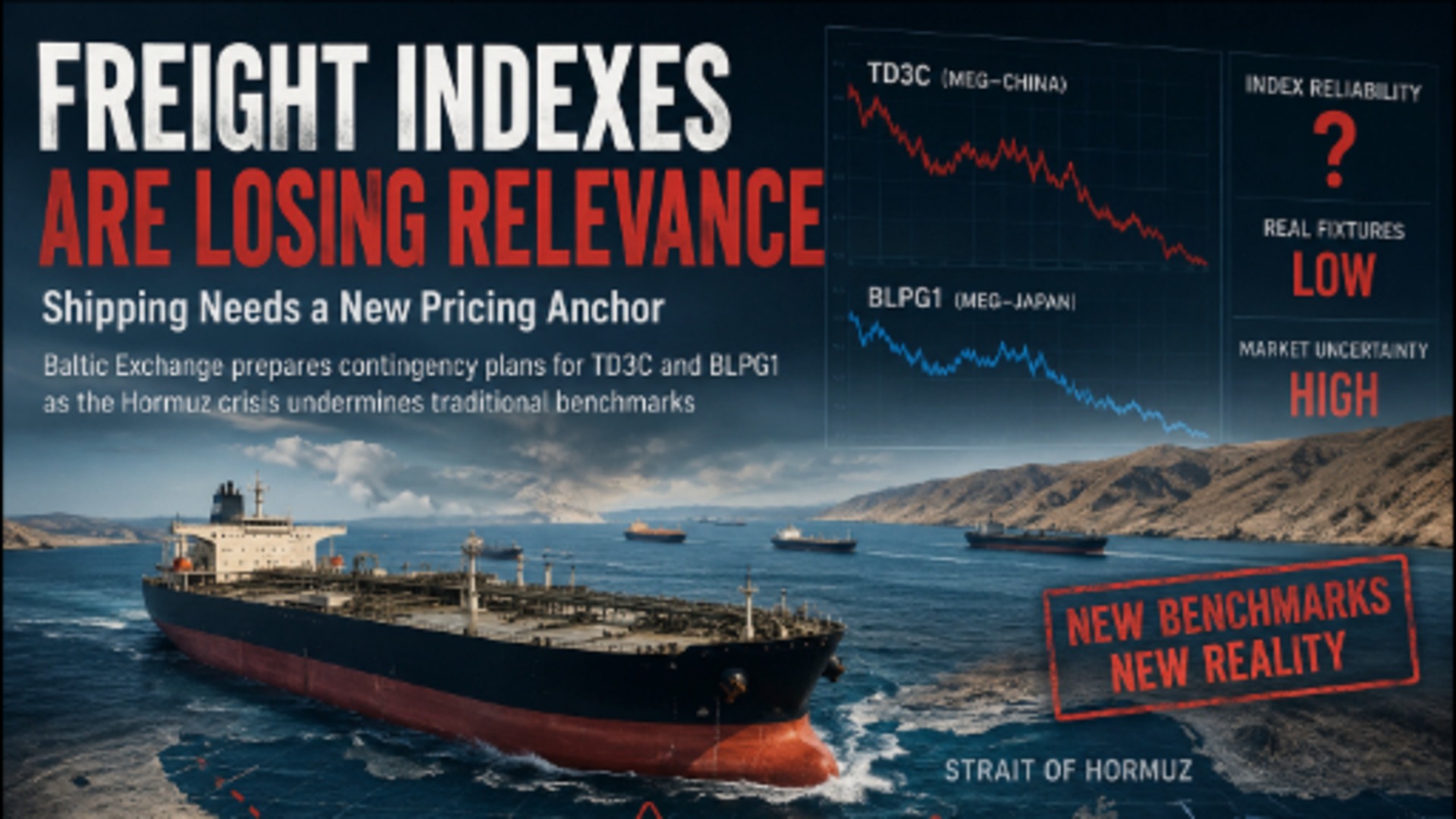

Baltic Exchange prepares contingency plans for TD3C and BLPG1 as the Hormuz crisis undermines traditional benchmarks
What happens when a shipping route has almost no real fixtures, and vessels can no longer perform the voyage under the conditions assumed by the benchmark?
Can the freight index attached to that route still represent the market?
The prolonged crisis in the Strait of Hormuz is forcing the global shipping industry to confront this question.
According to Lloyd’s List, the Baltic Exchange has disclosed contingency plans for freight indexes linked to the Middle East Gulf. If the Hormuz disruption continues, the exchange may change the methodology behind benchmarks including TD3C and BLPG1, using loading markets outside the strait, such as Oman and Houston, as alternative pricing references.
The dispute surrounding Hormuz has therefore moved beyond vessel safety, insurance and energy supply. It is now challenging one of the most fundamental components of the shipping market: its pricing infrastructure.
The indexes continue to be published each day, while the physical markets they are intended to represent have changed dramatically.
The route still exists, but the market behind the index is disappearing
TD3C is one of the most important benchmarks in the global VLCC market. It represents the cost of transporting 270,000 tonnes of crude oil from the Middle East Gulf to China, typically based on a voyage from Ras Tanura in Saudi Arabia to Ningbo.
BLPG1 represents the transportation of 44,000 tonnes of liquefied petroleum gas from Ras Tanura to Chiba, Japan.
Both indexes assume that vessels can enter and leave the Middle East Gulf through the Strait of Hormuz under normal commercial conditions. They are widely used in spot chartering, contracts of affreightment, long-term transportation agreements and forward freight agreement settlements.
Following the escalation of the Middle East conflict on 28 February, commercial traffic through Hormuz fell sharply. Large numbers of vessels became trapped inside the Gulf, while only a limited number of owners and crews remained willing to transit the strait.
Reuters reported in May that hundreds of vessels and approximately 20,000 seafarers had at one stage been stranded in the Gulf, with only a small number of ships prepared to undertake voyages through the high-risk area.
As physical fixtures declined, TD3C assessments increasingly depended on brokers’ professional judgement and hypothetical indications rather than observable transactions.
On 4 March, the Baltic Exchange issued guidance allowing its panellists, in the absence of direct fixtures, to consider chartering negotiations, comparable-route transactions, time-charter-equivalent earnings, vessel supply, cargo demand, market sentiment and even FFA information.
Assessors were expected to use these inputs to determine the best achievable market level for the route under the specified conditions.
Such a mechanism can preserve continuity during a short-term disruption. Its limitations become more serious as the crisis continues.
A market benchmark ultimately needs to be supported by transactions that can be executed, repeated and verified. A theoretical assessment based primarily on professional judgement is difficult to sustain indefinitely as the settlement basis for physical contracts and financial derivatives.
The central problem is increasingly clear: TD3C may remain technically assessable under the methodology, but its value as a reference for the real commercial market is being questioned.
Two contingency options, each solving only part of the problem
The first option proposed by the Baltic Exchange would directly change the route definitions of the Middle East Gulf indexes by moving the loading point outside the Strait of Hormuz.
Under this approach, TD3C would be assessed using a VLCC route loading in Oman. Vessels could load on the Gulf of Oman side without entering the Strait of Hormuz.
For BLPG1, the exchange could use the LPG market from Houston to Asia, replacing Middle East Gulf loadings with US Gulf cargoes.
The principal advantage is that the indexes would once again be supported by real transactions. Assessors could observe actual enquiries, negotiations and fixtures, restoring a degree of tradability and verifiability.
The cost would be substantial.
Oman-to-China and Middle East Gulf-to-China are different VLCC trades. Houston-to-Japan and Middle East Gulf-to-Japan differ even more significantly in voyage distance, fuel consumption, vessel positioning, cargo availability and fleet structure.
The index name might remain unchanged, while its underlying economic meaning would be transformed.
Lloyd’s List has noted that this first option could trigger a substantial decline in related FFA prices.
Existing Middle East Gulf assessments include risk premiums associated with entering a war-risk area, waiting for passage, higher insurance costs and severe restrictions on available tonnage. Shifting the loading basis outside Hormuz could strip out a significant proportion of that premium almost immediately.
The second option seeks to preserve greater continuity.
Under this approach, the Baltic Exchange would use assessments from alternative loading ports and then adjust them according to the historical relationship between those alternative routes and the Middle East Gulf indexes during the month preceding the methodology change.
The aim would be to reduce the risk of an abrupt break in the index and maintain greater continuity for existing contracts and FFA positions.
However, this option faces an obvious weakness.
The adjustment factor would still be derived from the existing Middle East Gulf assessments—the same assessments that have been criticised for relying too heavily on hypothetical pricing and too little on executable transactions.
The first option provides a more observable market price but risks destroying continuity. The second preserves continuity more effectively but may carry the weaknesses of the existing index into the replacement methodology.
Neither option fully resolves the conflict between market reality, index continuity and contractual stability.
A methodology change would redistribute substantial financial value
TD3C and BLPG1 are much more than market indicators.
They are settlement references for physical freight contracts, long-term transportation agreements and FFA positions. Daily movements in these indexes directly affect owners’ revenues, charterers’ costs, commodity traders’ hedging results and derivative-market margin requirements.
Any methodological change would therefore redistribute financial value between market participants.
Under the first option, prices could quickly converge towards lower-risk alternative routes. Participants holding long FFA positions and expecting Middle East Gulf freight rates to remain elevated could incur losses, while short positions might benefit.
Under the second option, a greater degree of pricing continuity would be preserved. However, participants who already consider the existing indexes detached from the physical market may continue to challenge their credibility.
In April, the Baltic Exchange consulted the market on whether Middle East Gulf indexes should be changed or suspended. Fifty-five per cent of respondents supported maintaining the existing approach, 28% favoured changing the route definitions, and 18% supported suspension.
The exchange ultimately decided to continue publishing the indexes under its 4 March guidance, while committing to provide greater clarity on possible future methodology changes.
Three months later, the crisis has lasted longer than many market participants initially expected, and the Baltic Exchange is now presenting more concrete contingency arrangements.
This suggests that the ability to maintain the original indexes through hypothetical assessments is becoming increasingly difficult.
The Mercuria lawsuit has brought the dispute into the courts
The debate over index reliability has already resulted in one of the most closely watched legal disputes in the shipping and commodities markets.
Energy and commodity trader Mercuria has sued the Baltic Exchange in the UK High Court, arguing that the exchange continued publishing TD3C after normal commercial transit through Hormuz had become extremely difficult.
Mercuria alleges that the index became excessively volatile and increasingly failed to reflect the underlying physical freight market.
The company has said that it suffered, or could suffer, losses amounting to hundreds of millions of dollars across physical transportation contracts and freight derivatives linked to TD3C. It argues that the Baltic Exchange should have suspended the benchmark.
The Baltic Exchange maintains that the Strait of Hormuz was never completely closed to lawful commercial navigation, that vessels continued to transit, and that its panel remained capable of producing independent assessments using available market information.
In court filings submitted in June, the exchange argued that the index inputs continued to reflect market or economic reality and that Mercuria’s allegations lacked foundation.
The importance of the case extends far beyond the correct TD3C assessment on any individual day.
The court may ultimately have to consider whether a theoretical price, produced largely through broker judgement when fixtures are scarce and the route’s commercial executability has deteriorated sharply, can still serve as a reliable settlement benchmark for contracts worth billions of dollars.
New indicators should separate base freight from crisis premiums
The difficulty facing the Baltic Exchange shows that a single-route freight index may no longer be sufficient during an extreme geopolitical disruption.
In normal conditions, freight rates are primarily shaped by cargo demand, vessel supply, voyage distance and bunker costs.
During the Hormuz crisis, prices also include war-risk insurance, crew compensation, waiting time, probability of safe passage, security expenditure and the reduction in available tonnage caused by owners refusing to enter the area.
When all of these components are compressed into one TD3C assessment, the market cannot clearly determine whether an increase reflects underlying tanker supply and demand or a temporary and difficult-to-replicate security premium.
A more workable approach would be a layered pricing structure.
Routes outside the Strait of Hormuz that continue to generate regular fixtures, such as Oman-to-China, could provide a base freight benchmark.
The additional insurance, crew, delay and transit risks associated with entering the Middle East Gulf could then be assessed separately as a dedicated Hormuz risk premium.
Together, the base freight index and the risk premium would represent the full transportation cost of a Middle East Gulf-to-China voyage during a crisis.
Such a structure would preserve an observable transaction base while allowing the market to identify how much of the price is attributable to geopolitical risk. It would also reduce the disruption caused by suddenly redefining TD3C as an entirely different route.
The trigger conditions for activating a back-up index should also be incorporated into the methodology in advance.
These could include minimum fixture volumes, the number of vessels completing normal transits, divergence between panel assessments and measurable route executability.
Once those thresholds are reached, the benchmark could automatically move to an alternative route or layered methodology, reducing the legal and commercial conflict created by ad hoc changes during a crisis.
The Hormuz disruption has exposed a basic reality: the continued existence of a route on a map does not mean that a functioning commercial market still exists.
An index may continue to produce a daily number without continuing to provide a reliable market reference.
The Baltic Exchange’s contingency planning is an important first step in addressing this weakness. The deeper challenge is to build a benchmark system that remains verifiable, explainable and suitable for settlement when shipping lanes are disrupted, physical fixtures disappear and security risks rise sharply.
As geopolitical disruption becomes a persistent feature of global shipping, the market’s pricing anchors will also have to change.


READ MORE
 Dry Cargo
Can Dry Bulk Match Tankers’ Earnings?
 Dry Cargo
How Much Longer Can Dry Bulk Stay Strong?
 Dry Cargo
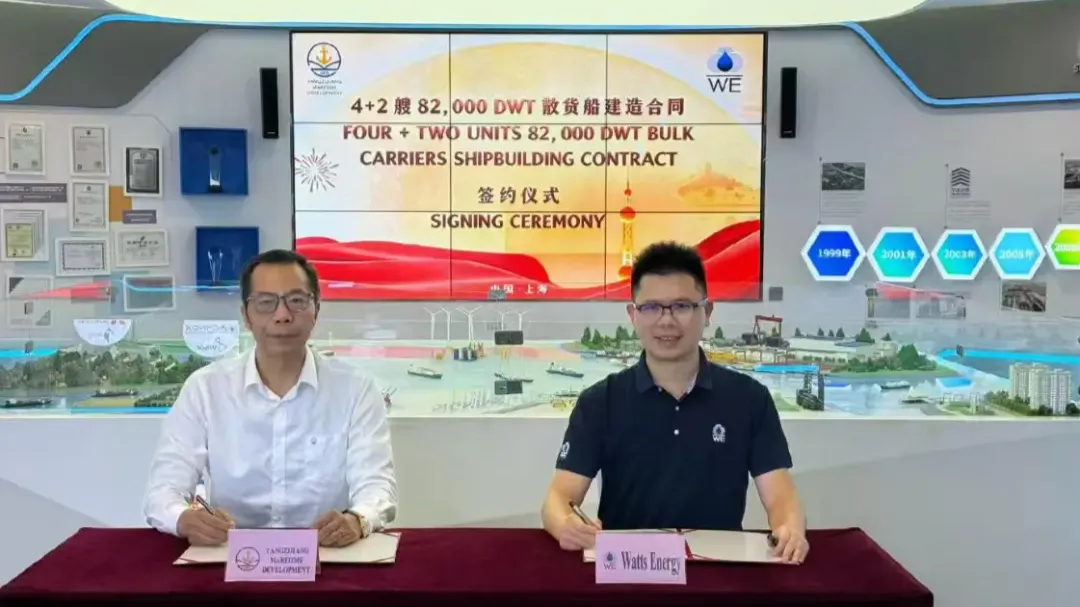
Yangzijiang Maritime Orders 4+2 Kamsarmaxes as Watts Energy Expands into Merchant Shipbuilding
 Dry Cargo
Paliou Urges Fleet Discipline as Dry Bulk Faces Rising Supply and Changing Demand
 Dry Cargo
Yangzijiang Maritime linked to 4+2 Kamsarmax order
 Dry Cargo
Black Sea Wheat Loadings Plunge 78% as Grain Trade Reroutes
 Dry Cargo
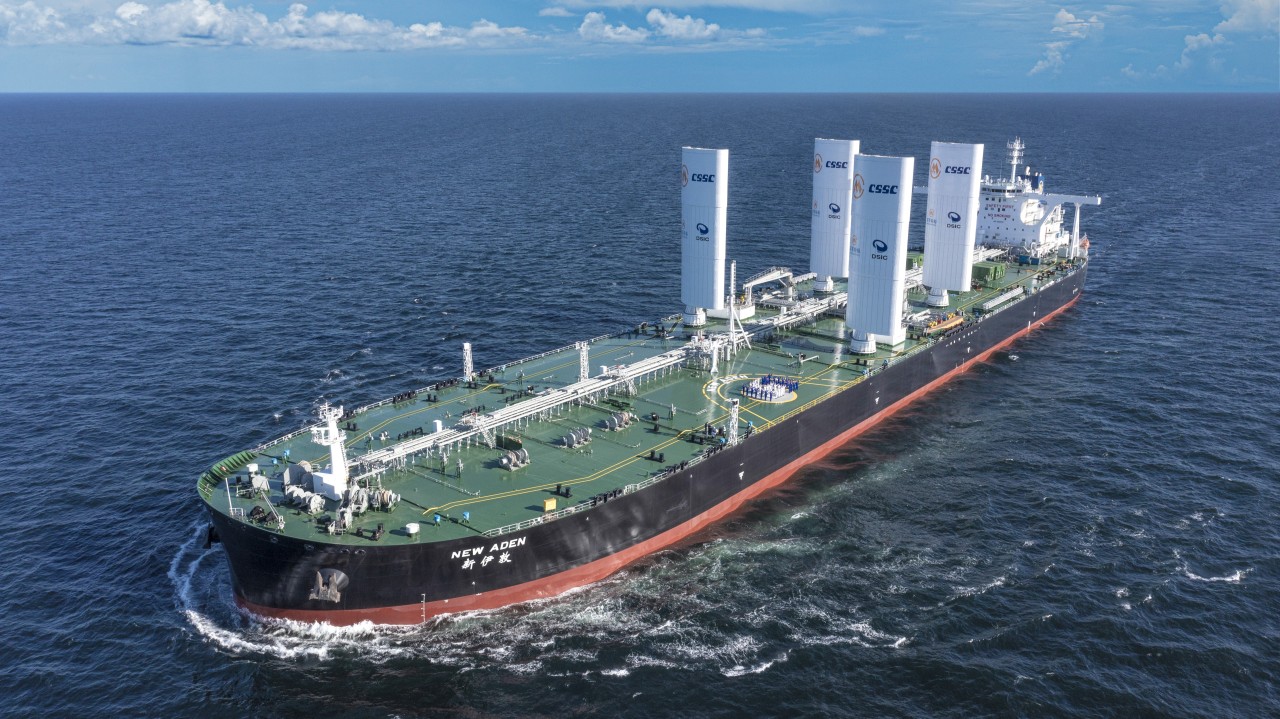
China Merchants Signs $2.8 Billion-Plus Simandou Shipping Deal
 Dry Cargo
Seaspan Enters Newcastlemax Market, with Yangzijiang Set to Build Two Tri-Fuel Ore Carriers
 Dry Cargo
Shipowners Bet on Ultramaxes: 42 Ships for Chinese Yards, Deliveries Stretch into 203
 Dry Cargo