


26-Year-Old PCTC Fetches $42 Million at Auction, Highlighting Tight Vehicle Carrier Market
A 26-year-old pure car and truck carrier (PCTC) has been sold for around $42 million, an unusually strong price for an ageing vessel and another signal of the strength of today’s vehicle shipping market.
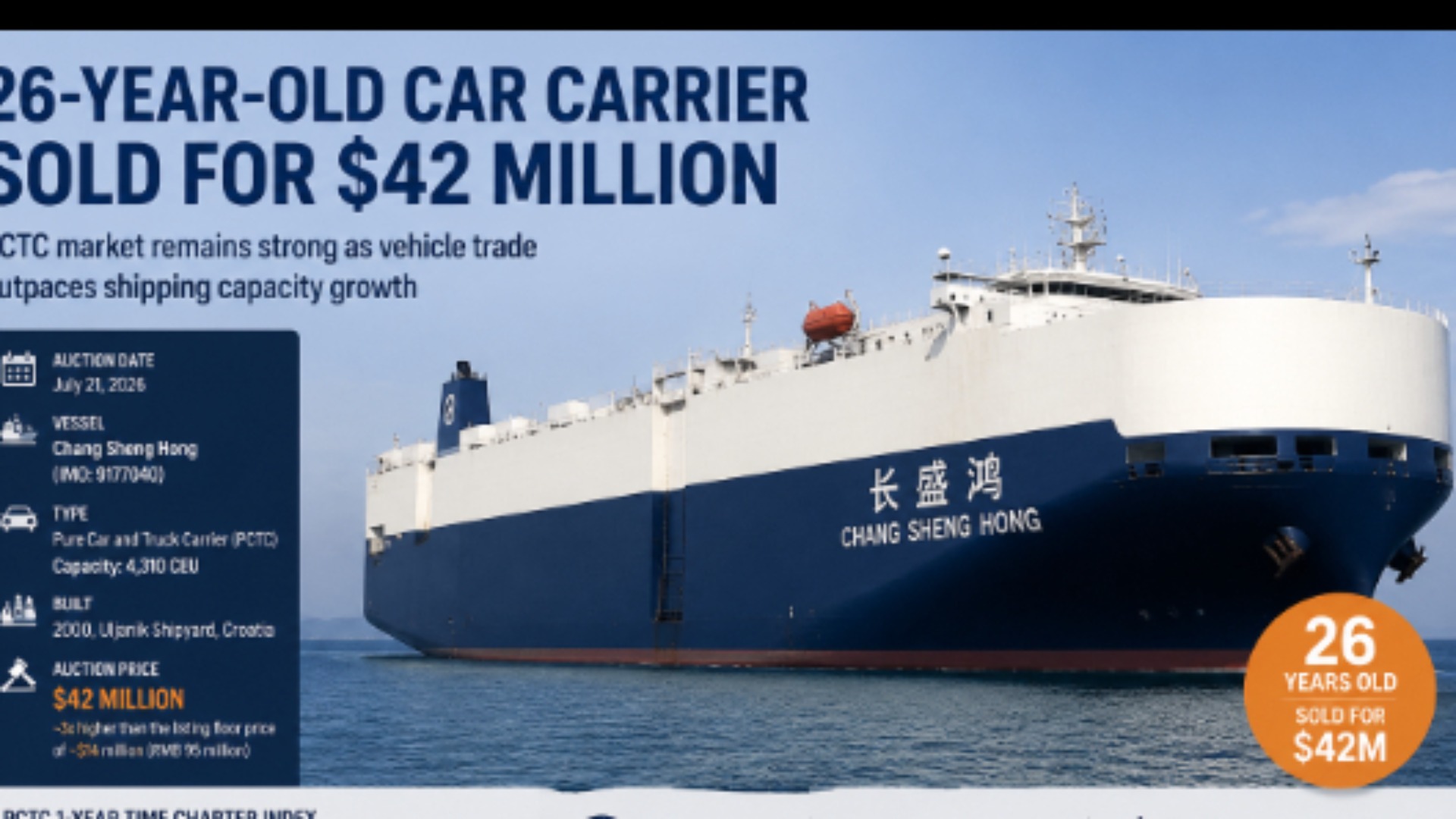

According to market sources, the 4,310 CEU car carrier “Chang Sheng Hong” (IMO: 9177040) was successfully auctioned on Tuesday, July 21, with the winning bid reaching approximately $42 million.
The transaction price was nearly three times higher than the vessel’s original listing floor price set by the Shanghai United Assets and Equity Exchange. The vessel had been offered at a minimum price of RMB 95 million (around $14 million), highlighting the strong demand from buyers competing for available PCTC tonnage.
Built in 2000 by Croatia’s Uljanik Shipyard, the vessel was originally named “Dresden” before being renamed “Chang Sheng Hong”. According to ship sale records, the vessel was sold by Wallenius Wilhelmsen in May 2002 for approximately $35.4 million when it was only two years old.
In July 2017, the vessel was acquired by China Merchants Energy Shipping’s Shenzhen Ro-Ro subsidiary and entered service under the name “Chang Sheng Hong”, mainly supporting domestic and international vehicle transportation routes.
The strong auction result reflects the continued tight supply-demand balance in the global car carrier sector.
Global PCTC capacity growth has struggled to keep pace with rapidly expanding vehicle trade flows. In the first half of 2026, the global vehicle carrier fleet increased by around 3.3%, broadly matching growth in global car-mile demand and keeping the market finely balanced.
Charter rates have continued to rise accordingly. According to VesselsValue data, the 6,500 CEU PCTC one-year time charter index has climbed approximately 45% since the beginning of the year, reaching around $67,000 per day.
China’s Vehicle Export Boom Reshaping Shipping Demand
The shortage of dedicated car carrier capacity has forced exporters and automakers to seek alternative solutions.
Industry forecasts suggest that more than 2 million vehicles will be transported by non-dedicated car carrier services this year, setting a new record. Increasingly, vehicle exporters are relying on container shipping services to move cars overseas when specialised PCTC capacity is unavailable.
Maritime data provider Veson Nautical noted that transporting vehicles on containerships has evolved from a temporary solution into a more structural feature of China’s vehicle export supply chain, driven by the rapid growth of China’s automotive exports.
China has become the world’s largest vehicle exporter, with annual light vehicle exports rising sharply from around 1.6 million units in 2021 to an expected 10 million units in 2026 across all transportation modes.
Although China’s automobile production and sales slowed slightly in the first half of 2026, the market remained resilient. According to data from the China Association of Automobile Manufacturers (CAAM), vehicle production and sales reached 14.993 million units and 15.017 million units respectively from January to June, with year-on-year declines narrowing compared with previous months.
Meanwhile, the global PCTC fleet is expected to grow by around 7.6% annually, but much of the new capacity will only be delivered gradually. The additional tonnage is unlikely to immediately eliminate the supply shortage, meaning exporters may continue to depend heavily on container shipping solutions.
The $42 million sale of the ageing “Chang Sheng Hong” demonstrates how valuable existing vehicle carrier assets have become in today’s market. Even older vessels with limited remaining commercial life are attracting strong interest as operators compete for scarce capacity amid booming global vehicle trade.


READ MORE
 Dry Cargo
Can Dry Bulk Match Tankers’ Earnings?
 Dry Cargo
How Much Longer Can Dry Bulk Stay Strong?
 Dry Cargo
Yangzijiang Maritime Orders 4+2 Kamsarmaxes as Watts Energy Expands into Merchant Shipbuilding
 Dry Cargo
Paliou Urges Fleet Discipline as Dry Bulk Faces Rising Supply and Changing Demand
 Dry Cargo
Yangzijiang Maritime linked to 4+2 Kamsarmax order
 Dry Cargo
Black Sea Wheat Loadings Plunge 78% as Grain Trade Reroutes
 Dry Cargo
China Merchants Signs $2.8 Billion-Plus Simandou Shipping Deal
 Dry Cargo
Seaspan Enters Newcastlemax Market, with Yangzijiang Set to Build Two Tri-Fuel Ore Carriers
 Dry Cargo
Shipowners Bet on Ultramaxes: 42 Ships for Chinese Yards, Deliveries Stretch into 203
 Dry Cargo