


Nearly $1 Billion: NYK Moves to Privatise NS United as Dry Bulk Consolidation Accelerates
NYK will raise its stake to 83.33%, while Nippon Steel will retain 16.67%; NS United is expected to delist by April 2027
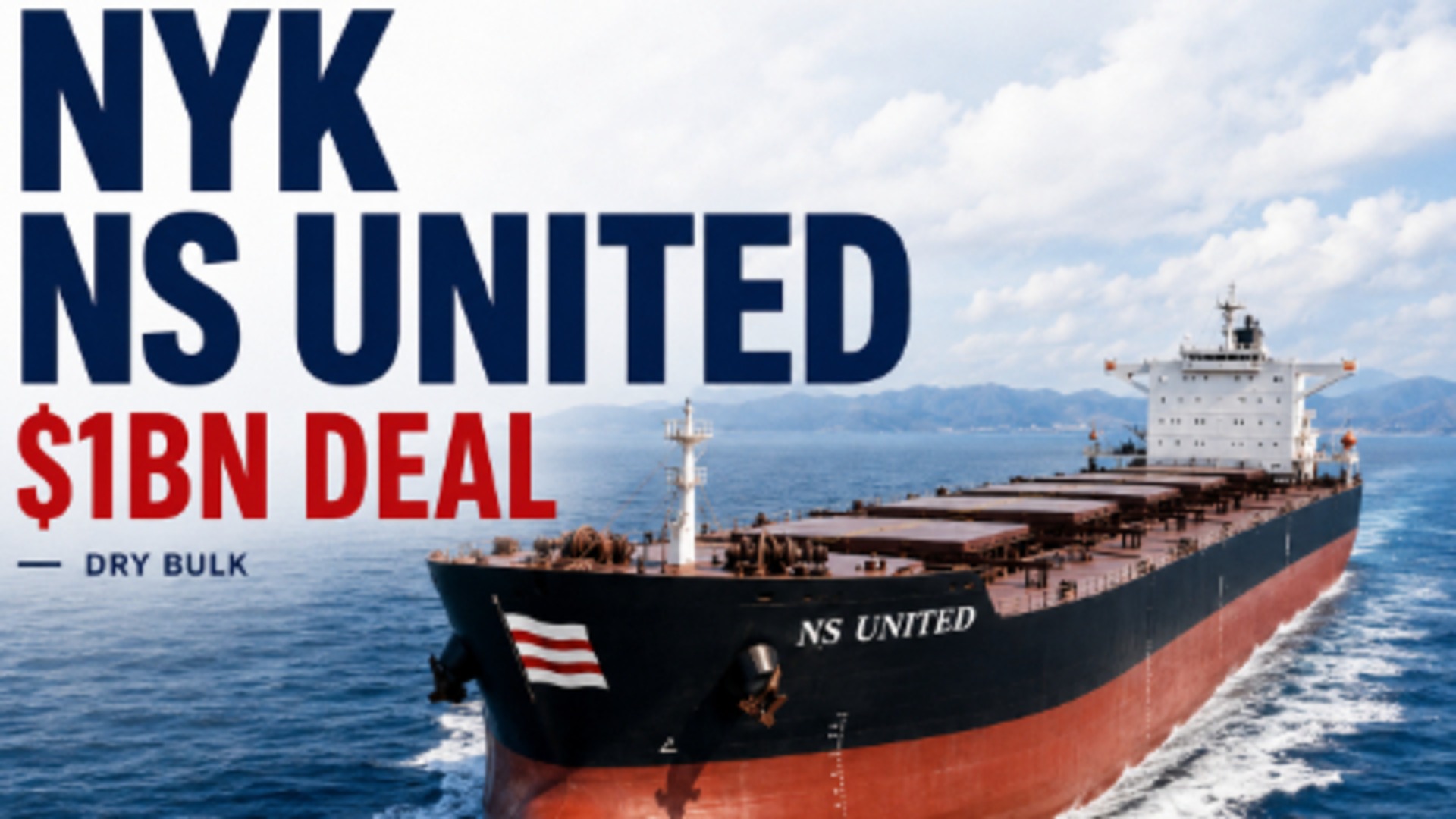

Japanese shipping giant Nippon Yusen Kabushiki Kaisha, or NYK Line, has launched a two-stage transaction worth approximately JPY 156.9 billion, close to $1 billion, to consolidate dry bulk shipping company NS United Kaiun Kaisha and take it private.
Upon completion, NYK’s stake in NS United will rise from 18.55% to 83.33%, while Nippon Steel Corporation will retain a 16.67% strategic interest. NS United will become an unlisted shipping platform controlled by NYK and backed by one of Japan’s largest steelmakers.
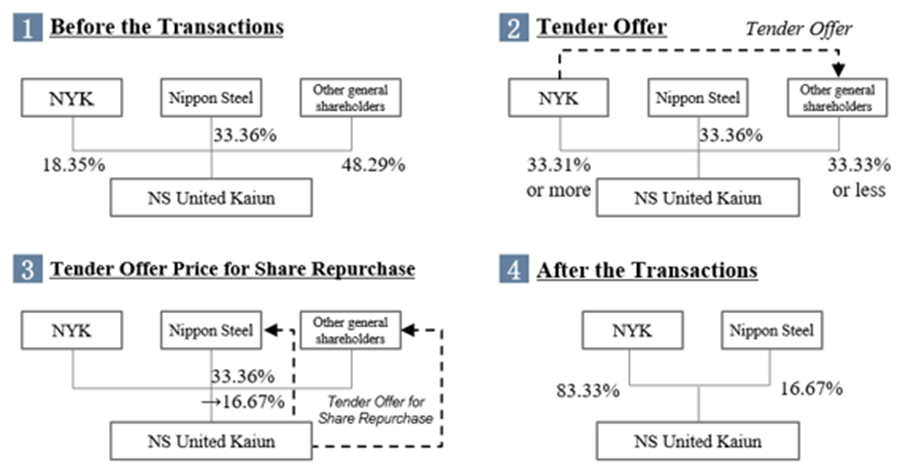
Two-stage transaction worth JPY 156.9 billion
The first stage will involve a tender offer by NYK for shares held by NS United’s other shareholders.
NYK plans to offer JPY 10,600 per share for up to 11.38 million shares, representing approximately 48.29% of NS United’s outstanding equity.
The maximum consideration for the tender offer will be JPY 120.6 billion, or around $765 million.
The offer price represents a premium of 36.95% to NS United’s closing share price on 30 July.
NS United’s board has expressed support for the transaction and intends to recommend that shareholders tender their shares once the offer formally opens.
The second stage will involve NS United repurchasing part of Nippon Steel’s shareholding.
NS United plans to buy back approximately 4.72 million shares from Nippon Steel at JPY 7,676 per share. The transaction will be worth about JPY 36.2 billion, or approximately $230 million.
Following the share repurchase and related capital restructuring, Nippon Steel’s stake will fall from 33.36% to 16.67%, while NYK’s ownership will increase to 83.33%.
The two transactions have a combined value of approximately JPY 156.9 billion, equivalent to about $992 million.
Should NYK fail to acquire all the targeted shares through the tender offer, the parties plan to implement a squeeze-out procedure, potentially through a share consolidation, to remove the remaining minority shareholders.
This would clear the way for NS United to delist from the Tokyo Stock Exchange.
The tender offer is expected to begin in late November or December 2026, after regulatory approvals are secured in Japan, Australia, China and Brazil.
The full privatisation process is expected to be completed by mid-April 2027.
A fleet of more than 210 ships linked to Japan’s steel industry
NS United was established in 1950 and has built its core business around the transportation needs of Japan’s steel industry.
As of the end of March 2026, the group operated approximately 130 ocean-going vessels with a combined capacity of around 13.07 million dwt.
Its domestic coastal shipping business operated another 81 vessels, bringing the total fleet to more than 210 ships.
The company focuses on the transportation of iron ore, coking coal, steel products and other industrial raw materials. It is also involved in LPG transportation, domestic LNG and LPG shipping, and vessel leasing.
For the financial year ended March 2026, NS United reported revenue of JPY 229.8 billion and operating profit of JPY 20.5 billion.
Its long-standing contracts with steel producers and its close commercial relationship with Nippon Steel are among its most important strategic assets.
NYK said NS United had built specialist expertise, long-term customer relationships and a well-established transportation network in the steel raw-materials market.
Following consolidation, the two companies plan to optimise vessel deployment, integrate their global networks and expand steel-related supply-chain services in overseas growth markets.
The post-transaction ownership structure will also preserve the capital relationship between NS United and its core cargo customer.
NYK will take operational control, while Nippon Steel will retain a strategic stake. This structure is designed to support both shipping integration and long-term cargo stability.
Cost savings are only part of the strategy
NYK has identified several areas for potential synergies, including vessel deployment, fuel procurement, newbuilding investment, financing, safety management and decarbonisation technologies.
As of March 2026, the NYK Group controlled approximately 912 vessels.
Its dry bulk business owned or chartered more than 400 ships, including Capesize, Panamax and Handysize bulkers, woodchip carriers and multipurpose vessels.
The addition of NS United will further expand NYK’s position in steel raw-material transportation, large bulk carriers and Japan’s domestic coastal shipping market.
A larger combined fleet should improve purchasing power in fuel, equipment, insurance and financing.
It should also allow the group to deploy vessels more efficiently across a broader operational pool.
When demand weakens on a particular route, or when ships enter drydock, NYK will have greater flexibility to substitute vessels and reduce idle time and ballast voyages.
Green fleet investment is another important factor behind the transaction.
Earlier in 2026, NS United signed long-term charter agreements with Rio Tinto covering two 209,000-dwt methanol dual-fuel Newcastlemax bulk carriers.
The ships are expected to enter service from 2028 and will be employed in iron ore transportation.
The agreements reflect a broader trend in which major mining companies are incorporating fuel type, vessel efficiency and lifecycle emissions into long-term freight contracts.
NS United has also been exploring the transportation of emerging cargoes such as direct reduced iron, scrap steel, liquefied carbon dioxide, ammonia and hydrogen.
Investment in large low-emission vessels requires substantial capital, technical expertise, fuel-supply arrangements and long-term cargo commitments.
As part of the NYK Group, NS United will gain access to a stronger balance sheet and broader global resources to support fleet renewal.
NYK accelerates dry bulk consolidation
The proposed acquisition of NS United is the latest step in NYK’s wider restructuring of its dry bulk business.
In April 2026, NYK combined Asahi Shipping, Hachiuma Steamship and Mitsubishi Ore Transport to establish NYK Bulkship Partners.
The new company brought shipping operations, vessel ownership and shipmanagement functions together under one platform.
In July, NYK also completed its acquisition of open-hatch operator Saga Welco.
Saga Welco operates 48 open-hatch vessels and provides semi-liner services linking the east coast of South America with global markets.
Its main cargoes include pulp, forest products, steel products and project cargo.
These transactions cover different parts of the dry bulk market.
NYK Bulkship Partners consolidates vessel ownership and management resources within the NYK Group.
Saga Welco strengthens NYK’s position in the specialist open-hatch and semi-liner market.
NS United brings long-term steel-industry contracts, large ore carrier capacity and an established Japanese coastal shipping network.
NYK is gradually bringing previously dispersed dry bulk resources into a more integrated structure.
Its objectives include increasing long-term contracted earnings, reducing duplicated investment, improving vessel utilisation and strengthening its ability to respond to freight-market cycles, environmental regulations and customer decarbonisation requirements.
For NS United, privatisation could reduce short-term pressure from public equity markets and allow the company to pursue larger low-emission vessel investments with NYK’s support.
For Nippon Steel, retaining a minority stake will help preserve access to transportation capacity and strengthen raw-material supply-chain security.
Should the transaction be completed as planned, NYK will gain control of a shipping platform operating more than 210 ocean-going and coastal vessels, with deep links to Japan’s steel industry.
The deal will also create a larger and more integrated dry bulk operating platform with stronger customer relationships, greater investment capacity and a broader fleet deployment network.

READ MORE
 Dry Cargo
Shipowners Are Raising Capital to Buy Ships Again: Safe Bulkers Signals Dry Bulk’s Shift from Freight Recovery to Asset Expansion
 Dry Cargo
NORDEN Shows Why Ships Alone Are No Longer Enough
 Dry Cargo
Vale’s 30-Vessel Triple-Fuel Ore Carrier Plan Takes Shape as 25-Year Contracts Reshape Iron Ore Shipping
 Dry Cargo
Wooyang orders four triple-fuel Newcastlemax bulkers at China’s New Times for Vale contracts
 Dry Cargo
HMM Locks in $3.5bn Vale Iron Ore Deal for Eight Triple-Fuel Newcastlemaxes
 Dry Cargo
Capesize Rates Hit Highest Since 2021 as Strength Spreads Into Asset Values and Newbuildings
 Dry Cargo
Cetus Maritime Prepares for IPO: 13-Vessel Deal and 70% Equity Payment Could Open a New Chapter for the Handysize Giant
 Dry Cargo
Cetus Maritime Eyes 13-Vessel Expansion as Seacon Deal Points to Pre-IPO Consolidation
 Dry Cargo
China’s Steel Demand Is Weak — So Why Are Capesize Ships Still Earning $30,000 a Day?
 Dry Cargo