


Houthi Embargo Starts to Bite as Tankers and a Cosco Car Carrier Turn Back

The Bab el-Mandeb remains open to general merchant traffic, but Saudi-linked voyages are already being reshaped by direct Houthi warnings, cancelled transit clearances and abrupt course changes. The latest AIS movements also show how fluid the situation remains.
The first operational effects of the Houthi maritime embargo against Saudi Arabia are now visible across the Red Sea and Gulf of Aden.
Tankers carrying Saudi crude have changed course, a VLCC scheduled to load at Yanbu has reconsidered its approach, and a COSCO Shipping vehicle carrier abandoned its planned voyage towards a Saudi port after a previously issued transit clearance was withdrawn.
The routing picture remains unsettled. The 308,400-dwt VLCC Xin Long Yang, which initially reversed northwards after loading Saudi crude at Yanbu, has since turned south again after slowing or waiting in the central Red Sea. Its declared destination remains Qinzhou, China, but its final route has yet to be confirmed.
That latest movement does not diminish the significance of the initial diversions. It shows that shipowners and operators are making real-time decisions in response to a rapidly changing security environment, rather than following a settled alternative route.
The Bab el-Mandeb has not been closed to general international shipping. Yet for vessels trading with Saudi Arabia, commercial access to the southern Red Sea is becoming less predictable even before any new missile or drone attack has been confirmed.
From a televised declaration to direct operational warnings
The Houthis announced an immediate maritime embargo against Saudi Arabia on July 20.
Their Sanaa-based Humanitarian Operations Coordination Center, or HOCC, subsequently sent emails to shipping companies prohibiting vessels from loading or discharging cargo at Saudi ports. The restrictions took effect at 1201 GMT on July 20.
According to the warning, vessels breaching the embargo could face Houthi-imposed sanctions and potentially be targeted anywhere within the group’s operational reach.
The HOCC previously served as the principal channel through which the Houthis communicated with shipowners, managers and operators during their Red Sea campaign from late 2023. Its involvement gives the latest warning greater operational weight than a purely political declaration.
The wording also broadens the potential exposure.
The embargo does not appear to be limited to Saudi-flagged vessels, Saudi-controlled tonnage or ships directly owned by Saudi companies. The main criterion is commercial involvement with a Saudi port.
That potentially places foreign owners, managers, charterers and cargo interests inside the risk perimeter, regardless of nationality.
Saudi crude tankers reassess their routes
The earliest visible response came from tankers carrying Saudi crude towards Asian markets.
The 308,400-dwt VLCC Xin Long Yang loaded approximately 2m barrels of Saudi crude at Yanbu and originally declared Qinzhou, China, as its destination.
After the Houthi warning, the vessel reversed northwards in the Red Sea and appeared to be moving towards the Suez Canal. It later slowed or waited in the central Red Sea.
The latest AIS track now shows Xin Long Yang turning south again.
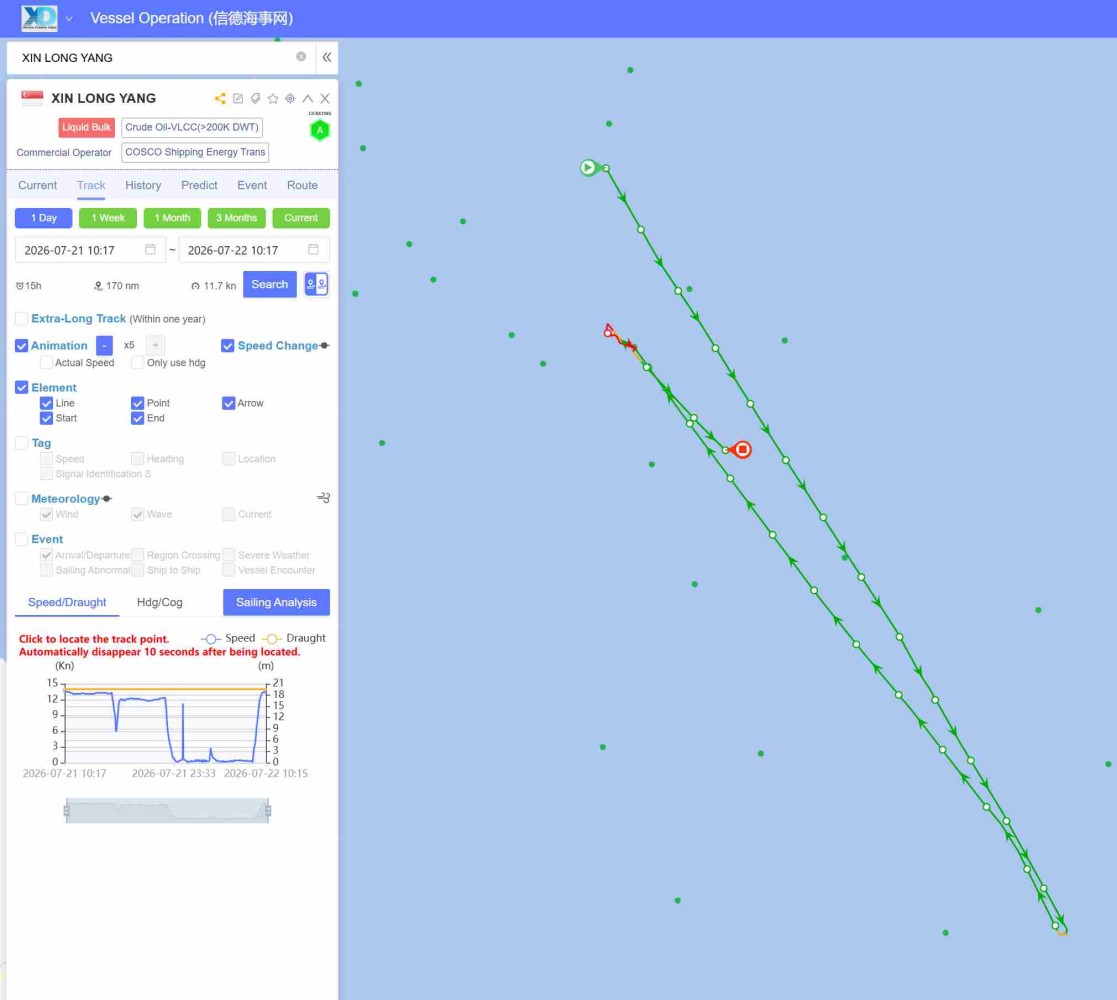
Its ultimate routing remains uncertain. The southbound movement should not yet be treated as confirmation that the VLCC will pass through the Bab el-Mandeb. The vessel could continue waiting, alter course again or proceed under revised security arrangements.
The ship’s repeated changes of direction offer a useful indication of current operating conditions: routing decisions remain fluid and are being reassessed against fresh intelligence, insurance requirements and communications from regional actors.
The Dynacom-managed 115,069-dwt tanker Rodos loaded about 700,000 barrels of Saudi crude at the Al Muajjiz terminal for India. It later turned north and updated its declared destination towards the Suez Canal.
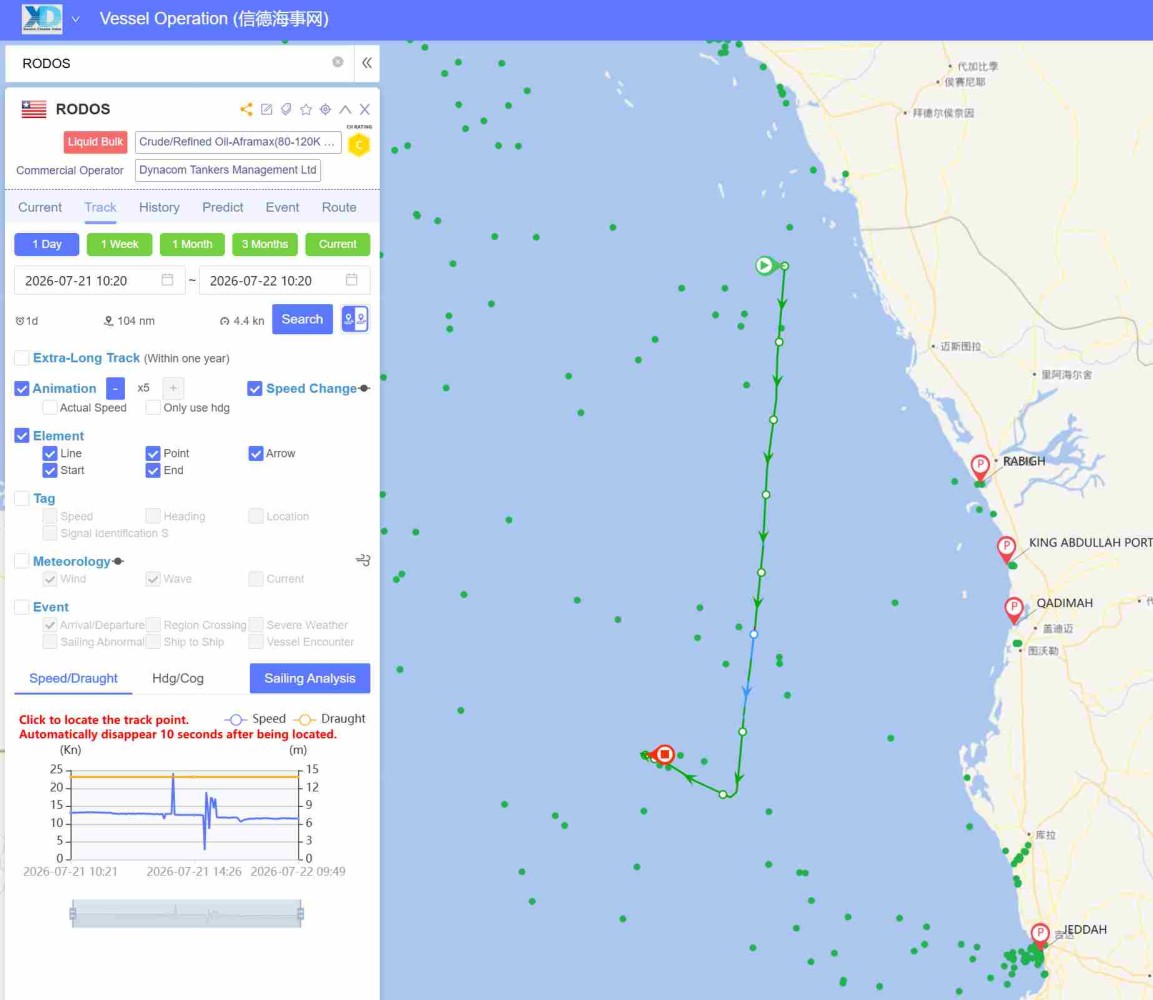
MarineTraffic data showed that Rodos had initially listed New Mangalore as its destination.
Reuters later identified another Dynacom-managed tanker, Amazon, as having loaded Saudi crude for India before also heading towards Suez.
The inclusion of Amazon came in a later update to the Reuters reporting. Details concerning its exact loading terminal, cargo volume and subsequent routing were less fully disclosed than those available for Xin Long Yang and Rodos.
The operational picture is therefore mixed:
Rodos and Amazon were reported heading north towards Suez.
Xin Long Yang initially turned north, then subsequently resumed a southbound course.
The vessels remain part of an evolving response rather than a fixed rerouting pattern.
COSCO vehicle carrier loses its transit clearance
The embargo’s reach has also moved beyond crude oil transportation.
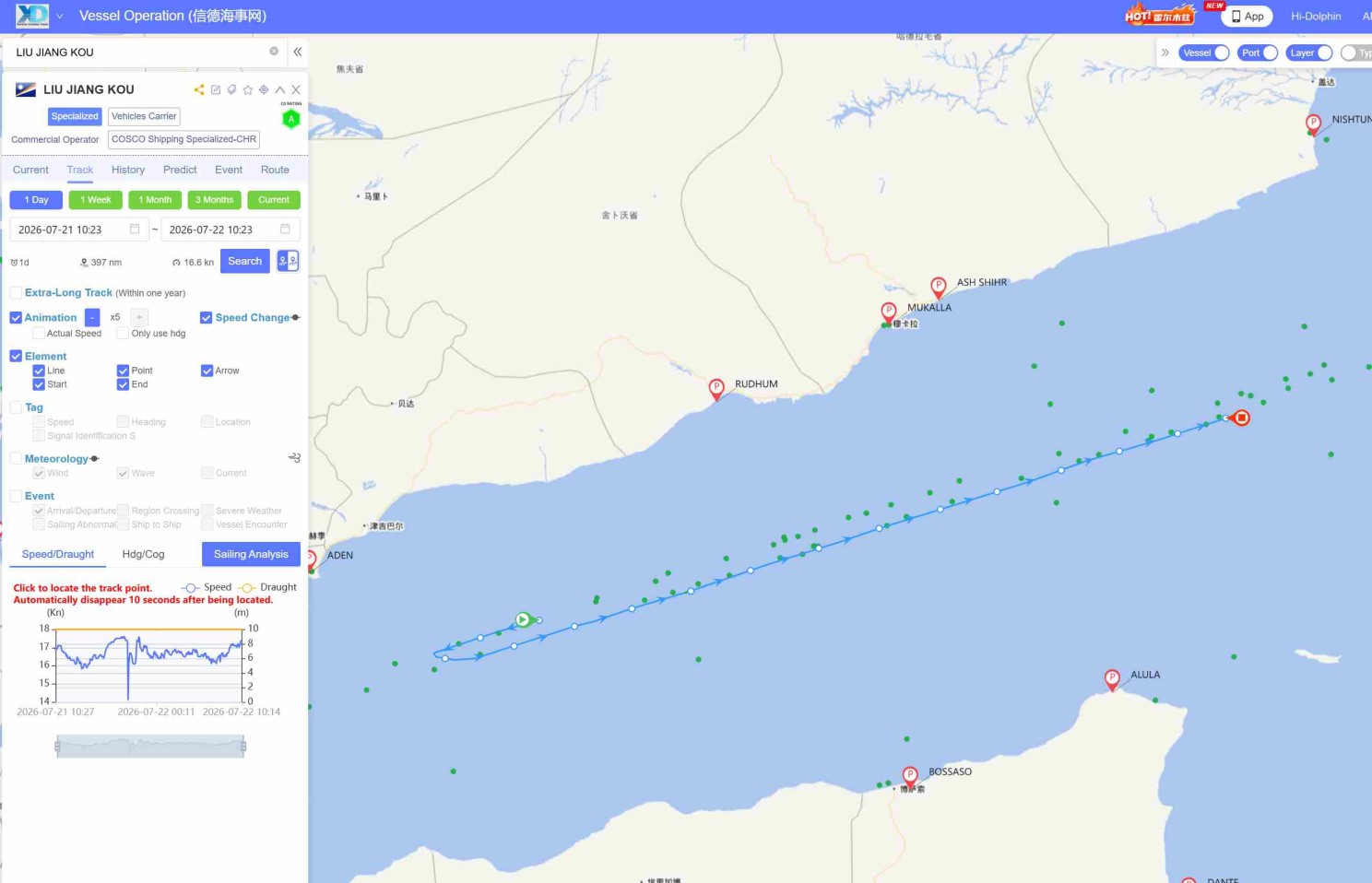
The 7,500-ceu vehicle carrier Liu Jiang Kou, operated by COSCO Shipping Specialized Carriers, changed course while sailing through the Gulf of Aden towards the Red Sea and a planned Saudi port call.
Lloyd’s List reported that the 2025-built vessel had previously received Houthi transit clearance on July 18.
Following the embargo announcement, the operator received a new HOCC message cancelling the earlier clearance and instructing the ship to stop proceeding towards Saudi Arabia.
The communication also warned that continued compliance with the original voyage plan could expose the vessel to sanctions or attack within Houthi operational range.
Liu Jiang Kou subsequently turned away near Djibouti.
This case provides the clearest evidence that the embargo is being applied at individual-vessel level. The ship was not simply reacting to a public threat. Its operator had received a specific notification withdrawing permission for the voyage.
The incident is also significant for China-linked shipping.
Chinese ownership, operation or flag-related considerations do not appear to provide an automatic exemption when a vessel is scheduled to trade with Saudi Arabia. For the Houthis, the port call itself may be the decisive factor.
More VLCCs reconsider Red Sea exposure
The 311,000-dwt VLCC New Prime, built in 2018, had been expected to arrive at Yanbu to load crude. Vessel tracking later indicated that it had changed direction off Oman before entering the Red Sea.
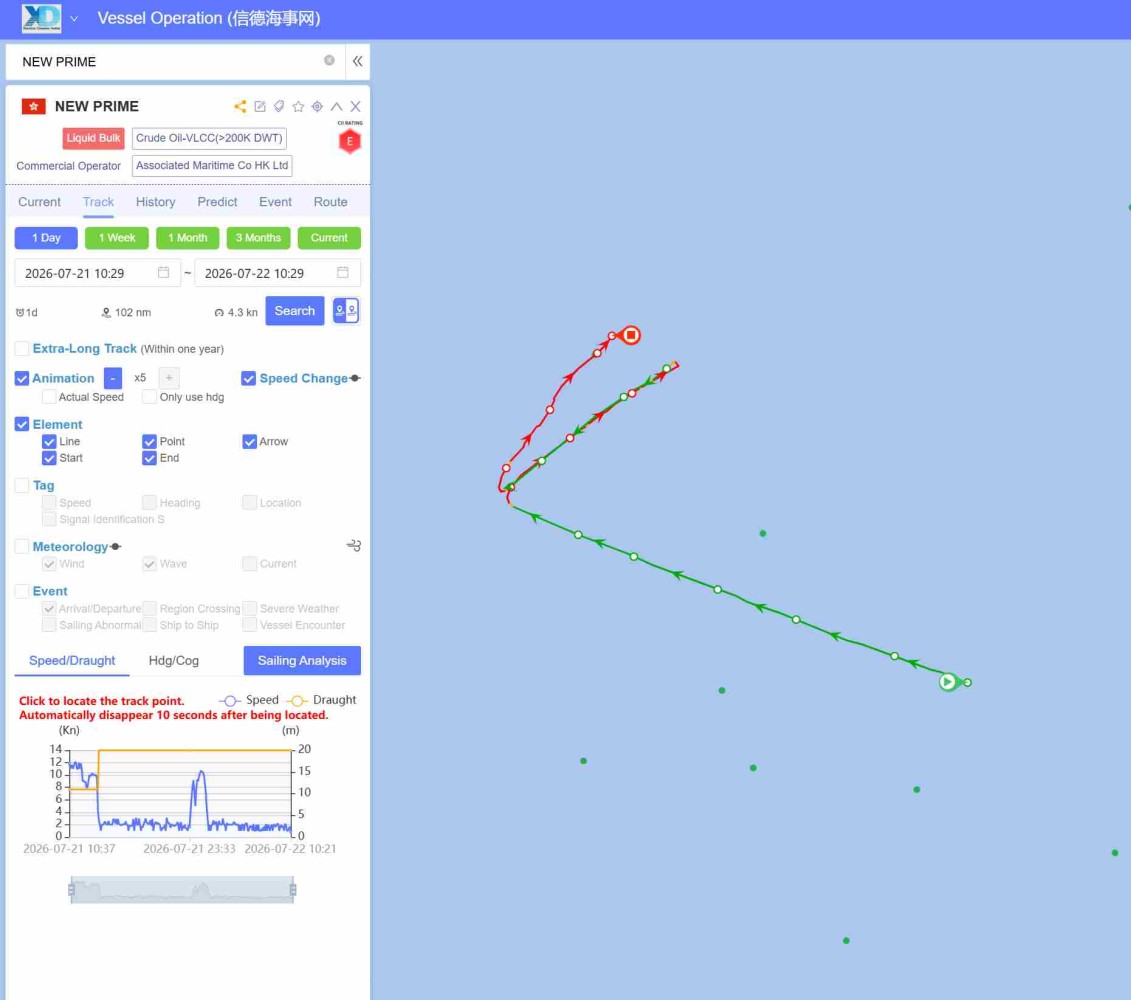
Other VLCCs heading towards the region have reportedly slowed, turned away or remained near the Gulf of Aden while operators assess the Houthi warning.
Yanbu remains operational.
Saudi Aramco is still loading ships that are already inside the Red Sea or approaching from the north through the Suez Canal. Some vessels continue to call at Saudi terminals.
This is creating a clear split in voyage economics and security exposure.
Ships entering the northern Red Sea through Suez, loading at Yanbu or Al Muajjiz and then returning north may still be able to complete their voyages without passing the Bab el-Mandeb.
Asia-bound cargoes face a much more difficult problem.
Under normal conditions, a tanker leaving Yanbu for China, India, South Korea or other Asian destinations would sail south through the Red Sea, cross the Bab el-Mandeb and enter the Indian Ocean.
If that route becomes commercially unacceptable, the vessel must first sail in the opposite direction.
Yanbu has become Saudi Arabia’s pressure-release valve
The timing of the Houthi embargo substantially increases its importance.
Commercial movements through the Strait of Hormuz have declined sharply amid US-Iran hostilities, attacks on merchant ships, military controls and high war-risk exposure.
Kpler data showed only four commodity-carrying vessels crossing Hormuz on July 20, down from seven the previous day. No normal VLCC or LNG-carrier passage was publicly observed that day.
As Gulf traffic contracted, Saudi Arabia increasingly relied on its East-West Pipeline to move crude from the Eastern Province to Red Sea export terminals.
Yanbu and Al Muajjiz have therefore become essential outlets for Saudi barrels that might otherwise leave the Gulf through Hormuz.
Kpler has estimated that the East-West Pipeline has theoretical capacity of up to approximately 7m barrels per day, while sustainable export capacity through Yanbu and related Red Sea facilities is closer to 4.5m–5m barrels per day.
The Yanbu North Crude Terminal can reportedly handle around 1.5m barrels per day, while the Al Muajjiz facility can handle approximately 3m barrels per day.
These assets give Saudi Arabia a major strategic advantage during a Hormuz disruption.
The Houthi embargo now places pressure on the opposite end of that contingency system.
The crude can still reach the Red Sea by pipeline. The uncertainty lies in whether ships can load, obtain insurance and leave safely towards their intended markets.
Saudi Arabia’s principal workaround for Hormuz is beginning to face a second chokepoint problem.
A northbound U-turn does not solve the VLCC problem
For a fully laden VLCC, reversing towards Suez creates new operational constraints.
A VLCC carrying around 2m barrels of crude generally cannot transit the Suez Canal at its maximum cargo draft.
The ship may need to discharge part of its cargo at Ain Sukhna before entering the canal. The removed crude can then move through Egypt’s SUMED pipeline to Sidi Kerir on the Mediterranean coast.
After transiting Suez, the VLCC could reload the cargo at Sidi Kerir and continue through the Mediterranean and Gibraltar before rounding the Cape of Good Hope on its way to Asia.
This arrangement is technically possible, but highly inefficient.
It adds partial discharge, pipeline transfer, reloading, port waiting time and another long diversion around Africa. It also raises exposure to demurrage, fuel costs, terminal charges and cargo-handling risk.
Other operating models may emerge.
Saudi exporters could reduce VLCC parcel sizes to meet Suez draft restrictions. Suezmaxes could shuttle crude through the canal. Cargoes could be moved into the Mediterranean and transferred to VLCCs waiting there.
If the embargo persists, the traditional model of loading a VLCC at Yanbu and sailing directly to Asia may be replaced by a more fragmented chain involving smaller tankers, SUMED and Mediterranean transshipment.
Tonne-mile demand could almost triple
Kpler principal freight analyst Matt Wright has estimated that routing Saudi Red Sea crude north through Suez and then around the Cape could almost triple tonne-mile demand for some Asia-bound voyages.
A normal Yanbu-to-Asia voyage runs south through the Bab el-Mandeb and across the Indian Ocean.
The alternative route first takes the ship north through the Red Sea and Suez Canal, then west through the Mediterranean, south around Africa and back east across the Indian Ocean.
Kpler has previously estimated that a Yanbu-to-South Korea voyage could increase from about 24 days via the Bab el-Mandeb to roughly 54 days under a Suez-plus-Cape routing.
The effect would extend beyond longer sailing time.
More vessel days would be absorbed. Immediate tanker availability would decline. Suezmax shuttle demand could rise, while VLCC positioning in the Atlantic and Mediterranean would become more important.
Asian refiners would face longer delivery schedules and higher landed costs. European refiners could gain a relative advantage when bidding for Saudi Red Sea crude because of their proximity to Suez and the Mediterranean.
Clarksons has suggested that some Yanbu barrels could be redirected towards Europe, while Atlantic Basin crude previously sold into Europe might move east to replace Saudi supply in Asia.
The resulting impact could reshape crude flows, vessel deployment and refinery sourcing patterns at the same time.
The exposure now covers Saudi Arabia’s wider trade
Liu Jiang Kou’s diversion shows that the threat is no longer confined to oil exports.
Vehicle carriers, container ships, bulkers and general cargo vessels planning calls at Jeddah, Yanbu or other Saudi ports must now assess a broader set of risks.
Operators will need to consider whether the Houthis track historical port calls, how long a vessel remains exposed after leaving a Saudi port, whether imports and exports are treated equally, and whether an individual ship’s Saudi call could affect the perceived risk profile of other vessels within the same fleet.
Previously issued transit clearances can no longer be assumed to remain valid.
For Chinese vehicle exporters, the car-carrier case has direct commercial relevance.
Saudi Arabia has become an increasingly important market for Chinese-built vehicles and electric cars. If PCTC operators become unwilling to call at Saudi Red Sea ports, manufacturers may have to use alternative Gulf or Mediterranean gateways, omit Saudi calls or rely on longer overland and feeder connections.
These alternatives would add cost, extend delivery times and create more handling and inventory risk.
Three major energy corridors are under pressure
The Red Sea escalation forms part of a broader deterioration in global energy-shipping security.
The Gulf–Strait of Hormuz corridor is experiencing a severe reduction in large-tanker and LNG-carrier movements amid attacks, military controls and elevated war-risk exposure.
The Red Sea–Bab el-Mandeb–Suez corridor now faces a targeted Houthi embargo against Saudi-linked trade, weakening the main route Riyadh is using to bypass Hormuz.
The Black Sea corridor is also under pressure following attacks involving tankers, ports and infrastructure connected with Russian and Kazakh crude exports, including operations linked to the Caspian Pipeline Consortium.
These corridors carry different cargoes and serve different markets, but they operate within the same global energy network.
When one route is disrupted, refiners and traders can shift cargoes, draw on inventories or source from another basin. When several routes become unstable simultaneously, that flexibility contracts.
The central issue becomes deliverability: whether cargo can reach a safe loading point, secure an insurable route, find a suitable vessel and obtain a crew willing to sail.
The Bab el-Mandeb remains open—for now
The current situation still requires careful description.
The Houthis have imposed a targeted embargo on Saudi port trade. They have not declared a universal closure of the Bab el-Mandeb, and merchant vessels unrelated to Saudi business continue to transit.
JMIC reported no confirmed new merchant-vessel attacks in the Red Sea during the 48-hour period preceding its latest assessment.
Yanbu also remains active for vessels already inside the Red Sea or arriving from Suez.
A formal military closure of the strait has not occurred.
Commercial disruption, however, has a much lower threshold.
Owners, insurers, charterers, banks and crews do not need to wait for a physical blockade. Direct emails, cancelled clearances, uncertain targeting rules and the risk of misidentification can make a voyage commercially unacceptable.
The latest movements of Xin Long Yang, Rodos, Amazon, New Prime and Liu Jiang Kou demonstrate that the warning is already influencing real decisions.
Xin Long Yang’s latest southbound turn also shows that those decisions can change again within hours.
The first diversions remain limited in number. Their significance lies in what they reveal: the Houthi embargo has moved beyond political messaging and insurance pricing into vessel deployment, cargo allocation and route planning.
Saudi Arabia’s Red Sea export system remains operational, but the reliability of its Hormuz alternative is now under direct pressure.
For global shipping, the first U-turns may mark the beginning of a much wider reconfiguration.


READ MORE
 Safety
US Says It Disabled Hong Kong-Owned Bulker off Oman
 Safety
Attacked Just 42Days After Delivery: George Prokopiou’s 115,000-Dwt Tanker Hit in Hormuz
 Safety
Five Seafarers Reported Dead as Puntland Retakes Hijacked Tanker Honour 25
 Safety
Middle East war leaves mounting toll on merchant shipping
 Safety
China-U.S. Consensus Highlights Free Navigation: No Country or Entity Should Impose Transit Fees on International Waterways
 Safety
1 seafarer killed, Fatal attack in the Strait of Hormuz: Capesize bulker CAPE DAO hit by unknown projectile
 Safety
25 Crew Abandon MSC Container Ship in the South China Sea — All Rescued, Vessel Still Adrift
 Safety
MSC Hermes III Adrift Unmanned in South China Sea After 25 Crew Abandon Ship
 Safety
Dangerous Goods Container Fire Reported at NPCT1 Terminal in Jakarta
 Safety