


World’s First Ammonia-Fuelled Oceangoing Vessel Loads First Ammonia Cargo in Nanjing, Bound for India
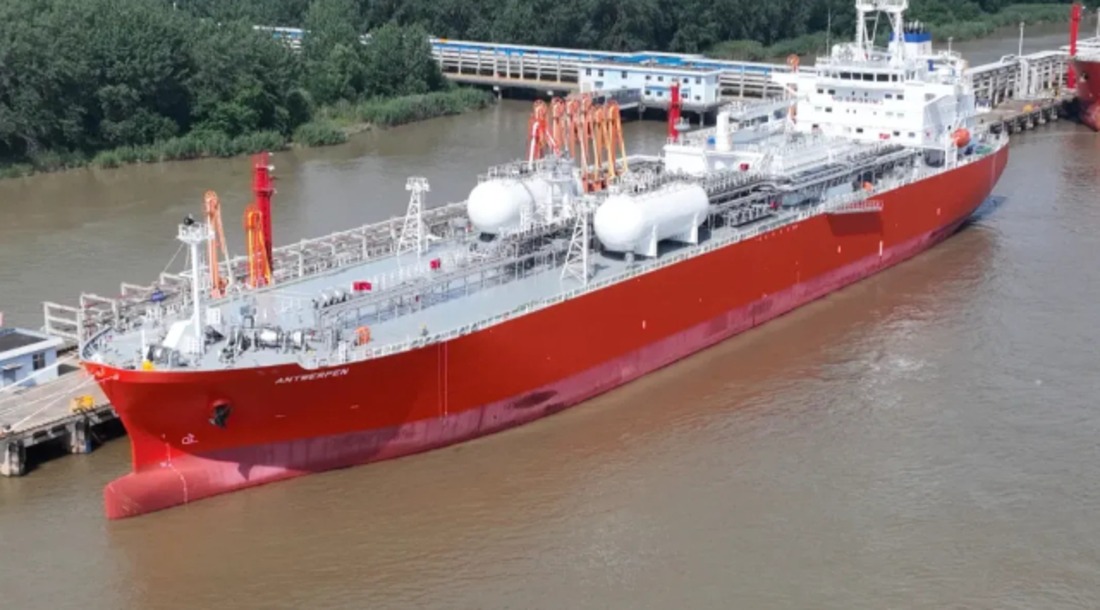
Exmar ’s #MGC ANTWERPEN completes its first cargo loading operation after entering service, marking a new step for ammonia-fuelled deep-sea shipping
XINDE MARINE NEWS — The world’s first ammonia-fuelled oceangoing vessel, MGC ANTWERPEN, has reached another important milestone after entering commercial service.
On 27 June, the vessel departed Qingjiang Terminal in Nanjing Jiangbei New Area after completing its first voyage and first cargo loading operation since entering service. On this voyage, MGC ANTWERPEN loaded 30,214 tonnes of liquid ammonia, with a cargo value of around RMB 132 million, for direct export to India.
The significance of this voyage goes beyond a single ammonia cargo.
From delivery in South Korea, to ammonia bunkering in Ulsan, and now to the first commercial cargo loading in Nanjing for a direct voyage to India, MGC ANTWERPEN is moving ammonia-fuelled shipping from concept validation, shipyard delivery and sea trials into real trade, real ports, real regulatory supervision and real commercial operations.
Nanjing Port opens a new liquid ammonia export channel
According to public reports, MGC ANTWERPEN safely berthed at Qingjiang Terminal in Nanjing Jiangbei New Area on 24 June and subsequently carried out cargo loading operations. On 27 June, the vessel departed after loading 30,214 tonnes of liquid ammonia for direct export to India.
This marks the opening of another foreign trade export channel for liquid ammonia at Nanjing Port and further expands the port’s handling capability for high-value liquefied chemical cargoes.
Liquid ammonia is both an important basic chemical raw material and one of the low- and zero-carbon fuel options attracting increasing attention from the shipping industry. Traditionally, ammonia has been widely used in fertiliser production, nitric acid, pharmaceuticals, synthetic fibres, industrial refrigeration, electronics and metallurgy. With the acceleration of the global energy transition, its role as an energy carrier is being reassessed, especially in shipping, power generation, chemical decarbonisation and cross-border green energy trade.
For Nanjing Port, the successful handling of the first commercial cargo operation of the world’s first ammonia-fuelled oceangoing vessel is a landmark case in liquid ammonia export, hazardous chemical port operations, green energy logistics and the support of new fuel vessel types.
What kind of vessel is MGC ANTWERPEN?
MGC ANTWERPEN is operated by Belgian gas carrier owner and infrastructure company EXMAR. It is widely regarded as the world’s first oceangoing vessel equipped with an ammonia dual-fuel main engine and placed into commercial operation.
According to EXMAR’s public fleet information, the vessel has IMO number 1013377, flies the Belgian flag, is classed by Lloyd’s Register, and was built in 2026. The ship is 190 metres long, 30.4 metres wide, has a draught of 10.6 metres, and offers 46,000 cubic metres of cargo capacity. Its fuel mode is ammonia.
The vessel is a Midsize Gas Carrier, or MGC, designed to carry ammonia or LPG. EXMAR has disclosed that the series is based on a 46,000 cubic metre design, including 45,000 cubic metres of cargo tank capacity and two 500 cubic metre deck-mounted fuel tanks. By increasing the vessel’s length and breadth compared with the standard design, the ship achieves higher carrying capacity.
MGC ANTWERPEN was built by HD Hyundai Heavy Industries and is the first vessel in EXMAR’s series of four ammonia dual-fuel MGCs. The vessels in the series are named after Belgian cities, with ANTWERPEN followed by sister vessels including ARLON.
The vessel has a special operational profile. It is both a gas carrier capable of transporting liquid ammonia and LPG, and an oceangoing vessel capable of using ammonia as a propulsion fuel.
This creates a natural operational synergy for gas carriers. EXMAR has also highlighted that the vessel can use cargo as fuel, providing greater flexibility and emissions reduction potential.
WinGD Ltd. ammonia-fuelled two-stroke engine enters commercial deep-sea application
The core technology attracting the most attention onboard MGC ANTWERPEN is its WinGD X52DF-A ammonia-fuelled low-speed two-stroke main engine.
According to WinGD, the X-DF-A engine adopts high-pressure ammonia injection and uses around 5% pilot fuel at full load. The engine’s Type Approval Test and Factory Acceptance Test were completed in January 2026 at HD Hyundai Heavy Industries Engine & Machinery Division’s facilities in South Korea, witnessed by Lloyd’s Register and representatives from other major classification societies.
During sea trials in South Korea, the vessel’s engine demonstrated load response, dynamic performance and fuel efficiency in both ammonia and diesel modes comparable to WinGD’s conventional X-Engine platform.
This is highly important for the commercialisation of ammonia as a marine fuel.
Discussions around ammonia fuel in shipping have long focused on fuel availability, safety, combustion stability, NOx and N2O control, fuel supply systems and crew operational risks. For deep-sea vessels, the key challenge is to achieve stable, controllable and maintainable performance under real sea conditions, changing loads and long-distance voyages.
The delivery and first commercial voyage of MGC ANTWERPEN show that ammonia-fuelled low-speed two-stroke engine technology has now moved from bench testing, type approval, shipyard installation and sea trials into actual operational verification.
WinGD has also described 2026 as a milestone year for ammonia as a next-generation marine fuel. From factory and type approval testing at the beginning of the year, to the successful sea trial of MGC ANTWERPEN in May, and delivery in June, a series of key technical milestones has been completed. The WinGD X-DF-A platform has already secured orders across gas carriers, bulk carriers, tankers and container ships, showing that the ammonia fuel pathway is moving beyond a single vessel breakthrough into broader vessel-type application.
First commercial ammonia bunkering completed in Ulsan
Before completing its first cargo loading operation in Nanjing, MGC ANTWERPEN had already completed what has been described as the world’s first port-to-ship ammonia bunkering operation for a commercial oceangoing vessel.
On 23 April, around 600 tonnes of ammonia were supplied to the EXMAR ammonia dual-fuel gas carrier at the main port area of Ulsan, South Korea. The bunkering operation was carried out by Lotte Fine Chemical, with participation from Ulsan Port Authority, the Korean Register, HD Hyundai Heavy Industries and other parties.
This was another pioneering step.
One of the greatest challenges for ammonia as a marine fuel lies in the bunkering process. Ammonia is toxic and corrosive. Leakage dispersion, human exposure, hose and pipeline connection, inerting, emergency response, area isolation and port coordination all require strict management. The Ulsan operation provides an early reference case for the future regular bunkering of ammonia-fuelled vessels.
From a global shipping energy transition perspective, MGC ANTWERPEN has now connected many of the key links in ammonia-fuelled vessel commercialisation: shipbuilding, engine testing, class certification, crew training, port bunkering, vessel delivery, port loading, deep-sea transportation and cross-border trade.
Safety supervision was central to the Nanjing operation
As ammonia-fuelled vessels enter real commercial operations, safety supervision will become one of the decisive factors shaping the pace of market development.
Public reports noted that liquid ammonia is a highly toxic and corrosive dangerous chemical, and that mature regulatory templates for new ammonia-powered vessels remain limited. As the authority responsible for water traffic safety and port inspection coordination in Nanjing, Nanjing Maritime Safety Administration carried out full-process support for this operation.
According to the reports, maritime officers conducted special inspections of the vessel’s ammonia fuel supply system, leakage monitoring system and emergency inerting equipment. As the Yangtze River is currently in flood season, the authority also monitored the vessel’s berthing and loading process in real time, deployed patrol vessels for on-site security, and provided 24-hour on-site supervision for high-risk operations such as liquid ammonia loading and ship-shore connection. Relevant parties also organised a joint emergency drill for liquid ammonia leakage.
These measures show that the commercialisation of ammonia-fuelled vessels depends on more than shipboard technology. Ports, maritime authorities, terminals, cargo owners, fuel suppliers and emergency response systems must work together.
Lloyd’s Register also emphasised safety as a core priority during the development of MGC ANTWERPEN. The project involved extensive technical collaboration, risk assessment, crew training and operational planning, helping to establish the regulatory and safety framework for gas carriers using ammonia cargo as fuel.
For ammonia, safety remains particularly sensitive. Ammonia contains no carbon and does not directly emit CO₂ during combustion, but its toxicity, corrosiveness and leakage risks require a more detailed risk control system than conventional marine fuels. The future scale-up of ammonia-fuelled fleets will depend heavily on engineering design, detection and monitoring, ventilation and segregation, fuel supply systems, emergency response and crew training.
Ammonia-fuelled oceangoing shipping enters the real operation stage
From a shipping decarbonisation perspective, the significance of MGC ANTWERPEN lies in the fact that ammonia-fuelled oceangoing shipping has now entered the real commercial operation chain.
EXMAR has stated that, when using low-carbon ammonia fuel, the vessel can reduce greenhouse gas emissions by up to 90% compared with conventional vessels. Lloyd’s Register has also noted that the 46,000 cubic metre vessel can carry ammonia or LPG and can use ammonia as fuel, creating the potential for near-zero-emission operation when low-carbon ammonia is used.
Today, the global shipping industry continues to assess multiple future fuel pathways, including LNG, methanol, ammonia, hydrogen, biofuels, synthetic fuels and onboard carbon capture. Ammonia’s advantage is that it contains no carbon and has strong potential as a zero-carbon fuel for deep-sea shipping. Its challenges include safety, supply chain readiness, combustion control, NOx and N2O emissions, fuel cost and certification.
MGC ANTWERPEN does not remove all barriers to ammonia commercialisation. It provides a real operating reference for how shipowners, shipyards, engine makers, classification societies, ports, fuel suppliers, regulators and crew systems can jointly complete the first commercial voyage of an ammonia-fuelled oceangoing vessel.
The value of this case lies in real operation. Only when ammonia-fuelled vessels enter real routes, real ports and real cargo scenarios can the industry gradually build replicable experience around technical performance, safety boundaries, operating costs, maintenance needs and crew competence.
From Nanjing to India, a green energy trade chain is taking shape
The departure of MGC ANTWERPEN from Nanjing with liquid ammonia bound for India also reflects broader changes in regional green energy and chemical trade in Asia.
On one hand, Chinese ports are becoming increasingly involved in high-value liquefied chemical exports. The new liquid ammonia export operation at Nanjing Port will help local and regional chemical producers improve logistics efficiency and strengthen direct access to overseas markets.
On the other hand, the role of liquid ammonia as a future energy carrier is expanding. As green ammonia production, certification, storage, transportation, bunkering and end-use applications develop, cross-border ammonia shipping routes such as Nanjing–India may become part of a broader green energy trade network.
For Nanjing Port, this operation is both a breakthrough in liquid ammonia export and a demonstration of its capability to handle special new-fuel vessel operations. For the global shipping industry, it marks the transition of an ammonia-fuelled oceangoing vessel from a delivery story to an operating story.
MGC ANTWERPEN’s first cargo loading in Nanjing shows that the ammonia shipping story has entered a new phase.
Previously, the industry focused heavily on whether ammonia could be used onboard deep-sea vessels. Now, the first such vessel has loaded cargo, departed port and entered commercial service. The next question is whether ammonia-fuelled oceangoing shipping can continue to prove its safety, economics and replicability across more voyages, ports, bunkering scenarios and regulatory environments.

READ MORE
 Shipbuilding
DryDel Orders Two Kamsarmax Bulkers at Tsuneishi
 Shipbuilding
Erasmus Orders Two More Feeders in Fourth Huangpu Wenchong Deal in Six Months
 Shipbuilding
Chipolbrok Begins Construction of First 60,800 DWT Forward-Accommodation Heavy-Lift Vessel
 Shipbuilding
COSCO Shipping Specialized Carriers Shifts Eight 60,000-DWT Heavy-Lift Ships from Chengxi to Dalian
 Shipbuilding
Jianglong Adds $40m Offshore Vessel Order to 2026 Contract Run
 Shipbuilding
Hubei Firm Proposes RMB427m LNG and Methanol Vessel Programme
 Shipbuilding
4 More,totally 16 Since 2024: Why RCL Keeps Ordering at Huangpu Wenchong
 Shipbuilding
Zodiac Linked to First LNG Carrier Order at Hanwha Ocean
 Shipbuilding
RCL Adds Four Feeders to Its Huangpu Wenchong Programme
 Shipbuilding