


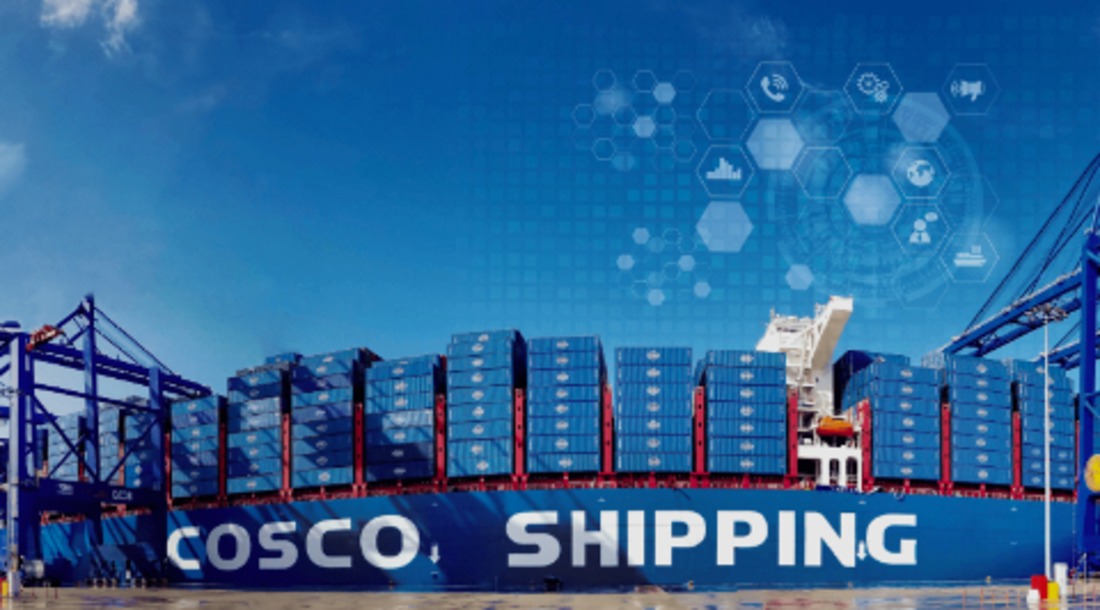
COSCO Shipping is reinforcing a capability that has long been underestimated: control over the ocean transport of key bulk commodities.
Behind the 8.656 billion yuan, 24 new vessels, and 20-year long-term lease arrangements, COSCO Shipping is reinforcing a capability that has long been underestimated: control over the ocean transport of key bulk commodities.

China does not lack the money to buy grain.
But in an era marked by geopolitical conflicts, shipping route disruptions, and frequent supply chain restructuring, another question is becoming increasingly important:
At critical moments, can grain be transported back stably, safely, and controllably?
On the evening of June 30, COSCO Shipping Development Co., Ltd. (CSD) issued consecutive announcements, declaring its intention to invest in the construction of 24 new vessels through an indirect wholly-owned subsidiary, with a total value of RMB 8.656 billion (excluding tax).
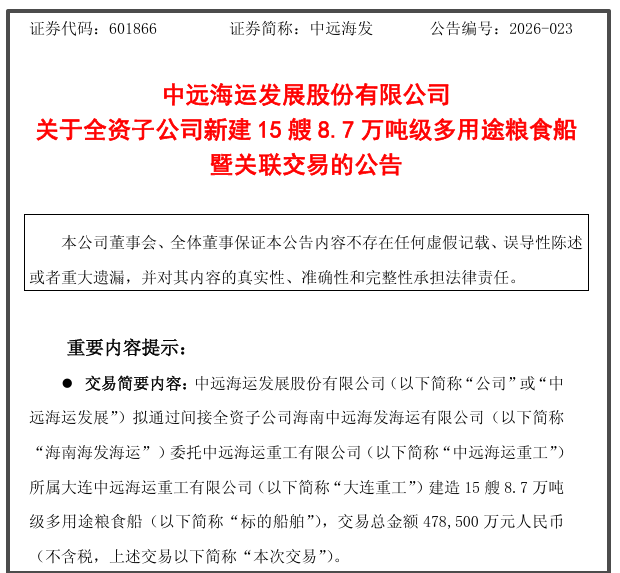
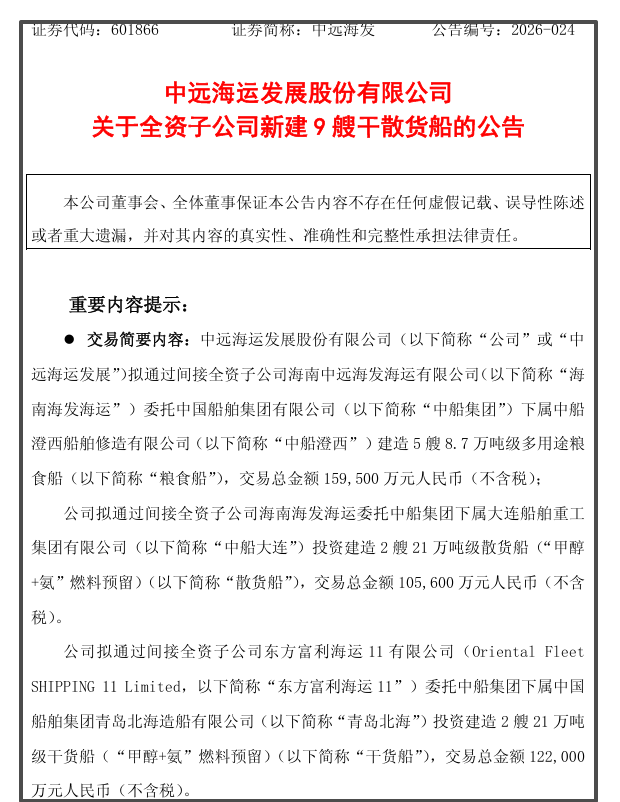
The new fleet includes:
20 multipurpose grain carriers of 87,000 DWT;
2 bulk carriers of 210,000 DWT with "methanol + ammonia" fuel-ready design;
2 dry cargo ships of 210,000 DWT with "methanol + ammonia" fuel-ready design.
On the surface, this is an investment arrangement by CSD to expand its shipping asset base and strengthen its vessel leasing business.
But viewed from within the COSCO Shipping system, it looks more like a long-term capacity layout centered around the "building, leasing, and operation" cycle.
In particular, the 20 multipurpose grain carriers of 87,000 DWT deserve close attention.
This is not an ordinary bulk carrier order.
It represents a concentrated reinforcement of COSCO Shipping's oceangoing grain transport capability.
A single order of 20 "grain carriers"
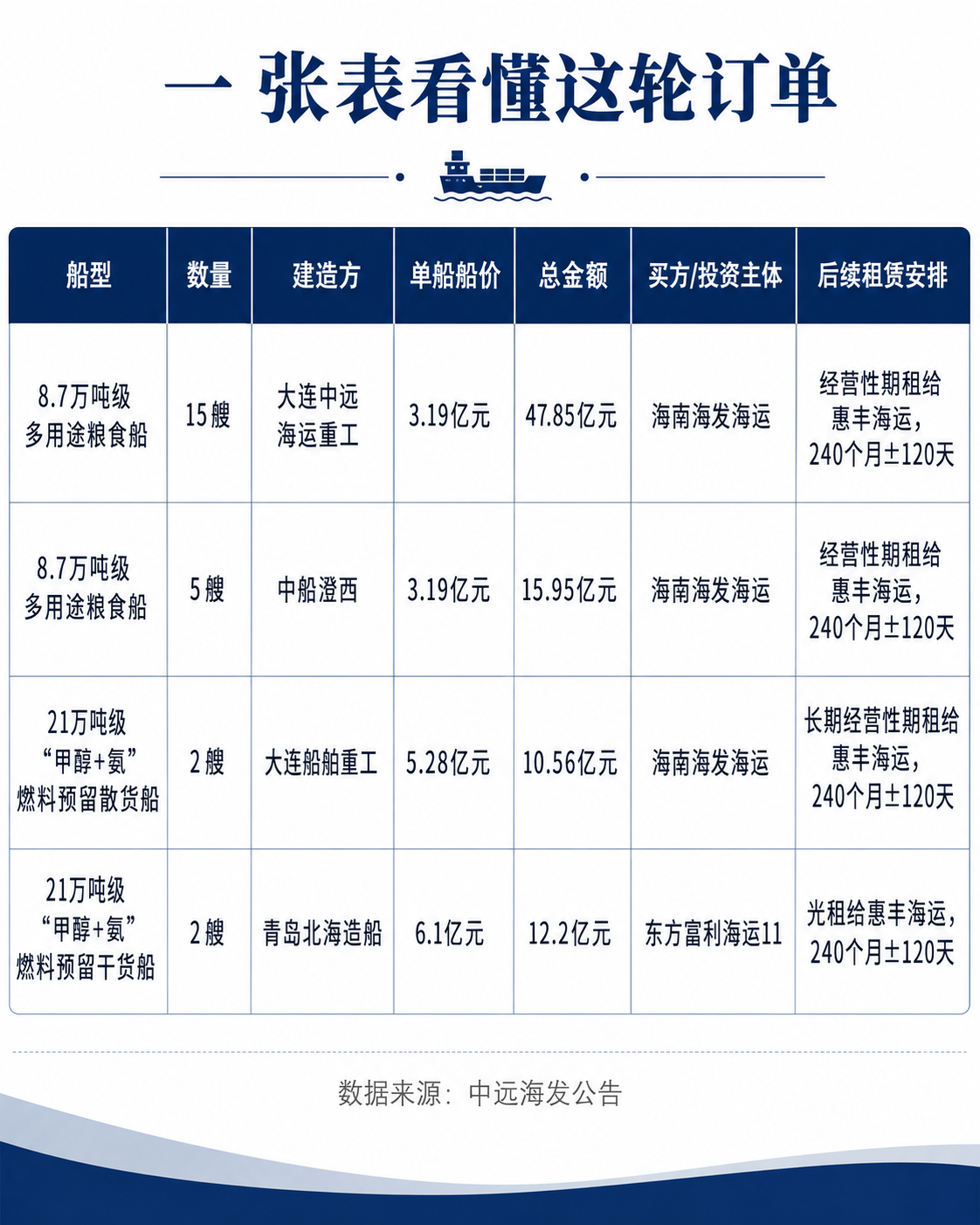
According to CSD's announcement, the company plans to entrust COSCO Shipping Heavy Industry's Dalian COSCO Shipping Heavy Industry Co., Ltd. to build 15 multipurpose grain carriers of 87,000 DWT through its indirect wholly-owned subsidiary, Hainan COSCO Shipping Development Shipping Co., Ltd.
Each of these 15 vessels is priced at RMB 319 million, with a total transaction value of RMB 4.785 billion (excluding tax). The first vessel is expected to be delivered on or before June 15, 2029, with the remaining vessels to be delivered successively by the end of 2030.
On the same day, CSD also announced plans to entrust CSSC Chengxi Shipyard Co., Ltd., under China State Shipbuilding Corporation (CSSC), to build 5 multipurpose grain carriers of 87,000 DWT through Hainan Haifa Shipping.
Each of these 5 vessels is priced at RMB 319 million as well, with a total transaction value of RMB 1.595 billion (excluding tax). The first vessel is expected to be delivered on or before September 30, 2029, with the remaining vessels to be delivered successively by the end of June 2030.
In other words, for the 87,000 DWT multipurpose grain carrier type alone, CSD plans to build 20 new vessels this time, totaling RMB 6.38 billion.
More critically, these 20 vessels will not be disposed of as short-term market assets after delivery. Instead, they will be leased on a long-term operational time-charter basis to Huifeng Shipping Co., Ltd., a subsidiary of COSCO Shipping Bulk Co., Ltd.
The lease term for each vessel is 240 months ± 120 days from the delivery date. In practice, this essentially covers the vessel's core operational lifecycle.
After considering fuel power system upgrades, the expected annual rent per vessel after delivery shall not exceed RMB 38.6061 million (excluding tax). At the end of the lease term, the ship assets are to be disposed of by the lessor, and the lessee has no obligation to purchase the ship assets.
This arrangement makes the nature of these vessels very clear:
This is not a short-term ship purchase.
This is a long-term, stable, and predictable capacity organization arrangement within the COSCO Shipping system.
Plus 4 more large vessels of 210,000 DWT
In addition to the 20 multipurpose grain carriers of 87,000 DWT, CSD also disclosed plans to build 4 vessels of 210,000 DWT.
Among them, Hainan Haifa Shipping plans to entrust Dalian Shipbuilding Industry Co., Ltd. (DSIC), under CSSC, to build 2 bulk carriers of 210,000 DWT with a "methanol + ammonia" fuel-ready design.
Each of these 2 vessels is priced at RMB 528 million, with a total transaction value of RMB 1.056 billion (excluding tax), and delivery is expected successively from October 2029 to August 2030.
After delivery, these 2 vessels will be leased on a long-term operational time-charter basis to Huifeng Shipping Co., Ltd., a subsidiary of COSCO Shipping Bulk, with the same lease term of 240 months ± 120 days. After considering dual-fuel power system upgrades, the expected annual rent per vessel after delivery shall not exceed RMB 59.4024 million (excluding tax).
Additionally, CSD plans to entrust Qingdao Beihai Shipbuilding Co., Ltd., under CSSC, to build 2 dry cargo ships of 210,000 DWT through its indirect wholly-owned subsidiary, Oriental Fortune Marine 11 Limited, also with a "methanol + ammonia" fuel-ready design.
Each of these 2 vessels is priced at RMB 610 million, with a total transaction value of RMB 1.22 billion (excluding tax), and delivery is expected successively from November 2029 to June 2030.
After delivery, these 2 vessels will be leased on a long-term bareboat charter basis to Huifeng Shipping Co., Ltd., a subsidiary of COSCO Shipping Bulk, with the same lease term of 240 months ± 120 days. After considering dual-fuel power system upgrades, the expected annual rent per vessel after delivery shall not exceed RMB 45.5342 million (excluding tax).
Thus, this round of 24 new vessel arrangements includes both the 87,000 DWT multipurpose grain carriers for bulk agricultural product transport and the 210,000 DWT vessels for large-scale dry bulk cargo transport with future green fuel conversion capability reserved.
But the truly significant spillover effect still comes from those 20 "grain carriers."
Food security also has a maritime dimension
In the past, discussions of food security more readily brought to mind arable land, seeds, output, reserves, and sources of imports.
These are certainly important.
But for a major country deeply engaged in global commodity trade, food security has another easily overlooked aspect: maritime transport.
China is a major global importer of grain. According to General Administration of Customs data, China imported a total of 140.563 million tons of grain in 2025, including 111.833 million tons of soybeans. That is to say, China needs more than 140 million tons of grain to enter the domestic market through the international trading system each year, with a considerable portion relying on ocean transport.
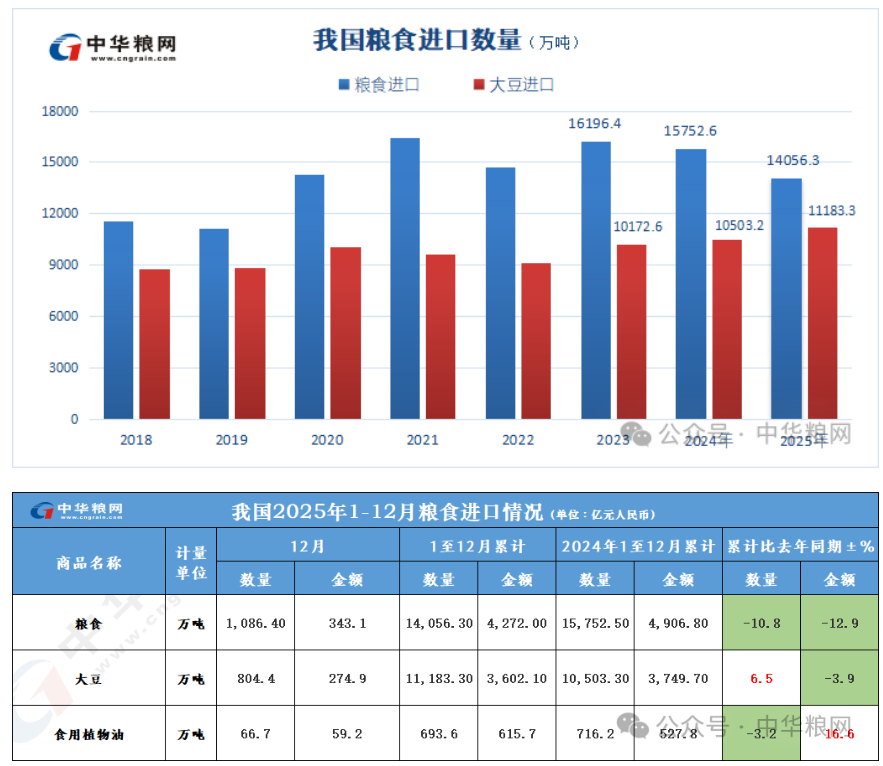
These grains travel from production regions in South America, North America, the Black Sea region, Australia, and elsewhere, crossing oceans and passing through ports, shipping routes, fleets, insurance, finance, trade, and logistics before finally entering China's consumption and processing systems.
When the global shipping market is stable, vessels can be chartered from the market.
But in the event of geopolitical conflicts, disrupted shipping lanes, soaring freight rates, rising insurance costs, port congestion, or changing trade policies, finding vessels on short notice becomes far more passive.
In recent years, the Red Sea crisis, Black Sea conflicts, risks in the Strait of Hormuz, and US-China trade friction have repeatedly reminded the global trading system:
Being able to buy the goods is only the first step.
Whether they can be transported back stably is the other half of supply chain security.
This is precisely the deeper significance of COSCO Shipping's current reinforcement of multipurpose grain carriers.
The value of the national team lies in critical moments
As China's national shipping champion, COSCO Shipping's value is not reflected solely in its fleet size.
What truly matters is whether it can provide long-term, stable, and controllable transport capacity for core cargo flows that affect national livelihoods and industrial security.
Grain, energy, and minerals are exactly such cargo flows.
Such cargo flows share a common characteristic: they may not attract the most attention in normal times, but once supply chains are disrupted, they can quickly impact industrial chains and the foundations of people's livelihoods.
Grain transport is particularly true in this regard.
It does not appear frequently in the public eye like container shipping, nor does it attract capital market attention like LNG carriers, VLCCs, or very large ore carriers. But it connects basic agricultural products such as soybeans, corn, sorghum, and barley, which underpin an entire industrial chain covering animal feed, livestock farming, edible oils, and food processing.
By locking in 20 multipurpose grain carriers of 87,000 DWT in one go, the COSCO Shipping system sends a very clear signal:
The oceangoing transport capacity for key bulk commodities must be more firmly held in one's own hands.
This "holding" is not simply about owning a few vessels.
It requires forming a complete closed loop from ship investment, shipyard construction, long-term leasing, actual operation, to cargo flow organization.
In this round of orders, CSD plays the role of ship investment and asset management; Chinese shipyards including Dalian COSCO Shipping Heavy Industry, CSSC Chengxi, DSIC, and Qingdao Beihai undertake the construction; and after delivery, the vessels are leased long-term to Huifeng Shipping, a subsidiary under COSCO Shipping Bulk, for operation.
This is precisely the advantage of the COSCO Shipping system.
Ship owners, shipyards, charters, operating entities, and long-term strategy can all be coordinated within one system.
This is not simply expanding the fleet
From CSD's perspective, this investment also aligns with its own business positioning.
In its announcement, CSD stated that the company, centered around the shipping logistics industry, focuses on container manufacturing, container leasing, and shipping leasing as its core businesses, supported by investment management, to promote integrated industrial-financial-investment development and build a world-class shipping industry-finance operator with COSCO Shipping characteristics.
The newbuild vessels will further leverage the synergies between industry and finance, enhance the scale and quality of the company's ship assets, solidify the foundation for its ship leasing business development, contribute long-term stable revenue and cash flow, improve overall financial robustness, and strengthen momentum for sustainable development.
The announcement also specifically noted that the company will rely on the policy dividends of the Hainan Free Trade Port, collaborating with upstream and downstream enterprises in the shipping industry chain to deepen the RMB application scenarios of "building, leasing, and operation," further advancing the practical use of RMB in the international shipping sector and enhancing market competitiveness.
This passage warrants attention.
The three words "building, leasing, and operation" neatly encapsulate the true structure of this round of orders.
Shipbuilding is completed at Chinese shipyards;
Leasing is arranged within the CSD system;
Operation is entrusted to the COSCO Shipping Bulk system;
Funding and settlement scenarios are integrated with the Hainan Free Trade Port and RMB internationalization applications.
This is not a simple newbuilding project, but a systematic coordination within the shipping industry chain.
Chinese shipyards are also part of this closed loop
Another notable aspect of this round of orders is that all builders are Chinese shipyards.
15 multipurpose grain carriers of 87,000 DWT built by Dalian COSCO Shipping Heavy Industry;
5 multipurpose grain carriers of 87,000 DWT built by CSSC Chengxi;
2 bulk carriers of 210,000 DWT built by Dalian Shipbuilding Industry;
2 dry cargo ships of 210,000 DWT built by Qingdao Beihai Shipbuilding.
This means that between Chinese ship owners, Chinese shipyards, Chinese leasing platforms, and Chinese shipping operating entities, a tighter internal circulation is taking shape.
In the past, discussions of China's shipbuilding leadership often used metrics such as completion tonnage, new orders, and order book volume.
But the deeper competitiveness lies in whether China's shipping industry chain can integrate ship owner demand, shipyard capacity, financial arrangements, long-term cargo flows, and operational organization.
This batch of vessels serves as a model.
It secures long-term orders for shipyards, provides CSD with ship assets capable of generating stable cash flows, gives COSCO Shipping Bulk long-term controllable capacity, and adds an extra layer of maritime protection to China's key bulk commodity supply chains.
Another layer of meaning in the "methanol + ammonia" fuel-ready design
The adoption of "methanol + ammonia" fuel-ready designs for the 4 vessels of 210,000 DWT also indicates that the COSCO Shipping system is not looking solely at current capacity needs.
From 2029 to 2030, the international shipping emission reduction framework will continue to advance, and green fuel supply chains will gradually mature — an important window period.
New vessels delivered at this point, without any consideration of future fuel adaptability, may face higher compliance pressures over their service lives.
By adopting the "methanol + ammonia" fuel-ready design for the 210,000 DWT vessels, CSD essentially leaves room for future power system upgrades.
This does not mean immediate use of methanol or ammonia fuel, but rather advance consideration in the design and construction phases for potential future conversions.
For a large dry bulk carrier with a service life of over twenty years, such a fuel-ready design enhances long-term adaptability.
This also echoes the 20-year long-term lease arrangements.
The vessels are not prepared just for the next few years, but for market, regulatory, and cargo flow changes over the next ten to twenty years.
The real signal
Therefore, to truly understand this round of orders, one cannot just look at the "RMB 8.656 billion" and the "24 new vessels."
One should also see the three signals behind them.
First, the COSCO Shipping system is continuously strengthening its oceangoing bulk commodity transport capacity, particularly in the relatively low-profile but critically important multipurpose grain carrier segment.
Second, CSD is embedding itself more deeply into the core operating scenarios of the COSCO Shipping Group through ship asset investment and long-term leasing arrangements, generating long-term stable cash flows.
Third, ever-closer industrial chain synergy is emerging between China's shipping, shipbuilding, leasing, operations, and RMB application scenarios.
This is what truly makes this round of orders remarkable.
Twenty multipurpose grain carriers of 87,000 DWT cannot possibly cover all of China's grain import transport needs.
But they are enough to point to a direction:
Amid rising global supply chain uncertainty, China needs not only the trading capability to buy grain, but also the shipping capability to transport it back stably.
That is precisely the value of COSCO Shipping as the national team.
As the world becomes increasingly uncertain, the oceangoing transport capacity for critical cargo flows must be built more solidly, held more firmly, and organized more deeply.
These 20 "grain carriers" are a clear signal from the COSCO Shipping system.
By: Liu Hongli

READ MORE
 Shipbuilding
Jianglong Adds $40m Offshore Vessel Order to 2026 Contract Run
 Shipbuilding
Hubei Firm Proposes RMB427m LNG and Methanol Vessel Programme
 Shipbuilding
4 More,totally 16 Since 2024: Why RCL Keeps Ordering at Huangpu Wenchong
 Shipbuilding
Chipolbrok Begins Construction of First 60,800 DWT Forward-Accommodation Heavy-Lift Vessel
 Shipbuilding
Zodiac Linked to First LNG Carrier Order at Hanwha Ocean
 Shipbuilding
RCL Adds Four Feeders to Its Huangpu Wenchong Programme
 Shipbuilding
X-Press Feeders CEO Shmuel Yoskovitz : “When You Own Your Own Vessels, You Control Your Destiny”
 Shipbuilding
DAB Group Enters Shipowning With First Ultramax Pair Ordered in China
 Shipbuilding
Union Maritime Adds Nine Ships Across Five Segments as Newbuild Programme Reaches 79
 Shipbuilding