


What Kind of Company Is Seaspan Today?
Seaspan is extending its vessel portfolio from containerships into car carriers, gas carriers, open-hatch vessels and large ore carriers. Behind that expansion is a consistent investment principle: commit capital against long-term customer requirements, supported by charter contracts and predictable cash flow.
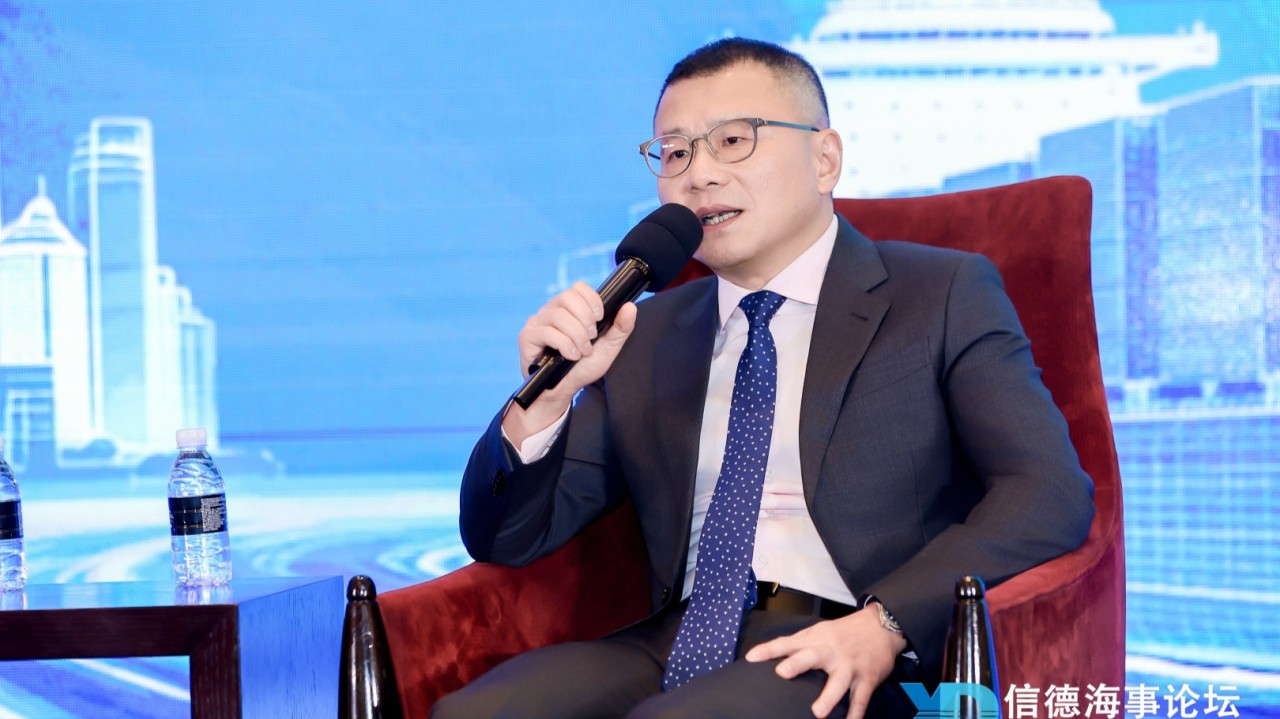
Speaking during a fireside discussion on the strategic resilience of shipping companies at the Ship Operations and Management Forum 2026 in Shanghai on 19 October, Bing Chen, Chairman, President and CEO of Seaspan, explained how that principle connects the company’s diversification, customer relationships and approach to decarbonisation.
His account offers a broader view of Seaspan’s business. The company is developing its role as a maritime asset owner and service provider that can support customers throughout a vessel’s life, bringing together investment, financing, technical expertise, operations and subsequent upgrades.

Preparing for the next cycle while markets are strong
Chen acknowledged the strength seen across several shipping sectors over the past year. He also stressed that favourable markets require companies to prepare for changes ahead. Shipping remains cyclical; the duration and intensity of each cycle may vary, but businesses must retain the ability to operate through different conditions.
For Seaspan, this means considering several cycles together. Economic and shipping cycles interact with changes in regulation, financing, technology and geopolitics. Some developments can be anticipated, while others remain difficult to identify in advance. A company’s business model, execution capabilities and customer relationships therefore need to provide a foundation for responding to both.
That thinking shapes Seaspan’s investment decisions. Chen said the company does not invest simply because it expects a particular shipping market to rise or considers a vessel attractively priced. Across its different vessel categories, investment must be underpinned by long-term employment and stable, predictable cash flow.
For a capital-intensive business, the sequence matters. Ships take years to build and can operate for decades, exposing their owners to conditions very different from those prevailing when the order was placed. Connecting an investment to a customer’s long-term requirements allows revenue, financing and operating responsibilities to be considered from the outset.
A partner throughout the vessel lifecycle
Seaspan’s position as the world’s largest independent containership owner remains central to its identity. Its growing involvement in other vessel categories raises a wider question: how should the company be understood today?
Chen’s answer starts with the customer. He described Seaspan as a provider of comprehensive, one-stop solutions. A shipping company securing a vessel must also consider emissions performance, operating efficiency, financing, maintenance, future modifications and fuel choices. Regulatory and geopolitical changes add further complexity, increasing the need to address these questions together.
That work begins before construction. Vessel design, build quality and the ability to accommodate future fuel requirements all influence the asset’s long-term usefulness. Once a ship enters service, attention shifts to operating performance, maintenance and upgrades as customer needs and regulatory requirements develop. Large shipping companies, with extensive and complex operations, require partners capable of working across these areas.
Chen said Seaspan’s customer charters have an average term exceeding 11 years, with the longest reaching 25 years. Such commitments reflect customers’ confidence in the company’s commercial model and its ability to help resolve problems that may arise over time.
A relationship extending over more than two decades consequently requires continuing investment after delivery. Technical support, management capabilities and the ability to develop practical solutions remain part of the service. For Chen, that capacity to work through uncertainty is an important foundation of a durable customer partnership.
Extending the model into more shipping sectors
Several recent projects illustrate how Seaspan is applying this approach beyond containerships.
In the car carrier market, the company has a programme of six 10,800-CEU LNG dual-fuel pure car and truck carriers. In June, Seaspan announced that the first vessel, Glovis Lighthouse, had begun its maiden voyage under a long-term time charter to Hyundai Glovis. Developed with the automotive logistics company, the vessel combines substantial carrying capacity, cargo flexibility and provisions for future fuel conversion.
Its open-hatch investment uses a different contractual structure. G2 Ocean has announced that six 65,400-dwt open-hatch gantry crane vessels will join its pool from 2029. Four will be owned by Seaspan and bareboat chartered to Gearbulk before entering the G2 Ocean operating network. The vessels will be built at New Dayang Shipbuilding in China. Seaspan’s published corporate milestones also identify a five-vessel programme of 100,000-cbm very large ethane carriers.
The company’s latest diversification move involves two 210,000-dwt tri-fuel ore carriers. As previously reported by Xinde Marine News, Seaspan confirmed that it would own the vessels, with Yangzijiang Shipbuilding constructing them and Mitsui O.S.K. Lines (MOL) chartering the ships for iron ore transportation for Vale.
MOL’s announcement on 2 October set out the underlying cargo commitment: its subsidiary MOL Ocean Bulk had signed a 25-year iron ore transportation agreement with Vale, supported by two new vessels scheduled for delivery in 2030. The ships will be capable of using ethanol, methanol and conventional heavy fuel oil, with design provisions for future conversion to LNG or ammonia.
The arrangement connects three complementary roles. Vale provides the long-term transportation requirement, MOL organises the transport service, and Seaspan provides the vessel assets. It gives the new ships a defined commercial purpose while creating an application for alternative-fuel technology.
The projects involve different ships, technical requirements and charter structures. Their common commercial foundation is the principle Chen emphasised in Shanghai: investment supported by long-term customer demand and contractual cash flow.
Connecting contracted income with funding
Seaspan’s recent financing developments provide another perspective on that model.
In August, KBRA upgraded the company’s issuer and senior unsecured debt ratings from BB+ to BBB-, with a Stable Outlook. The agency cited growth in contracted cash flows, longer charter terms and improved funding flexibility among the reasons for the upgrade. Its assessment referred to approximately US$34.9 billion in gross contracted cash flows, supporting visibility over future earnings.
Seaspan has also expanded its funding sources. According to the company, it issued a RMB1.5 billion, three-year Panda bond in China’s domestic market on 15 July 2026, carrying an annual coupon of 2.50%. The transaction added a funding channel alongside the company’s existing relationships across shipbuilding, chartering and maritime finance.
These developments illustrate how contracted business and financing capacity can reinforce each other. Predictable contractual income helps financing providers assess debt-servicing capacity. Broader access to capital gives an asset owner more options when supporting customer projects. Matching the duration and requirements of customer commitments, vessel investments and funding remains central to making the model work over time.
Looking beyond GDP when assessing container shipping demand
Containerships remain Seaspan’s principal business, making the industry’s growing orderbook an important subject in the discussion.
Chen argued that assessing today’s supply-demand balance requires a broader set of considerations than in the past. Comparing fleet growth with GDP growth alone provides an incomplete picture when geopolitics, emissions requirements, corporate network decisions and port congestion are also changing the amount of capacity needed and the efficiency with which ships can be used.
Changes in trading routes can increase the vessel time required to carry the same cargo. Congestion can absorb capacity by delaying ships. Environmental requirements can encourage fleet renewal and technological upgrades. Together, these influences make the sources of additional vessel demand more complex.
The orderbook therefore needs to be considered alongside deployment patterns and changes in effective capacity. Counting additional ships is one part of the assessment; understanding how those ships will be employed is equally relevant.
Chen nevertheless stressed that shipping’s cyclicality remains. A changing operating environment introduces more variables without removing the possibility of a future imbalance. The questions are how much additional supply and demand emerge, how large the gap becomes, and over what period the effects are felt.
That assessment is consistent with his broader investment approach. Where market outcomes are difficult to predict, companies need contractual arrangements and execution capabilities that can support the business through different scenarios.
Upgrading the fleet already on the water
Decarbonisation was another central theme of the discussion. Chen said the industry’s direction towards lower emissions remains intact even as the pace of individual regulatory measures changes. Newbuildings offer one route to improved performance, while the large existing fleet also requires practical solutions.
Many conventionally fuelled ships retain substantial operating value. Their ages and technical characteristics vary, calling for a combination of maintenance, efficiency upgrades and fuel conversions to extend useful service and meet evolving requirements. Chen suggested that retrofits could become particularly attractive when markets are less strong and owners take a more cautious approach to capital expenditure.
Seaspan’s work with Hapag-Lloyd provides a concrete example. In 2024, the companies agreed to convert five 10,000-TEU-class containerships to methanol dual-fuel operation, followed by long-term charters to Hapag-Lloyd. In June this year, they announced completion of the first conversion, Seaspan Yangtze. At the time, Seaspan said it had committed more than US$230 million across 86 vessels and over 550 efficiency and retrofit projects through its SAVER programme and CleanBlue initiative.
Upgrades also encompass ships continuing to use their existing fuels. In July, Seaspan and Maersk announced an efficiency programme covering 18 vessels on long-term charter, with completed and planned investments totalling approximately US$75 million. A major component involves four 13,000-TEU ships, with modifications including shaft generators, main-engine performance optimisation, high-efficiency propellers and pre-swirl devices, together with increased cargo-carrying capability. The measures are expected to improve slot costs by approximately 10–13%.
These projects connect technical work with the commercial objectives Chen described. Improving efficiency and preserving a vessel’s ability to serve customers can extend its productive life and support further cash generation. The value of an upgrade ultimately depends on the operating performance and economics it delivers over time.
Seaspan’s expanding portfolio and retrofit activity thus point to a business extending across vessel categories and along the asset lifecycle. Its ability to combine capital with technical and operational capabilities is becoming a larger part of what it offers customers.
As shipping companies commit to vessels that will operate through changing markets, fuel choices and regulations, the durability of those capabilities will matter throughout the investment’s life. Chen’s explanation of Seaspan’s strategy centres on that continuing responsibility: invest around long-term requirements, deliver on customer commitments and keep developing solutions as conditions change.


READ MORE
 Containers
HMM Approves $1.62 Billion Plan to Add 12 Containerships
 Containers
Buy Again! From Ships to Ports: Inside the Maersk Family’s Infrastructure Buying Spree
 Containers
CMA CGM Updates eBL Templates to Clarify Electronic Original Status
 Containers
With an Orderbook Above 45% of the Fleet, Why Are Container Lines Still Paying Up for Ships?
 Containers
Bigger Fleets, Wider Networks: China’s Provincial Shipping Companies Step Up Expansion
 Containers
2,824-TEU GFS PRIDE Sinks in Hormuz; All 21 Crew Safe
 Containers
Zhonggu Orders Its First 14,000 TEU Ships as Annual Newbuilding Tally Reaches 20
 Containers
CMA CGM Expands Biomethane Push with Singapore Supply Partnership
 Containers
sakos Returns to Containership Ordering After Four Years with Hengli Deal
 Containers