


Buy Again! From Ships to Ports: Inside the Maersk Family’s Infrastructure Buying Spree
Investment platforms associated with the family behind Maersk are extending their reach across the infrastructure that supports global trade.
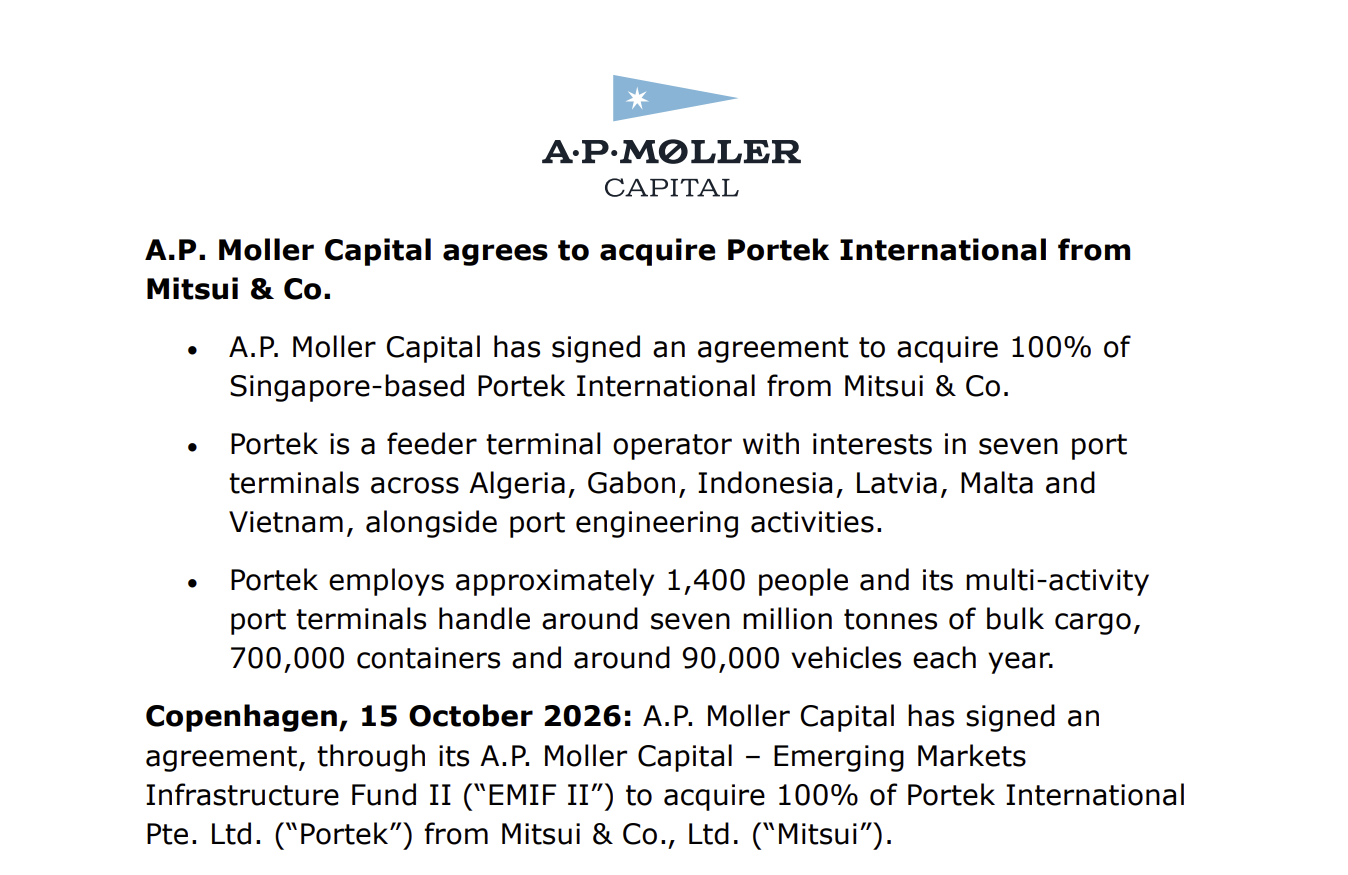
On 15 October 2026, A.P. Moller Capital announced an agreement, through its Emerging Markets Infrastructure Fund II (EMIF II), to acquire 100% of Singapore-based Portek International Pte Ltd from Japan’s Mitsui & Co. “Portek” holds interests in seven terminals across Asia, Africa and Europe, alongside a port engineering business. Completion remains subject to regulatory and other closing conditions.
The announcement came just 17 days after“Capital” agreed to acquire a majority stake in Euroports through a separately managed fund vehicle backed by A.P. Moller Holding. Euroports operates more than 50 deep-sea and inland terminals across 10 European countries and China, handling over 70 million tonnes of cargo annually.
The announcements follow “Holding”’s completed acquisition of ship-leasing company Ocean Yield AS , Capital-led investments in BERGÉ and AC Logistics , and an agreement for a majority investment in Globex. Taken together, they suggest a sustained interest in businesses that connect maritime transport with industrial production, distribution and consumption.
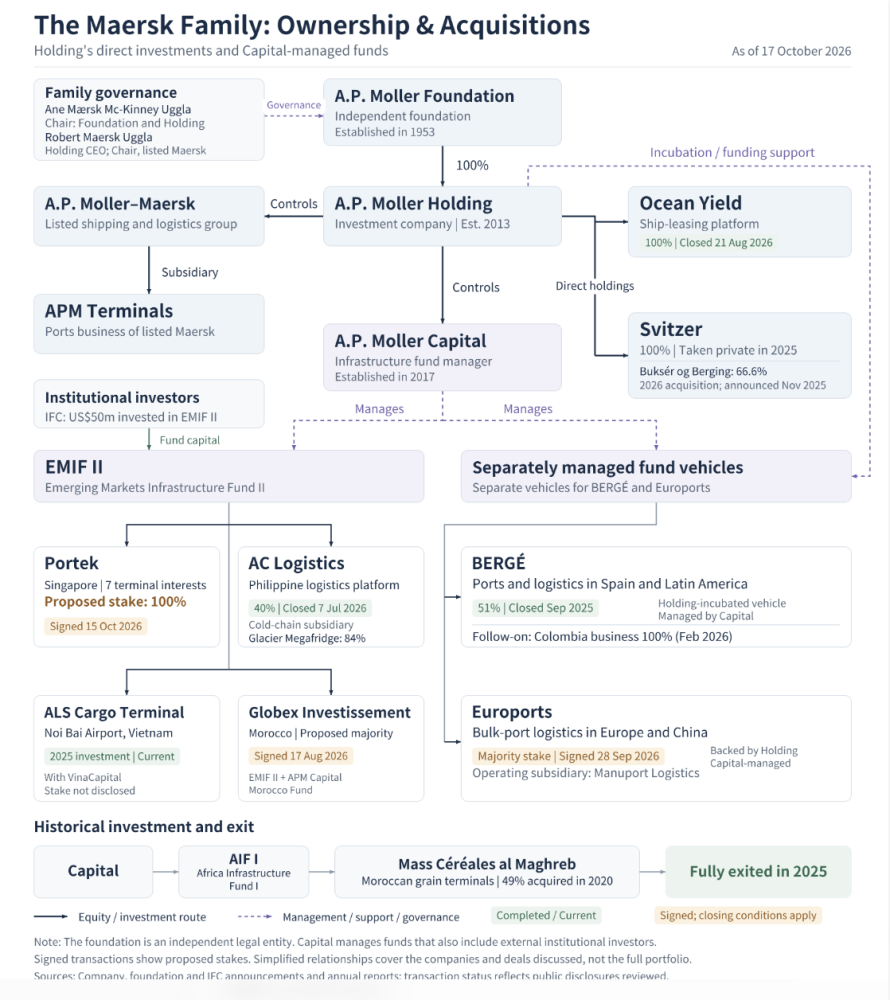
Two investment routes are developing alongside one another: “Holding” directly acquires and develops operating businesses, while “Capital” manages funds and investment vehicles deploying capital into infrastructure. Their shared industrial background provides a connection across the portfolio, while each transaction has its own ownership and funding arrangements.
Two platforms, linked by a foundation
The ownership structure begins with the A.P. Moller Foundation, established in 1953 to support the long-term continuity of the group and contribute to society through donations. The foundation wholly owns A.P. Moller Holding, established in 2013 as its investment arm.
Holding is the controlling shareholder of the listed A.P. Moller–Maersk and has developed a wider portfolio of companies. Capital, founded in 2017 and majority-owned by Holding, is an infrastructure fund manager investing principally in transportation, logistics and the energy transition.
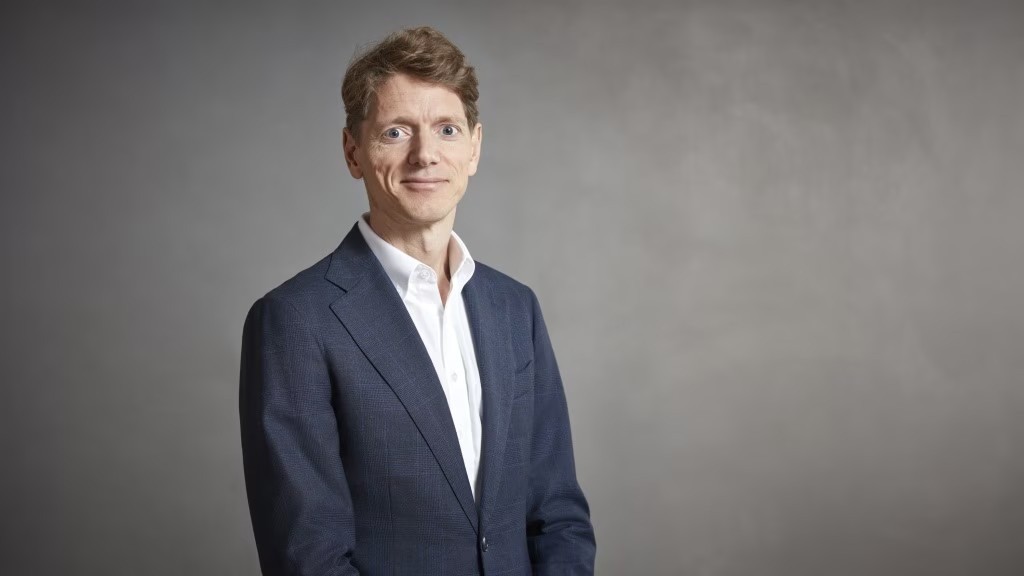
The founding family remains involved through governance. Ane Mærsk Mc-Kinney Uggla chairs the foundation and Holding. Robert Maersk Uggla is Holding’s chief executive and chairman of the listed Maersk group. The listed company operates its shipping and logistics businesses, including APM Terminals, while Holding undertakes broader capital allocation and Capital manages investment funds.
The recent transactions demonstrate how those roles can combine. Ocean Yield was acquired directly by a Holding subsidiary. Portek is being acquired through EMIF II. The BERGÉ investment used a fund vehicle incubated by Holding and managed by Capital, while Euroports involves a separately managed vehicle backed by Holding. This structure gives the wider investment system several ways to participate in businesses supporting trade.
Ports embedded in industrial supply chains
The port investments are particularly revealing because of the cargoes and customers they serve.
Capital’s 51% investment in Spain’s BERGÉ was completed in September 2025. The partnership identified opportunities for organic growth and acquisitions across the multipurpose port sector in Iberia and Latin America.
Euroports adds a broader network serving agricultural commodities, fertilisers, sugar, forest products, metals, minerals and liquid bulk cargoes. Its Manuport Logistics business extends into freight forwarding across more than 20 countries. Existing shareholders SFPIM and PMV are to remain invested following completion, alongside the continuing management team.
These businesses participate in recurring industrial requirements. Farmers need fertiliser, manufacturers need raw materials, food businesses need imports and distribution, and paper mills need dependable supplies of pulp. The commercial value of a terminal depends on how effectively it connects those customers with maritime and inland transport.
Euroports’ Chinese operations illustrate that connection. The group operates in Changshu, Jiangsu province, and Gaolan, Guangdong province. Changshu has a longstanding role in forest-product logistics along the Yangtze River, while the company’s services in China include transhipment, freight forwarding and bonded warehousing.
For a pulp customer, the service requirement continues after discharge. Storage conditions, onward transport and delivery schedules all affect production planning. A port business able to organise those activities can become part of the customer’s operating routine, with opportunities to provide a wider range of services over time.
Portek brings a different combination of capabilities. Its terminal interests span Algeria, Gabon, Indonesia, Latvia, Malta and Vietnam. The acquisition announcement reported annual handling of approximately seven million tonnes of bulk cargo, 700,000 containers and 90,000 vehicles, with around 1,400 employees across the business.
Portek also provides crane modification, relocation, modernisation and maintenance, as well as port information technology and automation services. That engineering capability matters because improvements in equipment availability, yard organisation and operating processes can release capacity from existing infrastructure.
Capital’s stated priorities after completion include operational performance, governance, safety, capital discipline and environmental performance. Portek therefore offers both established terminal positions and an operating organisation capable of improving those assets.
Across BERGÉ, Euroports and Portek, the investment exposure spans different regions, cargoes and operating capabilities. The common commercial question is how well each business can serve the trade and industry around it.
Following cargo beyond the waterfront
Capital has also been investing in the networks that move goods into domestic economies.
On 7 July 2026, Capital and the Philippines’ Ayala Corporation announced completion of EMIF II’s investment in a 40% stake in AC Logistics. The partnership focuses on cold chain, air cargo logistics, contract logistics and national distribution, and project cargo.
AC Logistics had also completed the acquisition of 84% of Glacier Megafridge, strengthening its temperature-controlled logistics platform. This connects storage facilities with transport and distribution services for sectors including food, agriculture and healthcare.
The operating demands are interconnected. A cold store needs utilisation, a delivery fleet needs effective scheduling, and customers need both temperature integrity and dependable arrival times. Expanding the service network can enable the operator to take on more of a customer’s recurring logistics requirements.
In Vietnam, Capital has invested alongside VinaCapital in ALS Cargo Terminal at Hanoi’s Noi Bai International Airport. Capital now lists ALSC as a current investment. The original September 2025 announcement described it as the start of a broader transport and logistics platform strategy, with potential improvements through automation, process optimisation and expansion.
In Morocco, EMIF II and APM Capital Morocco Fund signed an agreement in August 2026 to acquire a majority stake in Globex Investissement. Globex operates in express delivery, road freight, freight forwarding and customs brokerage. The announced transaction retains founder and chief executive Omar El Kadiri and the existing management team, and includes regulatory and other closing conditions.
Local partners have an important role in these investments. Ayala brings Philippine market knowledge and business relationships, VinaCapital contributes Vietnamese investment experience, and Globex has an established local operating organisation. International capital can support expansion through businesses that already have customers, teams and knowledge of their markets.
The portfolio consequently spans established industrial cargo flows and logistics platforms with scope to add capacity and broaden services. Across both, the investment opportunity depends on improving how goods are received, stored, transferred and delivered.
Holding expands its maritime portfolio
Alongside Capital’s fund investments, Holding has continued to acquire maritime businesses directly.
Holding announced the purchase of Ocean Yield from KKR-managed funds on 2 July 2026 and completed the transaction on 21 August. The company holds interests in more than 70 modern vessels across gas carriers, containerships, crude, product and chemical tankers, and dry bulk shipping.
The signing announcement said Ocean Yield had invested more than $3 billion during KKR’s ownership and increased its long-term contracted backlog to over $5 billion. Holding’s chief financial officer, Martin Larsen, highlighted the company’s stable cash-flow model as a complement to the existing maritime portfolio.
Ocean Yield gives Holding a platform combining vessels, charter contracts, customer relationships and financing arrangements. Long-term contracts improve revenue visibility, while management must continue to assess counterparty performance, vessel condition, funding terms and the economics of new investments.
Towage and marine services provide another form of exposure. Holding took full ownership of Svitzer in 2025, following the company’s earlier separation from the listed Maersk group.
Svitzer subsequently expanded through a majority acquisition of Norway’s Buksér og Berging. The transaction was announced in November 2025 as a 66.6% investment, and Svitzer’s current corporate timeline records the majority acquisition in 2026.
These businesses serve different customer needs. Ocean Yield provides maritime assets under leasing arrangements. Svitzer supplies towage and related services supporting vessel movements through ports and terminals. Together with the port and inland logistics investments, they broaden participation across several revenue models within the trade economy.
Long-term capital and institutional fundraising
Holding’s financial position provides part of the explanation for its ability to invest.
In its April 2026 shareholder letter, Robert Maersk Uggla reported that Holding’s net asset value had risen from DKK 107 billion at the end of 2015 to DKK 281 billion, approximately $44 billion, at the end of 2025.
The portfolio had also become more diversified. In 2016, the listed Maersk group and Danske Bank represented all of Holding’s net asset value. By the end of 2025, their combined share was approximately half. At holding-company level, Holding remained debt-free, with a liquid public-markets portfolio valued at about $8 billion.
Capital adds a separate ability to mobilise institutional money. IFC announced a $50 million investment in EMIF II in 2023. In February 2026, Capital’s Morocco-focused fund closed with approximately $178 million in commitments. A further commitment of around $65 million from EMIF II brought the combined capital available for Moroccan transportation and logistics investments to approximately $243 million.
This gives the investment system access to both Holding’s capital and funds raised from institutions. The BERGÉ and Euroports arrangements also show how Holding can support investment vehicles managed by Capital.
Operational experience supports the process. Capital’s managing partner and chief executive, Kim Fejfer, previously spent 13 years as chief executive of APM Terminals. Partner and chief financial officer Joe Nielsen also held senior roles in port investment and regional operations at APM Terminals.
Ports and logistics require detailed operating judgement. Equipment condition, customer concentration, inland connections, service quality and capital expenditure can materially affect performance. Industry experience can help an investor assess those issues before acquisition and work with management afterwards.
The test comes after the transaction
Several portfolio companies have already demonstrated how investment can support further expansion.
In February 2026, BERGÉ announced the acquisition of the remaining 49% of its Colombian business from Transportes Vigía, taking full ownership. The operation combines vehicle transport, storage and value-added services, managing more than 150 car transporters and over 300,000 square metres of vehicle yards. BERGÉ explicitly linked its international development to the support provided by Capital’s entry as a shareholder.
AC Logistics’ expansion in cold chain and Svitzer’s investment in Norwegian marine services show similar opportunities to develop operating platforms through related acquisitions.
Capital’s experience with Morocco’s Mass Céréales al Maghreb provides an example of a complete investment cycle. Its Africa Infrastructure Fund I acquired a 49% stake in 2020, supported capacity expansion during ownership and fully exited in 2025. Entry, business development and exit are all part of the fund manager’s investment process.
The practical outcomes of the current acquisitions will therefore be measured through operations: more reliable terminal services, better use of facilities, stronger delivery networks and disciplined management of contracts and capital.
In Xinde Marine News’ assessment, the common direction is a wider application of the industrial knowledge accumulated across shipping and logistics. Holding’s direct investments, Capital-managed funds and subsequent acquisitions by operating companies provide different ways to participate in the continuing movement of goods.
The next stage will be defined by completion of the outstanding transactions and the growth achieved by those businesses under their new ownership arrangements. That will show how effectively this expanding infrastructure portfolio converts capital and experience into services that customers continue to need.


READ MORE
 Containers
HMM Approves $1.62 Billion Plan to Add 12 Containerships
 Containers
CMA CGM Updates eBL Templates to Clarify Electronic Original Status
 Containers
Bigger Fleets, Wider Networks: China’s Provincial Shipping Companies Step Up Expansion
 Containers
With an Orderbook Above 45% of the Fleet, Why Are Container Lines Still Paying Up for Ships?
 Containers
2,824-TEU GFS PRIDE Sinks in Hormuz; All 21 Crew Safe
 Containers
Zhonggu Orders Its First 14,000 TEU Ships as Annual Newbuilding Tally Reaches 20
 Containers
CMA CGM Expands Biomethane Push with Singapore Supply Partnership
 Containers
sakos Returns to Containership Ordering After Four Years with Hengli Deal
 Containers
Global Ambitions, Provincial Roots: China’s State-Owned JOSCO Expands Overseas
 Containers