


With an Orderbook Above 45% of the Fleet, Why Are Container Lines Still Paying Up for Ships?
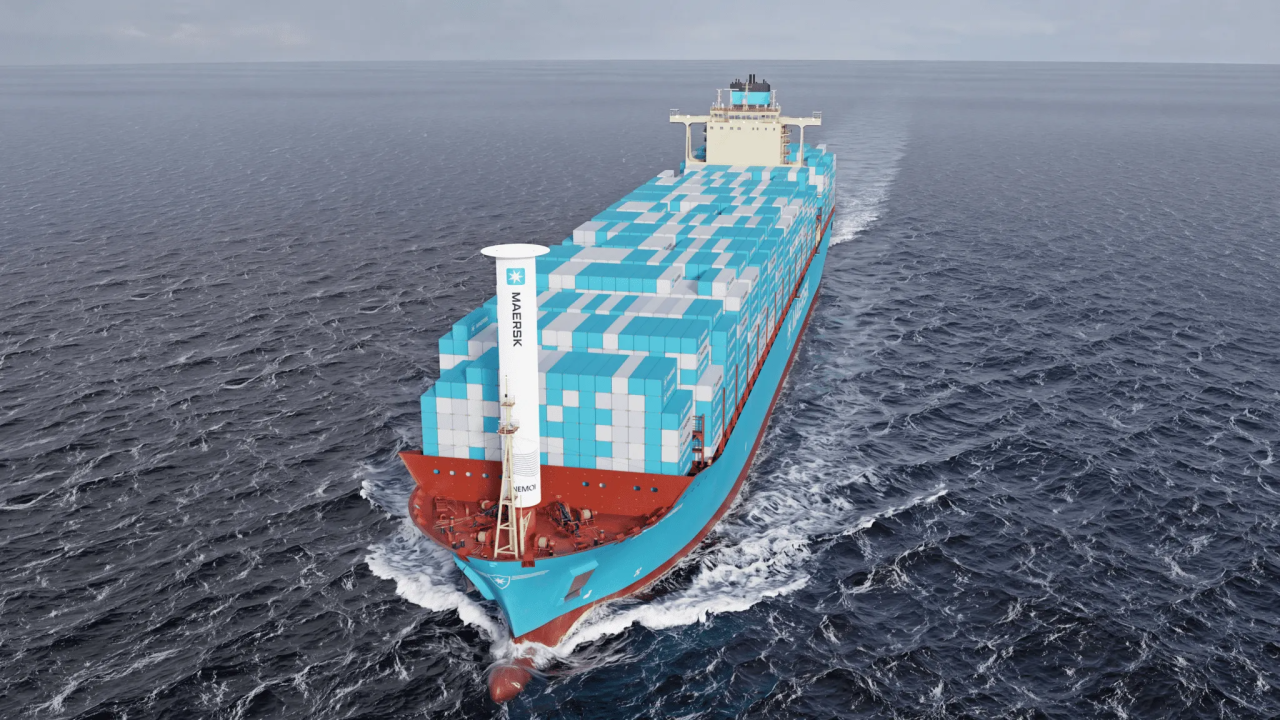

Container lines are securing ships more than a year before they become available, committing to charters that extend into the next wave of newbuilding deliveries. This is happening while the global containership orderbook already exceeds 45% of the capacity of the operating fleet.
According to Linerlytica’s September 21, 2026 report, the orderbook had reached 1,925 vessels with an aggregate capacity of approximately 15.6 million TEU, taking the orderbook-to-fleet ratio above 45%, its highest level since 2009. Meanwhile, disclosures by independent shipowners show that some recently agreed charters will begin only in the second half of 2027 and run for around three years, securing employment into approximately 2030.
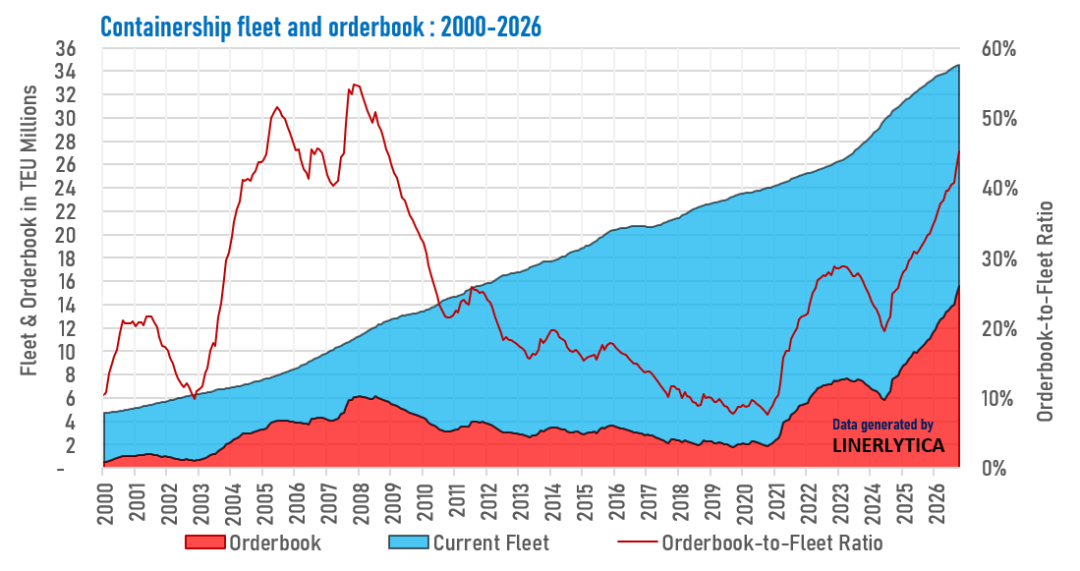
The commercial logic reflects a gap between future fleet capacity and ships that can meet an operator’s requirements at a particular time. Carriers need vessels to maintain schedules, develop services and retain customers. Independent owners can use that demand to secure several years of contracted earnings. As Suez routings gradually return and newbuilding deliveries accelerate, both sides are making commitments that will outlast today’s market conditions.
High Rates and Earlier Commitments
Harper Petersen’s HARPEX containership charter rate index stood at 2,468 on October 16, unchanged from October 9 and above the 2,456 recorded on October 2. Its assessments for six-to-12-month employment put daily hire at $72,000 for a 6,500-TEU vessel and $79,000 for an 8,500-TEU vessel. Following gains during the third quarter, the market remained firm into October.
Maritime Strategies International (MSI) reported that its one-year charter assessments for 1,700-TEU geared non-eco vessels and 6,500-TEU gearless non-eco vessels rose by approximately 18% and 14%, respectively, between June and September. In an October 9 analysis, MSI director Daniel Richards noted that charterers remained willing to accept two-to-three-year employment at strong rates, including fixtures for forward delivery.

Global Ship Lease’s second-quarter results, published on August 5, illustrate how far ahead carriers are committing. MSC Tianjin, MSC Qingdao and Agios Dimitrios had been forward fixed for 36–38 months, with the new charters expected to begin between the third and fourth quarters of 2027. GSL Ningbo had also secured a 36–38-month forward charter expected to start in the third quarter of 2027.
These fixtures extend the consequences of decisions made in 2026 into approximately 2030. For charterers, they provide continuity of vessel supply across several operating seasons. For owners, they establish employment well beyond the expiry of existing contracts. The duration and commencement dates are therefore as significant as the headline daily rates: carriers are securing ships through a period when substantial additional capacity is scheduled to enter the fleet.
Why a Growing Fleet Can Still Be Short of Ships
A weekly liner service requires a sequence of vessels moving through a defined rotation. In a simplified example, a service with a 70-day round-trip cycle needs approximately ten ships to maintain weekly departures. If diversions and port delays extend that cycle to 84 days, it needs approximately twelve. Cargo volumes can remain unchanged while the number of ships required to carry them rises by 20%.
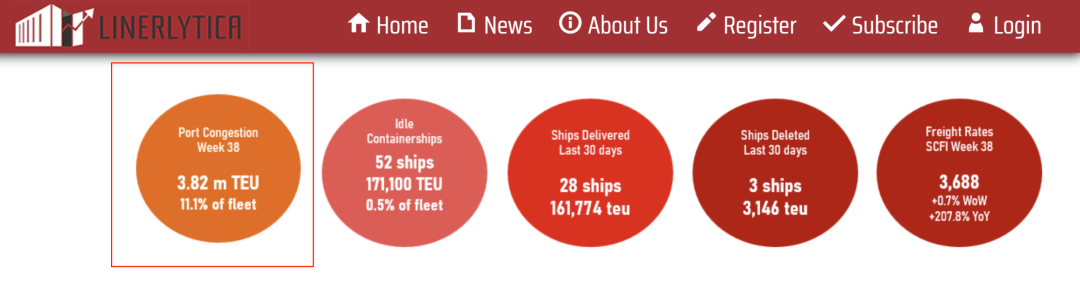
Linerlytica’s September 21 report noted that congestion in China was easing from earlier peaks, while disruptions in Southeast Asia, India and the Middle East remained severe. Its global congestion monitoring still involved capacity equivalent to more than 11% of the fleet. Longer voyages and waiting times absorb vessel days, limiting how much additional transport capacity a growing fleet can actually offer.
Delivery timing creates another constraint. A ship scheduled for 2029 cannot replace a vessel whose existing charter ends in 2027. Vessel specifications also matter. Port infrastructure, draught restrictions, cargo volumes and service design limit substitution between ship sizes. A 24,000-TEU vessel cannot readily take over the work of a 1,800-TEU feeder simply because both contribute to the same global capacity total.
Regional and interregional trade provide a further source of demand for flexible tonnage. In its earlier coverage of MPC Container Ships (MPCC), Xinde Marine News examined the company’s view that expanding links between Southeast Asia, the Far East and other emerging markets were increasing the relevance of smaller and mid-sized vessels. Their ability to operate across a wider range of ports gives them a different commercial role from the largest mainline ships.
Longer contracts also reduce the number of vessels available for subsequent fixtures. When ships are committed several years ahead, operators without secured replacement tonnage face fewer choices for particular delivery windows. That encourages earlier negotiations and helps explain why an expanding global fleet can coexist with tight availability in individual charter market segments.
Owners Are Turning Scarcity into Contracted Revenue
The disclosures of Global Ship Lease, Danaos and MPCC show how independent owners are responding. Their businesses depend on providing vessels to liner operators, making charter duration, counterparty strength and the relationship between contracted earnings and ownership costs central to investment decisions.
GSL reported approximately $3.2 billion in contracted revenue as of June 30, including its newbuilding programme at that date, with charter coverage of 100% for 2026 and 90% for 2027. Danaos reported approximately $4.6 billion in contracted operating revenue, including newbuildings, in its second-quarter release. Its contracted operating-day coverage for the containership fleet stood at 93% for 2027 and remained at 61% for 2029. Such coverage slows the transmission of changes in market charter rates into actual company revenue.
MPCC’s August 26 second-quarter announcement put its charter backlog at $2.2 billion, with coverage of 85% for 2027 and 60% for 2028. The company has combined disposals of older ships with newbuilding investment and acquisitions of modern vessels. In June, it announced the acquisition of four 7,000-TEU ships built in 2023–2024 for approximately $340 million. Each had a three-year fixed-rate charter to a top-five liner company, with the initial employment expected to generate approximately $180 million in combined revenue.
For these investments, the vessel and its attached employment jointly determine commercial value. Modern, efficient assets offer operating advantages, while secured charters provide a basis for assessing cash flow, arranging debt and planning repayment. Owners can undertake fleet renewal with less dependence on prevailing charter rates during the initial employment period.
Longer coverage does not necessarily mean rising earnings on every ship. GSL disclosed that the new charter for GSL Ningbo was expected to generate lower annualised adjusted EBITDA than its existing employment. Securing future income can remain attractive even when a vessel is coming off a more lucrative contract. For an owner managing debt and capital expenditure, the length and reliability of earnings can carry substantial value alongside the rate achieved.
How Long Charters Support a $1 Billion Loan
GSL’s October 12 financing announcement makes the connection between employment and investment particularly clear. The company agreed a $1 billion syndicated loan facility with a seven-year term and pricing of SOFR plus 150 basis points. The eight-bank syndicate included Bank of America as bookrunner, alongside institutions including Bank of China (Hong Kong), KfW IPEX and ABN AMRO.
The facility is intended to be drawn in tranches corresponding to deliveries of the 15 newbuildings announced earlier in the year. Those ships are scheduled for delivery between the fourth quarter of 2028 and the first quarter of 2030 and have secured multi-year employment commencing promptly after delivery. Their average firm charter term is 7.1 years, weighted by TEU capacity.
Aligning loan drawdowns with delivery and charter commencement links the expansion of debt to the start of operating income. Contracted revenue gives lenders a basis for assessing repayment capacity, while owners can evaluate returns against financing costs and expected residual values. Liner companies obtain future access to ships without having to own those assets themselves.
Owners nevertheless retain exposure where employment has yet to be secured. On October 6, GSL announced, subject to certain conditions precedent, the exercise of options for two additional newbuildings, increasing its orderbook to 17 ships. The two vessels are scheduled for delivery in the fourth quarter of 2029, and the company said it was discussing their employment with prospective charterers. Their eventual contracts will determine how much additional market exposure the investment carries.
Long-term charters thus connect decisions made by carriers, owners and banks. They make large investments easier to organise, but also carry commitments formed under today’s market conditions into a different stage of the shipping cycle.
Shorter Voyages Could Meet Faster Fleet Growth
The gradual return of Suez routings is an important change in that operating environment. On September 14, Maersk announced that the Gemini Cooperation’s AE5, AE11, AE12 and ME2 services would switch from the Cape of Good Hope to the Suez Canal. Hapag-Lloyd subsequently confirmed UMM QARN for the first relevant westbound SE1 sailing, scheduled to depart Tanjung Pelepas on October 27. Transits remain subject to security assessments and associated protection arrangements.
The speed and durability of the return remain uncertain. Its effect on vessel requirements is nevertheless straightforward: for unchanged cargo volumes and service frequency, a shorter round-trip cycle requires fewer ships. Vessels previously needed to compensate for Cape diversions can be redeployed, replace other tonnage or eventually return to their owners when contracts expire.
BIMCO’s September outlook forecast containership fleet capacity growth of approximately 4.6% in 2026, accelerating to 9% in 2027. It also estimated that, following full routing normalisation, ship demand could be approximately 10% lower than under continued Cape routing. Faster deliveries increase supply, while shorter voyages reduce the number of vessel days needed to perform the same transport work. If both occur together, the balance can loosen considerably.
MSI’s October 9 analysis also anticipated fleet growth approaching or exceeding 10% in 2028–2029. Although it had raised its charter rate forecasts for 2026–2027, it continued to expect a significant correction from current levels after 2027. The period covered by forward charters therefore overlaps with the years in which analysts expect supply pressure to become more pronounced.
The 15.6 million TEU orderbook will be delivered over several years and includes replacement investment. Net capacity growth will depend on actual deliveries, recycling and operating speeds. However, selling an older ship does not remove it from the global fleet if the buyer continues trading it. Fleet renewal at an individual company can therefore proceed without an equivalent reduction in industry capacity.
Deliveries of larger ships can also affect smaller vessel markets through redeployment. As new ships enter mainline services, displaced tonnage may move to other trades and alter demand for existing mid-sized vessels. Port constraints, cargo availability and efficiency differences influence how quickly this happens. Modern mid-sized ships retain important uses, but their charter market will still be influenced by the expansion of the wider fleet.
The Test Is Earnings Across the Full Charter Period
MSI’s question about FOMO—fear of missing out—reflects a real commercial pressure. An operator without suitable ships may be unable to launch a service, maintain its schedule or accept additional customer volumes. Paying a high charter rate can be justified when the resulting transport earnings cover the additional costs and support the wider network.
That operational need can reinforce competitive behaviour. One carrier’s forward fixture reduces the choices available to others, encouraging them to negotiate earlier or accept longer employment. Each company is seeking to reduce its own risk of being short of ships. Collectively, those decisions can strengthen the incentive to secure capacity further ahead, increasing the importance of assumptions about future volumes and deployment.
Freight revenue and vessel hire also adjust on different schedules. Carriers can reprice transport services as contracts renew and market conditions change, while a multi-year vessel charter establishes a relatively fixed cost over its agreed term. A movement in spot freight rates need not immediately change charter requirements, particularly where ships are needed for an established network. Sustained weakness in transport earnings, however, would gradually increase the burden of expensive fixed hire.
A ship’s contribution must therefore be assessed across the service it supports. An additional chartered vessel might complete a weekly rotation, improve connections or preserve an important customer relationship. Those benefits can extend beyond its individual voyages, but the resulting revenue still needs to cover hire, fuel, port charges and other costs. Lower-cost owned ships may strengthen overall fleet profitability without establishing that every additional high-priced charter will earn an adequate return throughout its term.
Independent owners face a different timing of exposure. Existing long-term contracts can delay the effect of falling market rates, while unchartered newbuildings and vessels approaching redelivery are exposed sooner. Owners also retain operating, counterparty and eventual rechartering risks. Contracted revenue improves visibility; its conversion into cash and the earnings available after expiry still matter.
The present charter market has a firm operational foundation, but the commitments being made now reach well beyond immediate vessel shortages. Their performance will depend on trade growth, routing decisions, deliveries, recycling and carriers’ ability to deploy ships productively.
Container lines are paying for dependable access to capacity over several years. As new ships arrive and voyage patterns change, the decisive test will be whether that secured tonnage continues to generate sufficient network earnings in 2028, 2029 and beyond to justify the costs agreed today.


READ MORE
 Containers
Buy Again! From Ships to Ports: Inside the Maersk Family’s Infrastructure Buying Spree
 Containers
CMA CGM Updates eBL Templates to Clarify Electronic Original Status
 Containers
Bigger Fleets, Wider Networks: China’s Provincial Shipping Companies Step Up Expansion
 Containers
HMM Approves $1.62 Billion Plan to Add 12 Containerships
 Containers
2,824-TEU GFS PRIDE Sinks in Hormuz; All 21 Crew Safe
 Containers
Zhonggu Orders Its First 14,000 TEU Ships as Annual Newbuilding Tally Reaches 20
 Containers
CMA CGM Expands Biomethane Push with Singapore Supply Partnership
 Containers
sakos Returns to Containership Ordering After Four Years with Hengli Deal
 Containers
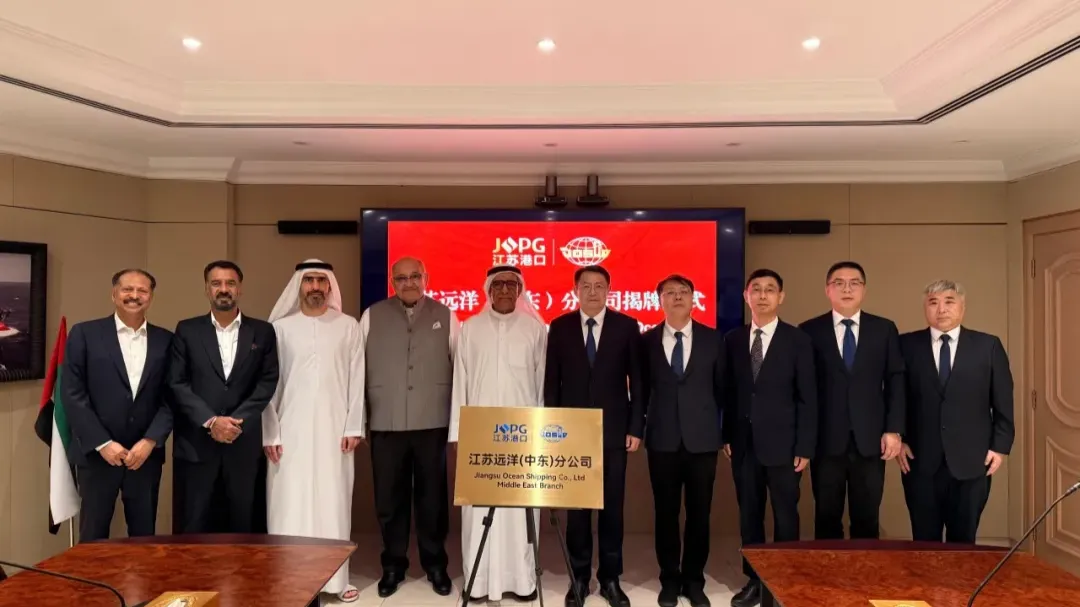
Global Ambitions, Provincial Roots: China’s State-Owned JOSCO Expands Overseas
 Containers