


Will Newbuilding Prices Still Be This High a Year From Now?
Xinde Marine News | Singapore

Newbuilding prices are approaching levels last seen at the peak of the previous shipbuilding cycle. Yet shipowners continue to place orders, while delivery slots at major Asian yards are stretching into 2029 and even 2030.
So, will newbuilding prices still be this high a year from now?
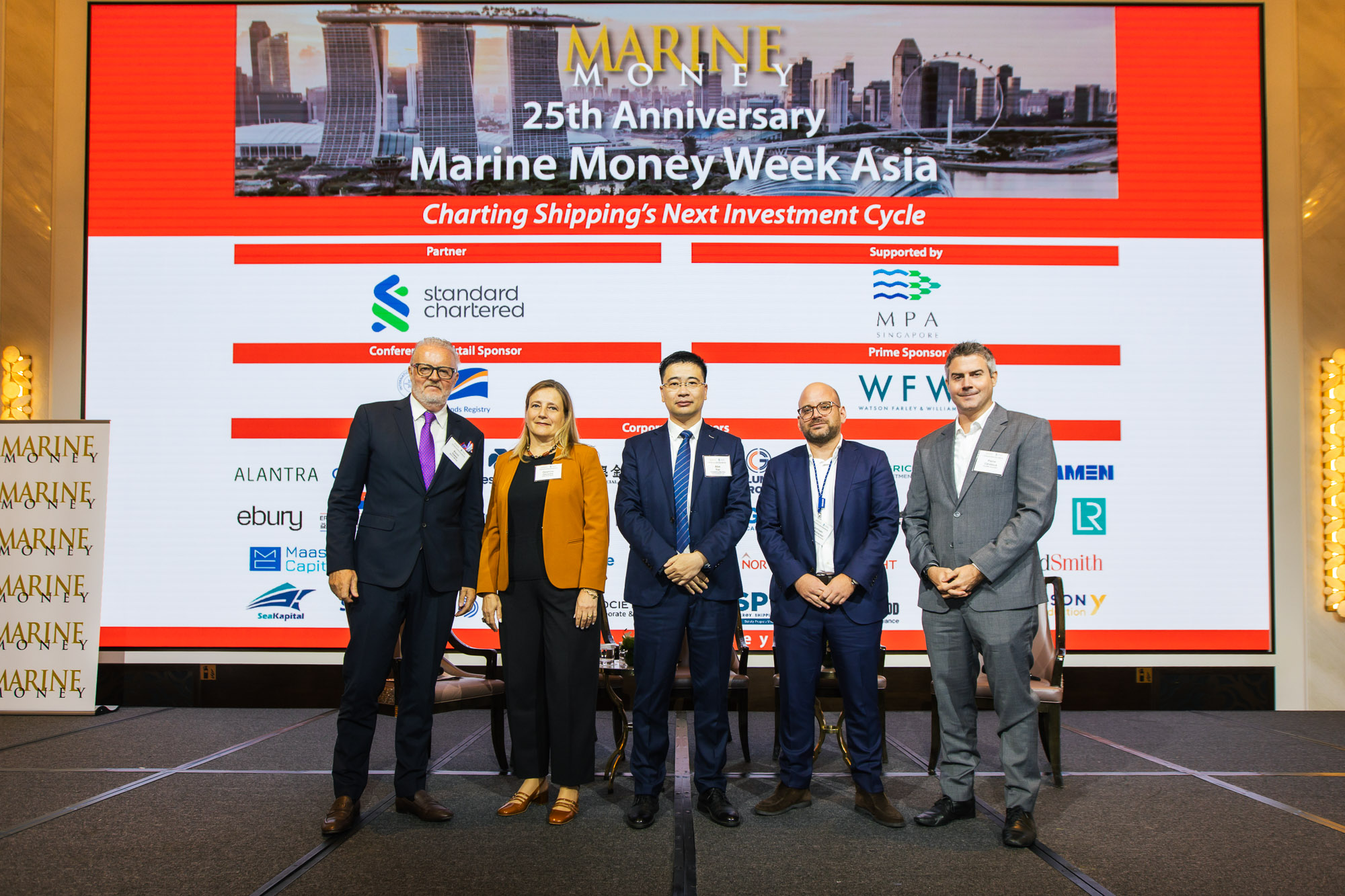
That question was at the heart of the panel “Are Sky High Newbuild Prices The New Norm?” at Marine Money Week Asia 2026 in Singapore.
Moderated by Kevin Oates of Marine Money, the discussion brought together Pierre Carassus, Head of Maritime Industries APAC at Société Générale; Alex Yan, Vice Chairman of Yangzijiang Maritime Development; Jurriaan Koekebacker, Financial Director at Damen Maritime Solutions; and Delphine Deroche of KfW IPEX-Bank.
Prices are close to the previous peak
Opening the session, Oates noted that newbuilding prices are at their highest levels in around 16 years. The newbuilding price index discussed during the panel stood at around 184, close to the previous peak of 186 at the end of 2007.
At the same time, yard capacity remains tight. Owners approaching major Far Eastern yards today are increasingly looking at delivery positions in 2029 or even 2030.
China has become central to this investment cycle, accounting for around 75% of orders according to figures cited during the session, while South Korean yards remain focused on higher-value vessel segments.
One panellist suggested that newbuilding prices could see a correction of around 10%–20% over the coming years, but also argued that prices were unlikely to return to the lows seen in the previous cycle.
Why are owners still ordering?
Part of the answer is timing.
With delivery slots extending towards the end of the decade, an order placed today is effectively a decision about the fleet an owner expects to need several years from now.
Replacement demand is another factor. The panel noted that a significant number of older vessels remain in service and will eventually need to be replaced, while evolving environmental requirements are adding further pressure to fleet renewal.
The financial position of shipowners also differs from the previous cycle. The discussion noted that many owners are more cash-rich today following several years of strong shipping markets, giving them greater capacity to invest despite high asset prices.
Alex Yan, Vice Chairman of Yangzijiang Maritime Development, drew on his experience across several shipping and shipbuilding cycles. He highlighted rising costs and labour constraints across the major Northeast Asian shipbuilding nations as important factors affecting the market.
The panel also pointed to greater discipline across the industry compared with the period around 2008. Higher labour and financing costs, together with lessons learned from previous cycles, are influencing investment and capacity decisions.
High prices create a financing challenge
For lenders, high newbuilding prices raise another question: if a vessel is financed close to the top of the historical price cycle, what will that asset be worth five or seven years later?
This became an important part of the discussion.
The financial institutions represented on the panel stressed the need to make assumptions about future vessel values, manage exposure and continue reviewing those assumptions over the long life of a shipping asset.
Interest rates add another layer to the equation.
Jurriaan Koekebacker, Financial Director at Damen Maritime Solutions, discussed the impact of high interest rates, while noting that customers are generally in a relatively strong financial position after the good markets of recent years. He also referred to lower financing margins as one factor helping customers manage the overall financing environment.
The issue therefore extends beyond whether a ship looks expensive today. Owners, investors and lenders also have to consider how the vessel will perform financially through future shipping cycles and how its asset value may develop over time.
Will prices be lower a year from now?
At the end of the session, Oates reduced the debate to a simple question:
When the panel returns a year from now, will newbuilding prices be higher or same?
The panellists did not give exactly the same answer.
Some expected prices to be higher. Others expected them to remain around current levels. But no one expected them to be lower.
That was a notable conclusion given where the market stands today. Newbuilding prices are already close to the highs seen during the previous shipbuilding boom. Traditionally, prices at such levels would naturally raise questions about when the cycle might turn.
The panel did not suggest that ship prices can only move in one direction. Over a longer period, prices could still correct, and buying vessels at historically high levels creates clear asset-value and financing risks.
But when asked specifically about the next 12 months, the direction of the discussion was strikingly consistent: higher, or around where they are today — but not lower.


READ MORE
 Shipbuilding
Henghui Reportedly Orders Up to Four Heavy-Lift Ships at ZPMC
 Shipbuilding
24 Firm Orders + 16 Options: Ren Yuanlin Accelerates Yangzijiang Maritime’s ‘Financial Shipowner’ Strategy
 Shipbuilding
Hengli Heavy Industries moves five newbuildings from world’s largest dock in latest production milestone
 Shipbuilding
Guohang Enters Tankers with RMB 2.49bn Fleet Plan
 Shipbuilding
$3.1 Trillion in Revenue, $824 Billion in New Ships: Is Shipping Buying the Wrong Tonnage?
 Shipbuilding
Maersk’s $5bn Newbuilding Push Signals a Shift Back Toward Fleet Growth
 Shipbuilding
185 Ships and Counting: How Union Maritime Is Building Its Next Fleet in China
 Shipbuilding
Ren Yuanlin: Shipbuilding Still Has 8–10 Years of Strong Growth Ahead
 Shipbuilding
CULines Steps Up Fleet Expansion with First 14,000 TEU Newbuildings
 Shipbuilding