


$3.1 Trillion in Revenue, $824 Billion in New Ships: Is Shipping Buying the Wrong Tonnage?
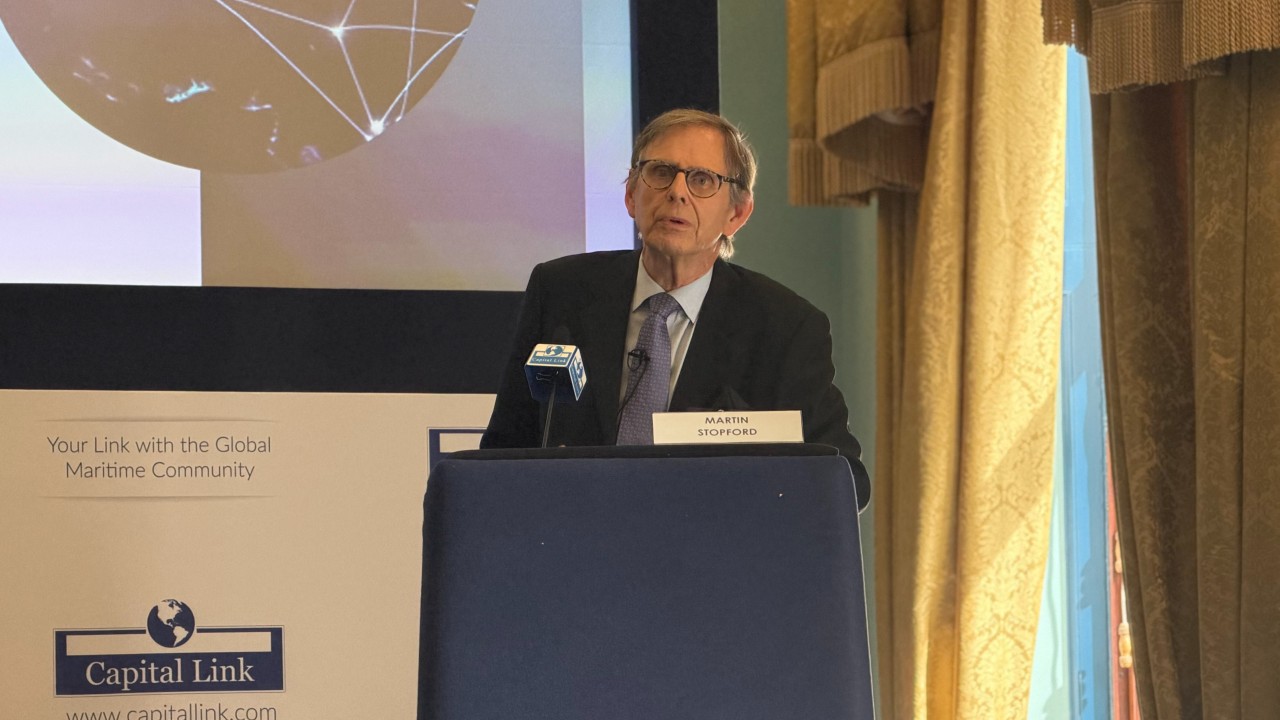

The latest newbuilding boom has arrived roughly eight years ahead of Martin Stopford’s 2023 scenario. Beyond the risk of excess capacity, the more fundamental question is whether ships ordered today will still be commercially and technologically fit for the 2030s, 2040s and 2050s.
At the 18th Annual Capital Link Shipping & Marine Services Forum in London on 15 September, renowned shipping economist Martin Stopford delivered a presentation entitled Heading into a New Era. It lasted little more than 20 minutes, but the question at its centre could shape the global fleet for the next two or three decades: after an extraordinary earnings cycle left shipowners with abundant cash and triggered a surge in contracting, what exactly is the industry buying—and will those ships be suitable for the next era of shipping?

The figures Stopford presented were striking. On the basis used in his presentation, the world merchant fleet generated approximately $3.1 trillion in gross revenue between 2021 and 2026, well above the level recorded in earlier cycles. This was revenue, not net profit, but it still illustrates the extraordinary volume of cash that passed through the industry. Over the same period, owners placed newbuilding orders worth about $824 billion, equivalent to roughly 26% of that revenue. By July 2026, annualised contracting had reached approximately 275 million deadweight tonnes, almost level with the 274 million dwt ordered at the 2008 peak. The global orderbook now stands at around 550 million dwt, again approaching the scale seen during the previous shipping supercycle.
Cash is being converted into steel at remarkable speed. Stopford’s concern is that this investment wave has arrived around eight years earlier than the fleet-development scenario he produced in 2023. Owners may therefore be committing capital to assets with operating lives of 25 to 30 years before future fuels, digital technologies, regulation and cargo flows have fully taken shape.
The last shipping “new era” put cargo owners at the centre
Stopford began by looking back to the 1950s and 1960s, a period he described as the last genuine “new era” in shipping. In the early 1950s, cargo handling remained heavily dependent on manual labour. A conventional general cargo ship could spend weeks, and sometimes months, in port. Vessel size was constrained by port infrastructure, congestion was severe and cargo-handling costs were rising. Oil majors, steelmakers, car manufacturers and other large cargo interests urgently needed a more efficient transport system, and many became directly involved in vessel design, technology selection and investment.

Long-term time charters were a crucial financial mechanism behind that transformation. Stopford showed a historic photograph of Sir Yue-Kong Pao signing a long-term charter in 1959. A shipowner could use a long contract from a cargo owner to secure bank finance and then build a vessel around the customer’s transport requirements. Cargo, capital and technology were connected within a single commercial framework.
That model helped bring product and chemical tankers, roll-on/roll-off vessels, containerships and very large crude carriers into mainstream commercial service. Stolt-Nielsen brought deepwell-pump expertise into the shipbuilding process and helped advance specialised chemical transportation. Wallenius used purpose-designed ro-ro ships to transform the seaborne movement of vehicles. Malcolm McLean’s container concept reshaped ships, ports and inland logistics. In each case, technical innovation was tied to an identifiable cargo requirement, a long-term contract and a financeable business model.
The tanker market illustrates how closely cargo interests once controlled shipping capacity. Before the 1973 oil crisis, oil companies directly owned about 36% of tanker tonnage and controlled another 52% through time charters, leaving only around 12% exposed to the spot market. Cargo owners therefore had substantial influence over vessel specifications, operating models and technology choices. Demand came first: the customer had a relatively clear view of the future supply chain, and owners and shipyards designed assets around a defined transport task.

After the oil shocks, the shipping cycle took over capital allocation
The oil shocks of 1973 and 1979 changed that structure. Higher oil prices disrupted trade, oil companies reduced their exposure to owned and long-term chartered tonnage, and a much larger share of the tanker fleet moved into the spot market. According to the figures shown by Stopford, the spot-market share subsequently rose to around 47%.

At the same time, commodity traders assumed a larger role in energy markets, while investment leadership gradually shifted from cargo owners to independent shipowners. Open-registry fleets expanded rapidly, giving owners greater freedom over flags, crewing, finance and operations. Newbuildings were less often developed jointly around a cargo owner’s long-term requirements and increasingly ordered with cash generated by the market cycle.
This capital-allocation mechanism has dominated shipping for roughly half a century. High freight rates generate cash and encourage owners to order ships; those vessels are delivered several years later, increasing supply and putting freight markets under pressure; weak markets then suppress investment until the next upswing begins. When ship technology changes incrementally, this system can function reasonably well. Owners can order a slightly larger and more efficient version of an established design without having to redefine the transport system around it.
The danger becomes visible when too much capital follows the same signal. Shipping endured a deep downturn in the 1980s, when daily earnings in some sectors fell to around $5,000, followed by a largely subdued 1990s. China’s demand growth then powered the shipping supercycle of the 2000s. Stopford’s figures showed that annual merchant-fleet revenue, which had remained around $150 billion for many years before 2004, eventually climbed to approximately $524 billion. Between 2004 and 2008, the industry generated about $2.2 trillion in revenue and committed roughly $774 billion—around 35% of that total—to newbuilding orders.
The resulting delivery wave contributed to the oversupply and prolonged market weakness of the 2010s. That experience underpins Stopford’s first major question: could today’s 550 million dwt orderbook push shipping into another extended period of excess capacity?
The investment wave has arrived eight years early
The cyclical threat, however, was only one part of Stopford’s argument. His deeper concern was the timing of the current investment wave.
In a fleet-renewal scenario developed in 2023, he had expected newbuilding investment to accelerate substantially during the 2030s. By then, a large volume of ageing tonnage would need replacement, low- and zero-carbon fuel technologies should be more mature, digital systems should be more stable, and owners should have greater visibility over the vessels their customers would require.

Instead, the investment surge arrived far sooner. The strong post-pandemic markets generated large cash balances, while contracting increased across containerships, LNG carriers, tankers, bulk carriers and several specialised sectors. In Stopford’s assessment, the process is running about eight years ahead of the scenario he had envisaged in 2023.
Eight years is a significant gap when the asset being ordered may trade for more than a quarter of a century. Methanol, LNG, ammonia, hydrogen and biofuels remain at different stages of technological and commercial development. Their supply availability, lifecycle emissions, engine reliability and bunkering infrastructure vary widely. IMO decarbonisation rules and regional regulation continue to evolve, while artificial intelligence, automation and ship-shore data architecture remain far from standardised.
When owners order at scale before these pathways converge, they lock in fuel systems, machinery configurations and digital platforms. A dual-fuel engine and an extensive equipment list do not automatically make a vessel ready for the next 30 years. A ship that appears technologically advanced at delivery could enter the 2030s facing high fuel costs, inadequate infrastructure, difficult conversions or declining commercial relevance.
For long-term asset value, optionality may prove more important than the number of systems installed at delivery. Fuel-ready notations, open digital architecture, equipment compatibility and practical space for future conversion can determine whether a vessel remains competitive as regulation and cargo demand evolve. Stopford’s second question therefore goes beyond the volume of the orderbook: are the hundreds of billions of dollars now being committed actually producing ships fit for the next three decades?
“What the shipyard can offer” cannot be the only answer
The investment habits developed over the past 50 years are now colliding with a much broader technological transition. A conventional owner earns cash at the top of the market, secures an available berth and selects a mature design that a shipyard can deliver with manageable technical and scheduling risk. That approach worked during a period of incremental improvement, but it cannot by itself coordinate the simultaneous transformation of fuel supply, vessel technology, digital infrastructure and global logistics.
Every participant has legitimate commercial constraints. Shipyards prefer standardised designs that can be built efficiently and delivered with predictable risk. Engine makers need sufficient commercial scale before committing to a technology. Fuel suppliers must justify infrastructure investment. Banks and leasing companies focus on repayment security and residual value. Owners want to control construction cost, delivery timing and asset risk. Yet without a clear cargo requirement and long-term contractual framework, the industry may choose vessels around the technologies already available rather than design them around the transport tasks that will exist in 10, 20 or 30 years.
This is why Stopford repeatedly returned to the question: where are the cargo owners? In the 1960s, cargo interests used long-term charters, operational requirements and joint vessel development to drive containerisation, ro-ro shipping and specialised liquid-bulk transport. The green transition also requires their participation because the cost of alternative fuels, the green premium, route deployment and the value of emissions reductions cannot realistically be carried by shipowners alone.
Greater cargo-owner involvement in long-term contracts, green corridors and joint vessel-development projects could bring freight demand, fuel supply, financing tenor and ship technology into the same commercial structure. Without that coordination, shipowners may have enough money to invest but still lack a reliable answer to the most basic question: what asset should they buy?
Shipping must invest in people and industrial capability—not only ships
Stopford also widened the discussion beyond the physical fleet. The industry has committed more than $800 billion to new ships during the current cycle, but it is far less clear whether investment in digital infrastructure, data governance and human capability has kept pace.
Artificial intelligence does not create value simply because software has been installed. Shipping companies need people who understand vessels, chartering, trade flows, weather, energy efficiency and risk management, and who can embed new tools into real operating decisions. They need reliable data interfaces connecting ships, shore teams, cargo owners, ports and financial institutions. They also need suppliers and engineering teams capable of integrating multiple systems rather than adding another isolated platform to the bridge or the operations desk.
These investments are less visible than a newbuilding and do not immediately add carrying capacity, but they will determine whether the future fleet can be operated efficiently. Without the necessary skills, data standards and industrial support, advanced onboard equipment may remain fragmented and fail to become a genuine commercial capability. The “new era” described by Stopford will be built from ships, fuels, data, people and relationships with cargo owners. New tonnage is only its most capital-intensive and visible component.
For Chinese shipbuilding, the contest is shifting from winning orders to defining the next generation of ships
The rapid expansion of the global orderbook has created an enormous market for Chinese shipbuilders, while also raising the level of the challenge. Delivery capacity, cost control and supply-chain depth remain fundamental competitive strengths. Over time, however, a vessel’s long-term value will increasingly depend on joint development in green propulsion, digital systems, lifecycle efficiency and future conversion capability.
Chinese yards will be asked to do more than execute an owner’s specification. They will need to help customers manage technological uncertainty by preserving conversion pathways between possible fuel solutions, improving the openness of equipment and software systems, feeding operational data back into future designs, and working with cargo owners, shipowners, engine makers and financial institutions to define the vessel’s commercial use case.
Order volumes show who holds market share today. The ability to help define the vessels of the 2030s and 2040s will determine the industry’s longer-term position. Competition for high-value ships is therefore likely to centre increasingly on optionality: whether a vessel can adapt to different fuels, regulatory regimes and cargo patterns, and whether it can extend its commercially useful life without prohibitively expensive conversion.
Cash is abundant; judgement remains scarce
Stopford did not attempt to identify a single winning fuel, nor did he argue that owners should stop ordering ships. Instead, he left the industry with two questions that should sit at the centre of every newbuilding decision: will the current orderbook create the next prolonged period of oversupply, and are the ships being ordered today genuinely suitable for the next generation of shipping?
The market has once again provided shipowners with exceptional financial capacity. Shipyards are filling rapidly, and the industry has the capital needed to renew the fleet. Yet this cycle is more complicated than the boom of the 2000s because decarbonisation, digitalisation, geopolitical fragmentation and the restructuring of supply chains are all changing at the same time. More money has not made the investment decision easier.
Once a newbuilding contract is signed, the fuel pathway, equipment architecture and capital cost are locked in for years. By arriving eight years early, the ordering boom has forced the industry to make today many of the choices it once expected to make gradually during the 2030s.
Shipping already has much of the money required to enter a new era. The question now is whether that money is buying ships that truly belong in it.


READ MORE
 Shipbuilding
185 Ships and Counting: How Union Maritime Is Building Its Next Fleet in China
 Shipbuilding
Ren Yuanlin: Shipbuilding Still Has 8–10 Years of Strong Growth Ahead
 Shipbuilding
CULines Steps Up Fleet Expansion with First 14,000 TEU Newbuildings
 Shipbuilding
Maersk’s $5bn Newbuilding Push Signals a Shift Back Toward Fleet Growth
 Shipbuilding
CMA CGM linked to $3bn Yangzijiang megamax programme
 Shipbuilding
Advantage Tankers adds MR2 quartet as product tanker orderbook builds
 Shipbuilding
Seven Months, $78 Million: George Procopiou Reaps Windfall on Hengli-Built VLCC
 Shipbuilding
12 24,000TEU Ultra-large Container Ships Awarded to Yangzijiang Shipbuilding; Private Chinese Shipbuilder Lands US$3 Billion Mega Deal
 Shipbuilding
Wealth Holdings builds three-tier MPP fleet with up to 18 China newbuilds
 Shipbuilding