


24 Firm Orders + 16 Options: Ren Yuanlin Accelerates Yangzijiang Maritime’s ‘Financial Shipowner’ Strategy
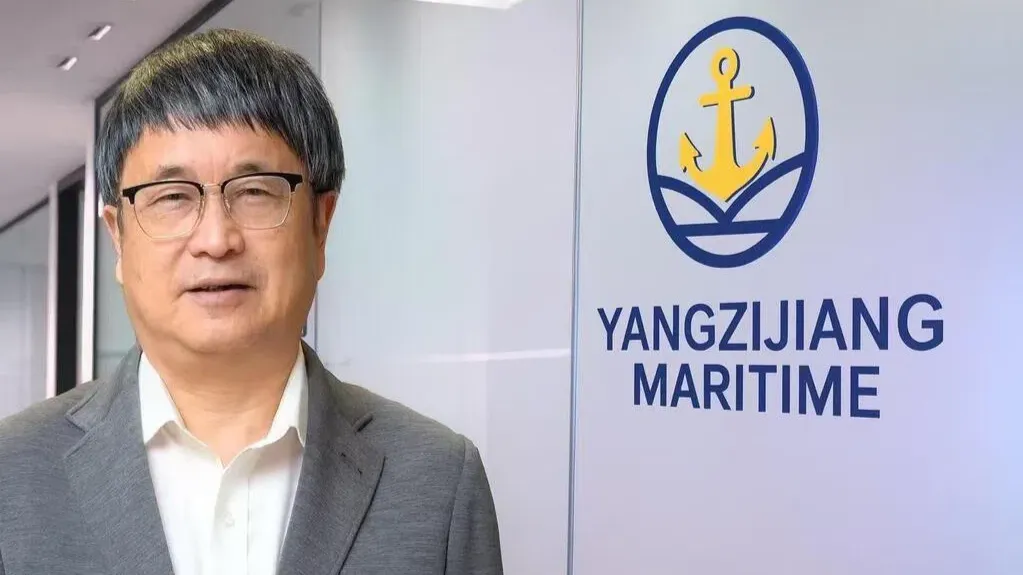
With 24 firm newbuildings and another 16 options added in one move, Yangzijiang Maritime’s newbuilding portfolio has reached 98 vessels. Behind the headline number is a broader strategy under Ren Yuanlin: combining China’s shipbuilding capacity, maritime asset investment and capital recycling into a business model that looks very different from that of a conventional shipowner.
Yangzijiang Maritime Development Ltd., led by Chinese shipbuilding veteran Ren Yuanlin, has once again made a major move in the newbuilding market.
On 18 September, the company announced that it had recently signed contracts for 24 new vessels, all to be built at Chinese shipyards and scheduled for delivery between 2028 and 2030. At the same time, Yangzijiang Maritime secured options for another 16 vessels.
Following the latest agreements, the company’s newbuilding portfolio — including delivered vessels, firm newbuildings under construction and optional vessels — has expanded to 98 ships, putting it just short of the 100-vessel mark.
The composition of the 24 firm orders is equally notable. They comprise six 64,500-dwt bulk carriers, six 49,800-dwt product/chemical tankers, four 28,000-dwt stainless-steel chemical tankers, four 29,000-dwt stainless-steel chemical tankers, and four 319,000-dwt VLCCs.
In other words, 18 of the 24 firm vessels, or 75%, are exposed directly to crude oil, refined products and chemical trades. The remaining six vessels are mainstream midsize bulk carriers.
The portfolio mix sends a clear signal. Yangzijiang Maritime is continuing to increase its exposure to tanker and chemical-shipping assets while retaining dry bulk as a source of diversification.
The four 319,000-dwt VLCCs are particularly significant. Earlier this year, Yangzijiang Maritime had already announced an investment in eight VLCCs of the same size. With the latest four vessels, its disclosed VLCC investment programme for 2026 has expanded to 12 ships.
That is no longer the profile of a conventional shipping company simply adding tonnage to meet operational requirements.
It is increasingly consistent with the model Ren Yuanlin himself has described as a “financial shipowner.”
From 50 newbuildings to 98 in eight months
Yangzijiang Maritime’s expansion in 2026 has been rapid.
On 14 January, the company announced investments in up to 16 vessels at three Chinese shipyards, comprising six firm orders and 10 options. The vessels included approximately 40,000-dwt bulk carriers, 49,800-dwt MR product tankers and 114,000-dwt LR2 tankers.
Following those commitments, its newbuilding portfolio stood at 50 vessels, including two already delivered, 34 firm newbuildings and 14 options.
The pace accelerated further in April.
On 16 April, Yangzijiang Maritime confirmed an investment in eight 319,000-dwt VLCCs while simultaneously selling four 49,800-dwt MR tankers scheduled for delivery in 2027 and 2028.
Then, on 27 April, the company announced another 10 firm newbuildings: four approximately 114,000-dwt product/crude tankers, four 49,800-dwt product/chemical tankers and two approximately 40,000-dwt bulk carriers. All were contracted at independent third-party Chinese shipyards for delivery between 2027 and 2029.
By the end of April, Yangzijiang Maritime said its broader maritime asset portfolio had reached 105 vessels, including 53 newbuildings under construction.
By 30 June, the company reported that its total maritime asset portfolio had exceeded 120 vessels, including more than 60 newbuilding projects.
The latest September contracts now take the newbuilding portfolio itself to 98 vessels: seven already delivered, 75 firm newbuildings and 16 optional vessels.
That distinction matters.
The figure of 98 does not mean Yangzijiang Maritime intends to retain and operate all 98 ships over the long term. Of the 75 firm newbuildings, 12 have already been committed for resale.
Understanding that point is essential to understanding how Ren Yuanlin has been able to scale the portfolio so quickly.
Ordering aggressively — while selling aggressively
The model of a traditional shipowner is relatively straightforward: assess the supply-demand outlook for a shipping segment, acquire or order ships, and generate returns through spot-market employment, time charters or proprietary cargo operations.
Yangzijiang Maritime adds another layer: active asset trading.
From the moment a newbuilding contract is signed, the vessel can be treated simultaneously as an operating asset and as an investment asset.
If market conditions favour long-term employment, the ship can be chartered out to generate recurring cash flow. If vessel values rise sufficiently, it can be sold before or after delivery to crystallise capital gains. In some projects, Yangzijiang Maritime can also invest alongside international shipowners or financial partners, combining equity co-investment with debt financing in order to reduce the amount of capital tied up in each individual asset.
On 14 April, the company signed charter agreements covering 13 vessels, including 12 tankers, chemical tankers and product tankers, together with one anchor-handling tug supply vessel. The charter periods range from one to eight years, with a total contract value of approximately US$89.8 million.
At the same time, Yangzijiang Maritime has been monetising assets through vessel sales.
On 6 August, the company announced the sale of four approximately 40,000-dwt newbuilding bulk carriers. Including earlier transactions, Yangzijiang Maritime had by then signed sale agreements for 12 newbuildings since November 2025, with an aggregate transaction value of about US$500 million.
The first of four 49,800-dwt MR tankers sold under an earlier US$180 million transaction was delivered in July this year.
Ren Yuanlin summarised the model in four words in an official announcement:
“originate, invest, monetise and recycle.”
In practical terms, Yangzijiang Maritime seeks to originate attractive maritime projects, invest in them, monetise the resulting assets when market conditions are favourable, and then recycle the capital into the next round of opportunities.
This is why the latest 24 firm vessels and 16 options should not simply be interpreted as another 40 ships that Yangzijiang Maritime plans to operate itself.
A vessel entering the portfolio may eventually become a long-term chartering asset, a jointly owned investment or a resale candidate even before delivery. The company continuously evaluates charter yields, vessel values, financing costs and exit returns before deciding how each asset should ultimately be deployed.
The 16 options also serve a strategic purpose. They allow the company to secure designs, potential yard capacity and future investment opportunities without committing the full amount of capital immediately. If vessel values and freight-market conditions remain attractive, the options can be exercised. If conditions deteriorate, capital expenditure can be moderated.
Capturing the spread between Chinese shipyards and global capital
Another important element of Yangzijiang Maritime’s strategy is that it does not restrict its newbuilding programme to Yangzijiang Shipbuilding itself.
The latest announcement only said the 24 vessels would be built by “various Chinese shipyards.” Previous Yangzijiang Maritime projects have been distributed across a number of independent Chinese private yards, including emerging or recently upgraded builders.
This is central to the company’s model.
In company materials released earlier this year, Yangzijiang Maritime explained that by developing strategic relationships with second- and third-tier Chinese shipyards, and by providing support in areas such as major-equipment procurement, technical management and quality control, it can in some cases secure newbuildings at costs up to around 20% below mainstream first-tier market quotations.
Once acquired at an attractive entry price, those vessels can either be resold after reaching a target investment return or chartered out to generate recurring income. Appropriate use of leverage can further enhance capital returns.
That structure combines shipyard development, asset investment and capital recycling in a way that reflects Ren Yuanlin’s own background.
Ren has spent nearly five decades in shipbuilding. His competitive advantage is therefore not limited to ownership of a major shipbuilding group. It includes his understanding of ship types, construction costs, yard capabilities, equipment supply, quality control, vessel-price cycles and international shipowner demand.
For a Chinese shipyard attempting to move from block fabrication into full-vessel construction, or from lower-value ships into more sophisticated vessel types, Yangzijiang Maritime can bring orders, capital, technical expertise, procurement support and project-management capability.
For Yangzijiang Maritime, those partnerships can create access to lower-cost shipbuilding capacity.
Qianyao Heavy Industry in Qidong provides one example. Ren Yuanlin has previously described how he saw the potential to upgrade a business focused on hull-block fabrication into a full-vessel builder. Through orders, capital and technical support, that capacity was gradually moved higher up the shipbuilding value chain.
The result is a broader network of Chinese yards from which Yangzijiang Maritime can source assets — and, in effect, turn part of China’s enormous shipbuilding capacity into an investment advantage.
At the company’s annual general meeting on 30 April, Ren described Yangzijiang Maritime’s strategy as combining China’s shipbuilding capabilities, international shipowner relationships and maritime financial services to build an independent and globally oriented maritime platform.
He also explicitly used the term “financial shipowner.”
That phrase captures the direction of the company more accurately than simple fleet size.
Why the emphasis on tankers and chemical carriers?
The fact that tanker and chemical vessels account for 75% of the latest 24 firm orders is not an isolated development.
Throughout 2026, Yangzijiang Maritime has expanded across MR tankers, LR2s, VLCCs and stainless-steel chemical carriers, giving the company exposure to crude oil, refined products and higher-value liquid chemical trades.
With the latest four VLCCs, its disclosed 319,000-dwt VLCC programme has expanded to 12 vessels this year alone.
This allocation is consistent with Ren Yuanlin’s broader view of the shipbuilding cycle.
At an industry event in Nantong on 4 September, Ren gave a notably bullish long-term assessment:
“The shipbuilding market should remain sound through 2035.”
In his view, the current shipbuilding upcycle could still have another eight to ten years to run. That assessment is not based simply on the current earnings of any single shipping sector, but on a combination of fleet renewal, energy transportation demand, environmental regulation, vessel upsizing and geopolitical disruption.
Fleet age is one of the structural factors.
Over the next 10 to 15 years, a large proportion of the global merchant fleet will enter replacement windows. Decarbonisation regulations are also likely to shorten the economic life of some older, less-efficient ships.
At the same time, the evolution of global energy trade is creating a more complex seaborne transportation system. LNG, LPG, ethane, ammonia, methanol and conventional petroleum products are all contributing to a wider range of cargo flows and vessel requirements.
Energy transition has not simplified maritime energy transportation. In many ways, it has made it more complex.
Geopolitics adds another dimension.
Disruption in the Red Sea, the Persian Gulf and other strategic waterways can increase sailing distances, vessel waiting times and operational restrictions, effectively reducing the amount of usable tonnage available to the market.
For global vessel classes such as VLCCs, LR2s and product tankers, the difference between nominal fleet capacity and effectively available capacity can become increasingly important.
That broader assessment helps explain why Yangzijiang Maritime is willing to continue allocating substantial capital to tanker assets.
From shipbuilding entrepreneur to “financial shipowner”
Ren Yuanlin stepped back from the daily management of Yangzijiang Shipbuilding in 2020, handing greater operational responsibility to the next generation, but he did not leave the maritime industry.
In 2022, Yangzijiang Financial Holding was listed in Singapore. In November 2025, maritime assets and related operations were separated into Yangzijiang Maritime, which subsequently listed on the Singapore Exchange.
The resulting structure is notable.
Yangzijiang Shipbuilding remains focused on ship construction. Yangzijiang Financial Holding provides a broader investment and asset-management platform. Yangzijiang Maritime, meanwhile, brings together the areas Ren knows best: shipbuilding, shipownership, chartering, maritime finance and capital markets.
Yangzijiang Maritime reported profit attributable to shareholders of US$129.7 million for 2025. Ren has attributed the company’s performance to its relatively asset-light model and its accumulated maritime investment capabilities.
The pace of transactions in 2026 suggests that this model is now being scaled more aggressively.
In January, the newbuilding portfolio reached 50 vessels. In April, Yangzijiang Maritime added VLCCs and another batch of tankers, chemical carriers and bulkers, while also securing charter coverage for 13 vessels. In July, it began delivering vessels that had already been sold. By August, 12 newbuilding resale contracts had generated approximately US$500 million in transaction value. In September, another 24 firm vessels and 16 options took the newbuilding portfolio to 98 ships.
The resulting system is one of rapid asset rotation: secure competitively priced newbuildings from Chinese yards, use co-investment and debt financing to control capital intensity, lock in charter income where appropriate, then decide whether to retain or sell the vessel according to asset values and market conditions. Capital released from disposals is then recycled into the next round of investments.
Whether this model can generate superior returns over multiple cycles will depend on far more than the ability to place orders.
Vessel selection, shipyard execution, financing costs, counterparty quality, timing of asset sales and investment discipline near the top of the market will all determine the durability of the strategy.
For now, Ren Yuanlin remains firmly on the constructive side of the cycle.
He believes global shipbuilding still has another eight to ten years of structural opportunity ahead, with Chinese yards continuing to expand their share of the market. Yangzijiang Maritime is translating that conviction into an asset strategy: secure the vessel, the yard slot and the option first, then decide over the following years whether the ship should be chartered, sold or jointly owned with international partners.
The number 98, therefore, is not the end point.
The more important question is what happens after Yangzijiang Maritime’s newbuilding portfolio crosses the 100-vessel threshold — and whether Ren Yuanlin can continue converting decades of accumulated Chinese shipbuilding capability into a globally scaled maritime investment and financial platform.
That may ultimately be the next chapter in the career of one of China’s best-known private shipbuilding entrepreneurs.

READ MORE
 Shipbuilding
$3.1 Trillion in Revenue, $824 Billion in New Ships: Is Shipping Buying the Wrong Tonnage?
 Shipbuilding
Maersk’s $5bn Newbuilding Push Signals a Shift Back Toward Fleet Growth
 Shipbuilding
185 Ships and Counting: How Union Maritime Is Building Its Next Fleet in China
 Shipbuilding
Hengli Heavy Industries moves five newbuildings from world’s largest dock in latest production milestone
 Shipbuilding
Ren Yuanlin: Shipbuilding Still Has 8–10 Years of Strong Growth Ahead
 Shipbuilding
CULines Steps Up Fleet Expansion with First 14,000 TEU Newbuildings
 Shipbuilding
CMA CGM linked to $3bn Yangzijiang megamax programme
 Shipbuilding
Advantage Tankers adds MR2 quartet as product tanker orderbook builds
 Shipbuilding
Seven Months, $78 Million: George Procopiou Reaps Windfall on Hengli-Built VLCC
 Shipbuilding