


CULines Steps Up Fleet Expansion with First 14,000 TEU Newbuildings
Chinese container carrier CULines is taking another significant step in its fleet expansion strategy, placing its first newbuilding order for containerships above 10,000 TEU.
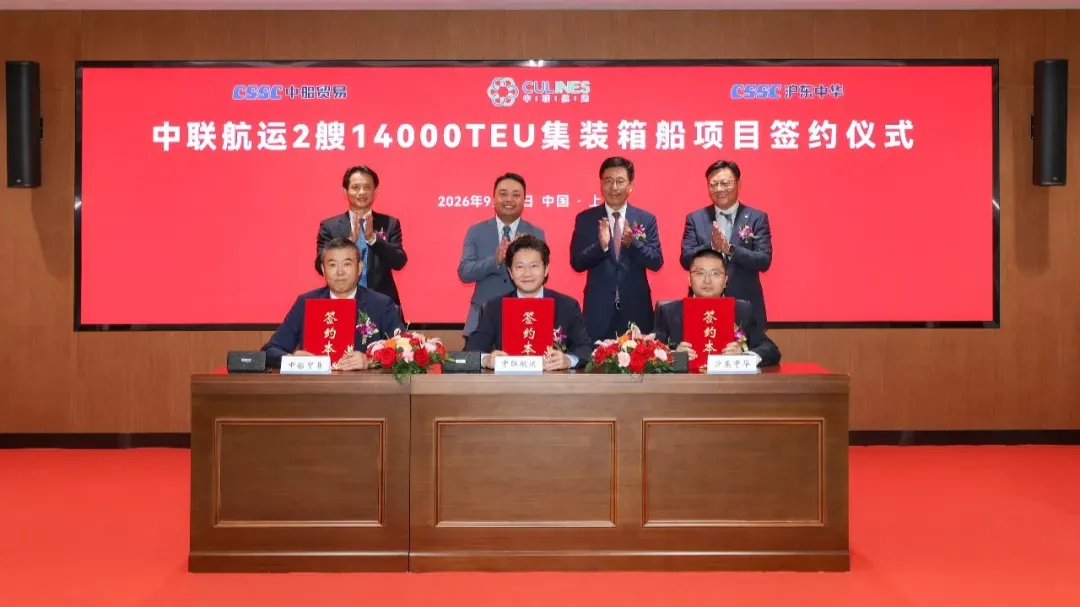
On September 16, Hudong-Zhonghua Shipbuilding and CULines signed contracts for two 14,000 TEU containerships, marking the first newbuilding cooperation between the two companies.
More importantly, the order represents a major milestone for CULines. While the carrier has already begun operating ships above 10,000 TEU through the charter market, the latest deal marks the first time it has committed to owning newly built vessels of this size.
The move also comes only months after CULines ordered four 6,400 TEU containerships, underlining an increasingly clear shift toward a larger, more structured and more diversified fleet.
From chartering 10,000 TEU tonnage to owning 14,000 TEU ships
CULines’ move into larger tonnage had already started before the latest order.
Earlier in 2026, the carrier chartered the 10,114 TEU EXPRESS BERLIN, together with the 6,758 TEU RACINE, from Greek shipowner Danaos as part of its expansion in the China–Middle East trade.
EXPRESS BERLIN was deployed on CULines’ CGX service, which connects Qingdao, Shanghai, Ningbo, Shekou and Nansha with Port Klang, Mundra, Karachi, Sohar and Khor Fakkan.
The deployment was significant because it represented CULines’ return to operating vessels above 10,000 TEU after several years of strategic adjustment.
The latest order for two 14,000 TEU newbuildings therefore takes that strategy one step further.
CULines is no longer relying solely on the charter market to gain access to larger ships. It is now locking in large-capacity owned tonnage for the longer term.
That distinction matters.
Chartering large vessels allows a carrier to respond quickly to market opportunities, while ordering newbuildings reflects a much longer-term commitment to particular trades, network structures and cargo volumes.
The two 14,000 TEU vessels suggest that CULines now sees sufficient long-term demand in its developing network to justify that commitment.
A renewed push toward larger ships
The latest order is also part of a broader fleet-building programme.
In April 2026, CULines ordered four 6,400 TEU containerships from Huangpu Wenchong Shipbuilding. At the time, Xinde Marine News noted that the carrier was once again moving toward larger vessels after several years of a more cautious fleet strategy.
CULines had previously attempted a similar move during the extraordinary container shipping boom of 2021 and 2022.
In February 2022, the company ordered two 7,000 TEU containerships from Shanghai Waigaoqiao Shipbuilding, describing the ships at the time as part of its longer-term plan for medium- and long-haul services.
Those vessels were later sold to Wan Hai Lines as market conditions changed and CULines adjusted its international network.
The current expansion, however, is taking place under a very different market and strategic environment.
Rather than rapidly expanding into virtually all major long-haul trades, CULines has spent the past several years strengthening a more focused network centred on Asia, India, the Middle East, the Red Sea, East Africa, the Mediterranean and North Africa.
The 6,400 TEU and 14,000 TEU orders therefore appear less like speculative fleet expansion and more like an attempt to align ship sizes with a more mature route network.
From global expansion to a more focused network strategy
CULines was founded in 2005 and originally developed around intra-Asia services.
During the container shipping boom, the company expanded rapidly.
In 2021, it entered the trans-Pacific market and launched direct services between China and the US West Coast. It also entered the Asia-Europe trade and expanded into the Middle East.
At one stage, CULines was among the fastest-growing container carriers globally.
But the market changed sharply from the second half of 2022.
As freight rates normalised and larger alliance carriers regained their cost advantage on the main East-West routes, CULines scaled back some of its long-haul operations, including direct Europe services.
The company subsequently placed greater emphasis on markets where a mid-sized independent carrier could compete more effectively.
India became one of those core markets.
CULines has operated in the Indian market for around a decade and has gradually built a network linking China, Taiwan, Southeast Asia, India and the Middle East.
The company established an Indian subsidiary in 2025, strengthening its local commercial and operational presence.
Shortly afterwards, it also established its West Asia company in Dubai.
CULines said at the time that the Dubai operation would be responsible for regional route planning, operations, management, cooperation with partners and strategic investment.
That was a significant development.
It suggested that the company was moving away from managing individual services independently and toward building a regional network platform capable of coordinating trunk routes and feeder services.
Middle East, Red Sea and Mediterranean become increasingly important
CULines’ recent service developments show how that strategy is taking shape.
Its CGX China–Middle East service is now complemented by other services covering the Middle East, the Red Sea and the Mediterranean.
Through the combination of CGX, CGS, REX, AEM and other regional services, the carrier has been building connections between China and South Asia, the Gulf, the Red Sea, the Eastern Mediterranean and North Africa.
At the same time, its intra-Asia network provides cargo connectivity from Taiwan, Southeast Asia and other regional markets into those longer-haul services.
This creates a network structure in which smaller and medium-sized vessels collect cargo across Asia, while larger vessels operate the higher-volume trunk routes.
The addition of 14,000 TEU ships could significantly strengthen that model.
Ships of this size offer substantially lower unit costs than smaller vessels while remaining more flexible than the 20,000-plus TEU ultra-large containerships primarily deployed on the Asia-Europe trade.
That makes 14,000 TEU vessels particularly suitable for high-volume services linking Asia with the Middle East, India, the Mediterranean or other long-haul markets where 20,000-plus TEU ships may be commercially or operationally excessive.
A three-tier fleet structure is emerging
CULines’ latest fleet moves point toward an increasingly clear fleet architecture.
At the lower end, the company operates smaller vessels serving intra-Asia and feeder markets.
At the middle level, the newly ordered 6,400 TEU ships can support regional trunk routes and medium-haul services.
The 10,000 TEU chartered tonnage and the newly ordered 14,000 TEU vessels create a third layer capable of serving higher-volume long-haul routes.
In other words, CULines is gradually building a fleet ranging from regional feeder ships to medium-sized mainline vessels and now large mainline tonnage.
That structure is important because container shipping economics are heavily influenced by ship size.
A carrier operating only small and medium-sized vessels can retain considerable flexibility but may struggle to compete on unit costs once cargo volumes on a route become sufficiently large.
Introducing 14,000 TEU vessels gives CULines another option.
It can continue using smaller ships where flexibility is important while deploying larger tonnage on routes where sufficient cargo density exists to capture economies of scale.
Hudong-Zhonghua adds another major containership customer
For Hudong-Zhonghua, the deal also adds another Chinese liner company to its expanding containership customer portfolio.
The two new vessels will be designed by Hudong-Zhonghua.
Each ship will measure approximately 335 metres in length, 51 metres in beam and 30.2 metres in depth, with a design speed of 21 knots.
The vessels will use conventional propulsion rather than LNG or methanol dual-fuel systems.
Nevertheless, Hudong-Zhonghua said the design incorporates a series of energy-saving technologies, including a twisted rudder with bulb, energy-saving ducts, variable-frequency engine-room fans and seawater cooling pumps.
The yard has developed containership designs ranging from around 1,700 TEU to 24,000 TEU and has delivered more than 100 containerships to customers including CMA CGM, MSC and COSCO SHIPPING.
The CULines contract therefore adds another important domestic customer to its large containership orderbook.
More than just two ships
The significance of the latest order goes well beyond the addition of two vessels.
CULines has already experienced one period of rapid long-haul expansion and subsequent retrenchment.
Its current strategy appears more measured.
Rather than attempting to compete directly with the largest global carriers across every major East-West trade, the company has spent several years developing regional strength in Asia, India, the Middle East, the Red Sea and the Mediterranean.
Its latest fleet investments are now beginning to match that network.
The progression is notable.
CULines first returned to larger tonnage through the charter market, deploying a 10,114 TEU ship on its Middle East network.
It then ordered four 6,400 TEU newbuildings.
Now it has committed to two 14,000 TEU ships.
For CULines, the latest deal therefore represents more than simply another newbuilding order.
It signals that the carrier is moving from temporarily accessing large-ship capacity to building large-vessel ownership into its long-term fleet strategy.
And as its regional network becomes increasingly interconnected, the arrival of 14,000 TEU vessels could give CULines significantly greater capacity to compete on the medium- and long-haul trades that are becoming central to its next phase of development.

READ MORE
 Shipbuilding
CMA CGM linked to $3bn Yangzijiang megamax programme
 Shipbuilding
Advantage Tankers adds MR2 quartet as product tanker orderbook builds
 Shipbuilding
Seven Months, $78 Million: George Procopiou Reaps Windfall on Hengli-Built VLCC
 Shipbuilding
Ren Yuanlin: Shipbuilding Still Has 8–10 Years of Strong Growth Ahead
 Shipbuilding
12 24,000TEU Ultra-large Container Ships Awarded to Yangzijiang Shipbuilding; Private Chinese Shipbuilder Lands US$3 Billion Mega Deal
 Shipbuilding
Wealth Holdings builds three-tier MPP fleet with up to 18 China newbuilds
 Shipbuilding
Schoeller Returns to Chengxi for Four More MRs as China Gains Ground on Korea
 Shipbuilding
China‘s Dajin Builds Its Own Fleet as Shipbuilding Orderbook Reaches RMB 12 Billion
 Shipbuilding
H-Line Ends Five-Year Bulker Ordering Hiatus With POSCO-Linked LNG Pair at New Times
 Shipbuilding