


Schoeller Returns to Chengxi for Four More MRs as China Gains Ground on Korea

The Cyprus-based owner is set to double its 50,000-dwt MR fleet after taking delivery of four Chengxi-built vessels, with the repeat order highlighting both the replacement case for ageing product tankers and the growing depth of China’s MR shipbuilding base.
Schoeller Holdings has returned to CSSC Chengxi Shipyard for another four 50,000-dwt medium-range product tankers, effectively doubling down on the Chinese yard shortly after completing delivery of its first four-ship series.
The latest agreement covers four firm vessels and was signed in early September around the SMM maritime exhibition in Hamburg. Neither Schoeller nor Chengxi has disclosed the contract value, detailed technical specification or formal delivery schedule. Market estimates put the price at more than $45 million per ship, with deliveries expected in 2029-2030.
TradeWinds reported on September 7 that the Cyprus-based group was doubling its MR fleet with the four-ship return order.
Four ships alone would not make the deal exceptional in a global MR orderbook already running into hundreds of vessels. What makes it more significant is the timing: Schoeller has only just completed delivery of its previous four Chengxi-built MRs.
That makes the contract a useful case study in two broader developments: why established European owners are still committing capital to MR newbuildings despite a substantial orderbook, and how Chinese yards are building a larger position in a tanker segment where South Korean builders have long held a strong competitive advantage.
From first order to repeat customer
Schoeller’s existing 50,000-dwt series comprises Cape Bilbao, Cape Bonny, Cape Brasilia and Cape Bowen. The first was delivered in 2025 and the remaining three joined the fleet in 2026. Schoeller’s own fleet database lists all four among its current 50,000-dwt product tankers.
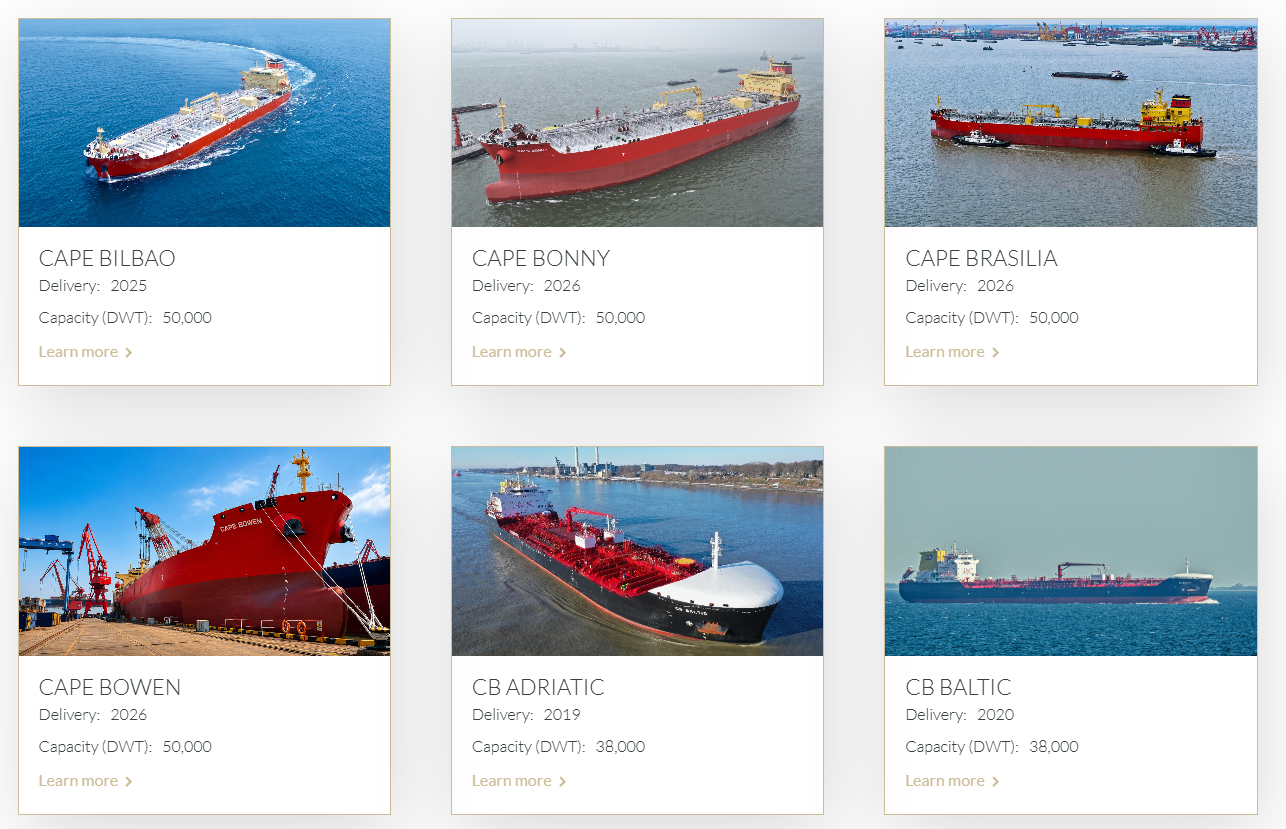
The final vessel, Cape Bowen, was delivered by Chengxi on June 30, completing the four-ship programme.
The series is based on Chengxi’s own MR product/chemical tanker design. Jiangsu Maritime Safety Administration said Cape Bonny measures 182.7 metres in length and 32.2 metres in beam, with cargo capacity of about 53,500 cubic metres.
More importantly for understanding the repeat order, Schoeller already had operating feedback from the earlier ships. Columbia Shipmanagement’s Compass magazine said in May that the first two units had been delivered and were “performing up to owner’s expectations”, while the remaining pair were approaching delivery.
That distinction matters.
A first order can be influenced heavily by price, financing, available berths or a shipowner’s willingness to test a new yard. A repeat order placed after vessels have been built, delivered and operated gives the owner considerably more information on fuel consumption, speed, cargo flexibility, equipment reliability, project execution and after-sales support.
There is no public evidence showing which of those factors was decisive in Schoeller’s latest decision. But the second four-ship contract moves Chengxi beyond simply winning a new international MR customer: it has now secured repeat business from an owner that has had the opportunity to assess the product in service.
A sizeable orderbook — but an ageing fleet
The order comes at a complicated point in the MR cycle.
Medium-range tankers, generally around 40,000-55,000 dwt, are the workhorses of the refined-products trade. They carry gasoline, diesel, jet fuel, naphtha and, depending on specification, a range of chemical cargoes, combining broad port access with considerable trading flexibility.
There is no obvious shortage of MR newbuildings.
Clarksons data cited by Hafnia show that as of March 1, 2026, the global MR fleet comprised 1,864 vessels totalling 90.4 million dwt, with an average age of 13.4 years. The MR orderbook stood at 260 vessels and 12.7 million dwt, equivalent to 14.1% of the existing fleet by deadweight.
That represents meaningful incoming supply.
But the age profile is moving in the opposite direction. Another set of Clarksons-based market data showed that by February 2026, 16.5% of the MR fleet was more than 20 years old, up from about 5% at the end of 2015. It also put the number of vessels aged 20 years or more at 323 — already higher than the MR orderbook measured in ships at that point.
Scrapping has so far provided little relief. MR recycling averaged only around 13 vessels per year between 2021 and 2025; just one MR was reportedly recycled in 2024, before the figure recovered to 14 in 2025. Strong freight markets and elevated secondhand values have helped older ships remain commercially viable for longer.
The result is an unusual supply picture: the orderbook is sizeable, but so is the pool of ageing tonnage that could eventually require replacement.
The crucial variable for the late 2020s will therefore not simply be how many of today’s 260 newbuildings are delivered. It will also be how much 15-, 20- and 25-year-old capacity remains commercially competitive once those vessels enter service.
Strong earnings support investment — but this is not a short-term freight-rate bet
Current product-tanker earnings have given owners the financial capacity to invest.
Ardmore Shipping, whose fleet includes a substantial number of modern MRs, earned an average spot MR TCE of $51,870 per day in the second quarter of 2026, more than double the $23,441 per day recorded a year earlier.
Yet by July 29, the company had fixed 45% of its third-quarter MR revenue days at an average of only $29,600 per day.
The contrast captures the current MR market well: earnings can be exceptionally strong, but they are also highly volatile.
Geopolitical disruption has amplified that volatility. Hafnia said in its second-quarter market review that disruption in the Persian Gulf and renewed pressure around the Red Sea had fragmented oil-product trading patterns, constrained volumes east of Suez and forced longer alternative routings, adding voyage distance and tonne-mile demand.
Schoeller’s ships, however, are not expected until around 2029-2030.
A three-to-four-year gap between contracting and delivery means the decision is difficult to interpret simply as a response to exceptionally strong 2026 earnings. By the time the vessels arrive, today’s geopolitical distortions and freight-rate environment could look very different.
The investment instead appears more exposed to longer-cycle assumptions: replacement of ageing tonnage, changes in refined-product trade patterns, and a widening efficiency gap between modern vessels and older ships as emissions regulation becomes more demanding.
Above $45 million does not necessarily mean a cheap ship
The reported price indication also needs context.
Market sources currently put the Schoeller vessels at more than $45 million each, but neither the owner nor the yard has published the contractual price. The wording matters: “above $45 million” is an indicative floor, not a confirmed $45 million transaction.
The Korea Ocean Business Corporation’s newbuilding index valued a standard 50,000-dwt MR at $49.86 million on September 3, slightly up from $49.81 million a week earlier.

A useful recent Korean comparison came from Hafnia. In April, the product-tanker major ordered eight MRs at HD Hyundai Heavy Industries for approximately $405 million, or roughly $50.6 million per vessel, with delivery scheduled from the third quarter of 2028 through the second quarter of 2029.
On the surface, that appears higher than the price level associated with Schoeller’s latest order.
But headline unit prices are not directly comparable.
MR newbuilding costs can vary materially according to engine choice, cargo-tank coating, class notation, shaft generators, scrubbers, shore-power arrangements, alternative-fuel readiness, spare-parts packages, payment schedules, exchange rates and delivery slots. Specification differences alone can move the contract value by several million dollars.
Schoeller’s original four-ship series, ordered in 2023, was widely valued at around $42 million per vessel. UPT said at the time that the ships would comply with IMO NOx Tier III and EEDI Phase 3 requirements and would be configured for flexibility across different cargo types.
The evidence therefore does not support describing the new deal as Chengxi winning business simply through aggressive pricing.
What it does show is that a Chinese yard can secure repeat business from an established international owner while global MR newbuilding values remain close to historically elevated levels.
Chengxi is becoming a series MR builder
The Schoeller order also fits into a broader shift in Chengxi’s product mix.
The yard, historically better known internationally for bulk carriers and ship repair, had already identified the 50,000-dwt MR as a strategic product several years ago.
In 2020, Chengxi signed a 50,000-dwt MR order with Japan’s Kumiai Navigation. China State Shipbuilding Corporation described the vessel at the time as a self-developed design that Chengxi intended to establish as one of its core shipbuilding products.
The industrial infrastructure around that strategy has since expanded.
In 2024, Chengxi and CSSC Power Group signed strategic procurement agreements worth more than CNY2 billion ($281 million) covering main engines, generators and environmental equipment for batches of 80,000-dwt bulkers and 50,000-dwt tankers. The equipment package included conventional SCR-equipped engines as well as a number of methanol dual-fuel units.
Capacity is also increasing. Jiangsu Maritime Safety Administration said in April that Chengxi had 103 newbuildings on order, with its delivery schedule extending into 2029. The yard delivered 11 newbuildings in 2025 and has been expanding output following the commissioning of a second shipbuilding production line.
That provides another perspective on Schoeller’s expected 2029-2030 delivery window.
In the current shipbuilding cycle, attractive construction slots are themselves becoming a scarce resource. Owners placing orders several years ahead are securing not only a vessel price but access to yards with proven designs and established serial-production capability.
Six Chinese yards are already among the global MR top 10
The broader competitive picture is even more revealing.
Clarksons data published in Hafnia’s 2025 annual report show that six of the ten largest MR builders by orderbook were Chinese as of March 1, 2026.

The six Chinese yards in that top 10 held a combined 95 MR orders, equivalent to about 36.5% of the entire 260-vessel global MR orderbook at the time. Chengxi ranked fifth globally with 13 ships.
That is a more useful indicator of the changing competitive landscape than a simple comparison of Chinese and Korean prices.
South Korea retains formidable advantages. HD Hyundai and K Shipbuilding have decades of tanker-building experience, highly standardised designs, established equipment supply chains, strong relationships with international owners and charterers, and extensive track records in efficient series construction.
But China’s competitive position is no longer dependent on one or two yards offering cheaper standard tonnage.
GSI, Chengxi, the Yangzijiang group, COSCO Shipping Heavy Industry and Penglai Jinglu are all building meaningful MR orderbooks. That creates a broader industrial base competing on design maturity, serial-production efficiency, delivery slots, specification flexibility and increasingly on operational track record.
Schoeller’s latest order illustrates that transition particularly clearly: the first four vessels have completed the construction cycle and entered service, and the next four remain with the same Chinese builder.
Schoeller’s China exposure extends well beyond tankers
The Chengxi relationship is also part of a much broader Schoeller newbuilding programme in China.
AAL Shipping, part of the Schoeller group, has been building its 32,000-dwt Super B-Class multipurpose heavy-lift series at CSSC Huangpu Wenchong Shipbuilding in Guangzhou.
The delivery of AAL Mumbai in May brought the series to eight ships. Two additional vessels, AAL Tianjin and AAL Miami, are due in 2028, taking the programme to ten.
Schoeller has also ordered four Construction Commissioning Service Operation Vessels, or C-CSOVs, at Huangpu Wenchong for its offshore-energy business. Its current fleet schedule shows deliveries running from the second quarter of 2027 through the first quarter of 2028.
The group’s Chinese newbuilding exposure therefore spans conventional product tankers, sophisticated multipurpose heavy-lift vessels and specialised offshore service ships.
For Schoeller, Chinese shipyards are no longer simply an alternative source of relatively low-cost standard ships. They have become part of several long-term fleet-renewal programmes across very different shipping segments.
Three details remain crucial
Three elements of the latest MR order have yet to be disclosed.
The first is the final contract price. The difference between an indicative “above $45 million” and the actual negotiated figure could be substantial, and will determine how meaningful any price gap with recent Korean contracts really is.
The second is the precise delivery window. Confirmation of 2029-2030 slots would reinforce the evidence that quality MR capacity at major Chinese yards is already extending deep into the next shipbuilding cycle.
The third is the technical specification.
The first Schoeller series met Tier III and EEDI Phase 3 requirements, while some vessels incorporated specialised cargo-tank coatings. But there is so far no public confirmation that the new series will replicate that specification or add features such as methanol readiness, shaft generators, enhanced propulsion packages or other energy-saving technologies.
That distinction will matter for ships expected to trade around 2030.
By then, owners operating into Europe will be managing the cumulative cost impact of the EU Emissions Trading System and FuelEU Maritime, alongside an evolving global greenhouse-gas regulatory framework. Fuel consumption, carbon intensity and future technical flexibility will increasingly affect not only operating cost but asset values and financing decisions.
If all four new vessels are delivered, Schoeller’s 50,000-dwt MR fleet will rise from four ships to eight.
The more revealing part of the transaction, however, is already visible: the owner completed one four-ship programme at Chengxi, accumulated operating experience with the vessels, and has returned to the same yard for its next series at a time when both Chinese and South Korean builders are competing aggressively for the late-decade MR replacement cycle.
For Chengxi, the next four ships will test whether that repeat-order relationship can be carried into 2029-2030 production. For the wider market, they add another data point to a tanker-building contest in which Chinese yards already account for more than a third of the global MR orderbook.


READ MORE
 Shipbuilding
COSCO SHIPPING Bulk Leads Order for 16 New 87,000-DWT Multipurpose Grain Carriers
 Shipbuilding
MISC Signs for Five More LNG Carriers at Hudong-Zhonghua
 Shipbuilding
Another Chinese Bridge Builder Moves Into Shipbuilding
 Shipbuilding
Global Newbuilding Orderbook Matches 2008 Peak as Clarksons Flags Faster Fleet Growth
 Shipbuilding
Amid China’s Shipbuilding Boom, a State-Owned Yard Quietly Enters Liquidation
 Shipbuilding
Yichang Changyun plans RMB120m inland bulker programme
 Shipbuilding
Steel Giant Shagang Eyes Shipbuilding as a Booming Market Draws Industrial Capital
 Shipbuilding
Hengli Secures 12 Tanker Orders, Retaining World’s Largest VLCC Orderbook
 Shipbuilding
Hengli Signs 11 VLAC Contracts in One Week
 Shipbuilding