


COSCO SHIPPING Bulk and Xiamen ITG to Build Breakbulk Liner Service from Lianyungang
From Capesize backhaul cargoes and purpose-built 80,000-dwt multipurpose grain carriers to North Africa container services, West Africa breakbulk sailings and an overseas multipurpose terminal, COSCO SHIPPING Bulk is assembling a two-way cargo system spanning containers, dry bulk and breakbulk. Xiamen ITG may provide the cargo aggregation, industrial customer base and end-to-end logistics capabilities required to turn these fleet investments into sustainable liner products.
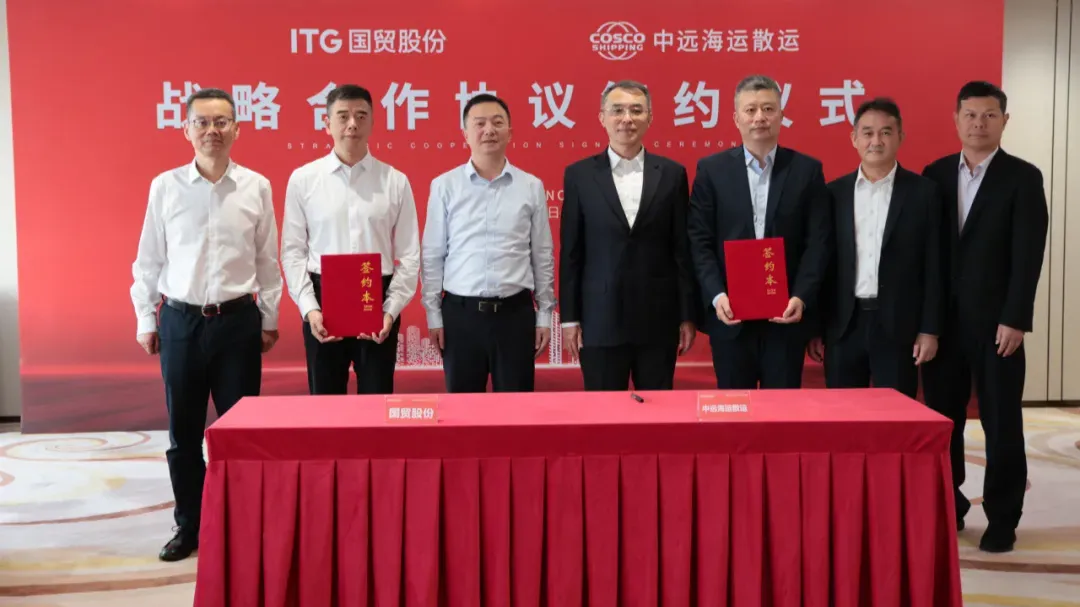
COSCO SHIPPING Bulk Co., Ltd. and Xiamen ITG Group Corp., Ltd. signed a strategic cooperation agreement on 8 September to jointly operate an export breakbulk liner service with Lianyungang as its base port and to develop overseas shipping markets together.
Statements released by both sides used three important terms: “base port”, “joint operation” and “overseas market development”. The agreement was also signed at operating-unit level by executives responsible for COSCO SHIPPING Bulk’s Handysize business and Xiamen ITG’s shipping and ship-related operations, indicating that the cooperation has moved beyond a general group-level framework and into direct business coordination.
Several important commercial details remain undisclosed. The partners have not announced the service’s destination region, port rotation, launch date, sailing frequency, vessel type, minimum cargo commitments or mechanism for sharing freight and capacity risks. “Joint operation” also does not necessarily indicate the establishment of a joint venture or joint ownership of vessels. The strategic direction is clear, while the final service structure will depend on subsequent implementation.
A base port, joint operation and overseas market development
Designating Lianyungang as the base port means the port is expected to perform a stable role in cargo collection, storage, loading and schedule coordination. Joint operation suggests that the relationship could extend beyond individual bookings or one-off ship-and-cargo matching. The stated goal of cultivating overseas shipping markets points towards a repeatable liner product rather than a series of unrelated spot voyages.
Operating a breakbulk liner service is commercially more demanding than transporting a single dry bulk commodity. Steel products, vehicles, construction machinery, wind and solar equipment, bagged cargoes and large structural components differ significantly in dimensions, packaging, handling, lashing and delivery schedules. A single shipper rarely has enough cargo diversity and volume to support a regular service throughout the year.
A vessel may be technically capable of carrying multiple cargo types, but that capability only becomes commercially valuable when supported by sufficient cargo density, reliable schedules and destination-port services. COSCO SHIPPING Bulk therefore needs more than another conventional shipper. It needs a cargo organiser capable of aggregating volumes across industries, customers and regions.
Xiamen ITG, meanwhile, needs stable oceangoing capacity, predictable shipping products and access to overseas networks. The two companies control complementary parts of the breakbulk liner model: COSCO SHIPPING Bulk provides vessels and shipping operations, while Xiamen ITG brings industrial cargoes, trading channels and end-to-end logistics resources.
From backhaul cargoes to a purpose-built multipurpose fleet
COSCO SHIPPING Bulk’s entry into the breakbulk market has been under preparation for several years.
In 2020, Xinde Marine News reported in “A 200,000-dwt Capesize Breakbulk Liner Service Is Here” that the company was using China-bound bauxite trades from Guinea to create backhaul capacity between China and West Africa. A 200,000-dwt Capesize bulker carried automobiles, steel products, construction machinery and pipes on the outbound leg from China, improving the utilisation of capacity that might otherwise have sailed in ballast.
The next stage has concentrated on fleet design. In 2025, COSCO SHIPPING Bulk joined financial leasing partners and Fujian Shipbuilding in ordering 30 units of the 80,000-dwt OCTOPUS 80 multipurpose grain carrier. Featuring box-shaped open cargo holds, the ships are designed to transport grain and conventional dry bulk cargoes while also accommodating containers, breakbulk, vehicles, construction equipment, energy-storage systems, solar equipment and wind-power components.
The first vessel, Guo Yun Hai, was delivered in March 2026, when COSCO SHIPPING Bulk also held a dedicated multipurpose shipping business promotion event. By the end of June, another 20 units of 87,000-dwt multipurpose grain carriers had entered newbuilding and long-term leasing arrangements, with deliveries scheduled between 2029 and 2030. The company has described the series as an important platform for innovation in both fleet structure and business model.
Shipping products have developed alongside the fleet. In April 2026, Guo Yun Hai was deployed on COSCO SHIPPING Bulk’s first North Africa container liner service. Its rotation covered Qingdao, Incheon, Shanghai, Ningbo, Nansha, West Port Said, Benghazi, Misrata and Valencia. The vessel can carry new-energy vehicles, lithium batteries, energy-storage containers and refrigerated boxes, combining containerised outbound cargoes with the potential to load dry bulk commodities on return voyages. According to the Guangzhou Port Authority, the fastest transit from Nansha to North Africa is approximately 21 days.
COSCO SHIPPING Bulk also launched a direct China–West Africa breakbulk service using Handysize vessels with relatively shallow draught and greater access to smaller ports. Cargoes have included cement clinker, project equipment, bulk bags, vehicles, steel pipe piles and grinding balls. Official statements described the route as a stable, regular transport corridor and a platform for end-to-end logistics solutions, with ports in Guinea and elsewhere in West Africa serving as regional distribution points.
The network is beginning to extend ashore. In May 2026, a consortium involving COSCO SHIPPING Ports, COSCO SHIPPING Bulk and PTP secured the concession for a multipurpose terminal at the Port of Tarragona in Spain. The proposed 50-year concession covers approximately 510,000 square metres and can handle containers, general cargo, automobiles, ro-ro traffic and rail freight. It will also connect with the adjacent rail terminal.
Together, these moves have created the initial structure of a multipurpose shipping platform: dedicated vessels, liner products and overseas terminal access. The agreement with Xiamen ITG adds the cargo base, industrial customers and door-to-door logistics capabilities needed to support that structure.
Xiamen ITG can provide the cargo density
Xiamen ITG is not a single-cargo shipper. Its operations cover metals, energy and chemicals, pulp and paper, agricultural products, non-ferrous metals and new-energy industries, allowing the company to aggregate cargoes from a large number of customers, product categories and shipment sizes.
According to its 2025 annual report, Xiamen ITG had established relationships with more than 90,000 upstream and downstream companies across 170 countries and regions. It operated 113 overseas warehouses, owned or managed oceangoing vessels, and had access to domestic warehouses, storage yards, truck fleets, freight-forwarding and customs-clearance resources. Its annual seaborne cargo volume exceeded 34m tonnes.
The company has also revised its strategic vision towards becoming “a leading global industrial-chain organiser”, with logistics support identified as one of its five core capabilities. During the first half of 2026, Xiamen ITG’s overseas revenue exceeded Rmb40bn, rising by more than 30% year on year. It added 21 overseas warehouses across Africa, Southeast Asia and South America, while its steel trading volume increased by more than 50%. Its ship-related business also secured additional export sales orders for multipurpose vessels.
Xiamen ITG’s own maritime and logistics resources add another layer to the partnership. Its shipping operations cover dry bulk trades ranging from Handysize to Capesize and handle commodities including steel, coal, grain and bauxite. The group also has container logistics, terminal and yard services, shipmanagement, agency, customs-clearance and overseas business capabilities. Its ship-related operations include vessel trading, investment and project logistics, with experience serving European and African non-main ports.
These resources can be combined into a relatively complete service chain. Xiamen ITG can collect steel products, machinery, new-energy equipment and other export cargoes from different industrial customers, arrange factory pickup, warehousing, customs clearance, port consolidation and stowage, and then use its overseas warehouses, agencies and local operations to organise customs clearance, distribution and inland delivery at destination. Its commodity trading network may also help secure return cargoes.
The agreement does not disclose whether Xiamen ITG has accepted a minimum-volume commitment, and the existence of cargo aggregation capabilities should not be treated as evidence that the vessels are already fully covered. Nevertheless, during the development phase of a breakbulk liner service, a partner capable of collecting cargoes across industries and regions can significantly reduce the cost of acquiring numerous fragmented shippers.
Why Lianyungang?
Lianyungang combines the characteristics of a manufacturing export gateway with those of a land–sea intermodal hub. Supported by the Longhai Railway and the New Eurasian Land Bridge, the port can draw steel products, vehicles, construction equipment and project cargoes from Jiangsu, Shandong, Henan, Anhui and inland provinces.
As a base port, Lianyungang can serve both its coastal industrial hinterland and a wider cargo catchment area connected by rail and road. It also already has an established breakbulk export base.
During the first half of 2026, the port’s breakbulk exports to Africa increased by 35% year on year, while the number of related vessel calls rose by 25%. Maritime authorities supported operations by more than 180 vessels carrying Africa-bound breakbulk cargoes with a combined trade value exceeding Rmb40bn. Major cargo categories included construction equipment, infrastructure materials and commercial vehicles.
For a breakbulk liner service, the port’s role extends beyond loading ships. A base port must standardise cargo receiving windows, yard arrangements, lashing requirements, documentation procedures and cut-off times, turning non-standard cargoes from multiple shippers into a predictable vessel load.
The overseas destination of the new service has yet to be announced. Lianyungang already supports breakbulk links with West Africa, the Mediterranean and Southeast Asia, while COSCO SHIPPING Bulk operates North and West Africa products. These conditions make Africa a commercially plausible market, but they do not confirm the route. Its destination, rotation and vessel deployment should be judged only after further announcements from the partners.
COSCO SHIPPING Specialized Carriers provides a strategic reference
Xinde Marine News previously examined the “Three Cores and Three Chains” strategy of COSCO SHIPPING Specialized Carriers in “COSCO SHIPPING Specialized Carriers Makes a Major Strategic Adjustment”.
The “Three Cores” refer to new-energy industries, Chinese advanced manufacturing and strategic bulk commodities. The “Three Chains” refer to pulp logistics, project logistics and automobile logistics. The strategy seeks to expand the company’s role from specialised vessel operator to industrial-chain participant and integrated solutions provider.
This approach begins by identifying industries requiring long-term service and then configuring vessels, routes, terminals, warehouses, inland transport and digital systems around those industries. COSCO SHIPPING Specialized Carriers’ use of multipurpose pulp carriers to transport vehicles from China and load pulp on return voyages is a representative example. In 2023, the company transported 144,000 vehicles using container-frame solutions, including 86,000 new-energy vehicles, while continuing to develop port-based pre-delivery inspection, storage, distribution and overseas inland transport capabilities.
COSCO SHIPPING Bulk’s multipurpose grain carriers display a similar underlying structure. One leg can carry containers, automobiles, steel, construction machinery and new-energy equipment, while the other can transport grain and conventional dry bulk commodities. The vessel becomes a physical interface connecting exports of Chinese manufactured products with imports of strategic commodities.
Management experience provides an additional point of reference. Chen Wei, the current chairman of COSCO SHIPPING Bulk, served as chairman of COSCO SHIPPING Specialized Carriers from 2020 to 2024. Huang Nan became general manager of COSCO SHIPPING Specialized Carriers in 2023, left the position in March 2026 following a work reassignment, and subsequently became a director and general manager of COSCO SHIPPING Bulk. Huang had previously also held management positions at China Shipping Bulk and COSCO SHIPPING Bulk.
These appointments do not, by themselves, prove a direct causal link between individual executives and corporate strategy. They nevertheless provide context for the growing similarities in the language of fleet development, liner operations, industrial partnerships and overseas nodes used by the two COSCO SHIPPING companies.
Their operating boundaries remain distinct. COSCO SHIPPING Specialized Carriers has stronger capabilities in oversized and heavy cargoes requiring specialised lifting, engineering and project management. COSCO SHIPPING Bulk’s emerging model is more suited to high-volume general breakbulk, containers and dry bulk combinations, supported by return cargoes from its existing commodity trades. Future product design will therefore need clear coordination with both COSCO SHIPPING Specialized Carriers and COSCO SHIPPING Lines, concentrating on markets where cargo volumes are substantial, conventional liner frequency is limited, and mixed loading or direct calls provide a clear advantage.
NORDEN shows how competition is moving upstream into cargo-flow design
Xinde Marine News’ recent analysis of NORDEN highlighted a wider industry trend: competition among professional shipping companies is moving from vessel supply and cargo acquisition into cargo-flow organisation and supply-chain design.
NORDEN defines Maritime Logistics as a way of integrating fragmented port operations, transhipment activities and individual voyages into a coordinated cargo-flow system. Depending on port draught, cargo volume and transport cost, a solution may combine barges, Supramax, Panamax and Capesize vessels with offshore transhipment facilities. Some agreements can run for 10, 15 or even 25 years.
COSCO SHIPPING Bulk and Xiamen ITG are pursuing a different route towards a comparable objective. NORDEN relies heavily on its operating platform, acquisitions and long-term logistics projects to expand its role. COSCO SHIPPING Bulk is linking a ship operator with a large supply-chain company, combining one side’s vessels and operational expertise with the other’s industrial cargoes, trading channels, warehouses, customs services and overseas network.
The assets can remain under different ownership while cargo-flow design, shipping schedules and performance obligations are coordinated through long-term contracts and digital systems.
Supply-chain security under this model has at least five dimensions: long-term or readily deployable capacity ensures that ships remain available; base ports, direct services and overseas nodes help keep transport corridors open; professional stowage, lashing and cargo-condition management protect the goods; two-way loading and long-term cargo volumes support commercial sustainability; and documentation, customs processing, cargo tracking and risk management provide visibility and accountability throughout the journey.
Adding vessels addresses only one part of this equation.
Five questions still need to be answered
The first question is where the initial service will sail, when it will begin, and whether it will operate with a fixed rotation and published frequency or as a semi-liner product. The second is whether the partners will initially deploy Handysize vessels or the new 80,000-dwt multipurpose grain carriers, and how many ships will be assigned.
The third concerns the annual base cargo volume Xiamen ITG can organise and how the partners will allocate freight, capacity and empty-space risks. The fourth concerns return cargoes, overseas base ports, warehouses and responsibility for inland delivery. The fifth is whether the two sides can establish common standards covering quotations, bookings, documentation, cargo tracking, claims and end-to-end service.
Vessel selection will be particularly important. An 80,000-dwt multipurpose carrier offers lower unit transport costs and broad cargo flexibility, but its larger capacity demands greater cargo aggregation and may face draught or handling restrictions at smaller overseas ports. Handysize tonnage provides greater port flexibility and is better suited to multi-port rotations and non-main ports, although it offers less economy of scale.
The fact that COSCO SHIPPING Bulk’s Handysize business unit participated in the signing is a useful organisational signal, but it is not sufficient evidence to determine the vessel type to be deployed during the initial phase.
The market should ultimately measure the agreement through operating performance: actual service launch, schedule reliability, voyage utilisation, return-cargo ratio, contribution per tonne or revenue tonne, and the proportion of income generated by door-to-door services. Only when these indicators stabilise will the strategic agreement have become a sustainable liner product.
From carrying cargo to organising cargo flows
COSCO SHIPPING Bulk currently lists China–West Africa breakbulk liner services, parcel cargoes, dry bulk semi-liner operations and integrated logistics as distinct business offerings. Combined with the delivery of its multipurpose fleet, the launch of North and West Africa services, participation in the Tarragona terminal and its agreement with Xiamen ITG, the company’s breakbulk strategy is developing into a broader operating system.
A successful service would give COSCO SHIPPING Bulk longer-lasting customer relationships and more stable fleet utilisation than spot voyages. Xiamen ITG could convert its trading, logistics and overseas business network into greater control over physical transport corridors. Industrial customers would gain more predictable capacity, delivery times, logistics costs and cargo visibility.
The vessel provides the transport platform. Cargo supports the economics. Ports anchor the network. Long-term contracts and digital systems allow the service to operate repeatedly.
If those elements can be kept in motion, the service developed from Lianyungang could become a supply-chain corridor with durable cargo commitments—supporting both the overseas expansion of Chinese manufacturing and the security of strategic commodity flows.

READ MORE
 Containers
Container Trade Hits Record 17.3m TEU as Far East Exports Surge
 Containers
China’s First Arctic Container Service Reaches Europe
 Containers
Beyond 24,000 TEU: Why the 27,500-TEU ‘Gigamax’ Is Back in Play
 Containers
Ningbo Containerized Freight Index Weekly Commentary Freight Rates Fluctuated but Composite Index Remained Stable
 Containers
MSC Keeps Buying Used Boxships After 500-Ship Milestone
 Containers
The New Battleground in Container Shipping: Why Maersk, MSC, Hapag-Lloyd, CMA CGM and COSCO Are Investing in Ports
 Containers
Why Container Freight Rates Have Not Fallen as Expected in H2 2026
 Containers
Ningbo Containerized Freight Index Weekly Commentary: Freight Rate Trends Showed Some Divergence; Composite Index Narrowly
 Containers
Statement of COSCO SHIPPING
 Containers