


Ernst Russ Expands Chinese-Built Tanker Fleet to Six with Cargill Charters


Hamburg-listed shipowner Ernst Russ has agreed to acquire two more 18,500-dwt chemical/product tanker newbuildings from China’s Wuhu Shipyard, taking its fleet of the type to six vessels less than six months after entering the tanker sector. The latest pair will be chartered to Cargill for at least three years and add about $38.3 million to contracted charter backlog.
German shipowner Ernst Russ AG is accelerating its move into chemical and product tankers, agreeing to acquire another two 18,500-dwt IMO Type II newbuildings under construction at Wuhu Shipyard Co., Ltd. in China.
The two sisterships are scheduled for delivery in 2026, with the first expected within days and the second before year-end, according to Ernst Russ’s latest disclosure on September 9. Both vessels have secured fixed charters of at least three years with Cargill, adding approximately $38.3 million to the group’s charter backlog.
The acquisition takes Ernst Russ’s fleet of this design to six vessels, following its purchase in April of four sisterships from the same Chinese yard. Those earlier vessels were fixed for at least five years from delivery and added about $126 million of contracted charter revenue.
The significance of the latest deal goes beyond the addition of two ships. In less than six months, a company historically weighted toward container shipping has built a sizeable position in a specialised tanker segment by combining Chinese-built newbuilding assets with pre-arranged long-term employment.
An acquisition, not a fresh shipbuilding order
The transaction is best understood as an acquisition of vessels already under construction rather than a new order placed directly by Ernst Russ with Wuhu Shipyard.
Ernst Russ said it had “agreed to acquire two further sister vessels”, the same structure it used when entering the tanker sector with four vessels in April. The company has not disclosed the seller, the original contracting party or the purchase price of the latest pair.
That distinction matters in a shipbuilding market where forward berth availability can stretch several years. Acquiring existing newbuilding positions can give an owner access to modern tonnage substantially earlier than starting a fresh construction project from scratch.
For Ernst Russ, the strategy also allows the vessels to enter the portfolio with employment already attached. Financing for the latest two units has been secured, although the company did not disclose the loan amount, leverage or pricing.
More than a conventional small product tanker
The six vessels are 18,500-dwt IMO Type II chemical/product tankers, a specification that gives them considerably greater cargo flexibility than a conventional clean petroleum product carrier.
Each ship is fitted with 12 MarineLINE-coated cargo tanks, allowing it to carry cargoes ranging from vegetable oils to refined petroleum products and chemicals. The vessels are also designed as methanol-ready, while Ice Class 1B notation and Great Lakes capability give them access to more specialised regional trades.
For owners and charterers, these characteristics broaden the number of cargo combinations and trading regions available to the ship.
The ability to operate in ice conditions and within the dimensional and technical constraints associated with Great Lakes trades is particularly relevant for operators seeking employment in Northern Europe and North America. Ernst Russ has described these characteristics as giving the ships access to markets with comparatively high barriers to entry.
Wuhu Shipyard’s 18,500-dwt chemical tanker platform is also becoming a repeat-build product rather than a one-off project. In September, the Wuhu municipal government said an 18,500-dwt chemical tanker built by the yard had received what it described as China’s first carbon-footprint evaluation certificate for a chemical tanker from China Classification Society (CCS). The same design family incorporates hull-efficiency measures and provisions for future methanol conversion.
That growing degree of series construction is commercially important. Standardised designs can give international owners access to proven specifications, established supply chains and existing construction slots without necessarily originating the order themselves.
Cargill deal creates a deliberately staggered charter profile
The charter structure is one of the most important features of the latest acquisition.
The first four tankers acquired in April were committed under fixed charters of at least five years, while the latest two will be employed by Cargill for at least three years.
Ernst Russ said the different contract maturities were deliberate. Staggering the six tankers’ charter expiries spreads future renewal negotiations across different years, reduces the risk of having the entire fleet exposed to the market at the same time, and retains some ability to capture higher rates if market conditions improve.
It also diversifies charterer exposure within the tanker portfolio.
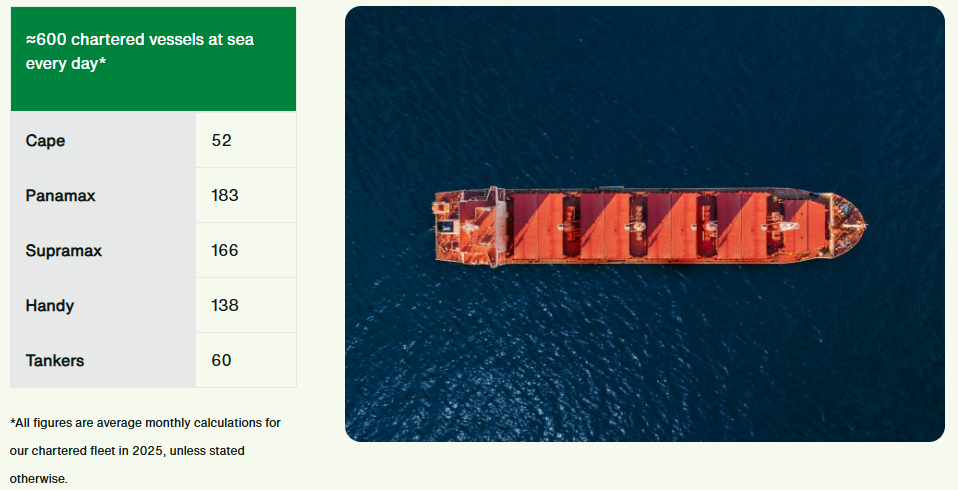
Cargill is a substantial counterparty in the global freight market. Its Ocean Transportation business averaged about 600 chartered vessels per day in 2025, including roughly 60 tankers, and handles both dry and wet bulk cargoes. Its tanker activities include food-grade liquids, bio-based cargoes, refined petroleum products, chemicals and other clean cargoes.
The $38.3 million figure disclosed by Ernst Russ represents additional charter backlog, not a published daily hire rate. Because the company describes the employment period as “at least three years” and has not disclosed the detailed contractual structure, the number cannot reliably be converted into an actual daily charter rate.
From container shipping to a four-segment fleet
The tanker acquisitions fit into a broader reshaping of Ernst Russ’s portfolio.
The Hamburg-based company has historically been closely associated with container shipping, but it has increasingly diversified into other vessel classes.
Earlier this year, Ernst Russ took delivery of two modern multipurpose vessels, Ronnie and Charlie, each backed by seven-year fixed charters. It is also developing two 2,280-TEU container newbuildings with Icelandic partner Eimskip through the ElbFeeder joint venture, with ten-year employment planned from delivery.
By the end of June, Ernst Russ described its portfolio as spanning four fleet segments.
The strategy has materially increased contracted revenue visibility. Charter backlog rose from $522.2 million at the end of 2025 to $688.6 million at June 30, 2026, while the minimum average remaining charter duration increased from 26 to 32 months. The group’s average daily charter rate rose to $19,716 in the first half, from $17,412 a year earlier, with fleet utilisation of 98.3%.
The latest tanker transaction adds another $38.3 million of backlog on top of that position.
At the same time, Ernst Russ is recycling older tonnage.
Alongside the tanker announcement, the company disclosed the sale of the 1,710-TEU EF Emma, built in 2008 and held in a joint venture with Eimskip. Delivery to the buyer is scheduled for the fourth quarter of 2026. The sale contributed to an increase in Ernst Russ’s 2026 EBIT guidance to €55 million–€65 million, from €45 million–€55 million previously, while revenue guidance was narrowed to €150 million–€160 million.
The combination is increasingly clear: dispose of older assets selectively, add modern tonnage in new segments and attach multi-year employment to new acquisitions before they enter service.
Newbuilding supply remains a risk for chemical tankers
Ernst Russ is increasing its tanker exposure at a time when the wider chemical tanker market is facing a significant newbuilding wave.
SSY estimated the dedicated chemical tanker fleet at around 3,270 vessels and 53 million dwt at the end of 2025, with an average age above 14.5 years. About 9% of the fleet was more than 25 years old.
At the same time, SSY estimated that roughly 46% of the chemical tanker orderbook would be delivered during 2026, warning that the influx of capacity would put pressure on the market unless scrapping removes more older tonnage.
A broader assessment by Quincannon Associates, covering the IMO II/III fleet, counted 5,635 existing vessels in early 2026 and an orderbook equivalent to about 17.3% of the existing fleet. More than 400 vessels were expected to enter the market during 2026.
China has become central to that expansion. Quincannon estimates that 71% of the entire IMO II/III orderbook is contracted at Chinese shipyards, including 61% of the stainless-steel orderbook.
That supply backdrop helps explain the logic of Ernst Russ’s charter-first approach.
If a heavy delivery schedule weakens spot and short-period tanker markets, multi-year employment provides a degree of cash-flow protection. At the same time, the shorter three-year duration on the two Cargill ships leaves them with an earlier repricing window than the four vessels fixed for at least five years.
Chinese-built tonnage moves deeper into global asset markets
There is also a broader implication for Chinese shipbuilding.
The internationalisation of China’s commercial shipyards is no longer measured only by the volume of fresh contracts placed directly by overseas owners. As Chinese yards develop larger series of internationally accepted designs, vessels under construction can increasingly become tradable assets in their own right.
The Ernst Russ transactions illustrate that shift.
A European owner has been able to enter a new tanker segment not by waiting several years for a fresh design and berth, but by acquiring a package of modern Chinese-built vessels already moving through the construction pipeline and coupling them with long-term charter coverage.
For Wuhu Shipyard, the commercial significance is therefore wider than six vessels carrying an Ernst Russ ownership interest. Its 18,500-dwt platform is entering the international ecosystem of newbuilding resale, ship finance, chartering and portfolio management — areas where repeatability and acceptance by charterers can matter as much as the original shipbuilding contract.
Ernst Russ’s latest deal also comes as Chinese yards expand their position in chemical tankers, one of the more technically demanding conventional merchant ship segments. Quincannon’s estimate that Chinese yards now hold 71% of the IMO II/III orderbook underlines how quickly that shift has progressed.
For Ernst Russ, the rationale is more straightforward: modern tonnage, multiple cargo capabilities and contracted cash flow.
“With the expansion of our tanker segment, we are consistently continuing our growth strategy,” Co-CEO and Chief Commercial Officer Joseph Schuchmann said. He added that the different three- and five-year charter maturities were intended to spread future renewal negotiations and preserve flexibility.
One disclosure point remains worth watching. Ernst Russ’s September 9 announcement states that the two newly acquired sisterships will both be delivered in 2026, while the company’s online fleet list currently shows later handover dates for two named 18,500-dwt tankers. The latest transaction-specific disclosure therefore provides the most current delivery guidance, while individual vessel identities for the new pair remain to be clarified.

READ MORE
 Tankers
CMB.TECH’s Tanker Sales Set to Generate Nearly $680m in Gains
 Tankers
INTERTANKO Press Statement -- Easing of US sanctions
 Tankers
International Seaways Agrees $370 Million Bruton Takeover to Expand VLCC Fleet
 Tankers
69 Ships for Prokopiou, 10 for Centrofin: Why Owners Keep Choosing Hengli
 Tankers
Kinetai Holdings Opens Singapore Base with Fleet Expansion and Tanker Plans
 Tankers
Emarat Maritime Adds Six LR1s as China Newbuilding Programme Reaches 22 Ships
 Tankers
China Merchants Energy Shipping Establishes European Marketing Hub in London to Expand Global Reach
 Tankers
Guohang expands Hong Kong platform for tanker and heavy-lift push
 Tankers
A 15-Year-Old VLCC Sells for $161 Million as Tanker Asset Prices Surge
 Tankers