


Putin Launches Vostok Oil as Arctic Crude Exports Enter Shipping Phase
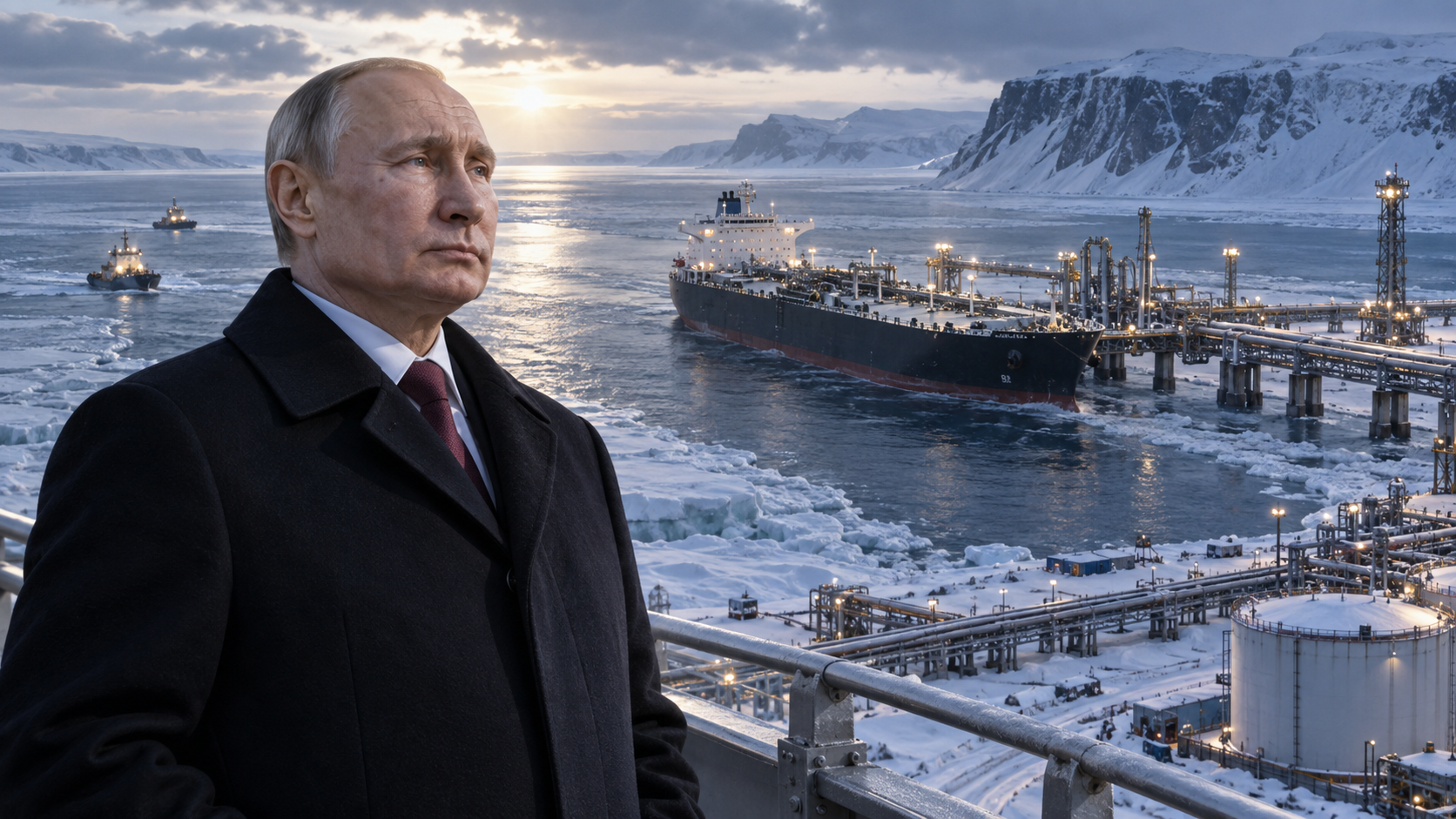

Rosneft has loaded the first crude from its RUB4 trillion Vostok Oil development at the new Bukhta Sever terminal. The milestone opens a new Arctic export route, but scaling volumes to 30 million tonnes from 2027 will require far more than a functioning pipeline and port: ice-capable tanker capacity, reliable Northern Sea Route logistics, Asian demand and sanctions-compliant shipping infrastructure will all have to develop in parallel.
Russia's long-delayed Vostok Oil development has moved from construction into physical crude exports, with the first cargo loading at the new Bukhta Sever terminal on the Taymyr Peninsula.
Russian President Vladimir Putin formally launched the project on September 6 via video link, while Rosneft Chief Executive Igor Sechin initiated loading of the first crude onto Valentin Pikul. Rosneft said the Aframax tanker Akademik Gubkin was already waiting at anchorage to take the next parcel. Total investment in the integrated project has reached around RUB4 trillion.
The significance for shipping goes beyond a ceremonial first loading. Vostok Oil has now connected a new Arctic production base to a dedicated export system comprising fields, a long-distance trunk pipeline, storage, a deepwater terminal and seaborne transportation.
Rosneft says it intends to ship 30 million tonnes of oil to customers from the second half of 2027, rising to 50 million tonnes by 2030. Capacity could ultimately reach 100 million tonnes a year if market demand and project economics allow.
The challenge is now shifting from building infrastructure to moving those volumes reliably.
A new Arctic crude export gateway
The centrepiece of the new logistics system is the 790-km Vankor-Payakha-Bukhta Sever pipeline, designed to move as much as 100 million tonnes of oil per year. Some 414 km of the route has been constructed as a dual-line system, while a six-kilometre section crosses beneath the Yenisei River.
At Bukhta Sever, Rosneft has completed an oil-loading berth, two cargo berths, a berth for the port fleet and 14 storage tanks capable of holding 30,000 tonnes each. Full development calls for 102 tanks.
The loading berth has a water depth of 18 metres and is designed to handle Arctic tankers of up to around 120,000 dwt. A protective structure has also been built to allow port operations in conditions including ice ridging and heavy spring ice movement.
That makes Vostok Oil fundamentally different from simply rerouting existing Russian barrels from Baltic or Black Sea ports towards Asia. It creates a new production source with its own Arctic maritime outlet.
For tanker markets, that distinction matters. If Rosneft can ramp output toward its stated targets, Vostok Oil could generate a sizeable new stream of crude cargoes originating directly on the Northern Sea Route.
The timetable has slipped sharply
The first loading is important, but Vostok Oil is also running well behind Rosneft's earlier schedule.
In 2021, Rosneft said Bukhta Sever infrastructure was being developed to handle 30 million tonnes in 2024, 50 million tonnes in 2027 and 100 million tonnes in 2030. The company had also ordered a series of 10 high ice-class tankers at Russia's Zvezda Shipbuilding Complex to support exports.
The latest targets are considerably more conservative.

The change matters when assessing the first shipment. Vostok Oil has undoubtedly entered the physical export phase, but there remains a large gap between loading initial cargoes and operating a 30 million-tonne-a-year Arctic export system.
An unusual class discrepancy over the first tanker
There is also an important technical detail surrounding Valentin Pikul.
Rosneft described the vessel in its September 6 announcement as an Arc7 ice-class Arctic tanker.
However, the current register of the Russian Maritime Register of Shipping lists Valentin Pikul — IMO 9885879 — with the class notation KM(*) Arc6, a deadweight of 69,322.81 tonnes, and a build date of December 25, 2024.

The two official-source descriptions should therefore be distinguished rather than reconciled without further technical clarification: Rosneft calls the tanker Arc7, while the classification society's current public register lists it as Arc6.
Either way, the approximately 69,000-dwt Valentin Pikul is substantially smaller than the 120,000-dwt high ice-class tanker series originally envisaged for Vostok Oil.
The second vessel waiting for cargo, Akademik Gubkin, is closer to that size. Rosneft described it as an approximately 120,000-dwt Aframax; commercial vessel databases put its deadweight at about 112,900 tonnes.
The distinction highlights a broader issue: Russia has ships capable of starting Vostok Oil exports, but that is not the same as having the dedicated fleet required for tens of millions of tonnes of regular Arctic crude movements.
What does 30 million tonnes mean for tanker demand?
Rosneft's original maritime plan called for 10 high ice-class, 120,000-dwt tankers to be built at Zvezda. The company has also said full development of Vostok Oil would require around 50 vessels of different types, including tankers, gas carriers and supply ships.
A simplified capacity calculation illustrates the scale of the challenge.
Assume a future 120,000-dwt tanker loads around 110,000 tonnes per voyage and completes a direct Bukhta Sever-East Asia round voyage, including loading, discharge, waiting time and Arctic navigation, in roughly 35-45 days.
That produces the following indicative requirement:

These are shipping-capacity scenarios, not Rosneft fleet forecasts. Actual requirements would depend heavily on cargo size, destination, speed, seasonal ice conditions, icebreaker assistance, port waiting times, maintenance and whether shuttle or transshipment systems are used.
Under the same assumptions, a fleet of 10 such tankers operating direct voyages between the Arctic and East Asia would move only around 9 million-11.5 million tonnes per year.
That suggests a 30 million-tonne Vostok Oil system is unlikely to depend solely on a small group of expensive ice-class ships sailing the entire distance to Asian discharge ports.
A more efficient structure could involve high ice-class shuttle tankers working the Arctic leg, with crude transferred farther west or east to conventional Aframax or larger tankers for long-haul transportation.
Such a model would improve utilisation of scarce ice-capable tonnage but would introduce another set of requirements: transshipment capacity, additional tanker employment, storage, ship-to-ship operations and more complex logistics.
The scale is broadly consistent with earlier industry expectations. Zvezda officials said in 2021 that potential demand for the 120,000-dwt Arc7 design could reach about 30 vessels.
The missing piece: the 120,000-dwt Arc7 fleet
The progress of the dedicated Vostok Oil tanker programme is therefore one of the project's most important shipping variables.
Rosneft confirmed in 2020 that Zvezda had been assigned a series of 10 high ice-class 120,000-dwt tankers adapted for Northern Sea Route operations.
Yet Rosneft's latest project-start announcement did not provide a ship-by-ship update on that series or state that one of those 120,000-dwt Arc7 tankers was conducting the inaugural shipment.
Instead, the first loading is being handled by the smaller Valentin Pikul, followed by Akademik Gubkin.
For shipping markets, the pace at which the dedicated high ice-class fleet becomes operational may now be as important as the pace at which Vostok Oil production rises.
An Arctic resource project needs production capacity, pipelines, terminal throughput and specialised marine transportation to increase together. A shortfall in any one of those components can constrain the entire export chain.
China is already the key NSR crude market — but not yet confirmed for this cargo
China is central to the commercial case for expanding Russian Arctic oil exports, although the distinction between existing trade patterns and the destination of the first Vostok Oil cargo is important.
Reuters reported on August 11 that seven tankers carrying around 6 million barrels of Russian crude had already sailed towards Asia through the Northern Sea Route during the 2026 navigation season — nearly half the total carried on the route during all of 2025.
The voyages involved six Aframax tankers and one Suezmax, with China the principal destination. The NSR can cut roughly two weeks from a Russia-China voyage compared with the conventional Suez Canal route, although the route remains highly seasonal for conventional tanker traffic.
The market backdrop has made alternative Russian supply particularly relevant to Chinese refiners. Reuters data show China's seaborne Russian crude imports reached about 1.68 million barrels per day in August, as disruption to Middle Eastern supply continued to reshape Asian crude flows.
Only two days before Vostok Oil's launch, Sechin used the Russia-China Energy Business Forum to argue that the Northern Sea Route could reduce delivery times to trading partners by 1.5-2 times and said China had an opportunity for priority access to the route. That was a statement of strategic intent, not confirmation of a Vostok Oil purchase agreement.
Crucially, Rosneft has not disclosed the buyer or final discharge port for the first cargo loaded aboard Valentin Pikul.
There is therefore strong evidence that China is already the principal market for Russian crude moving through the NSR, and it is a natural candidate to absorb future Vostok Oil volumes. There is not yet public evidence that the inaugural Vostok Oil shipment itself is bound for China.
Sanctions add another constraint to the fleet equation
Ship availability is not the only maritime constraint.
Both vessels associated with the first Vostok Oil loading have been targeted by Western sanctions.
The US Treasury's Office of Foreign Assets Control added VALENTIN PIKUL, IMO 9885879, to its SDN List in January 2025 and linked the vessel to JSC Rosnefteflot. The same action also designated AKADEMIK GUBKIN, IMO 9842190, and linked it to Rosnefteflot.

This does not mean sanctioned vessels are physically unable to trade with Asian ports, nor does it imply that Chinese terminals will necessarily reject their cargoes.
But as Vostok Oil scales from occasional shipments to potentially hundreds of tanker loadings a year, sanctions can affect the commercial chain through insurance and P&I arrangements, banking and settlements, repair and spare-parts access, port services, ship-to-ship transfers and the compliance policies of buyers and service providers.
Those frictions can translate directly into higher costs and lower fleet productivity — particularly for a project dependent on specialised vessels with few substitutes.
From the first cargo to 30 million tonnes
Vostok Oil's first loading is a clear milestone. Russia now has a new Arctic crude source physically connected to the maritime market through the 790-km pipeline and Bukhta Sever terminal.
The next stage is much more demanding.
Moving 30 million tonnes annually would represent roughly 270 cargoes a year at 110,000 tonnes per lifting, requiring a marine system operating at an entirely different scale from the first two shipments.
Several indicators will show how quickly that transition is occurring: the final discharge destination of Valentin Pikul; the loading and voyage of Akademik Gubkin; the delivery and deployment of the 120,000-dwt high ice-class tanker series; whether Rosneft can establish a 30 million-tonne annualised supply rate from the second half of 2027; and whether identifiable Chinese refiners or traders emerge as regular Vostok Oil buyers.
Those developments — rather than the project's longer-term 100 million-tonne aspiration alone — will determine how quickly Vostok Oil becomes a material new source of tanker demand on the Northern Sea Route.

READ MORE
 Tankers
International Seaways Agrees $370 Million Bruton Takeover to Expand VLCC Fleet
 Tankers
Kinetai Holdings Opens Singapore Base with Fleet Expansion and Tanker Plans
 Tankers
Emarat Maritime Adds Six LR1s as China Newbuilding Programme Reaches 22 Ships
 Tankers
INTERTANKO Press Statement -- Easing of US sanctions
 Tankers
China Merchants Energy Shipping Establishes European Marketing Hub in London to Expand Global Reach
 Tankers
Guohang expands Hong Kong platform for tanker and heavy-lift push
 Tankers
A 15-Year-Old VLCC Sells for $161 Million as Tanker Asset Prices Surge
 Tankers
VLCC Benchmark Tops $1 Million a Day: How Are Owners Using the Windfall?
 Tankers
An $81 Million Quote for One Voyage: How Long Can the Tanker Market Frenzy Last?
 Tankers