

World’s Largest Product Tanker Operator Posts $278 Million Quarterly Profit
Hafnia’s net profit rises to nearly 3.7 times the year-earlier level, with 90% returned to shareholders as effective clean tanker supply remains tight


By Chen Yang, Xinde Marine News
Hafnia, widely regarded as the world’s largest product tanker operator, has reported a sharp increase in earnings, delivering its strongest quarterly performance since the third quarter of 2022.
The company recorded a net profit of $277.8 million in the second quarter of 2026, nearly 3.7 times the $75.3 million earned in the corresponding period last year.
Time Charter Equivalent earnings reached $372.9 million, compared with $231.2 million a year earlier, while the fleet achieved an average TCE rate of $44,093 per day. Adjusted EBITDA more than doubled year on year to $287.3 million.
For the first half of 2026, Hafnia generated a net profit of $457.5 million, up from $138.5 million in the same period of 2025.
Hafnia Chief Executive Mikael Skov described the second quarter as the second-strongest quarter in the company’s history, surpassed only by the third quarter of 2022. He attributed the result to geopolitical disruption, restrictions at critical maritime chokepoints and the longer replacement voyages created by changing oil trade patterns.
Strong freight rates, vessel sales and TORM dividends boost cash returns
Hafnia’s second-quarter profit included a $39.3 million gain from vessel sales. Its investment in fellow product tanker owner TORM also contributed $9.9 million in dividend income.
The substantial increases in TCE earnings and adjusted EBITDA nevertheless show that the underlying vessel-operating business remained the main driver of the result.
The performance was achieved despite approximately 392 off-hire days associated with scheduled drydockings during the quarter. Hafnia expects scheduled drydocking to result in around 225 off-hire days in the third quarter.
Strong operating cash flow and vessel sale proceeds reduced Hafnia’s net loan-to-value ratio from 20.2% at the end of the first quarter to 13.0% at the end of June.
Under Hafnia’s dividend policy, a net LTV ratio at or below 20% triggers the highest payout tier. The company will therefore distribute 90% of its second-quarter profit, equivalent to a total dividend of $250 million, or $0.5003 per share.
Hafnia has declared combined dividends of $0.7880 per share for the first half of 2026. Based on a reference share price of $7.50, this represents an annualised dividend yield of approximately 21%. The latest distribution also marks the 18th consecutive quarter in which Hafnia has returned capital to shareholders.
Skov said Hafnia’s capital allocation strategy has been built around investing when freight markets and vessel values are low, while selling assets, realising gains and returning cash to shareholders during stronger parts of the cycle. Gains from vessel sales and dividends received from TORM are included in the company’s dividend calculation.
From 2027, however, Hafnia will calculate net LTV on a fully committed basis, incorporating outstanding newbuilding commitments and the corresponding vessel values. Future payout ratios will consequently be influenced by freight earnings, vessel valuations and the capital requirements associated with the company’s newbuilding programme.
Lower cargo volumes but longer voyages keep vessel utilisation high
The current product tanker market is characterised by an unusual combination of lower seaborne volumes and persistently high vessel utilisation.
According to Hafnia, oil production in the Persian Gulf had recovered only partially by July, reaching approximately 23.9 million barrels per day, still 8.3 million barrels per day below pre-conflict levels.
Persian Gulf loadings briefly recovered to nearly 20 million barrels per day at the beginning of July. Renewed attacks on tankers and energy infrastructure subsequently reduced loadings to around 12 million barrels per day by the end of the month.
Conditions around the Bab el-Mandeb Strait and the Red Sea have added another layer of disruption. Some Red Sea exports have been redirected northwards through the Suez Canal and the SUMED pipeline. Hafnia estimates that such rerouting can add almost 30 days to Asia-bound voyages, increasing tonne-mile demand.
Global seaborne oil product exports averaged 27.7 million barrels per day in July, down 3.8 million barrels per day from a year earlier. Persian Gulf exporters accounted for approximately 2.9 million barrels per day of that reduction, while higher US exports offset about 700,000 barrels per day.
Buyers previously dependent on Russian and Middle Eastern barrels have increasingly sourced replacement cargoes from the United States, Europe and India. These longer Atlantic Basin voyages have helped offset the impact of lower overall cargo volumes on tanker demand.
Restrictions at the Panama Canal are further absorbing vessel capacity. Skov said the number of daily transit slots had been reduced, with some vessels required to participate in auctions to secure priority passage.
Gas carriers and container ships can generally afford to pay more for these slots, leaving product tankers facing longer waiting times or alternative routes. The combined impact of disruption in the Persian Gulf, Red Sea and Panama Canal has helped the market absorb new vessel deliveries.
Inventory replenishment could generate new transportation demand
The significant depletion of global oil inventories is central to Hafnia’s medium-term market outlook.
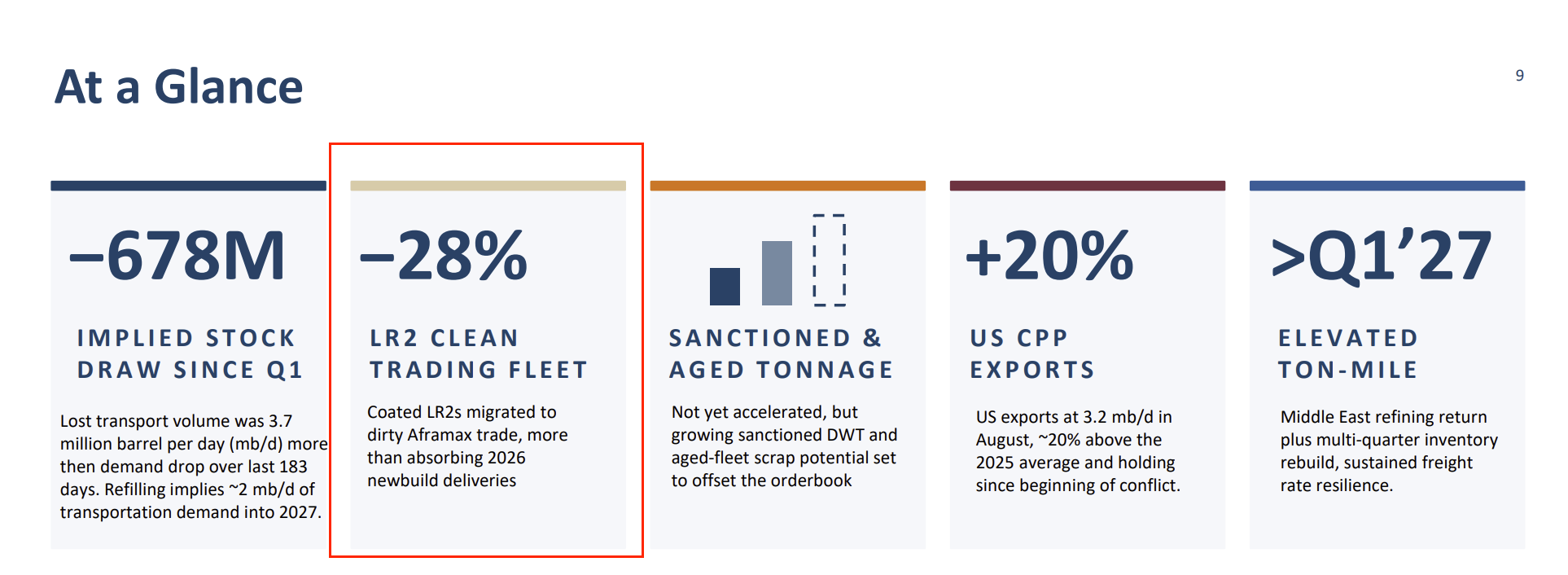
The company estimates that, over a 183-day period, the reduction in seaborne crude and product transportation exceeded the fall in oil demand by approximately 3.7 million barrels per day. This implies that around 678 million barrels were drawn from global inventories.
Replenishing those stocks could generate roughly 2 million barrels per day of additional transportation demand into 2027, according to Hafnia.
International Energy Agency member countries may need to replace up to 400 million barrels of emergency inventories released during the crisis. Around 300 million barrels had already been drawn by the end of July.
The United States announced a release of 172 million barrels from the Strategic Petroleum Reserve, of which approximately 134 million barrels had been contracted. Hafnia expects the replenishment of these barrels to begin in 2027. Inventories in non-IEA countries, including China and India, have also declined.
Changing export patterns could provide additional support. Chinese clean petroleum product exports increased from approximately 600,000 barrels per day in January to around 900,000 barrels per day in August. Hafnia estimates that about 226 million barrels of China’s annual export quota remain unused.
US clean product exports, meanwhile, reached approximately 3.2 million barrels per day, around 20% above the 2025 average. Lower Russian exports and damage to Middle Eastern refining capacity have increased Europe’s dependence on supplies from the US Gulf and Nigeria’s Dangote refinery, supporting longer Atlantic Basin voyages.
The outlook remains exposed to demand risks. Hafnia’s report cited an IEA forecast that global oil demand will decline by 1.6 million barrels per day in 2026 to 103.3 million barrels per day, compared with the 400,000-barrel-per-day reduction forecast in May. Global demand is expected to rebound by 2.4 million barrels per day in 2027.
Skov also warned that if demand continues to recover while Persian Gulf supply remains constrained, a rapid increase in oil prices could weaken consumption and ultimately reduce transportation demand.
Paper orderbook diverges from effective clean tanker supply
Hafnia believes that headline product tanker orderbook figures do not accurately reflect the number of vessels entering the clean petroleum product market.
The industry has taken delivery of coated newbuildings equivalent to approximately 259 MR tankers during 2026. However, a large number of LR2 vessels have entered crude and dirty petroleum product trades immediately after delivery.
Hafnia’s investor presentation indicates that the number of LR2s employed in clean trades has fallen by approximately 28% since the beginning of the year. After accounting for new deliveries and vessels migrating between clean and crude trades, the effective clean trading fleet is now smaller than at the end of 2025 by the equivalent of 82 MR tankers.
Skov said that orderbook analysis must consider the identity of the ordering company, the technical configuration of each vessel and its likely commercial deployment. Some ships classified as product tankers were ordered by owners focused on crude transportation and entered Aframax crude trades after delivery, adding no immediate capacity to the clean market.
That movement could eventually reverse. A large number of VLCC and Suezmax newbuildings are scheduled for delivery between 2027 and 2029. If these vessels put pressure on Aframax earnings, coated LR2s currently carrying crude could return to clean product trades and increase product tanker supply.
Hafnia estimates that tanker deliveries across all size segments between 2027 and 2029 could exceed scrapping and sanctioned-fleet removals by approximately 55 million dwt. The resulting supply pressure is expected to become more visible from 2028.
The actual pace of scrapping will therefore be critical. Skov said that, in theory, new deliveries over the next three to four years could be offset by recycling and the removal of sanctioned tonnage. This balance depends on older vessels actually leaving the market, while high freight rates and strong secondhand values could encourage owners to keep ageing ships in operation.
Hafnia remains constructive on the approaching winter market but continues to lock in a portion of its earnings. Management intends to maintain time-charter coverage of around 20% to 30% for periods extending 12 to 24 months, providing a floor beneath earnings during a highly uncertain market.
As of August 17, Hafnia had covered 80% of its third-quarter earning days at an average rate of $30,716 per day. This is significantly below the second-quarter fleet average of $44,093 per day, indicating that freight earnings are normalising from the exceptional levels recorded during the second quarter.
Hafnia sells 12 vessels while ordering 10 MRs
Hafnia is using the strong market to sell older vessels while securing the next stage of its fleet renewal programme.
At the end of the second quarter, the company owned or financially controlled 103 vessels and had another nine vessels on time charter. It also commercially managed approximately 60 third-party vessels, bringing the total number of product tankers under its commercial responsibility to close to 200.
Hafnia’s owned fleet had an average age of approximately 9.7 years, compared with an average of close to 14 years for the global product tanker fleet.
During the second quarter, Hafnia completed the sale of one LR1, two MRs and three Handy product tankers, recognising a gain of $39.3 million.
Across the first half of 2026, the company sold four LR1s, four MRs and four Handy vessels. The 12 transactions generated total proceeds of $281.3 million.
In the third quarter, Hafnia also completed the sale of its 50% interest in two MR vessels held through the H&A Shipping joint venture, generating a profit of $13.3 million for the company.
Hafnia has signed construction contracts for 10 MR newbuildings scheduled for delivery in 2028 and 2029. Outstanding contractual payments related to the programme stood at approximately $503.6 million at the end of June.
Skov said shipyards are heavily booked with orders for container ships, gas carriers and other vessel types, significantly extending lead times for tanker newbuildings. Hafnia ordered the 10 MRs to avoid a multi-year gap in its fleet renewal programme.
According to Skov, the prices achieved from selling older vessels at elevated secondhand values are broadly comparable with the depreciated economic cost of the newbuildings. This allows Hafnia to replace older tonnage with younger and more efficient vessels without materially expanding the overall fleet.
Management stressed that Hafnia is not preparing to order another 10, 20 or 30 newbuildings at current price levels. Capital allocation remains focused on shareholder distributions and disciplined fleet renewal rather than aggressive expansion.
Hafnia also continues to hold a 13.97% stake in TORM, which had a market value of approximately $369 million at the end of the second quarter. The company said its view of the strategic logic behind product tanker consolidation remains unchanged, but the timing and structure of any future action will be determined by its ability to maximise returns for Hafnia shareholders.
The second-quarter report was Skov’s final quarterly report as Hafnia’s chief executive. He will step down on September 1 after approximately 16 years in the role and will be succeeded by Søren Steenberg Jensen, currently Executive Vice President and Head of Asset Management.
Subject to approval at an Extraordinary General Meeting scheduled for September 23, Skov is expected to join Hafnia’s board of directors.
Hafnia’s results demonstrate how fragmented trade routes, depleted inventories, changing export patterns and a reduction in effective clean tanker supply are supporting the product tanker market.
Third-quarter covered rates have already fallen below the second-quarter average, while a durable reopening of the Strait of Hormuz and Red Sea routes could unwind some of the inefficiencies currently absorbing vessel capacity.
Hafnia is responding by realising vessel values, reducing leverage and returning cash during the stronger part of the cycle, while securing replacement tonnage for delivery from 2028. The company’s capital discipline, together with the direction of freight rates, will determine how effectively it continues to convert shipping-market volatility into shareholder returns.


READ MORE
 Tankers
Guohang expands Hong Kong platform for tanker and heavy-lift push
 Tankers
A 15-Year-Old VLCC Sells for $161 Million as Tanker Asset Prices Surge
 Tankers
VLCC Benchmark Tops $1 Million a Day: How Are Owners Using the Windfall?
 Tankers
China Merchants Energy Shipping Establishes European Marketing Hub in London to Expand Global Reach
 Tankers
An $81 Million Quote for One Voyage: How Long Can the Tanker Market Frenzy Last?
 Tankers