


VLCC,$759,969/Day !!!
TD3C Surges to a Record $759,969 a Day as VLCC Market Faces an “Effective Supply” Crisis
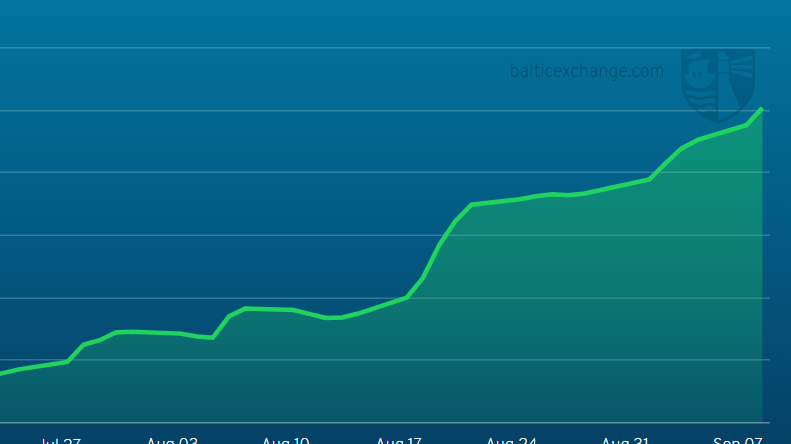


The global very large crude carrier market has moved into price territory few industry participants have experienced before. On September 8, the Baltic Exchange’s Middle East Gulf–China TD3C benchmark reached an estimated time-charter equivalent of $759,969 per day, setting a new record for the index and exceeding the previous peak recorded on March 16 by approximately 26%. The surge was not confined to cargoes loading inside the Strait of Hormuz. The Oman–China TD34 assessment climbed to a record $358,201 per day, while West Africa–China TD15 reached $237,259 per day and US Gulf–China TD22 stood at $210,307 per day, within roughly $6,000 of its own historical high. Across the Middle East, the Gulf of Oman and the Atlantic Basin, the main long-haul VLCC routes are being repriced simultaneously.
The figure of nearly $760,000 per day requires careful interpretation. It is a Baltic Exchange TCE assessment calculated under standardised voyage assumptions, rather than the reported net profit of an individual vessel or a confirmed daily charter hire. The TD3C index has also become increasingly theoretical because much of the crude leaving the Middle East Gulf is moving through a shuttle-tanker and ship-to-ship transfer system instead of being loaded directly onto conventional VLCC voyages inside Hormuz. Even with those qualifications, the record remains an extraordinary market signal: this is the price the benchmark model currently assigns to deploying a VLCC on one of the world’s most important crude oil routes under severe geopolitical, insurance and operational constraints.
Cargo volumes are falling while freight rates are breaking records
The current rally differs sharply from a conventional tanker upcycle driven by rising oil production and rapidly expanding cargo volumes. Vortexa data cited by Lloyd’s List shows that Middle East crude exports averaged approximately 11.8 million barrels per day in August, around 6.6 million barrels per day, or 36%, below the average during the six months preceding the Hormuz crisis. Global crude and condensate exports averaged 38.3 million barrels per day between mid-March and early September, down roughly 10% year on year. The decline was concentrated in the VLCC segment, where export loadings averaged 16.3 million barrels per day during the crisis, approximately 27% lower than a year earlier.
VLCC tonne-mile demand also weakened in August, while the number of vessels sailing in ballast increased as more ships completed laden voyages. Vortexa estimated that the mainstream VLCC ballast fleet had risen by around 25% from its July low and remained elevated for almost a month. By late August, around 40 VLCCs were waiting east of Hormuz, the highest number since the beginning of 2025. Under ordinary market conditions, lower cargo volumes and a growing ballast fleet would be expected to intensify competition among owners and place downward pressure on freight.
Rates have moved in the opposite direction because the physical presence of a ship no longer guarantees that it can compete for a particular cargo. A VLCC waiting east of Hormuz may be technically available, yet its owner may be unwilling to enter the Gulf, its crew may object to the voyage, its war-risk cover may be insufficient, or its charter terms and compliance profile may prevent it from being accepted by the cargo interest. The market is therefore being determined by what Vortexa described as vessels that are both “commercially willing and operationally able” to access individual loading areas. The number of ships visible on a positioning map remains substantial; the pool of vessels that can actually be fixed for a high-risk Middle East Gulf cargo is much smaller.
This distinction between physical supply and effective supply lies at the centre of the record TD3C assessment. Spot tanker markets are priced by the marginal ships available for a specific loading window, not by the total number of VLCCs in the global fleet. If dozens of vessels are waiting outside Hormuz but only a small number of owners are prepared to enter, the other ships exert little competitive pressure on the freight negotiation. The global fleet has not suddenly contracted, yet the effective tradable fleet serving the Middle East Gulf has shrunk dramatically.
War risk has changed the definition of an available VLCC
Before accepting a Middle East Gulf cargo, an owner must now assess a much wider range of exposures than vessel position, fuel consumption, expected freight and the next employment opportunity. War-risk insurance must be obtainable at commercially acceptable terms. The crew must be willing to enter a high-risk area. The owner’s management and board may need to approve the voyage. Charter-party provisions must establish how additional premiums, delays and route changes will be allocated. The vessel must also satisfy the charterer’s vetting and sanctions requirements, while both parties consider the possibility that the ship could be delayed or trapped if transit conditions deteriorate further.
Each of these constraints removes potential vessels from the competitive pool. Some owners may be prepared to trade east of Hormuz but refuse to transit the strait. Others may accept Gulf of Oman loadings while declining cargoes from terminals inside the Gulf. A smaller group may be willing to take the full exposure, provided the freight compensates them for the insurance cost, asset risk, crew considerations and uncertain duration of the voyage. The market price is consequently set by a highly selective group of owners rather than by the entire regional tonnage list.
This changes the logic behind freight negotiations. In a normal market, owners compare the rate available today with alternative employment and their expectations for the next fixture. Under current conditions, they must also calculate the price required to justify exposing an asset worth well over $100 million to a conflict zone. The resulting TCE contains several layers of compensation: the underlying value of the ship, the scarcity of acceptable tonnage, war-related operating costs, potential delays and a premium for extreme but difficult-to-quantify risks.
For that reason, the TD3C figure should not be reported simply as a VLCC “earning $760,000 in profit every day.” TCE is a standardised measure designed to compare voyage economics, and actual owner returns depend on fuel costs, insurance, waiting time, commissions, operating expenses and the final terms of an individual fixture. The record nevertheless demonstrates how much the market is currently prepared to pay to attract effective tonnage into the Middle East Gulf.
The Gulf of Oman has become a central VLCC loading market
The rise of the Oman–China TD34 route provides an even clearer view of how the Hormuz crisis is reshaping the crude transportation system. On September 8, TD34 reached $358,201 per day, its highest level on record and 144% above its level one month earlier. Because a VLCC loading in the Gulf of Oman does not need to sail deep into the Middle East Gulf, its direct exposure to Hormuz is lower than that of a conventional TD3C voyage. The fact that TD34 has still risen above $350,000 per day shows that the disruption has spread far beyond cargoes loaded west of the strait.
A new logistics chain has developed in which shuttle tankers carry crude through the highest-risk part of the route and transfer it to ocean-going VLCCs outside Hormuz. Vortexa data shows that crude exports handled through ship-to-ship transfers outside the strait increased from approximately 603,000 barrels per day in April to 4.6 million barrels per day in August. The share of cross-Hormuz exports using the shuttle-and-STS system was recently estimated at around 80%.
This system keeps part of the region’s crude exports moving, although it consumes considerably more shipping capacity. A conventional voyage requires one VLCC to load, sail and discharge. The new structure can require a shuttle tanker, an ocean-going VLCC, an offshore transfer operation and extended waiting time while the two ships are coordinated. Weather, security arrangements and delays in the arrival of shuttle cargoes can keep the receiving VLCC occupied without generating the tonne-miles associated with a normal long-haul voyage. More vessel days are required to move fewer barrels, reducing the efficiency of the entire fleet.
Reported fixtures demonstrate how strongly the market is pricing this inefficiency. Tankers International said that DHT Taiga was fully fixed for a Gulf of Oman–Myanmar voyage at an estimated $365,031 per day. It subsequently reported Sea Emerald on subjects for a Gulf of Oman–China voyage at approximately $409,913 per day. These fixtures indicate that even owners avoiding a direct loading inside Hormuz are demanding returns of between $350,000 and $400,000 per day.
TD3C and TD34 therefore represent two related layers of the same disrupted logistics system. TD3C captures the exceptional price associated with loading inside the Gulf, although direct benchmark-style voyages have become less common. TD34 reflects the cost of receiving crude outside Hormuz after it has passed through a more complex shuttle-and-transfer chain. Their simultaneous record highs show that the disruption is being priced across the regional transport network rather than at a single geographical chokepoint.
The pressure has spread into the Atlantic Basin
The rally in West Africa–China TD15 and US Gulf–China TD22 confirms that the effects are global. TD15 reached $237,259 per day, up 118% in one month, while TD22 rose to $210,307 per day, an increase of 77% over the same period. Neither route requires a vessel to pass through Hormuz, yet both are trading at historically extreme levels.
The connection operates through vessel positioning and competing employment opportunities. Exceptional returns in the Gulf of Oman attract ships towards the Middle East and raise the minimum earnings owners are prepared to accept elsewhere. Atlantic cargoes must compete for the same global pool of internationally acceptable VLCCs. A vessel available in West Africa or the US Gulf can either take an Atlantic cargo or reposition towards an unusually profitable market in the East. Owners will compare both options, allowing high Middle East returns to influence rate expectations thousands of miles away.
Long-haul Atlantic voyages also absorb tonnage for extended periods. A VLCC carrying crude from the US Gulf, Brazil or West Africa to Asia remains employed much longer than a vessel on a typical Middle East Gulf–Asia voyage. Even a limited number of long-haul fixtures can remove several ships from the prompt market for months and delay their return to the Middle East. The commercial effect is similar to a temporary reduction in fleet supply: the ships still exist, but their available days have already been committed elsewhere.
The current market is therefore being tightened from two directions. In the Middle East, geopolitical and operational risk excludes ships that are physically nearby. In the Atlantic, long-haul cargoes and competition with exceptional Eastern returns absorb or redirect the vessels that might otherwise ballast back towards the Gulf. One part of the market restricts access to ships, while another keeps ships occupied for longer periods. Together, they reduce the number of VLCC days available to charterers worldwide.
The industry needs to look beyond headline fleet numbers
The present situation also highlights the increasing segmentation of the global VLCC fleet. Tankers are usually analysed by age, carrying capacity and technical specification, but commercial access is becoming equally important. One group of vessels can serve international oil companies, national oil companies and major commodity traders under mainstream insurance and compliance standards. Another group is closely connected to sanctioned Russian, Iranian or other restricted trades. Older vessels may remain technically operational yet face limitations arising from flag, class, insurance, ownership history, sanctions exposure or charterer vetting.
Vortexa estimates that around 22% of the active VLCC fleet is at least 20 years old. Approximately 63% of this older group is sanctioned, leaving non-sanctioned vessels aged 20 years or more equivalent to only about 8% of the total fleet. This means the apparent retirement potential suggested by the headline age profile does not translate directly into removable capacity within the mainstream market. Many elderly ships have already migrated into separate trading systems, while charterers in the conventional market depend on a smaller and more tightly controlled pool.
A global fleet count therefore gives only a partial picture. For each cargo, the relevant questions are more specific: where is the vessel, when can it arrive, will the owner accept the voyage, can the ship obtain insurance, will the crew agree to sail, does the vessel meet the charterer’s vetting requirements, and can it trade without creating sanctions or reputational exposure? A ship that fails one of these tests may remain visible in the global fleet statistics while contributing no effective supply to the cargo being negotiated.
The scarce commodity in the present market is consequently not vessel steel or deadweight capacity alone. It is the number of tradable VLCC days available in the right location under acceptable operational, regulatory and insurance conditions. Detours, waiting, ship-to-ship transfers, longer voyages and restricted market access all consume those days. The same nominal fleet can deliver much less effective transportation capacity when each cargo requires more time and fewer vessels can participate.
Record spot rates are changing owner strategy and asset values
The strength of the spot market is already influencing secondhand values, chartering decisions and fleet strategy. When benchmark earnings move into six figures and selected routes approach or exceed $400,000 per day, owners naturally reassess the value of retaining an existing vessel, purchasing modern tonnage or fixing ships on longer-term employment. Sellers demand higher prices because the earnings potential of the asset has increased, while buyers calculate how quickly an acquisition could be repaid if a portion of the elevated market continues.
Owners are also balancing exceptional spot exposure against the security of term charters. Fixing a ship for several years at a rate far below the current TD3C assessment may appear conservative, yet the comparison is misleading because the record index includes a large and potentially volatile war-risk component. A multi-year charter at a historically strong rate can convert a period of extreme spot earnings into predictable cash flow while protecting the owner from a sudden reopening of Hormuz or a rapid release of waiting tonnage.
Clarksons Securities has sharply revised its broader crude tanker outlook. According to figures reported by Lloyd’s List, the firm raised its forecast for average weighted VLCC earnings in 2026 from $75,000 to $135,000 per day and lifted its 2027 projection from $60,000 to $117,000 per day. Its base case assumes that disruption at Hormuz continues through the first half of 2027, followed by a gradual reopening from the third quarter. Clarksons also forecasts average VLCC earnings of $79,000 per day in 2028, despite the expected delivery of 99 newbuildings that year.
Those forecasts remain far below the current TD3C level, underscoring the two components of today’s market. The first is an exceptional geopolitical premium generated by Hormuz access, war risk and the shuttle-STS system. The second is a broader structural layer supported by fleet inefficiency, ageing mainstream tonnage, segmented trading systems, long-haul employment and potential future inventory rebuilding. The geopolitical premium can move rapidly; the structural component may support elevated earnings well after the most extreme route assessments have retreated.
What does $759,969 per day mean for Chinese refiners?
TD3C connects the Middle East Gulf with China, making the increase directly relevant to Chinese crude buyers and the country’s energy supply chain. Middle Eastern crude has traditionally enjoyed a major transportation advantage because of its shorter sailing distance to Asia. When freight, insurance and security costs rise to exceptional levels, that geographical advantage is eroded, and shipping becomes a much more important part of the refinery’s procurement calculation.
Refiners effectively face two costly choices. Continuing to buy Middle Eastern crude means absorbing higher freight, war-risk insurance and uncertainty over transit and arrival times. Sourcing more barrels from the US, Brazil or West Africa reduces direct exposure to Hormuz but requires longer voyages and more vessel days. The first choice supports the Middle East Gulf risk premium; the second strengthens tonne-mile demand and keeps VLCCs occupied for longer periods.
This creates a reinforcing cycle across the tanker market. Higher Hormuz risk reduces the number of owners willing to enter the Gulf. TD3C rises, encouraging buyers to consider more distant Atlantic barrels. Longer voyages then absorb VLCCs that might otherwise return to the Middle East, reducing the prompt vessel pool and reinforcing owners’ bargaining power. Even as total crude export volumes decline, transportation inefficiency can keep freight rates exceptionally high.
The same effective-supply mechanism could drive a rapid reversal
A rate of $759,969 per day should not be extrapolated as a sustainable long-term earning level. A sizeable number of VLCCs are already positioned east of Hormuz, including ships waiting, slowing down or temporarily refusing to enter the Gulf. If security conditions improve and war-risk costs fall, some of these vessels could become commercially available very quickly. The market would not need to wait for newbuildings to be delivered; existing ships could move from ineffective to effective supply almost immediately.
A recovery in Middle East exports could also reduce Asian demand for longer and more expensive Atlantic barrels. That would release tonnage from US Gulf, Brazilian and West African voyages while additional ships re-entered the Middle East market. The combination of renewed Gulf access and weaker Atlantic employment could produce a much faster correction than would normally occur during a gradual shipping cycle.
Breakwave Advisors describes this as an asymmetric supply risk. The present market requires a very large premium to persuade owners to accept Gulf exposure, but an improvement in transit conditions could unlock ships already waiting nearby. This potential release of capacity would coincide with an approaching newbuilding delivery cycle, increasing competitive supply in the mainstream market.
Extreme TD3C levels may therefore prove highly volatile. However, a decline from nearly $760,000 per day would not automatically return the VLCC market to weak conditions. The longer-lasting direction will depend on how much of the current inefficiency remains: whether the shuttle-and-STS system continues, how quickly Middle East exports recover, whether Atlantic-to-Asia flows remain strong, how the sanctioned and mainstream fleets evolve, and how rapidly new vessels enter service.
A record price for a less efficient crude transportation system
The TD3C record ultimately reveals much more than the earnings potential of one class of tanker. Global oil demand has not suddenly increased by several million barrels per day, and the physical VLCC fleet has not disappeared. What has changed is the efficiency with which the fleet can connect producers and refiners.
Hormuz risk has removed ships from the commercially available pool. Shuttle tankers and offshore transfers have added new stages to the transport chain. Waiting times have increased. Longer voyages have tied up vessels for additional weeks. Sanctions, insurance and vetting requirements have divided the fleet into increasingly separate trading systems. Each factor raises the number of vessel days needed to move a given volume of crude.
The supply-and-demand equation for the VLCC market can therefore no longer be reduced to cargo volumes and total ship numbers. It must also include distance, voyage duration, waiting time, market access and the proportion of the fleet that can actually perform the required trade.
At $759,969 per day, TD3C is more than a historical record for a Baltic Exchange benchmark. It is the price the global crude supply chain is paying for lost transportation efficiency under the combined pressure of war, insurance restrictions, trade rerouting and fleet segmentation.
The world does not currently lack VLCCs in absolute terms. It lacks VLCCs that can reach the right place at the right time—and complete the voyage in a compliant, insurable and operationally acceptable manner. As long as that constraint remains unresolved, the most extreme rates may fluctuate sharply, but the high-risk premium and strong underlying earnings environment will be difficult to eliminate.


READ MORE
 Tankers
CMB.TECH’s Tanker Sales Set to Generate Nearly $680m in Gains
 Tankers
INTERTANKO Press Statement -- Easing of US sanctions
 Tankers
International Seaways Agrees $370 Million Bruton Takeover to Expand VLCC Fleet
 Tankers
69 Ships for Prokopiou, 10 for Centrofin: Why Owners Keep Choosing Hengli
 Tankers
Kinetai Holdings Opens Singapore Base with Fleet Expansion and Tanker Plans
 Tankers
Emarat Maritime Adds Six LR1s as China Newbuilding Programme Reaches 22 Ships
 Tankers
China Merchants Energy Shipping Establishes European Marketing Hub in London to Expand Global Reach
 Tankers
Guohang expands Hong Kong platform for tanker and heavy-lift push
 Tankers
A 15-Year-Old VLCC Sells for $161 Million as Tanker Asset Prices Surge
 Tankers