


VLCC Resale Talk Hits $200m as Prompt Tonnage Commands a Record Premium


Market talk linking Dynacom Tankers Management and Iraqi interests to a 2026-built VLCC at around $200 million highlights a widening gap between ordinary newbuilding prices and the value of ships available for immediate deployment. With Middle East crude flows constrained by the Strait of Hormuz crisis, control of prompt tonnage is becoming an asset in its own right.
A VLCC resale price once considered difficult to imagine is now being discussed in the sale-and-purchase market.
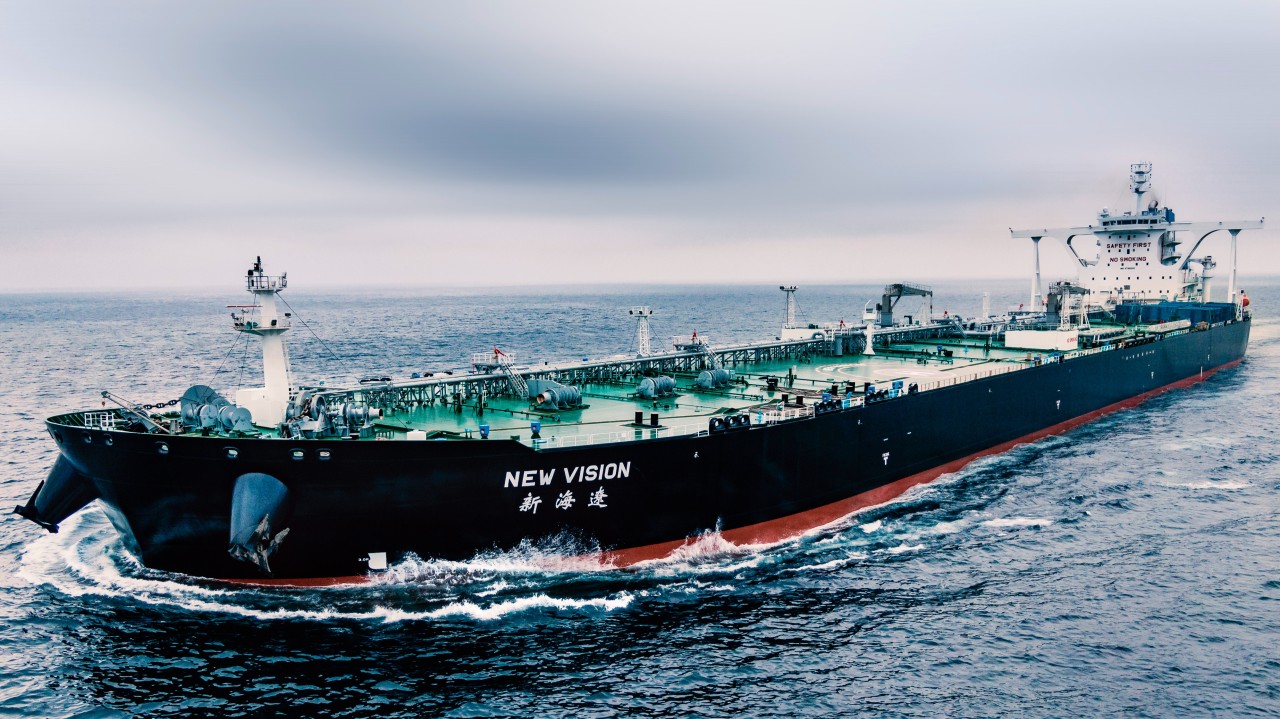
TradeWinds reported on September 7 that brokers and market sources have been circulating talk of a $200 million resale involving a 2026-built, scrubber-fitted VLCC available for prompt delivery in the Middle East. Greece’s Dynacom Tankers Management and Iraqi interests have been linked to the transaction, with some sources associating the Iraqi side with entities connected to the country’s State Oil Marketing Organization, or SOMO.
The deal has not been confirmed by the parties involved. Clarksons described the market talk as strong but unsubstantiated, while managers approached by TradeWinds had not responded to requests for comment.
That distinction matters. The significance at this stage is not that every modern VLCC is suddenly worth $200 million, but that buyers are discussing such a price for a ship they may be able to take over almost immediately.
The price of time
The gap between conventional newbuilding values and prompt tonnage has become unusually wide.
TradeWinds cited Clarksons data putting the three-month trend value of a VLCC resale at about $182 million, compared with an average newbuilding contract value of roughly $131 million.
The reported $200 million transaction would extend that premium still further.
A useful comparison comes from Frontline. On August 4, the tanker major announced the sale of two 2017-built VLCCs for an aggregate $270 million, or $135 million per vessel. The transaction is expected to generate about $179 million in net cash proceeds after debt repayment and a gain of approximately $110 million, subject to completion.
The contrast is striking. A nine-year-old VLCC changed hands at an average $135 million only weeks before market participants began discussing a near-new vessel at $200 million.
The difference is not simply age or technical specification. Delivery timing itself has acquired a very high value.
Freight earnings provide the cash-flow case
The asset-price surge is occurring against an extraordinary VLCC freight market.
The Baltic Exchange said on September 4 that the benchmark TD3C Middle East Gulf-China route had climbed to WS677.22, producing a round-trip time-charter equivalent of just under $704,000 per day for the standard Baltic VLCC. The Gulf of Oman-China TD34 assessment generated more than $261,800 per day.
Those returns are far above levels seen earlier in the year.
Frontline reported average second-quarter VLCC spot TCE earnings of $152,700 per day. It also fixed two newly delivered VLCCs on one-year charters at $120,000 per day each, illustrating how sharply the spot market subsequently moved.
At earnings measured in several hundred thousand dollars per day, the economic difference between receiving a vessel now and waiting years for a newbuilding becomes substantial.
A $131 million ship delivering several years from now and a $180 million-plus ship capable of entering today’s market are no longer economically interchangeable assets.
Hormuz is putting a price on control
The Strait of Hormuz crisis adds another layer to that premium.
Reuters reported on September 6 that an average of only 10 commodity-carrying ships per day had transited Hormuz over the previous 10 days, the lowest level since May. Only two passed through on September 5, and no VLCC had exited the strait since the preceding Wednesday, according to vessel-tracking data cited in the report.
That environment changes what vessel ownership means.
Middle Eastern crude producers and traders do not merely need theoretical fleet capacity. They need ships they can deploy, manage and direct under highly uncertain security conditions.
TradeWinds noted that regional interests generally prefer having tonnage under their own control rather than depending on time-chartered vessels whose owners or masters may be unwilling to enter danger zones.
That makes control of tonnage part of the asset value.
If Iraqi interests ultimately pay close to $200 million for a VLCC positioned for near-term Middle East employment, they would be acquiring more than the vessel’s long-term earning capacity. They would also be buying access to scarce transport capacity at a moment when getting crude physically out of the Gulf has become increasingly difficult.
Two China-built VLCCs enter the frame
The reported transaction also has a potentially significant China connection, although the specific ship has not been identified.
TradeWinds said Dynacom has two scrubber-fitted VLCCs scheduled for delivery in the coming weeks: a 299,200-dwt vessel due from New Times Shipbuilding in September, and a 307,000-dwt unit expected from CSSC Tianjin in October. The Greek owner is believed to have contracted the ships at around $115 million each.
New Times Shipbuilding held a naming ceremony on August 26 for Dynacom’s 299,500-dwt KALAMOS I, hull 0330002. Its size and delivery timing closely match the New Times vessel described in the resale report, but there is no public confirmation that KALAMOS I is the ship involved in the $200 million transaction.
The second possible candidate comes from the Dynacom programme at CSSC (Tianjin) Shipbuilding, part of Dalian Shipbuilding Industry Co. The yard is building 307,000-dwt VLCCs for Dynacom under a programme originally secured by DSIC and China Shipbuilding Trading Co.
Until the vessel identity is confirmed, however, it would be premature to describe the transaction as a $200 million sale of a specific Chinese-built VLCC.
From $115m contract cost to a possible $200m resale
If the resale ultimately proves to involve one of the two vessels identified by TradeWinds, the numbers would be remarkable.
A reported original contract price of around $115 million compared with a resale price of $200 million implies a nominal value increase of approximately $85 million, or about 74%.
That is not the same as an $85 million profit for Dynacom. Financing expenses, specification changes, owner-supplied equipment, commissions and other project costs are not publicly known.
But the scale of the difference illustrates how strongly the market is rewarding owners that secured shipyard slots before the latest freight and asset-price surge.
It also highlights an important distinction for shipbuilders. The appreciation primarily benefits the owner that locked in the earlier contract. A yard does not retrospectively participate in a resale gain.
Instead, the implications appear in the pricing of the next newbuilding contract.
Dynacom keeps expanding its China VLCC exposure
Dynacom remains one of the most active overseas customers of Chinese VLCC builders.
In June, Hudong-Zhonghua Shipbuilding and China Shipbuilding Trading Co signed a contract with Dynacom for 12 307,000-dwt VLCCs, a project valued at nearly RMB10 billion, or about $1.5 billion. The vessels will use a new-generation design developed within China State Shipbuilding Corporation, with construction scheduled to begin in October 2027.
WinGD subsequently confirmed that it will supply 12 6X82-2.0 main engines for the Hudong-Zhonghua series, with the ships also equipped with scrubbers and high-pressure SCR systems.
Dynacom has also continued ordering at Hengli Heavy Industry in Dalian. Seatrade Maritime reported in August that another four-ship order had lifted its VLCC programme at Hengli to 20 vessels.
The pattern is important for Chinese shipbuilders.
VLCCs contracted several years ago around the $115 million level are now entering service when immediate-access asset values are dramatically higher. Meanwhile, shipyards are signing new series at substantially firmer prices and with increasingly valuable forward delivery slots.
That does not mean Chinese yards missed out on the current rally. It means the market value of their future capacity is being reset.
Iraq’s need for transport capacity is intensifying
The potential Iraqi connection is equally significant.
Reuters reported that Iraq increased crude exports from roughly 1.35 million barrels per day in July to about 2.34 million bpd in August, helped by improved but still constrained access through Hormuz and aggressive pricing by SOMO. PetroChina, Zhenhua Oil and other international buyers were among companies taking Iraqi barrels, while Chinese refiners had purchased more than 16 million barrels for September delivery.
Iraq has also been looking for alternative export routes. TradeWinds reported that Iraqi producers had even used overland trucking to Mediterranean ports, while Iraq and Turkey signed a one-year agreement on August 2 covering up to 750,000 bpd through the pipeline to Ceyhan.
Against that backdrop, securing direct access to a modern VLCC would have strategic value beyond ordinary fleet investment.
Is $200m a new benchmark — or a crisis premium?
It is still too early to describe $200 million as the new normal for VLCCs.
The present market combines several unusual forces: exceptionally high freight earnings, scarce prompt tonnage, disrupted Middle East oil flows, elevated security risks and buyers seeking greater control over transport capacity.
Those conditions can generate a price well above the long-term value implied by conventional newbuilding economics.
The next transactions will therefore matter more than the headline number itself.
If the reported deal is confirmed and is followed by additional modern VLCC resales in the $180 million-to-$200 million range, the market may be establishing a materially higher asset-price band.
If it proves to be a one-off transaction shaped by a specific buyer, delivery location and security requirement, the $200 million figure will be better understood as an extreme prompt-tonnage and geopolitical premium.
For now, three variables remain central: the identity of the vessel, whether the reported $200 million price is ultimately confirmed, and how much buyers remain willing to pay for the ability to put a VLCC to work immediately.


READ MORE
 Tankers
International Seaways Agrees $370 Million Bruton Takeover to Expand VLCC Fleet
 Tankers
Kinetai Holdings Opens Singapore Base with Fleet Expansion and Tanker Plans
 Tankers
Emarat Maritime Adds Six LR1s as China Newbuilding Programme Reaches 22 Ships
 Tankers
INTERTANKO Press Statement -- Easing of US sanctions
 Tankers
China Merchants Energy Shipping Establishes European Marketing Hub in London to Expand Global Reach
 Tankers
Guohang expands Hong Kong platform for tanker and heavy-lift push
 Tankers
A 15-Year-Old VLCC Sells for $161 Million as Tanker Asset Prices Surge
 Tankers
VLCC Benchmark Tops $1 Million a Day: How Are Owners Using the Windfall?
 Tankers
An $81 Million Quote for One Voyage: How Long Can the Tanker Market Frenzy Last?
 Tankers