


GSI Seals $1bn-Plus PCTC Deal as Ray Car Carriers Is Linked to China Newbuilding Debut
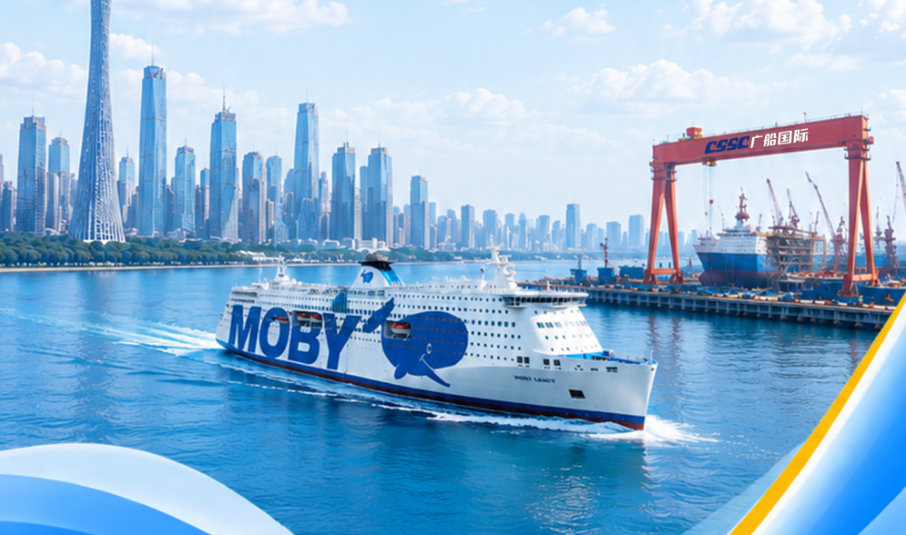

China CSSC Holdings has confirmed a firm order for 10 LNG dual-fuel 8,200-ceu PCTCs at Guangzhou Shipyard International, with deliveries scheduled for 2029–2031. The buyer remains officially undisclosed, but shipping and shipbuilding sources identify Ray Car Carriers — a development that would mark a notable shift for an owner whose newbuilding programme has long been concentrated at HD Hyundai yards.
Guangzhou Shipyard International has secured a newbuilding contract worth more than $1bn for 10 large LNG dual-fuel pure car and truck carriers, turning a deal that was still under negotiation in August into one of the largest confirmed PCTC contracts of the year.
China CSSC Holdings, the Shanghai-listed parent of GSI, said its subsidiary, together with China Shipbuilding Trading Co, signed the contract with an unnamed “well-known shipowner” on September 1. Each vessel will have capacity for 8,200 cars, with deliveries scheduled in batches between 2029 and 2031. The contract became effective upon signing and will be paid in US dollars.
The identity of the customer was withheld under confidentiality arrangements with the buyer. TradeWinds, however, reported that shipbuilding sources identified Ray Car Carriers as the owner behind the programme. Riviera Maritime Media has separately reported that shipbroking and market sources also point to Ray.
If confirmed, the order would be significant beyond its headline value. Ray has spent more than two decades placing newbuildings with HD Hyundai shipyards, according to TradeWinds, making the GSI contract its first newbuilding programme in China.
The final contract differs from the August proposal
The September agreement also provides a useful illustration of how large newbuilding projects can change between advanced negotiations and signature.
TradeWinds reported in August that Ray was discussing a programme of between 10 and 14 LNG dual-fuel PCTCs at GSI, with the ships then described as 8,600-ceu units. The formal CSSC disclosure has now fixed the firm order at 10 vessels of 8,200 ceu each.
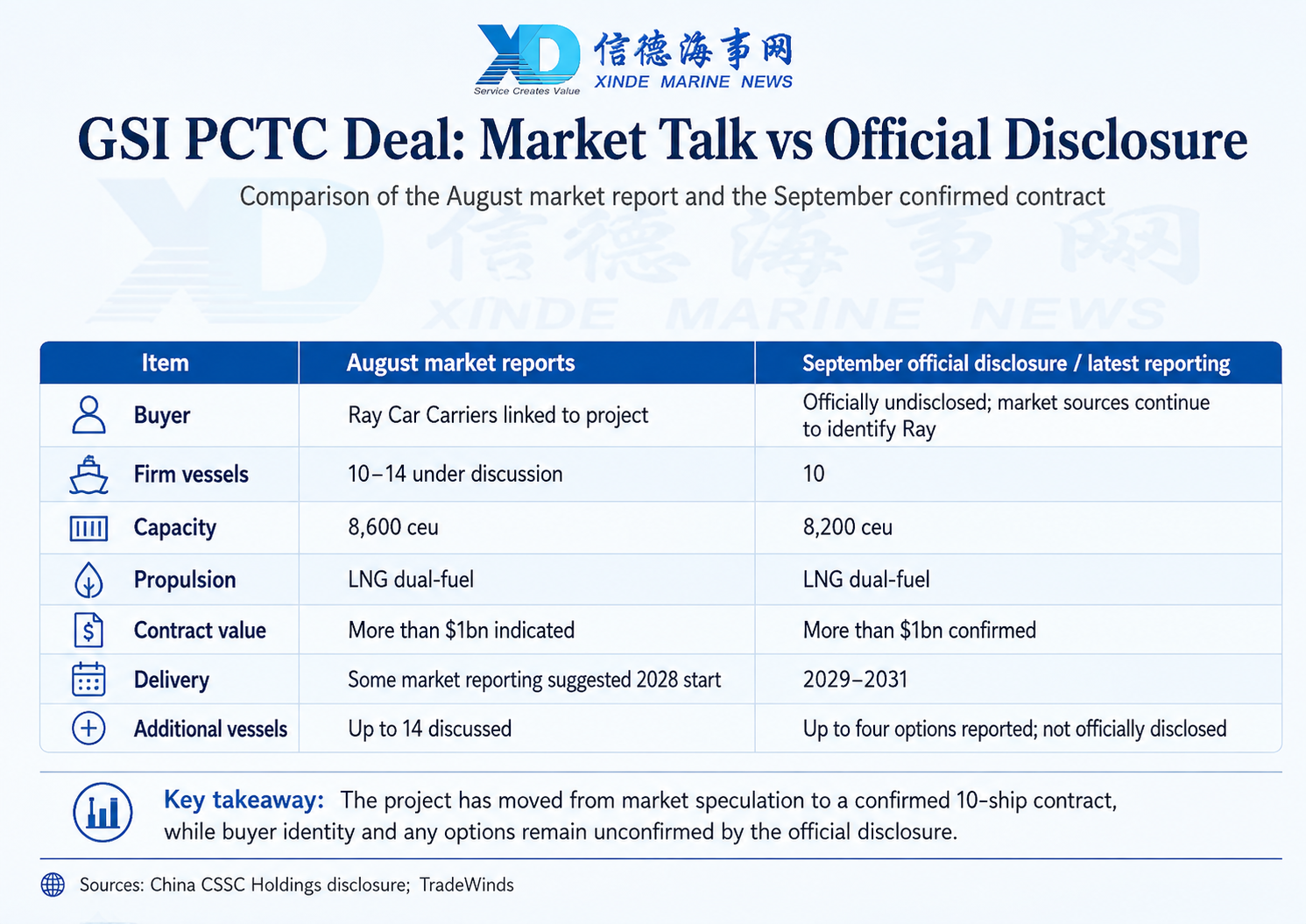
TradeWinds said sources familiar with the negotiations believe the contract also includes options for up to four additional vessels. Those options are not mentioned in China CSSC Holdings’ announcement and should therefore be treated as unconfirmed market information rather than firm orders.
There is also a discrepancy over delivery timing. The standfirst on the latest TradeWinds report refers to deliveries between 2028 and 2031, while its article body — in line with the Chinese listed company disclosure — says the 10 ships are scheduled for 2029–2031.
For the confirmed series, the listed-company timetable of 2029–2031 is the more authoritative reference.
Why a Ray order in China would matter
Ray is a major tonnage provider in the vehicle-carrier sector. TradeWinds describes its trading fleet as comprising around 60 car carriers, while Riviera, citing Clarksons, puts its active fleet at 66 vessels with another 15 ships on order across several vessel types.
The owner has historically maintained particularly close newbuilding ties with HD Hyundai.
That relationship remains active. In April, Ray was linked to two 7,300-ceu LNG dual-fuel PCTCs at HD Hyundai Heavy Industries at a reported price of $134.5m each. TradeWinds said those vessels are due in the second half of 2028. HD Hyundai is also building five 7,600-ceu LNG dual-fuel PCTCs for Ray under contracts placed between 2023 and 2024.
The GSI programme therefore does not amount to Ray abandoning South Korea.
It is better understood as a diversification of a newbuilding programme that had previously been concentrated almost entirely in Korean yards. That distinction matters because the competitive implications are different: Chinese yards are not simply attracting buyers that already routinely build in China, but increasingly competing for programmes from established international owners with longstanding Korean relationships.
TradeWinds cited industry sources as saying HD Hyundai had limited appetite for further PCTC contracts because of its already heavy orderbook, while GSI was understood to have offered more competitive pricing. Neither explanation has been formally confirmed by the shipowner or the yards.
Even so, the reported factors point to the broader competitive equation now shaping newbuilding decisions: price, available berth capacity, delivery windows and a Chinese PCTC construction base that has accumulated substantial series-building experience.
China is already dominating the current PCTC ordering cycle
The Ray-linked deal comes as car-carrier contracting has rebounded sharply after a near-pause in 2025.
A Xinde Marine News review of Clarksons contract-date data showed that 37 car carriers had been ordered globally in 2026 as of July 16, compared with only nine during the whole of 2025. Chinese shipyards secured 35 of the 37 vessels, with the remaining two — the 7,300-ceu pair widely linked to Ray — placed at HD Hyundai Heavy Industries. Xinde Marine News: 37 PCTCs ordered in 2026
Lloyd’s List separately counted 29 vehicle-carrier newbuildings contracted during the first half of 2026, against just two in the same period a year earlier.
The concentration in China extends well beyond orders signed this year. Lloyd’s List reported earlier in 2026 that Chinese yards controlled roughly 90% of the global large vehicle-carrier orderbook, compared with about 75% for containerships and around 70% for tankers and bulk carriers. South Korean builders, meanwhile, have increasingly scarce delivery positions for several high-value ship types as schedules extend towards 2029 and beyond.
That competitive backdrop makes the possible arrival of Ray at GSI more meaningful. The owner would be joining a widening group of international vehicle-carrier operators and tonnage providers placing sizeable programmes in China rather than relying exclusively on the traditional Japanese and South Korean builders.
GSI builds a deeper PCTC backlog
For Guangzhou Shipyard International, the 10-ship contract further expands a business that has become an increasingly important part of its product mix.
TradeWinds cited Clarksons data showing that GSI had an orderbook of around 120 vessels, including 15 PCTCs, before the latest 10-ship contract.
The yard has also moved rapidly up the size range.
In April, GSI delivered the 10,800-ceu Glovis Lighthouse, an LNG dual-fuel PCTC that CSSC described as the world’s first 10,800-car vessel and the largest vehicle carrier by capacity at the time. The ship is 230 metres long and incorporates 14 vehicle decks.
The latest Ray-linked contract therefore comes after GSI has already demonstrated both large-PCTC construction capability and experience with LNG dual-fuel designs.
For international owners, that track record matters alongside price. Series construction, delivery performance, access to equipment suppliers and confidence in increasingly sophisticated dual-fuel designs all influence whether an owner is prepared to move a multibillion-dollar fleet-renewal programme to a different shipbuilding country.
More than $1bn does not mean $100m per ship
The contract value also needs to be interpreted carefully.
China CSSC Holdings disclosed only that the total value is more than $1bn. It did not provide the exact consideration or an individual vessel price.
Dividing the minimum disclosed value by 10 shows only that the average contract value is above $100m per vessel. It does not establish $100m as the actual unit price.
TradeWinds made a similar calculation in its report.
Comparisons with Ray’s reported $134.5m-per-ship HD Hyundai order should therefore be treated cautiously. The Korean vessels are smaller at 7,300 ceu, but differences in technical specification, owner-furnished equipment, payment terms, contract date, propulsion package and other commercial conditions can materially affect headline prices.
The reported pricing advantage of GSI may have influenced the decision, but there is not enough publicly disclosed contract information to quantify the gap reliably.
Strong market supports investment, but 2030 supply remains the risk
The renewed ordering wave is taking place despite a heavy delivery schedule across the vehicle-carrier fleet.
China’s continuing growth as a vehicle exporter has helped absorb much of the new capacity. Lloyd’s List said in July that strong Chinese exports, together with disruption to established shipping routes, had kept the vessel supply-demand balance tighter than expected. It estimated that around 2m vehicles could still need to move on vessel types other than dedicated vehicle carriers during 2026 because of insufficient PCTC capacity.
That helps explain why owners are again prepared to commit capital to vessels that will not enter service until close to the end of the decade.
But the distance between contract signature and delivery also creates risk. By 2029–2031, market conditions will depend on the pace of global vehicle trade, Chinese auto exports, tariffs and trade policy, demolition of older tonnage, the scale of the newbuilding delivery wave and the economics of alternative-fuel compliance.
Charter coverage could therefore be important for the economics and financing of the GSI programme. Earlier market reports suggested the prospective Ray vessels were backed by long-term employment, but neither China CSSC Holdings nor the latest TradeWinds report has disclosed charterers, charter periods or rates. Those arrangements remain unconfirmed.
The next orders will show whether this is a lasting shift
For now, the confirmed elements are clear: GSI and China Shipbuilding Trading have signed a firm contract for 10 LNG dual-fuel 8,200-ceu PCTCs worth more than $1bn, for delivery between 2029 and 2031.
What remains unresolved is equally important: whether Ray Car Carriers will publicly confirm itself as the buyer; whether the reported four options form part of the contract; the exact vessel pricing; and whether the ships are already supported by long-term charters.
If Ray is confirmed, the deal will provide one of the clearest examples yet of the changing competitive balance in the PCTC newbuilding market — not because the owner has stopped building in South Korea, but because a company that relied on HD Hyundai yards for more than two decades has been willing to allocate a much larger series to China.
The next test will be where Ray places its subsequent fleet-renewal orders. Repeated diversification towards Chinese yards would carry much more significance for the longer-term China-Korea competitive landscape than a single programme driven partly by today's yard availability.

READ MORE
 Shipbuilding
Another Chinese Bridge Builder Moves Into Shipbuilding
 Shipbuilding
Amid China’s Shipbuilding Boom, a State-Owned Yard Quietly Enters Liquidation
 Shipbuilding
Yichang Changyun plans RMB120m inland bulker programme
 Shipbuilding
MISC Signs for Five More LNG Carriers at Hudong-Zhonghua
 Shipbuilding
Steel Giant Shagang Eyes Shipbuilding as a Booming Market Draws Industrial Capital
 Shipbuilding
Hengli Secures 12 Tanker Orders, Retaining World’s Largest VLCC Orderbook
 Shipbuilding
Hengli Signs 11 VLAC Contracts in One Week
 Shipbuilding
China ZWI Enters Ocean Shipping with VLGC Acquisition and Chemical Tanker Newbuild Project
 Shipbuilding
World’s First 325,000-DWT Methanol Dual-Fuel Ore Carrier Delivered
 Shipbuilding